
Choosing between high-pressure die casting and investment casting for an aluminum housing comes down to internal geometry, draft constraints, sealing needs, and production volume.
High-pressure die casting suits high-volume runs with external geometry that ejects cleanly from a rigid tool. Investment casting fits complex housings with zero-draft vertical walls, tortuous internal passages, or lower production volumes where steel tooling cannot be amortized.
How Do Investment Casting and Die Casting Form a Housing?
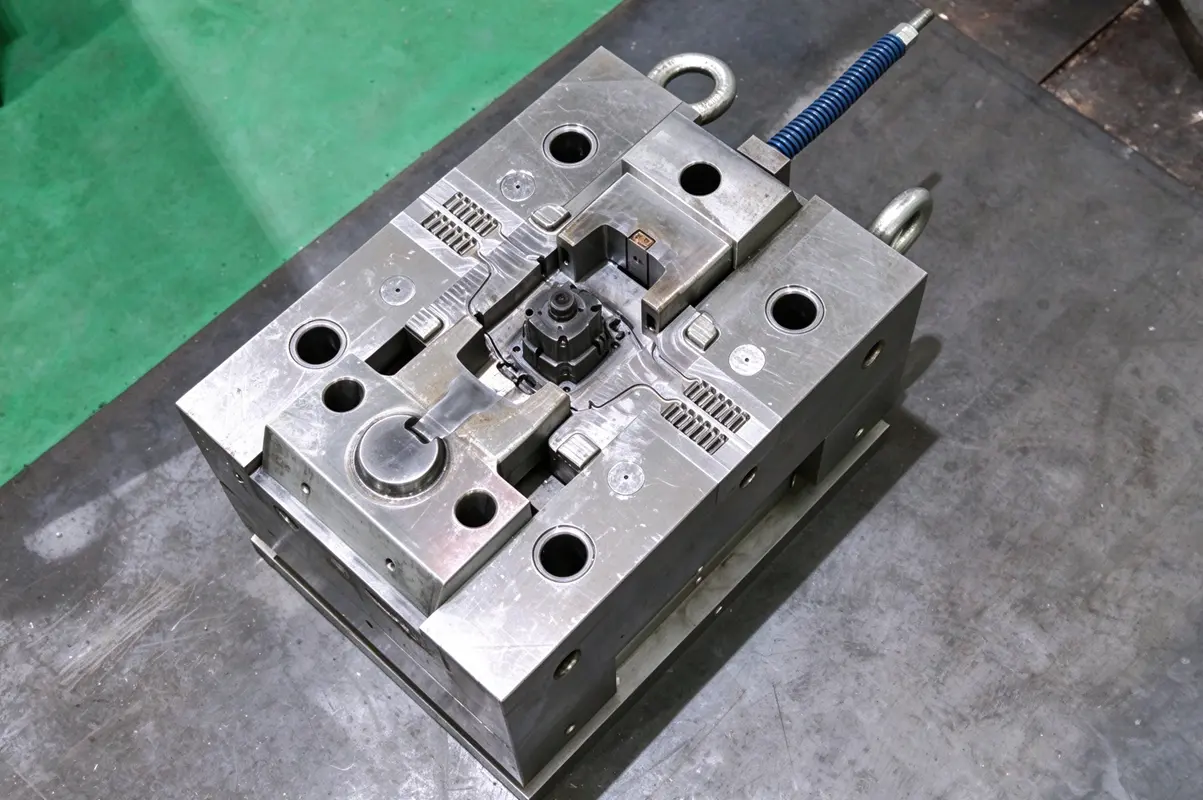
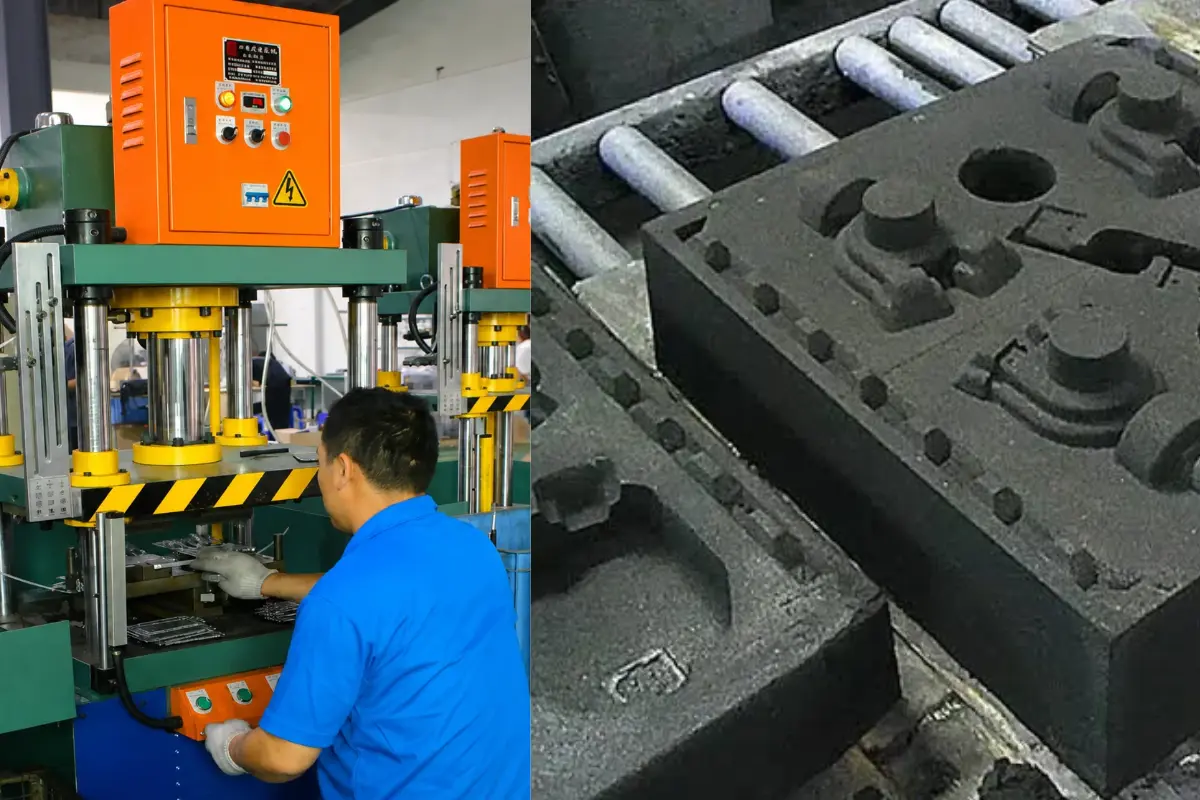
In precision manufacturing, high-pressure die casting forces molten aluminum under hydraulic pressure into a hardened steel die. Rapid chilling creates dense, thin-walled enclosures in cycle times under two minutes.
Investment casting coats an injected wax pattern in ceramic slurries, bakes out the wax, and pours molten metal into the hollow shell. Breaking away the ceramic shell releases complex shapes that cannot pull straight out of a permanent metal tool.
| Design and production parameter | High-pressure die casting | Investment casting | Engineering impact |
|---|---|---|---|
| Tooling and cavity release | Hardened steel die with mechanical slides; requires 1° to 3° wall draft | Sacrificial ceramic shell destroyed at demolding; permits zero draft | Complex internal channels or zero-draft slots avoid secondary milling in investment casting. |
| Typical alloy selection | Hypereutectic/hypoeutectic alloys (A380, ADC12, A383) | Foundry structural alloys (A356, A357, 319) | A380 offers high castability; A356 allows structural T6 solution heat treatment. |
| As-cast wall thickness | 1.5 mm to 3.0 mm uniform walls run reliably | 2.5 mm to 4.0 mm nominal walls avoid misruns | Die casting produces lighter, thinner-walled enclosures at scale. |
| Production sweet spot | Thousands to hundreds of thousands of parts | Tens to low thousands, or complex legacy geometries | Die casting balances high tooling investment against low piece prices and fast cycles. |
Which Housing Features Change the Process Choice?
Evaluating an enclosure solely on external dimensions overlooks internal passage routing, draft angles, and datum placement that dictate tooling feasibility.
Tool Release, Draft, and Internal Routing
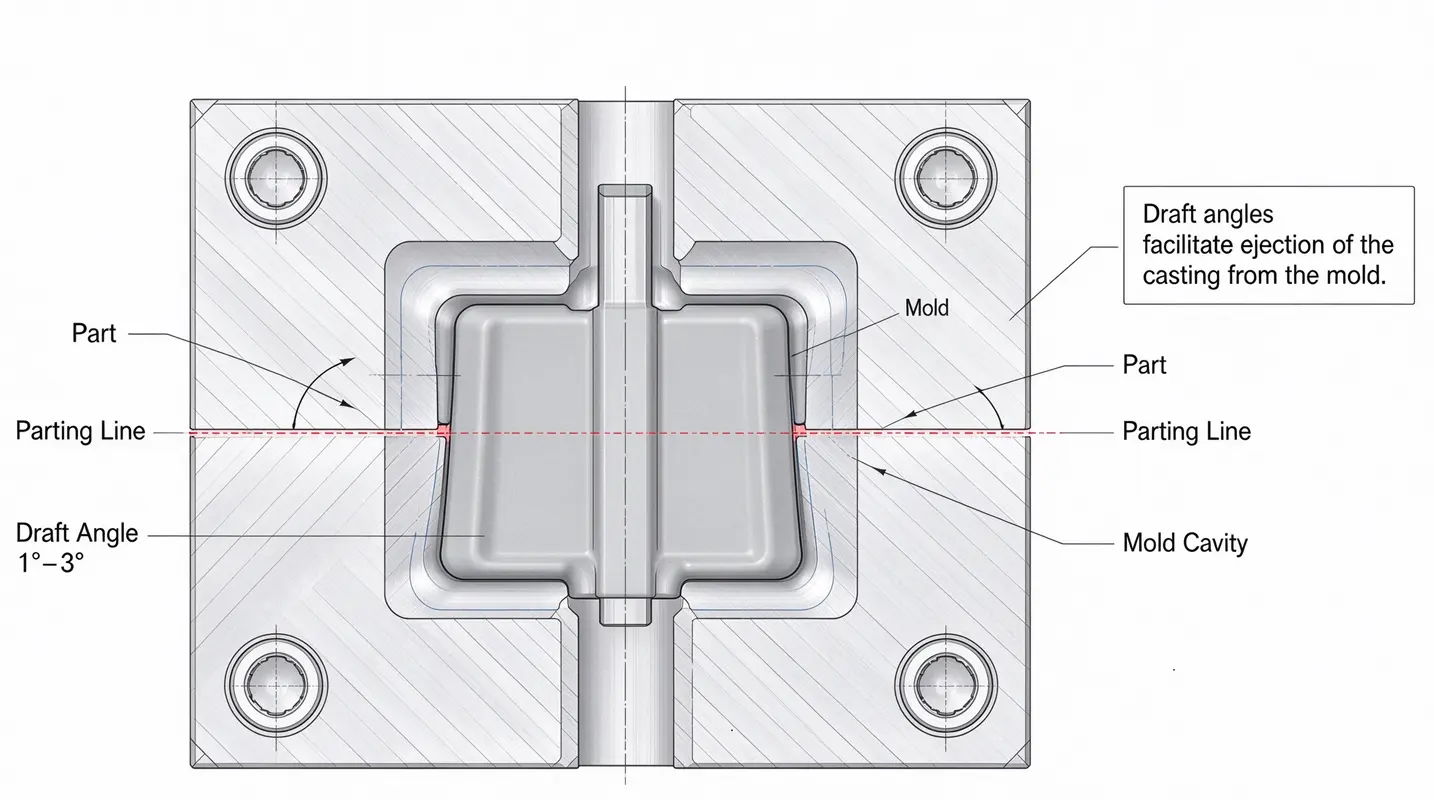
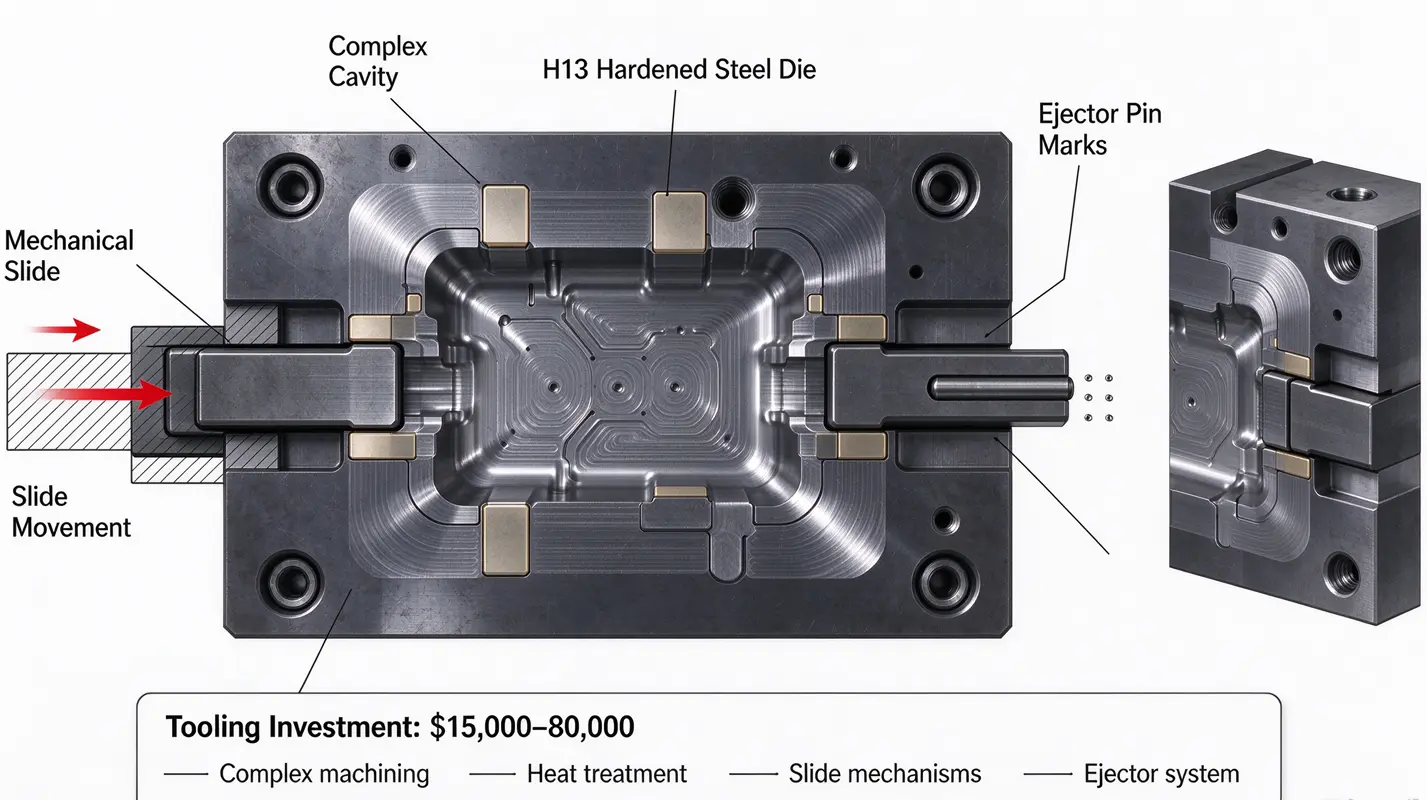
High-pressure die casting requires a direct line-of-sight draw along the tool parting line. Mechanical slides and angle pins can form external side holes or shallow undercuts, but they cannot release curved cooling jackets or enclosed fluid passages.
Investment casting uses soluble wax or ceramic cores to form these complex internal channels, which are dissolved or washed out after the metal solidifies.
Draft angles also separate the two methods. Die casting mandates a 1° to 3° wall draft so the housing ejects without galling the steel cavity. Investment casting breaks away the mold, enabling parallel, zero-draft vertical walls on connector faces and slide-in PCB slots without secondary CNC milling.
Critical Datums and Machining Allowances
Both methods yield near-net shapes, but critical functional features still require CNC machining. High-pressure die casting typically holds as-cast linear tolerances around ±0.15 mm, while investment casting averages ±0.25 mm due to wax shrinkage and shell expansion.
For high-volume production, sourcing finished die-casting parts with integrated secondary CNC machining ensures that critical bearing bores, O-ring tracks, and datum alignments are verified under a single quality system. Engineering drawings should define primary datum targets on unmachined cast surfaces and specify 1.0 mm to 2.0 mm of uniform stock to avoid cutting past the dense skin into core porosity.
What Changes for Sealed or Cosmetic Housings?
A housing that holds pressure or sits in a visible customer-facing assembly introduces specific metallurgical and finishing constraints.
Leak Tightness and Porosity Management
High-pressure die casting creates a dense outer skin roughly 0.5 mm to 1.0 mm thick, but the slower-cooling interior traps microscopic gas and shrinkage porosity. When secondary CNC machining cuts deep O-ring grooves into this spongy core, pressurized fluids can track through interconnected pores and bypass the gasket.
Drawings for sealed housings should define the test medium, proof pressure, and maximum allowable leak rate. For high-pressure die casting, engineering teams should establish an OEM high-pressure die casting quality plan to verify whether vacuum-assisted casting, squeeze pins, or post-machining vacuum resin impregnation is needed to seal micro-porosity. Investment casting avoids turbulent air entrapment through laminar gravity pouring, though gating must still prevent shrinkage voids at thick-to-thin transitions.
Surface Roughness and Coating Compatibility
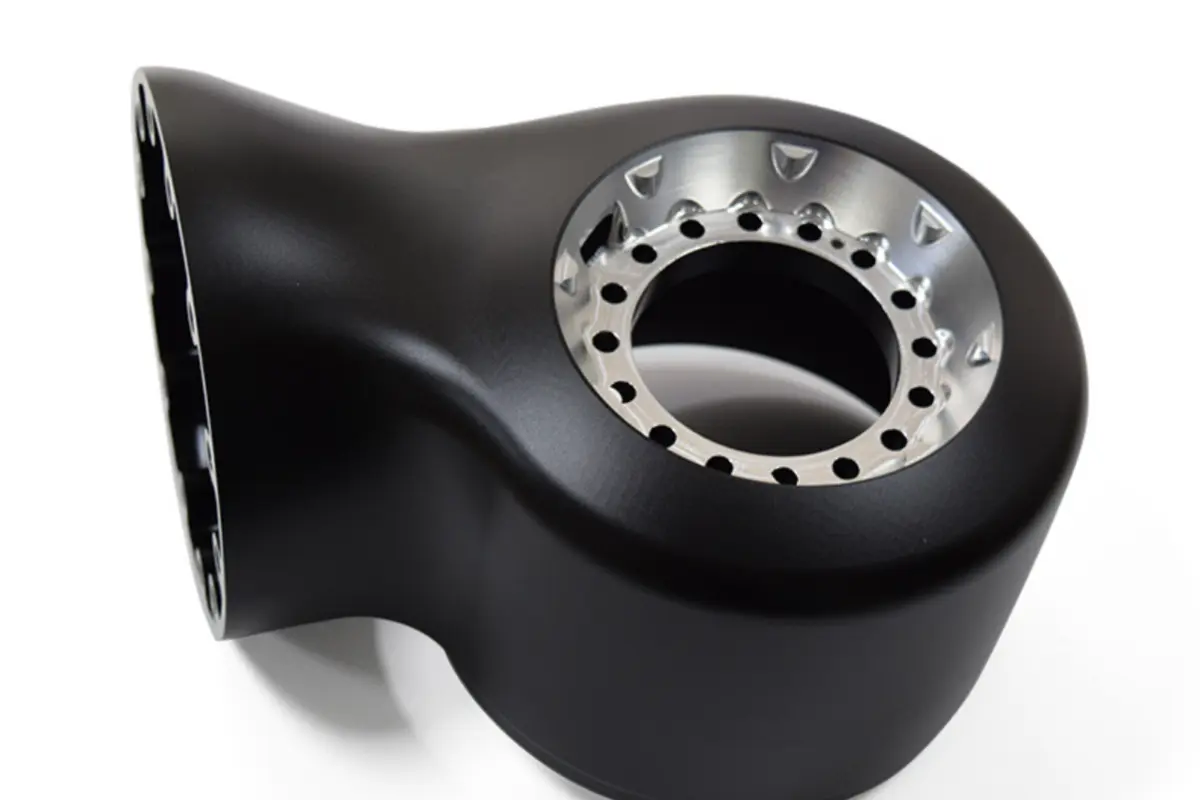
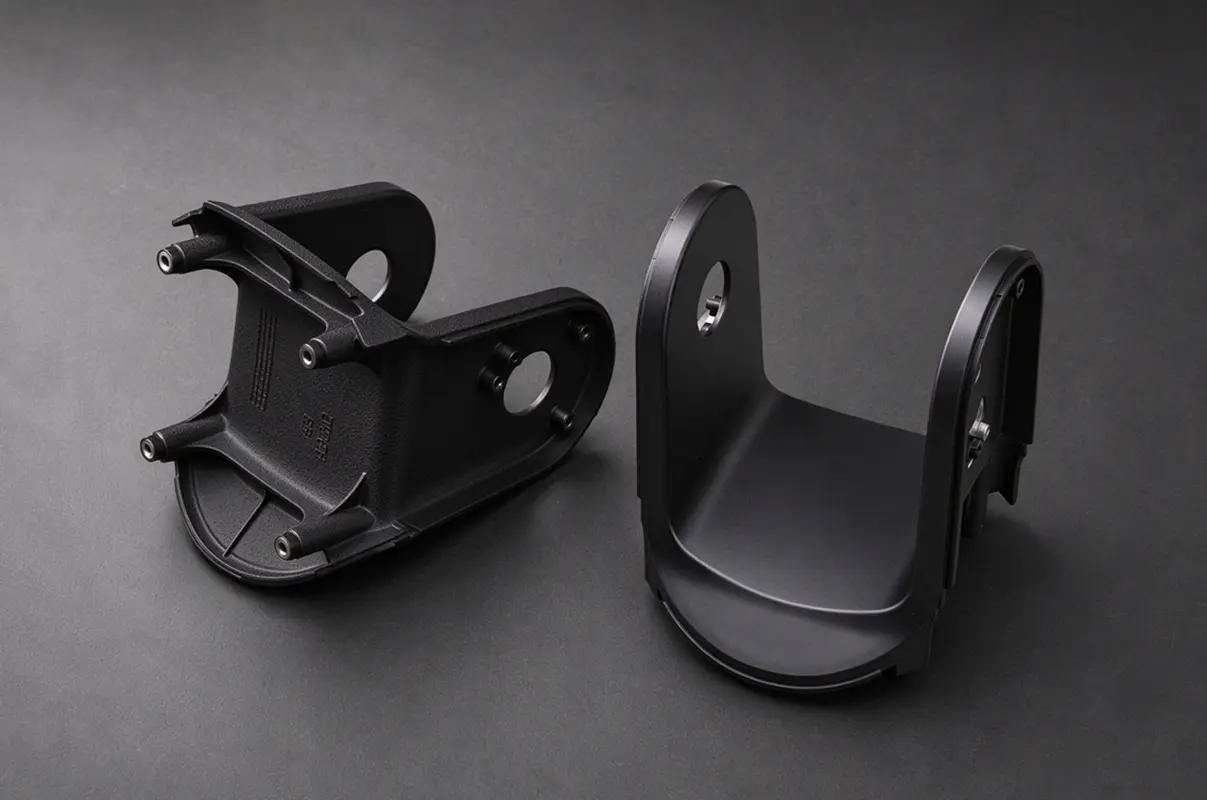
As-cast surface finish reflects the mold material. Die castings mirror the polished steel tool, achieving Ra 1.6 to 3.2 µm, but leave witness marks along the parting line, overflow vents, and ejector pins. Investment castings produce a uniform, matte ceramic texture around Ra 3.2 to 6.3 µm without ejector marks, though gate cut-off locations require manual grinding and blending.
Alloy composition controls secondary finishing performance. Standard die-casting alloys like A380 contain significant silicon and copper, which cause blotchy, dark discoloration under decorative anodizing; these housings typically require powder coating, e-coating, or wet paint. In contrast, investment-cast alloys like A356 contain minimal copper and accept clear or colored anodizing with consistent appearance.
How Should Teams Compare Tooling and Finished-Part Cost?
Total program cost shifts dramatically based on order frequency, amortization schedule, and the likelihood of design revisions.
Tooling an aluminum housing for high-pressure die casting typically requires $15,000 to $80,000 in hardened H13 steel, especially when side-action slides are needed. Comparing the full die-cast tooling cost against projected batch sizes shows whether the lower cycle time will offset the die before the design changes. Investment casting lowers that barrier through cheap aluminum wax molds, though manual shell building pushes the piece cost up.
Tooling adaptability also impacts total cost. Modifying a hardened steel die for a drawing revision requires slow, costly wire EDM, CNC re-machining, or cavity welding. Modifying an aluminum wax mold or editing a 3D-printed CAD pattern involves far lower capital risk, making investment casting more forgiving when enclosure designs remain fluid.
What Should Engineering and Sourcing Teams Send for a Process Quote?
To receive comparable manufacturing proposals, engineering and sourcing teams should supply a native 3D CAD model, a 2D drawing with designated datum schemes, annual volume forecasts, and leak-test criteria.
Collaborating with a precision manufacturing partner like Rollyu Precision gives teams early DFM feedback on draft angles, parting lines, and secondary CNC datum setups before tooling begins. Sourcing teams evaluating both casting routes should benchmark a production die-casting proposal against an investment casting quote, balancing upfront tool payback against long-term piece cost.
Frequently Asked Questions
Can a Die-Cast Aluminum Housing Meet a T6 Temper Requirement?
Conventional high-pressure die castings cannot undergo standard T6 solution heat treatment. High temperatures above 500°C cause entrapped gas to expand, resulting in surface blisters and dimensional distortion.
When an enclosure requires high impact strength and elongation through T6 temper, investment casting with alloy A356-T6 is the industry standard. High-pressure die casting can only match these properties by running specialized structural alloys in high-vacuum tooling.
Can an Investment-Cast Prototype Approve a Later Die-Cast Housing?
An investment-cast prototype validates spatial packaging, cable routing, and bolt alignment, but it cannot qualify the structural strength or leak integrity of a die-cast housing.
Rapid solidification in water-cooled steel dies creates a much finer grain structure and different residual stress than slow cooling in a ceramic shell. Die-cast housings require separate qualification using first-article samples from the production steel tool.
What If the Housing Faces Outdoor Moisture or Dissimilar Metals?
Alloy composition governs corrosion performance. Common die-casting alloys like A380 contain 3% to 4% copper, which reduces corrosion resistance in marine environments and requires powder coating or e-coating. Investment-cast alloys like A356 contain under 0.2% copper, offering superior bare-metal resistance.
When installing stainless steel fasteners into either casting in moist environments, drawings should call out isolating washers or joint sealants to prevent galvanic corrosion.