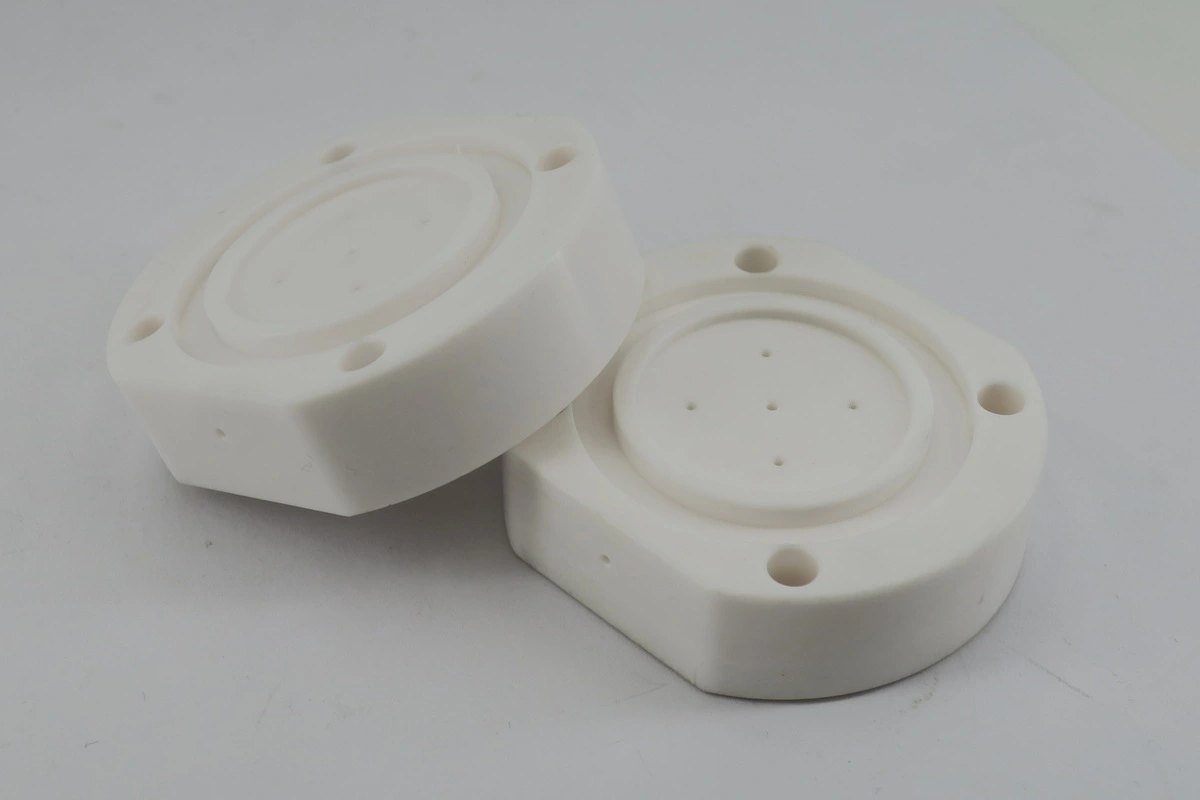
Choose medical grade PEEK stock by the finished device’s body-contact category first, then by stock shape and stress condition. Limited-contact grades such as Ensinger TECAPEEK MT and Mitsubishi Chemical Group Ketron LSG PEEK are pre-assessed for body contact of up to 24 hours, while permanent implants need implantable resin made to ASTM F2026. The wrong grade can force retesting late in development, and stressed stock can warp after machining and scrap material that costs more than industrial PEEK.
What Medical Grade Means for PEEK
Medical grade is a supplier designation, not a single standard. A resin or stock-shape supplier runs selected ISO 10993 and USP Class VI tests for a stated contact duration, then documents the results. Those results support the device maker’s biocompatibility assessment, but they do not make a machined part biocompatible on their own. FDA compares biocompatibility test articles with the device in its final finished form, including formulation, processing, sterilization, and geometry. The ASTM F2026 abstract also notes that machining and sterilization can alter PEEK’s characteristics.
FDA groups body contact into three durations: limited (24 hours or less), prolonged (more than 24 hours up to 30 days), and long-term or permanent (more than 30 days). Match the stock grade to the finished device’s category, and check that the supplier’s stated scope covers it.
Medical PEEK Grades by Contact Duration
Medical PEEK stock falls into three practical tiers, and each tier changes what the supplier documents and where the material can be bought.
| Grade Tier | Example Stock | Supplier-Stated Scope | Typical Machined Parts |
|---|---|---|---|
| Industrial PEEK | General-purpose natural and filled grades | No biocompatibility pre-assessment | Fixtures, test equipment, and bench fit-check prototypes |
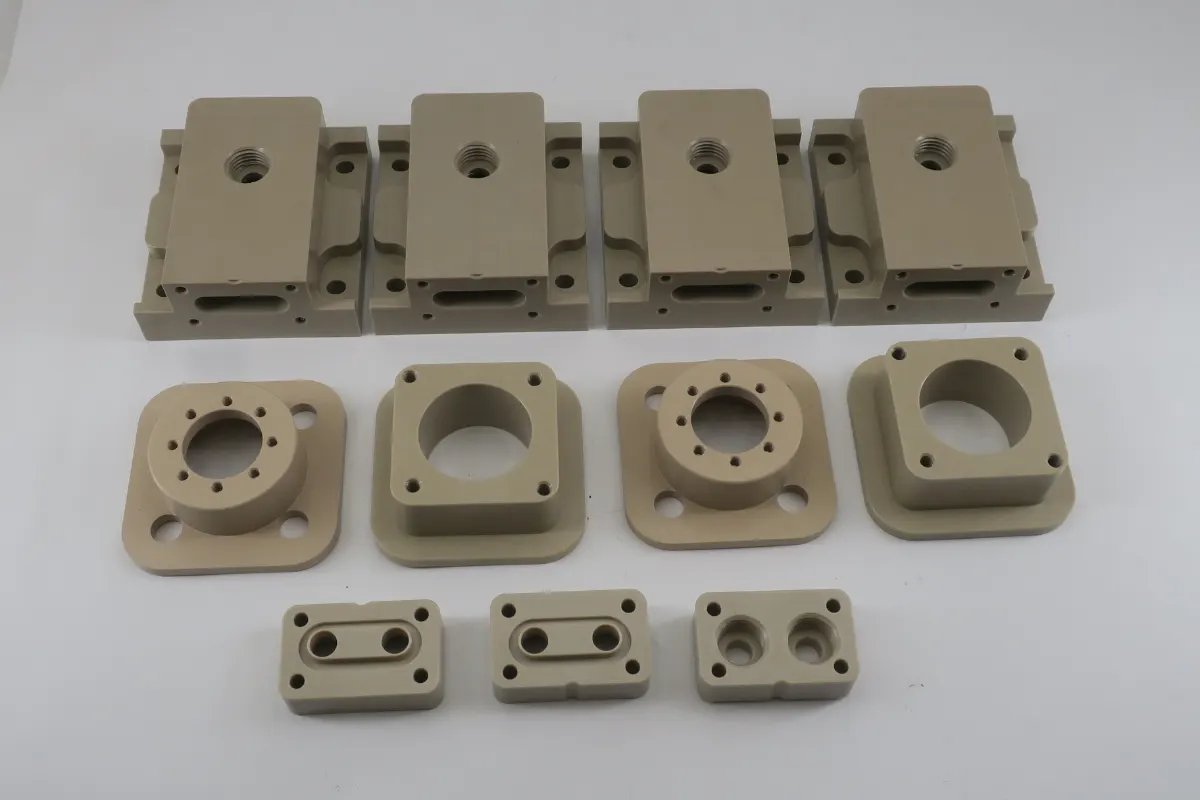
| Limited-contact medical PEEK | Ensinger TECAPEEK MT, Mitsubishi Chemical Group Ketron LSG PEEK | ISO 10993 and USP Class VI pre-assessment for contact up to 24 hours | Instrument handles, trial sizers, endoscope components, and diagnostic manifolds |
| Implantable PEEK | Invibio PEEK-OPTIMA, Syensqo Zeniva PEEK | ASTM F2026 resin for implants in place more than 30 days | Spinal cages, bone anchors, and cranial implants |
Limited- and Prolonged-Contact Grades
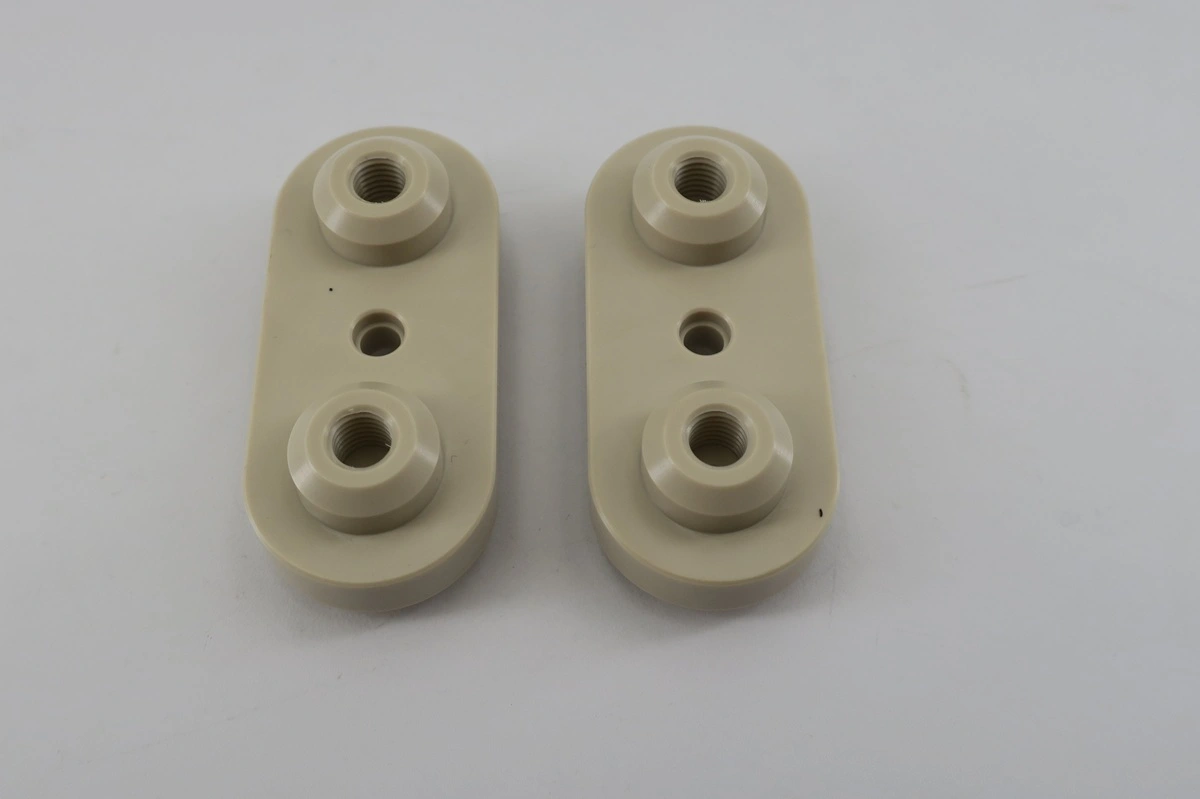
Ensinger tested TECAPEEK MT to ISO 10993-1, -4, -5, and -18 for contact of up to 24 hours with skin and tissue, and the natural color also meets USP Class VI as a semi-finished shape. Ketron LSG PEEK carries a similar 24-hour pre-assessment, and Mitsubishi Chemical Group states that LSG grades are not intended for permanently implanted or life-sustaining devices. Prolonged contact needs a grade whose documentation states that duration, such as TECAPEEK MT CLASSIX, which Ensinger rates for indirect blood contact of up to 30 days.
Implantable Grades
ASTM F2026 covers virgin PEEK polymer, including fabricated forms, for intracorporeal devices such as surgical implants. The specification excludes PEEK that contains colorants, fillers, processing aids, or reclaimed material. An MDDI article on implantable PEEK reports that Invibio has device and drug master files with traceability information on file with FDA. A master file holder gives the device maker a letter of authorization, which lets the device submission reference the file without disclosing the supplier’s data.
Implant stock also comes through fewer channels. Mitsubishi Chemical Group describes itself as the exclusive converter and supplier of Syensqo’s Zeniva PEEK stock shapes, which it states comply with ASTM F2026 for long-term implants. Confirm availability, stock sizes, and paperwork with the stock supplier before committing a design to an implant grade.
Choosing Rod or Plate Stock
PEEK conducts heat poorly: Ensinger lists about 0.29 W/m·K for TECAPEEK MT natural. Extruded rod and plate cool unevenly as a result and hold residual stress, which heavy or one-sided machining releases as warp.
Matching Stock Shape to the Part
Use rod for turned parts such as cylindrical housings, shafts, and bushings, and keep the part centered on the rod axis so stress releases evenly around it. Use plate for prismatic parts such as fluid blocks and instrument bodies. When a plate part has deep pockets, rough both faces evenly, because milling from one face releases stress on that side and bows the plate. Order stock as close to the finished envelope as the supplier’s standard sizes allow. Less removal means less released stress and less scrapped material.
Annealed Stock and Intermediate Annealing
Order stress-relieved stock, and add an intermediate anneal for parts with heavy removal, thin sections, or tight tolerances. Ensinger’s machining guidelines recommend roughing critical parts with a safety margin, annealing them, and then making the final cuts, because annealing can cause some shrinkage.
The guidelines’ cycle for TECAPEEK heats the part over 3 hours to 250 °F (121 °C) and holds it for 4 hours at 430 °F (221 °C). It then cools the part at 30 °F (about 17 °C) per hour, with cooling time scaled to wall thickness. Support the part during the anneal so it does not sag, and confirm with the device owner that the added heat treatment fits their process documentation.
Machining Medical PEEK Without Distortion
Local heat and clamping force both distort machined PEEK, and PEEK CNC machining depends on keeping both low. Ensinger notes that PEEK tends toward post-shrinkage and can warp from local overheating.
Part Geometry and Tolerances
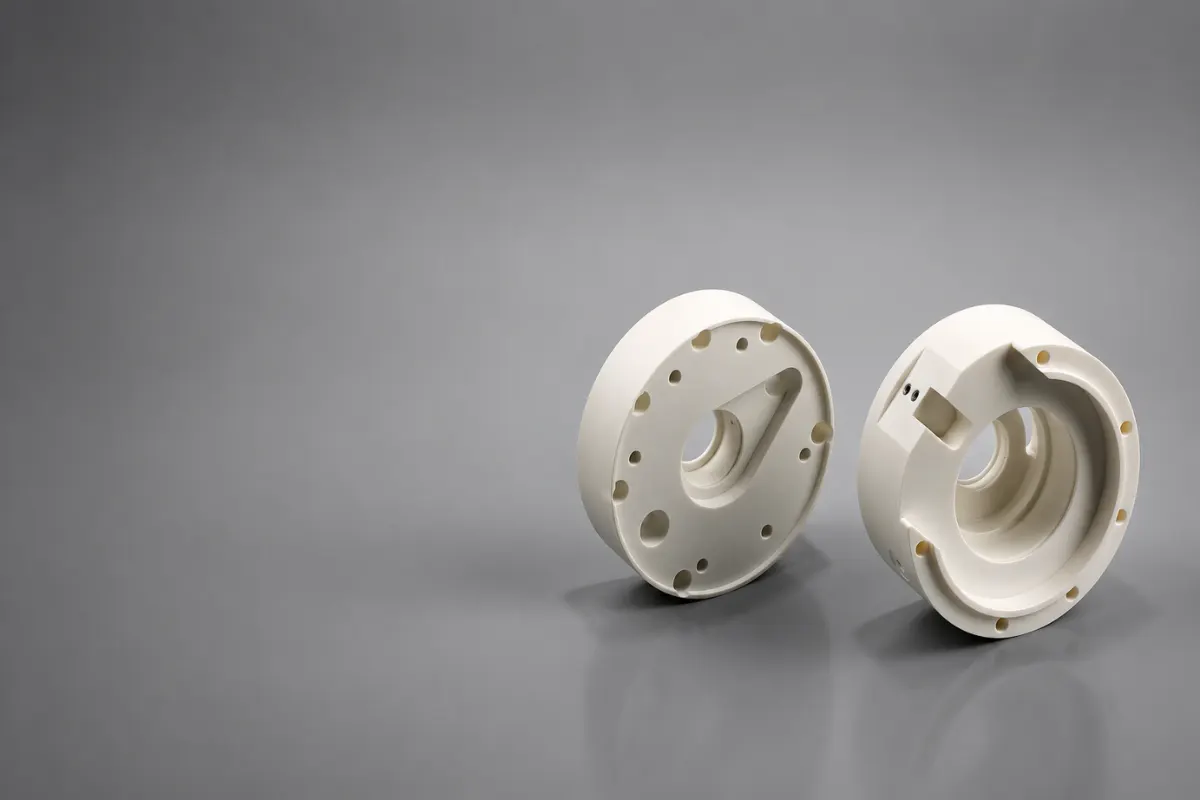
Thin walls deflect under the cutter and hold heat, and deep, narrow pockets need long tools that chatter and rub. Give internal corners a radius larger than the cutter radius so the tool keeps cutting through the corner instead of dwelling in it. Rollyu’s published plastics tolerance for custom CNC machined parts is ±0.05 mm, and its PEEK guide cites ±0.02 to ±0.05 mm for holes and mating features. Reserve tighter callouts for features that locate or seal, and review them with the machinist together with the stock and annealing plan.
Workholding and Coolant
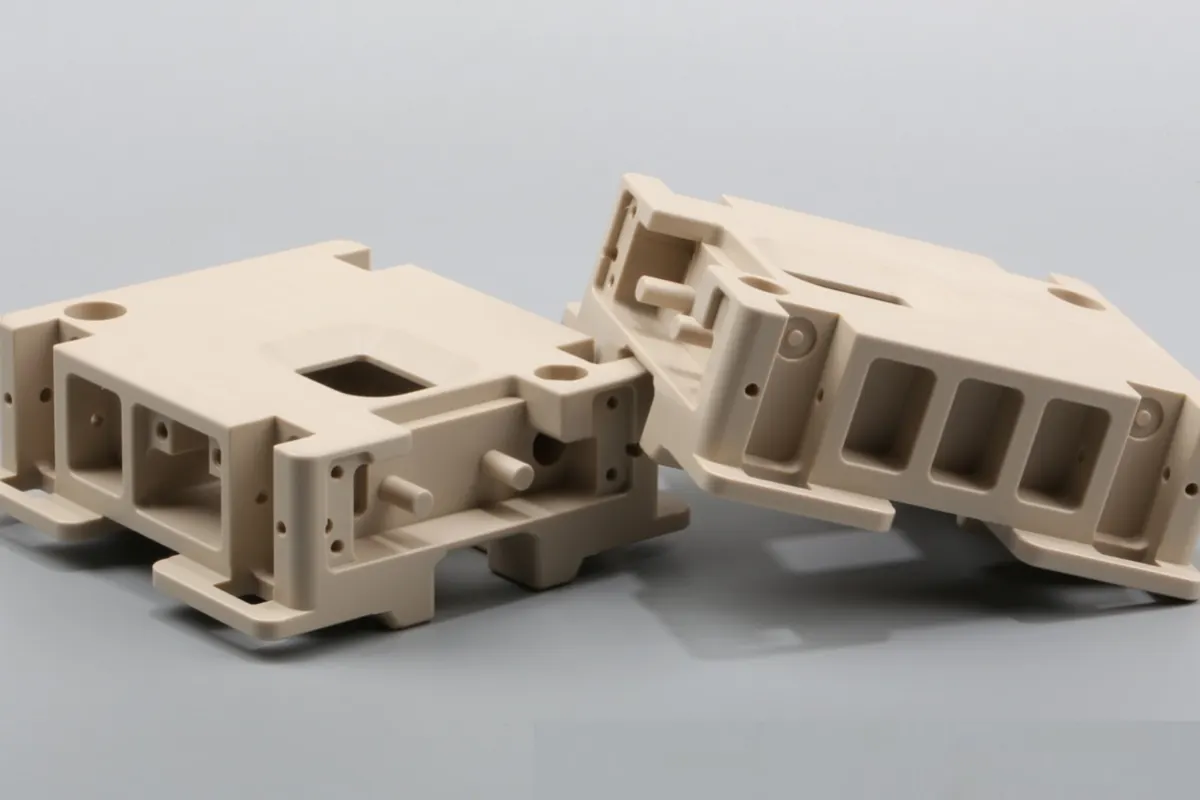
Spread clamping force with soft jaws, vacuum fixtures, or full-face support, because concentrated vise pressure strains PEEK and the part springs out of shape when released. Ensinger recommends moderate clamping pressure, flat support, and, for fiber-reinforced grades, clamping in the extrusion direction. Deformation control in plastic machining follows the same principles for other engineering plastics.
Ensinger notes that medical device parts are mostly machined dry, which avoids coolant residue and migration, and that compressed air or spray mist can remove heat when cooling is needed. Agree on any coolant and post-machining cleaning with the device owner, because both change the finished part that their biocompatibility assessment covers.
Documentation for Medical PEEK Parts
Medical PEEK parts need a document chain from the stock lot to the finished part, and the inspection documents a medical program needs grow with part risk and build stage. Request these records with the quote:
- A stock supplier certificate naming the grade, color, lot, and biocompatibility or ASTM F2026 statement
- Lot traceability that links each part to its stock lot and, for implant grades, to the resin lot
- A Certificate of Conformance (CoC) to the drawing revision, including any annealing or cleaning steps the drawing specifies
- Dimensional inspection or first article inspection (FAI) reports for critical features
- For implant grades, the resin supplier’s letter of authorization to reference its FDA master file
Rollyu Precision machines PEEK components for medical devices and states that its quality management system is certified to ISO 9001:2015 and ISO 13485:2016. The company does not operate a cleanroom, which matters when a drawing calls for cleanroom packaging.
Rollyu Precision’s medical device manufacturing scope includes material certification, FAI reports, traceability documentation, ultrasonic cleaning, and packaging protocols. The device owner remains responsible for the biocompatibility assessment, cleaning and sterilization validation, and regulatory submissions.
Frequently Asked Questions
Can Industrial PEEK Be Used for Medical Device Prototypes?
Yes, for fit checks and bench tests that never contact patients or feed biological testing. Parts for biocompatibility, animal, or clinical testing should use the production grade, because FDA compares test articles with the final finished device in formulation and processing. Switching grades after testing can mean repeating those tests.
Does the Color of Medical PEEK Affect Its Documentation?
Yes. Medical stock lines come in several colors for instrument coding, and Mitsubishi Chemical Group notes that approvals for Ketron LSG PEEK can vary by color. Check that the certificate and biocompatibility statement cover the exact color ordered. A colored or image-contrast implant grade falls outside ASTM F2026, because the specification excludes colorants and fillers.
Can Medical PEEK Be Autoclaved Repeatedly?
Yes, within the limits the supplier documents. Ensinger reports that TECAPEEK MT stock resists repeated steam autoclaving without loss of dimensional stability or physical properties, and implantable PEEK can be sterilized by gamma irradiation, steam, or ethylene oxide. Validate the actual method and cycle count on finished parts, since geometry and residual stress can affect how a component holds its dimensions.
How Does Carbon Fiber Reinforced PEEK Differ From Unfilled PEEK?
Carbon fiber raises stiffness while keeping the part radiolucent, meaning nearly invisible on X-ray. An MDDI report on implantable-grade PEEK notes that short carbon fibers raise the modulus from about 3.5 GPa to about 18 GPa, close to cortical bone. Because ASTM F2026 excludes filled PEEK, confirm which documentation supports a reinforced implant grade such as PEEK-OPTIMA Ultra-Reinforced. The fibers are also abrasive, and Ensinger recommends carbide or, ideally, polycrystalline diamond (PCD) tooling.
Sources
- Biocompatibility Evaluation Endpoints by Contact Duration Periods, FDA: Limited, prolonged, and long-term contact duration categories.
- Component and Device Documentation Examples, FDA: Comparing biocompatibility test articles with the device in its final finished form.
- Master Files, FDA: Device master files and letters of authorization.
- ASTM F2026-23, Standard Specification for Polyetheretherketone (PEEK) Polymers for Surgical Implant Applications, ASTM International: Scope, exclusions, and processing effects.
- PEEK Medical Grade Rods and Plates, Ensinger: TECAPEEK MT biocompatibility testing, contact durations, and colors.
- TECAPEEK MT Natural, Ensinger: Thermal conductivity and steam autoclave resistance.
- Machining Engineering Plastics, Ensinger (hosted by Curbell Plastics): Annealing cycle, intermediate annealing, dry machining of medical parts, clamping, and tooling for reinforced grades.
- Ketron LSG PEEK, Mitsubishi Chemical Group: Biocompatibility pre-assessment, implant restrictions, and color-dependent approvals.
- MediTECH Implantable Polymers, Mitsubishi Chemical Group: Zeniva PEEK stock shapes to ASTM F2026 and exclusive conversion.
- Implantable, Invibio (Victrex): PEEK-OPTIMA implant applications, radiolucency, and PEEK-OPTIMA Ultra-Reinforced.
- Using Implantable-Grade PEEK for In Vivo Devices, MDDI: Master files with traceability, carbon fiber modulus and radiolucency, and sterilization methods.