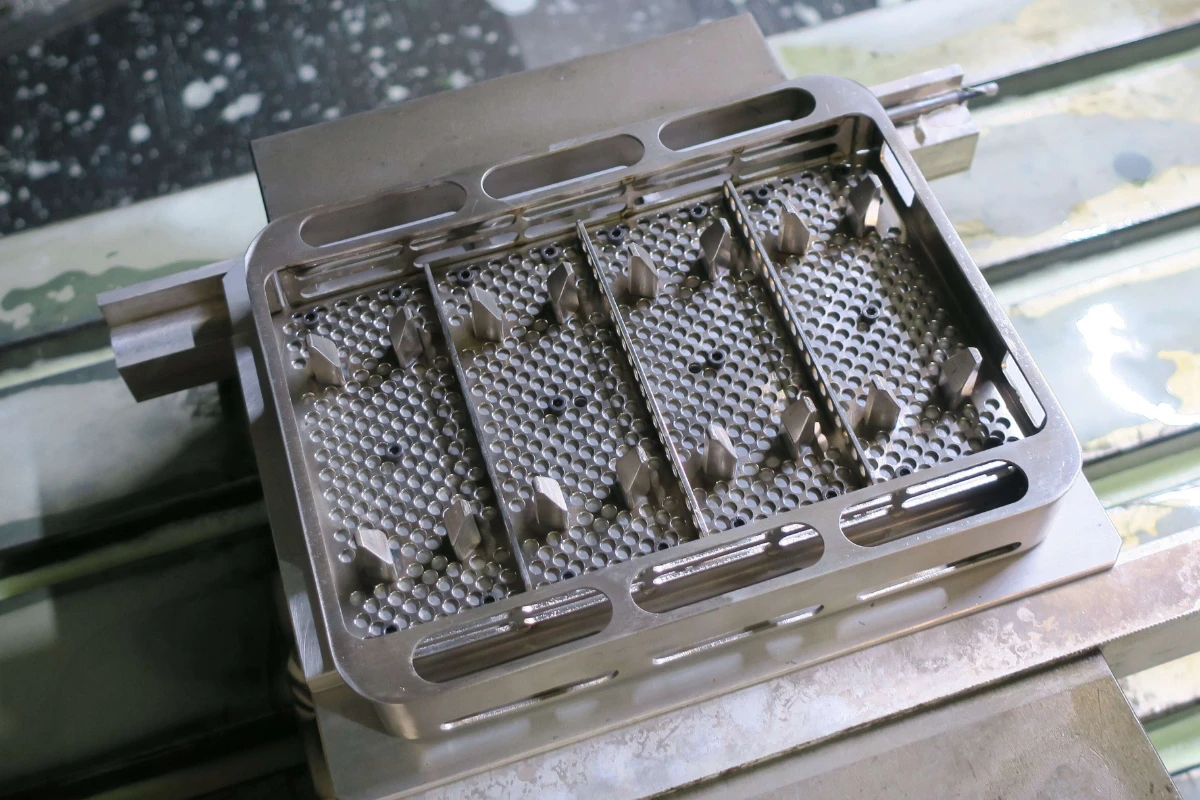
Specify a custom dental instrument cassette when standard clinic trays waste sterilizer space, do not hold a procedure kit securely, or break down under automated washer-disinfector cycles. A perforated cassette holds instruments through washing, wrapping, steam sterilization, and chairside staging, while a flat setup tray is mainly for chairside presentation. Settle the alloy, drainage layout, retention method, and tolerances before releasing drawings, because weld distortion and late design changes cost far more once fabrication starts.
When Does a Custom Dental Cassette Make Sense?
Standard multi-slot cassettes suit routine hygiene, restorative, and exam kits when the stock footprint fits the sterilizer chamber. Specify a custom cassette or fabricated sterilization tray when the instruments, packaging, or OEM hardware fall outside what stock trays handle:
- Procedure-specific layouts, such as implant, bone-grafting, or microsurgical kits that need stepped tool heights, sequenced bays, or dedicated bur racks
- Sterilizer envelope limits, where a custom footprint avoids overhang on narrow tabletop racks and keeps wrapped sets or rigid containers within validated loading clearances
- Integrated hardware, such as hinged lids, machined latch blocks, and welded locating pins that depend on controlled datum alignment
- OEM marking and records, including laser-marked UDI zones, specified alloys, and batch material certificates
Which Cassette Materials and Finishes Withstand Repeated Sterilization?
A reusable cassette’s material and surface finish both have to survive saturated steam, typically at 121 °C to 134 °C, and washer-disinfector chemistry. Choosing an alloy or polymer for room-temperature strength alone can lead to pitting, coating breakdown, or stress cracking over repeated reprocessing.
| Material Family | Primary Cassette Use | Sterilization and Chemical Limits | Fabrication and Cost Tradeoffs |
|---|---|---|---|
| Austenitic stainless steel (304, 316L, 321) | Full cassette shells, perforated baseplates, welded frames, hinged lids | Broad washer compatibility; residual chlorides can still cause localized pitting if parts are poorly rinsed | High stiffness and good weldability; more press-brake force, sensitivity to weld warpage, and more mass to dry |
| Anodized aluminum (5052, 6061) | Lightweight multi-level trays, color-coded frames, machined divider blocks | Strongly acidic or alkaline cleaners can damage the anodized finish | About one-third the mass of steel and lower forming force; adds anodizing control and contact-point masking |
| CNC-machined polymers (PEI/Ultem, PEEK) | Rigid instrument cradles, insulating bushings, low-volume prototype rails | Good wet-steam stability; amorphous grades can stress-crack in harsh solvents | No corrosion and custom pockets without die tooling; higher stock cost and machining time per part |
Stainless Steel Grades
Type 304 suits standard cassettes washed with neutral detergents and finished with deionized rinses. Move to 316L when wash cycles introduce chlorides or the design has dense TIG or spot welds. 316L’s 2% to 3% molybdenum improves pitting resistance, and its low carbon limits chromium carbide formation in the heat-affected zone. AISI 321 is titanium-stabilized, which suits welded baseplates and subframes: titanium ties up carbon during welding and keeps chromium available at the grain boundaries.
Anodized Aluminum and Polymers
Aluminum alloys 5052 and 6061 cut cassette weight, with 5052 sheet suited to formed walls and 6061 plate to machined internal blocks. The Aluminum Anodizers Council notes that cleaner damage to an anodized finish gets worse at elevated temperature or without prompt rinsing. Use aluminum where the reprocessing instructions call for neutral-pH cleaners, because exposed aluminum can otherwise discolor and pit, particularly around hardware.
Engineering plastics such as PEEK and PEI (Ultem) suit machined rails and protective cradles when weight, galvanic isolation, or color coding matters. Of the two, amorphous PEI is more prone to stress cracking in aggressive disinfectants. Confirm the cycle life for the specific grade and reprocessing method with the material supplier. Molded PPSU tubs are also used for catalog cassettes, although they need production mold tooling outside sheet metal and CNC workflows.
Surface Finishes and Laser Marking
Bare laser-cut edges can tear sterile wrap and trap soil. Specify edge finishing, surface treatment, and marking together:
- Deburr every perforation lip and sheared corner, and set a roughness limit, such as Ra 1.6 µm (63 µin), for welds and instrument contact faces that need a smoother finish.
- Specify ASTM A967 chemical passivation (citric or nitric) to remove free iron left by forming tools without changing nominal geometry, or ASTM B912 electropolishing when perforated edges also need micro-deburring and a brighter finish.
- For UDI codes and part IDs on stainless steel, laser annealing marks the surface by color change instead of cutting the grooves that deep engraving leaves. Passivate after welding and marking, and confirm with the finisher that the passivation chemistry will not fade the annealed marks.
How Should You Design the Cassette Layout?
Lay out perforations, instrument retention, and bends together, because every cutout changes drainage, flat-pattern stiffness, and how the sheet behaves on the press brake.
Perforations and Drainage
Perforations in the floor and lid let air out and steam in when the set is wrapped. Size the open area for the steam process covered by ANSI/AAMI ST79 and the containment-device requirements in ANSI/AAMI ST77. Too little open area, or flat shelves without slots, can hold condensate on instruments and produce wet packs. Perforated sheet also avoids the wire gaps where small burs and elevators catch in welded mesh baskets, and it takes formed corners and welded pin brackets more cleanly. Common starting values for keeping thin perforated sheet flat are at least 2t from hole to edge and 3t between holes (t is sheet thickness), with unperforated ribs under load-bearing latch rails.
Instrument Retention and Silicone Rails
Avoid pressure-sensitive adhesives and glued pads in reusable cassettes. Steam cycles, rapid temperature changes, and enzymatic detergents can weaken the bond line until strips peel and trap soil underneath. Retain customer-supplied molded silicone rails and cushions mechanically with laser-cut keyhole slots, formed bridge tabs, or shoulder pins that capture the rail profile. Where burs, osteotomes, or micro-instruments need tighter spacing than elastomers hold, bolt or tack-weld machined PEI, PEEK, or 316L blocks into unperforated floor zones.
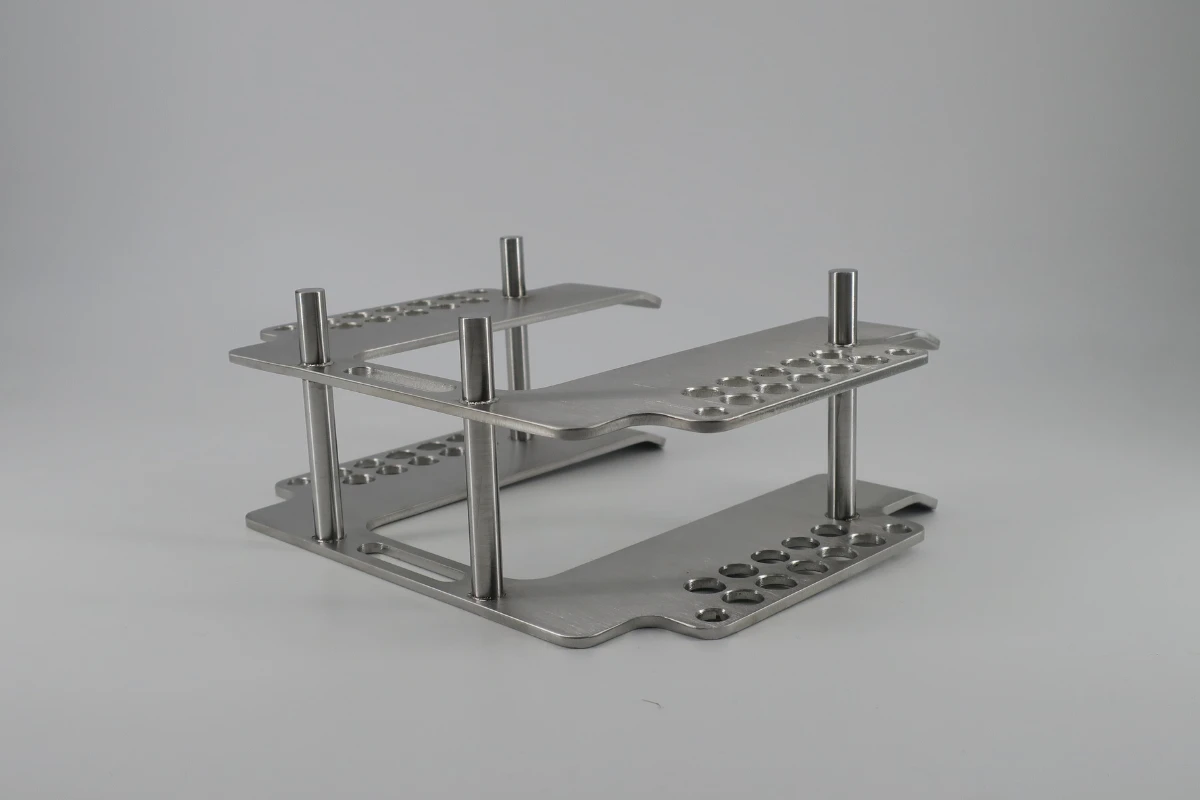
Bends and Latch Clearance
Four checks keep thin cassette walls from tearing pouches, cracking at flanges, or binding at the lid. The radius and spacing values are common starting points to confirm with the fabricator:
- An inside bend radius of at least 1t for 5052 aluminum and 1.5t for 304 or 316 stainless steel, to keep the outside of the bend from cracking
- Perforations at least 2.5t + R from the bend tangent, where R is the inside bend radius, to keep forming from pulling drainage holes oval
- Bend-relief notches at flange intersections, at least t wide and slightly longer than R + t, to prevent corner tearing
- Generous exterior corner radii to protect wraps and pouches, and a sheet metal box and lid fit modeled with full-height instruments and compressed silicone rails before hinge knuckle height and latch stroke are fixed
Which Fabrication Processes and Tolerances Fit Each Cassette Feature?
Give each feature to the process that can hold it: sheet metal forming for large perforated shells, and CNC machining for locating hardware that has to fit precisely. Asking a press brake or weldment to hold machined dowel fits drives up scrap and rework.
Sheet Metal Fabrication and Welding
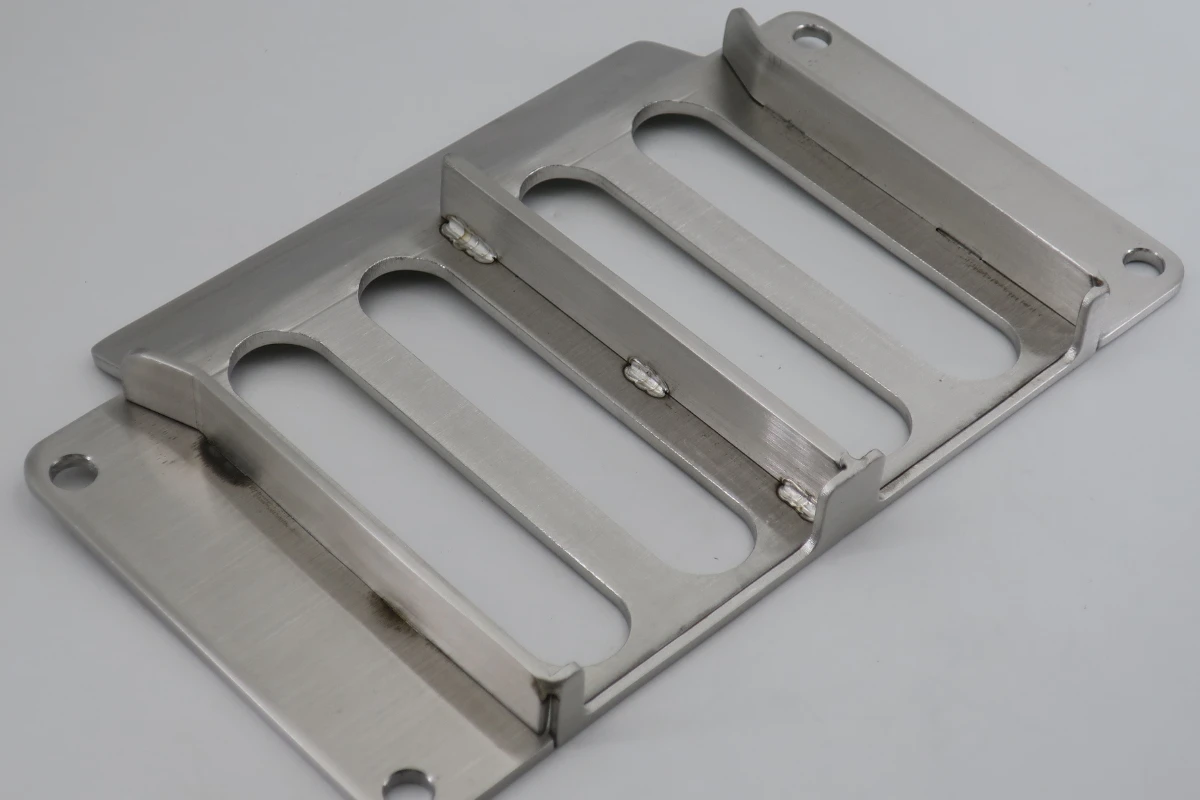
Fiber laser cutting handles dense perforation grids, narrow rail slots, and sharp tab geometry, and cut profiles usually hold tighter than anything formed or welded afterward. Formed features carry wider tolerances because of springback, which WILA puts at about 2° to 4° on a 90° bend in mild or stainless steel before the press brake compensates for it. Welded assemblies widen further. Assign tolerances by feature type, as the guide to sheet metal tolerances describes, and confirm post-weld position and flatness limits with the fabricator for the actual tray size and weld layout.
Welding thin perforated sheet, such as 0.06 in. (1.5 mm) stock, next to locating pins or corner seams is the main distortion risk. Excess heat input tilts pins out of perpendicular and bows the tray base after the fixture is released. Rollyu Precision’s custom sheet metal fabrication work on a dental sterilization tray used dedicated fixtures to lock pin position and perpendicularity before welding. The welding plan added a balanced sequence, controlled cooling and clamp release, and pin checks during setup and at final inspection.
CNC Machining for Tight Fits
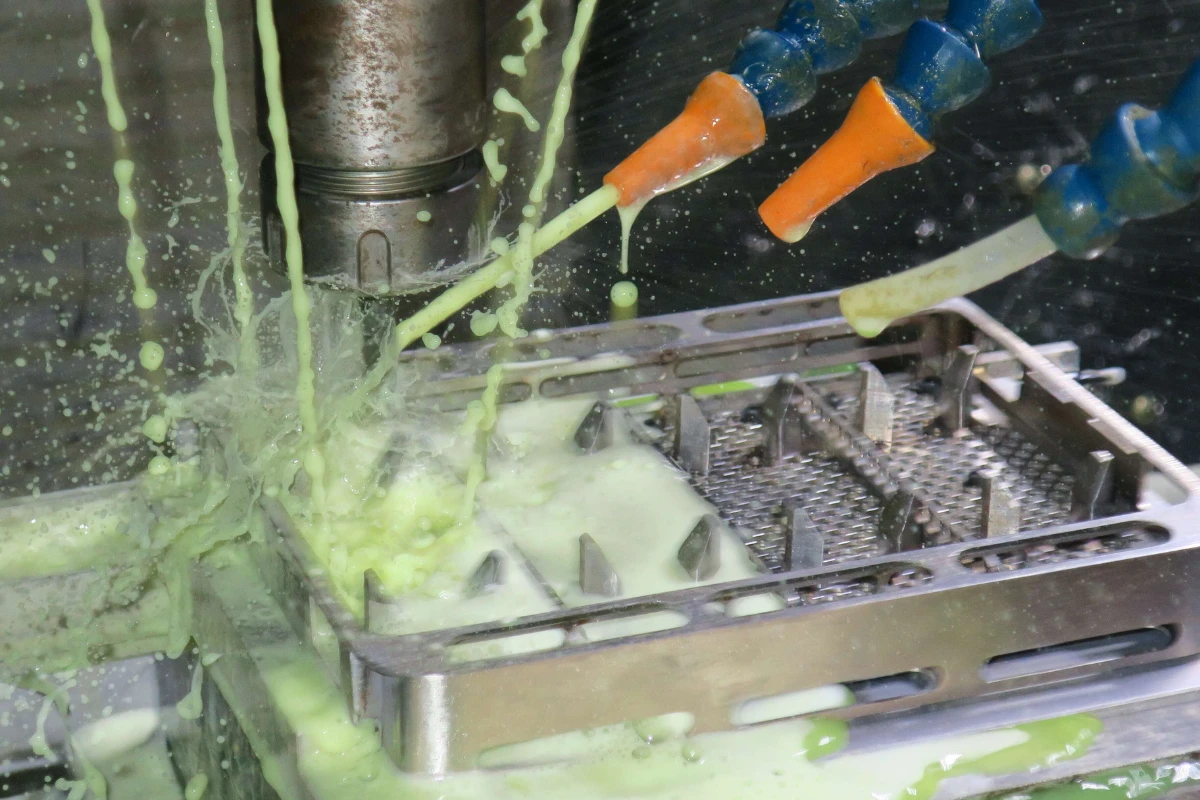
Use 3-, 4-, or 5-axis CNC milling, turning, or post-weld machining for cam latches, spring-detent blocks, multi-level bur holder racks, hinge knuckles, and rigid PEI or PEEK divider rails. Rollyu’s published CNC capability table lists ±0.01 mm for specified metal features and ±0.05 mm for plastics, and DFM review confirms what a given feature can hold. Put those tolerances on latch catches, bore-to-pin pairs, and bur pockets.
How Rollyu Precision Supports Custom Dental Cassettes
Rollyu Precision makes dental sterilization trays, cassette baseplates, and bur holders, combining sheet metal fabrication, multi-axis CNC machining, and finishes such as passivation and electropolishing. The company states that its quality management system is certified to ISO 9001:2015 and ISO 13485:2016.
RFQ Package for DFM Review
A complete package with the quote request lets DFM review catch flatness, tooling, and finishing conflicts while the model is still easy to change:
- STEP models and 2D drawings with alloy grades, UNS designations, sheet thickness, and functional datums for latch hooks and locating pins
- A surface treatment and marking map showing roughness faces, passivation or anodizing specifications, masking on tight fits, and UDI locations
- A hardware split that separates machined metal or polymer parts from slots sized for supplied elastomer inserts, with the mating slot tolerances
- Prototype quantities, production batch cadence, and the quality records you need
Inspection and Quality Records
For final inspection, Rollyu measures pin position, perpendicularity, and tray flatness with CMMs, optical comparators, micrometers, height gauges, and surface roughness testers, adding latch fits where the drawing specifies them. The company can supply Material Test Reports (MTRs), Certificates of Conformance (CoCs), first article inspection (FAI) reports, and lot traceability records when the purchase order calls for them. The device owner remains responsible for validating cleaning and steam sterilization under ANSI/AAMI and regulatory requirements. Rollyu’s dental equipment manufacturing team can review open material and fixture questions before tooling is released.
Frequently Asked Questions
Can You Fit Custom Inserts Into a Standard Dental Cassette?
Yes, if the stock outer tray already fits the sterilizer rack and meets your latch and drainage needs. A custom baseplate or machined sub-rack inside a proven standard shell avoids enclosure tooling and shortens lead time. Check material compatibility where the insert touches the shell, and update UDI records and sterilization validation for the modified configuration.
Can Stainless Steel Pins Cause Galvanic Corrosion in Aluminum Cassettes?
Yes. Stainless steel rivets, screws, or hinge pins against an aluminum tray form a galvanic couple in wet detergent or condensate. The aluminum corrodes around the joint, and the attack speeds up once cleaning chemistry or wear breaks through the anodized layer. Use aluminum hardware in aluminum trays, build the cassette entirely from stainless steel, or isolate the pins with PEEK or PTFE bushings.
Does Electropolishing Affect Hinge Pin or Latch Clearance?
Yes. Electropolishing removes metal from every exposed surface and can remove more at sharp corners and pin tips, where current density is higher. ASTM B912 does not set one allowance for that loss. State the allowable removal on the drawing, mask critical press-fit bores or latch catches where needed, and say whether finished dimensions apply before or after electropolishing.
Which Non-Destructive Tests Verify Stainless Steel Passivation?
ASTM A967/A967M water immersion (Practice A) and high-humidity (Practice B) tests check for free iron without leaving chemical residue on finished trays. The copper sulfate test (Practice D) is faster, with copper deposits marking free iron, but its acidified solution can leave residue. Reserve Practice D for witness coupons from the same lot unless QA approves testing finished parts and removing the residue.
Sources
- FDA Recognized Consensus Standards Database, FDA: Scope of ANSI/AAMI ST77 for sterilization containment devices and ANSI/AAMI ST79 for steam sterilization.
- ASTM A967/A967M, Chemical Passivation Treatments for Stainless Steel Parts, ASTM International: Citric and nitric acid passivation and the Practice A, B, and D verification tests.
- ASTM B912, Passivation of Stainless Steels Using Electropolishing, ASTM International: Scope of electropolishing as a passivation treatment.
- Anodized Aluminum FAQ, Aluminum Anodizers Council: Damage to anodized finishes from harsh acidic or alkaline cleaners.
- Tool Angle, WILA: Typical springback on 90° bends in mild and stainless steel.
- ISO 13485:2016, Medical Device Quality Management Systems, ISO: Scope of the medical device quality management standard.