The difference is heat. According to Mordor Intelligence, high-performance polymers are projected to grow near 6% a year, as buyers pay up for parts that survive heat and chemicals. Thermosets cure once and stay locked; thermoplastics melt and reshape on demand. That single property sets strength, recyclability, and cost.
Choose wrong and the part warps, cracks, or fails inspection. The right pick hinges on four things: operating temperature, mechanical load, recyclability, and production cost. Below, how the two materials differ, where each lands in medical, semiconductor, and robotics parts, and how to decide.
What’s the Difference Between Thermoset and Thermoplastic?
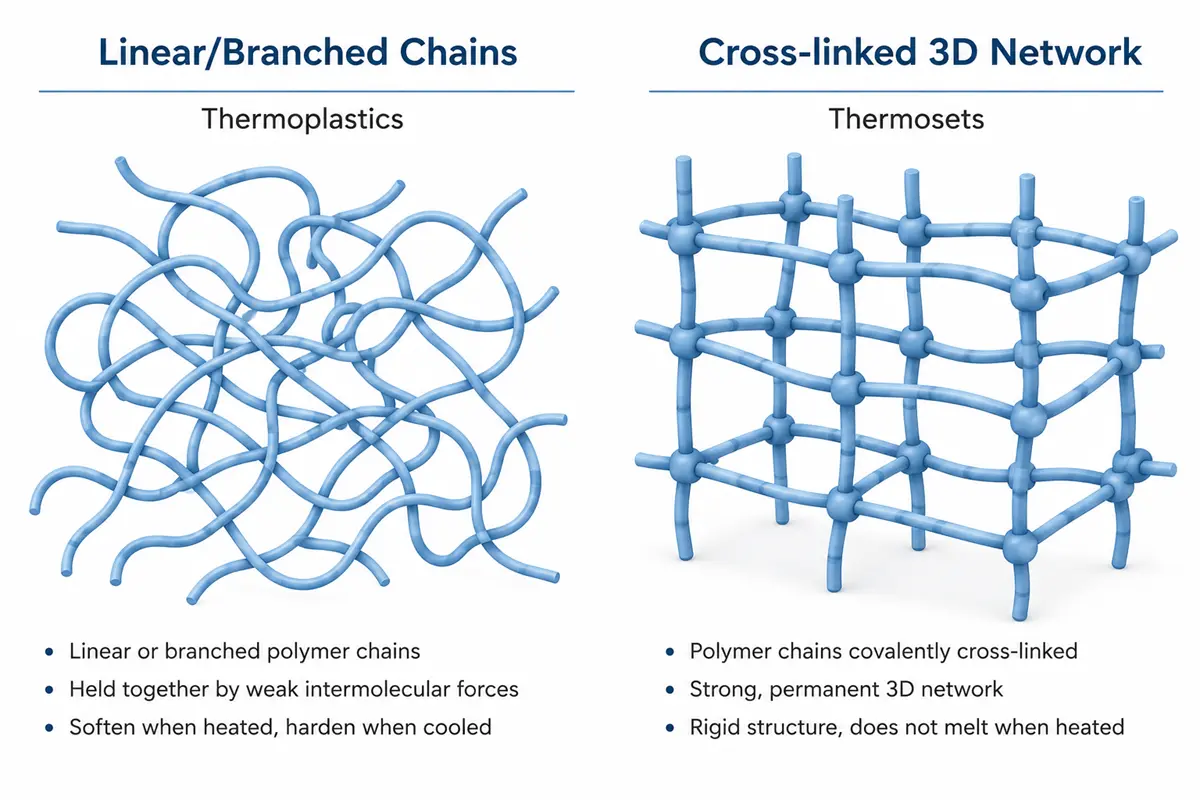
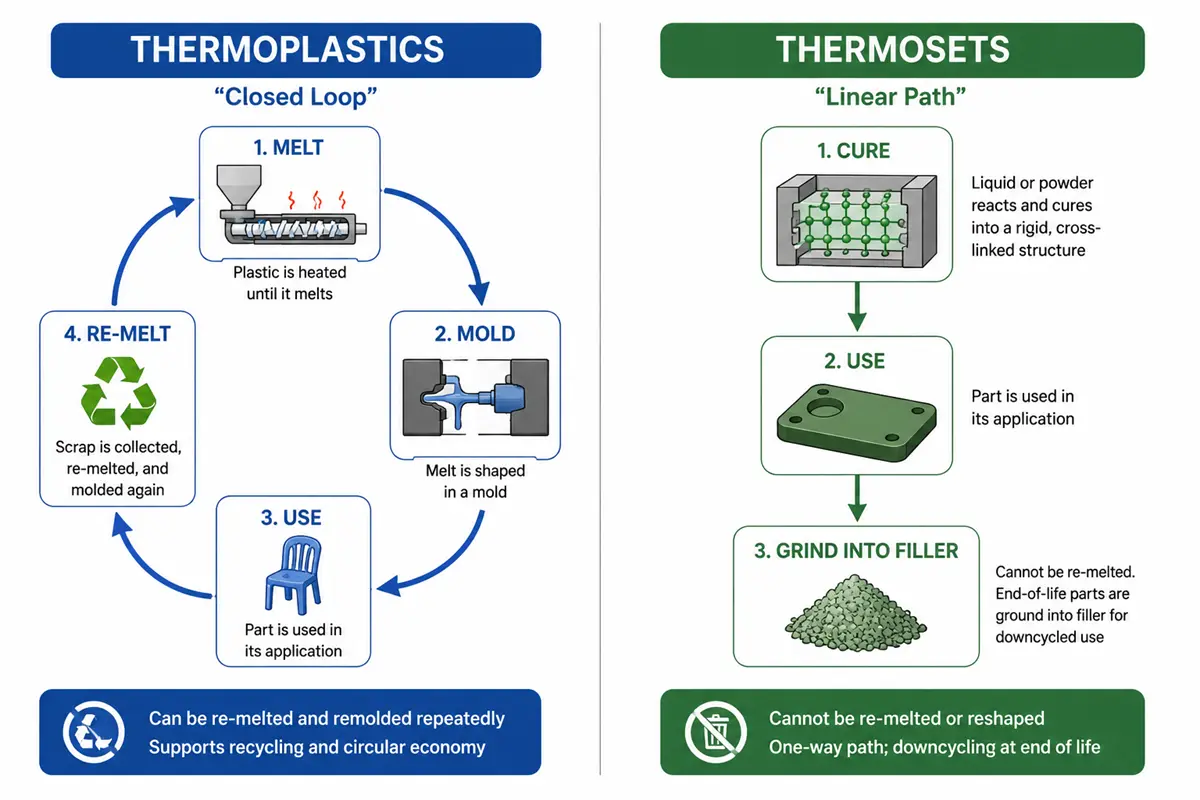
Thermosets and thermoplastics differ in how they handle heat. A thermoset cures once into a fixed, cross-linked solid and does not remelt. A thermoplastic softens with heat and hardens when cooled, so it reshapes and recycles. That single behavior decides whether a part survives its heat, load, and service life.
| Property | Thermoset | Thermoplastic |
| Reaction to heat | Cures once; added heat chars, not melts | Softens hot, hardens cool, repeatable |
| Molecular structure | Cross-linked 3D network | Linear or branched chains, weaker bonds |
| Strength & toughness | Rigid, heat- and creep-resistant, more brittle | Tougher, better impact, can creep under load |
| Recyclability | Hard to recycle; grind to filler only | Remeltable; recyclable where streams exist |
| Machinability | Hard, abrasive, holds tight tolerance | Softer, easier cuts, can warp or gum |
| Common materials | Epoxy, phenolic, polyester resin, melamine | ABS, PC, nylon, POM, PEEK, PEI |
Response to Heat
Heat sets a thermoset permanently. Curing cross-links the chains into a fixed network, so added heat chars the surface instead of melting it. Many thermosets hold form past 250°C, which suits hot zones near motors, electronics, and ovens.
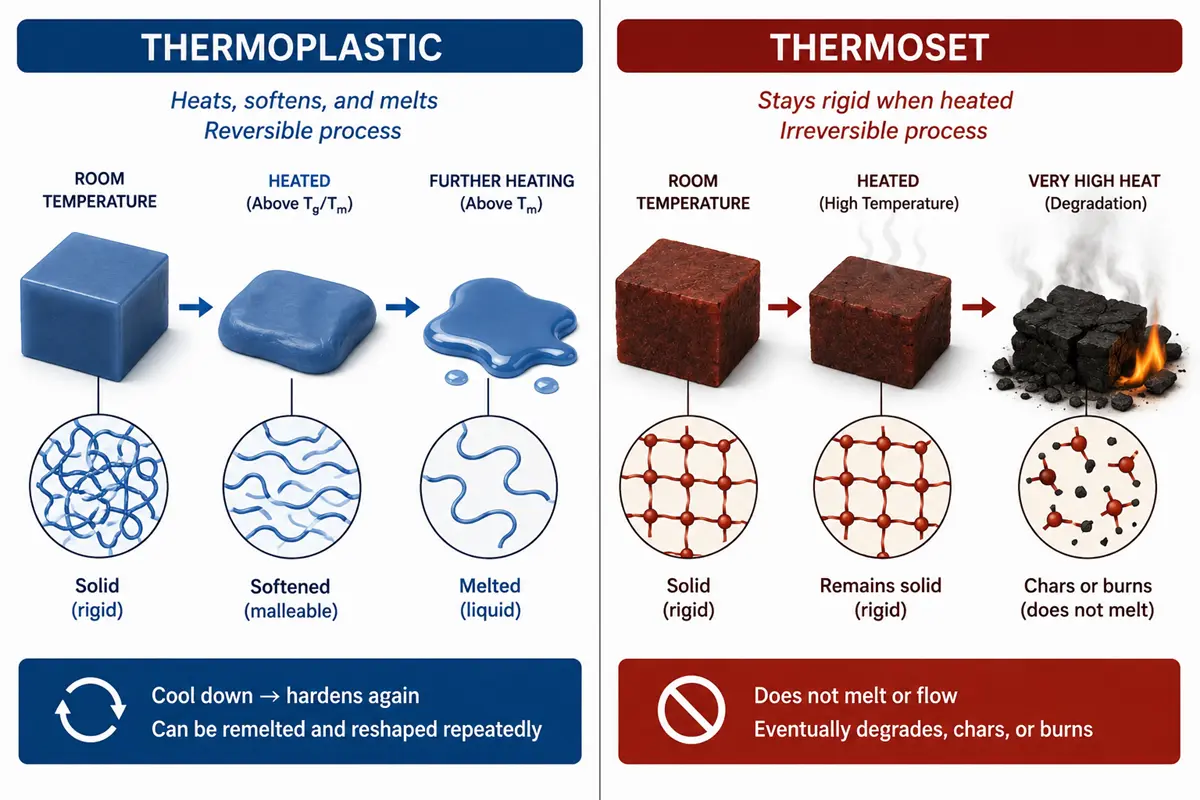
Thermoplastics do the reverse. Heat softens the chains, the part turns pliable, and cooling resets it, so the same stock can reshape or weld. Limits swing by grade: PEEK stays usable near 260°C, while commodity grades sag much sooner.
Recyclability and Reuse
Thermoplastics recycle; thermosets mostly do not. Because thermoplastic chains only soften, scrap and worn parts can remelt and reform, though repeated cycles can lower strength. Thermosets stay cross-linked and do not remelt, so recyclers grind them into filler or recover them through chemical and heat-based routes that stay niche. For teams with take-back or ESG targets, that gap often steers the pick toward thermoplastics.
Structure and Strength
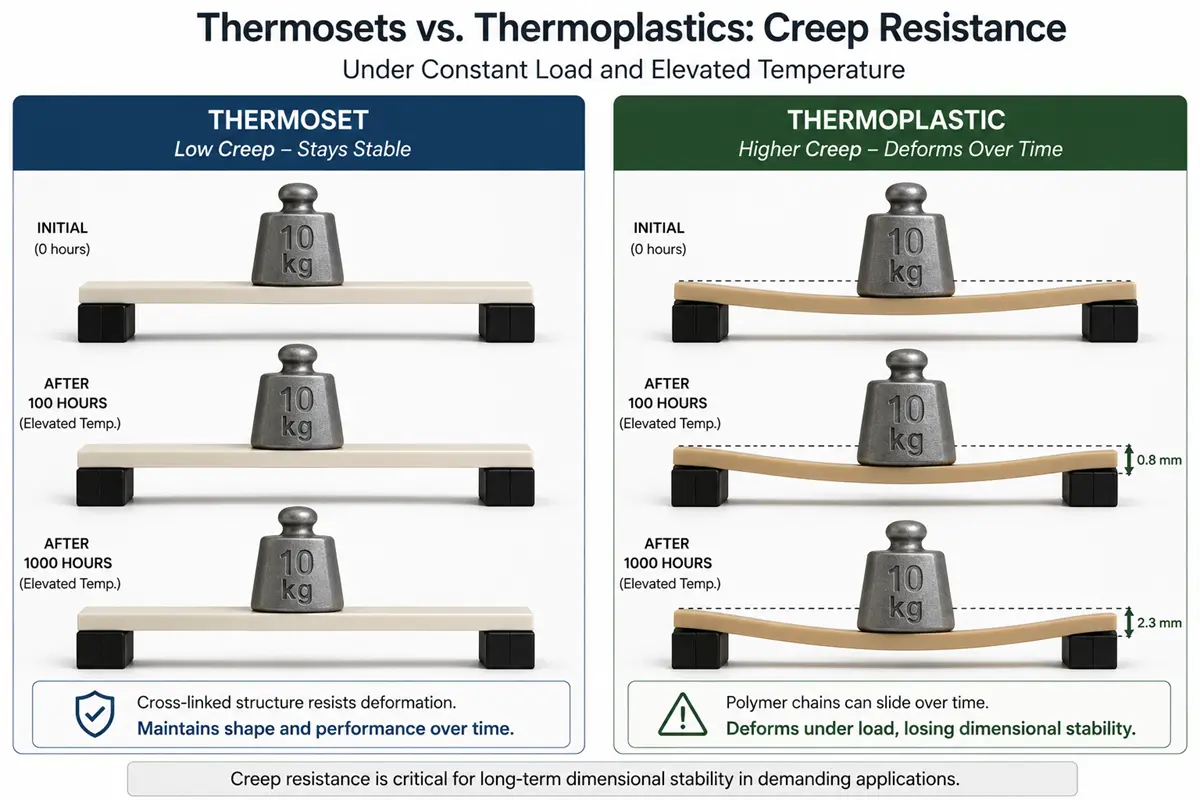
Structure drives the strength tradeoff. A thermoset’s cross-linked network resists heat, creep, and deformation, so it holds tight tolerances under load, yet the same rigidity makes it more brittle on impact.
Thermoplastic chains slide a little, which absorbs shock and lifts impact strength, but that same movement lets them creep under steady load or heat. Fillers narrow the gap on both sides: glass or carbon fiber stiffens a thermoplastic and cuts creep. When a drawing lists Shore or Rockwell values, a hardness of materials guide helps separate surface resistance from impact toughness.
Common Materials by Type
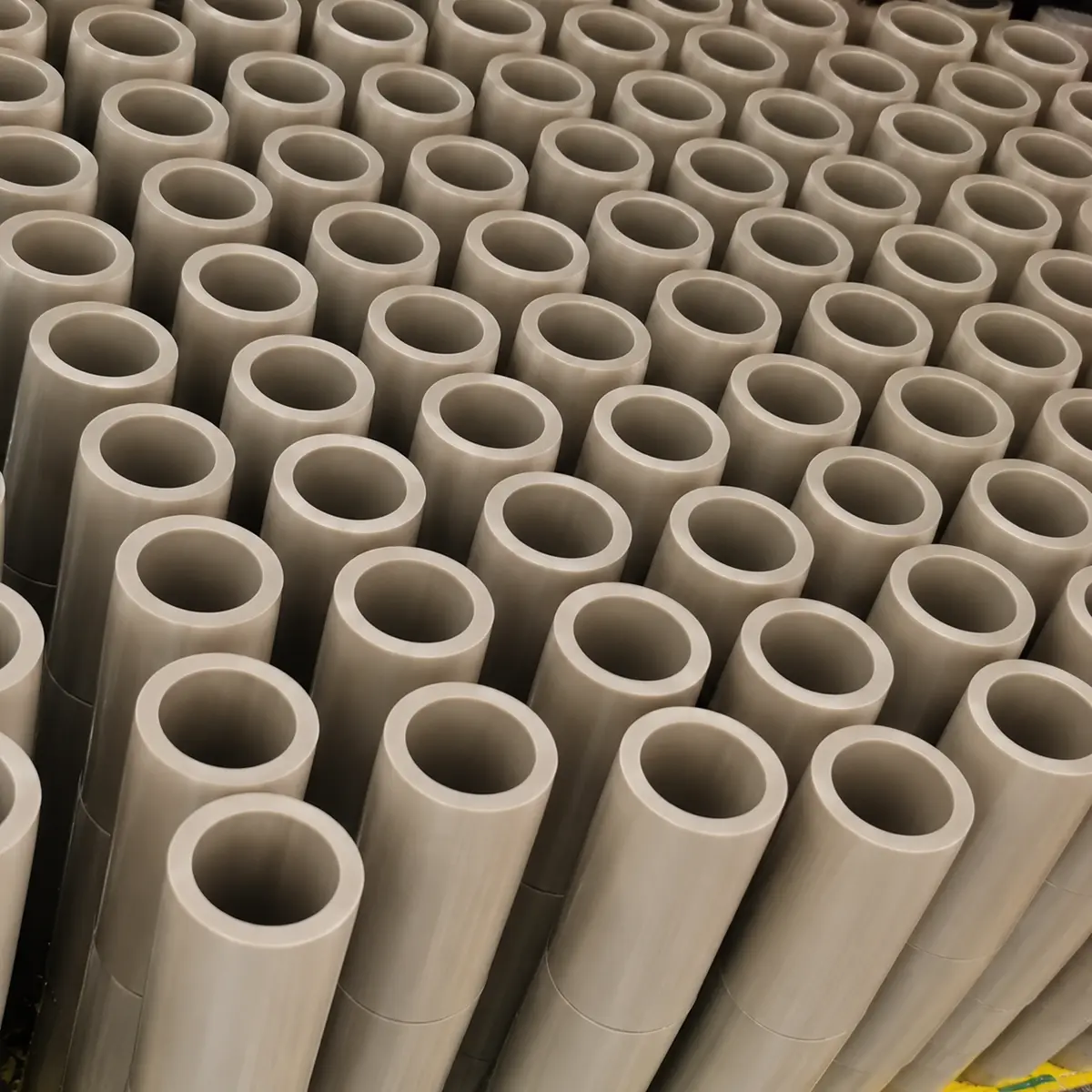
Material names map to type, but a few trip people up. Epoxy, phenolic, polyester resin, and melamine are thermosets. ABS, polycarbonate, nylon, POM, PEEK, and PEI are thermoplastics. The usual mix-up is PEEK: it resists heat like a thermoset, but it melts and reflows, so it counts as a thermoplastic. Thermoplastics also split into amorphous grades like PC and semi-crystalline grades like PEEK, which machine, bond, and shrink differently.
Where Are Thermosets and Thermoplastics Used?
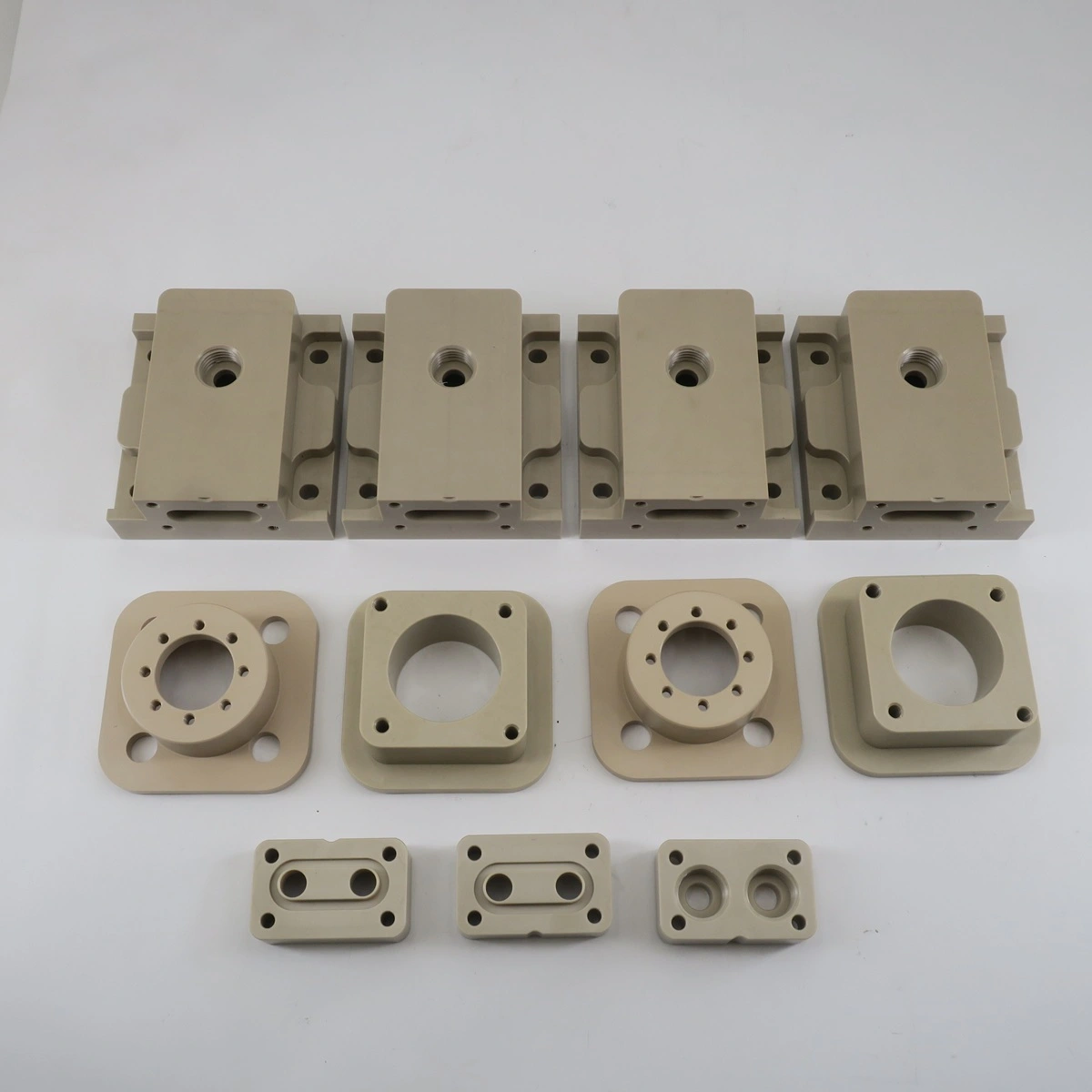
Both appear, but thermoplastics dominate many custom CNC machining parts that need heat resistance, sterilization tolerance, or tight dimensional control. PEEK, PEI, POM, and PC carry that work across medical, semiconductor, photonics, and robotics. Thermosets stay in a narrower lane: composite laminates, insulators, and adhesives, where a cured, non-melting structure earns its place.
Medical and Dental Parts
Medical parts lean thermoplastic for biocompatibility and steam sterilization. PEEK suits implants and instrument parts, PEI (Ultem) takes repeat autoclaving, and Delrin handles low-friction moving parts. Thermoset G10 laminate stays for insulating, structural pieces. Rollyu machines these parts for medical and dental device programs, where material certs and lot traceability gate every order.
Semiconductor and Photonics Parts
Vacuum stability and low outgassing favor thermoplastics here. PEEK and PTFE serve wafer-handling tooling, lens holders, and alignment jigs at tight tolerance. Thermoset epoxies mostly stay out of vacuum optical paths, where outgassing can fog mirrors and sensors. Rollyu holds these to ±0.005 mm and Ra < 0.2 µm for semiconductor and photonics builds.
Robotics and Automation Parts
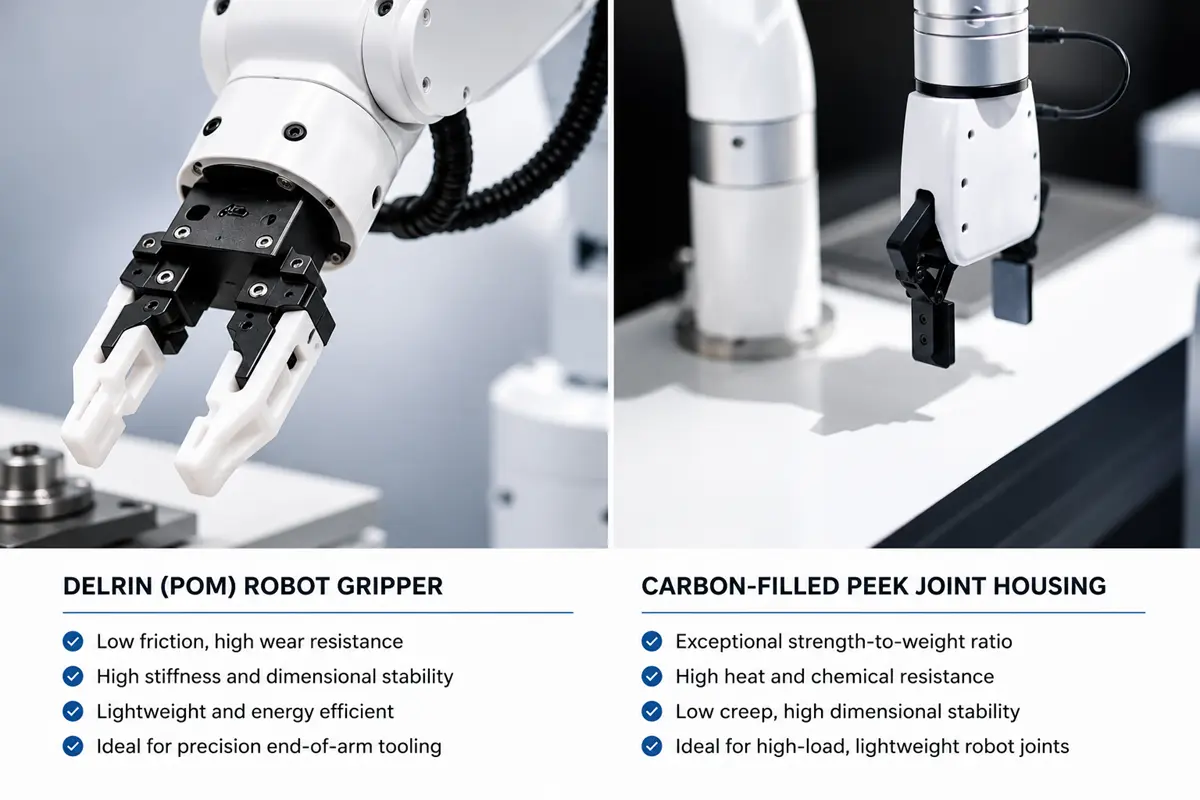
Robotics parts favor thermoplastics for light weight and impact resistance. PEEK and Delrin form grippers, joint housings, and sensor mounts. For low-friction parts, an acetal vs Delrin comparison helps control wear, weight, and CNC cost. Thermosets show up as stiff composite brackets where rigidity beats reworkability. Rollyu cuts the same in titanium and PEEK for robotics and automation lines.
How Do You Choose Between Thermoset and Thermoplastic?
Choose by service conditions, not habit. Run four filters in order: operating temperature, mechanical load, recyclability, then production method and cost. Temperature usually rules first, since it knocks out whole material classes. Where two materials both pass, volume and cost break the tie.
| Requirement | Best fit | Why |
| Hold shape above ~250°C continuous | Thermoset or PEEK | resists softening |
| Survive repeated impact or vibration | Thermoplastic | absorbs impact |
| Stay fixed under steady static load | Thermoset or filled thermoplastic | resists creep |
| Meet take-back or ESG rules | Thermoplastic | remelts and recycles |
| Ship as 1–100 prototype parts | Thermoplastic, CNC-cut | no tooling needed |
| Run high volumes of a fixed design | Either, molded | tooling amortizes |
Operating Temperature
Start with the hottest the part will run. Continuous heat past roughly 250°C points to a thermoset or a high-temp thermoplastic like PEEK, which stays usable near 260°C. Below that, standard engineering thermoplastics carry the load at lower cost.
Load and Stress Tolerance
Match the load type, not just the peak force. Steady static load favors thermosets or glass-filled thermoplastics, since low creep holds tolerance over time. Shock, vibration, and impact favor plain thermoplastics, because flexible chains absorb energy instead of cracking.
Recyclability Needs
If take-back or ESG targets apply, thermoplastics are the safer pick. Thermoplastics remelt and reform, so scrap and end-of-life parts re-enter the stream. Thermosets cannot remelt, so thermosets downcycle into filler at best. Regulated programs increasingly weight this factor in sourcing.
Production Method and Cost
Volume picks the method, and the method sets cost. For 1 to 100 functional plastic parts, CNC machining from stock often wins. A 3D printing vs CNC machining comparison helps when tolerance, strength, and prototype cost matter. For high volumes of a fixed design, molding amortizes tooling and drops per-part cost. Thermosets almost always need tooling, so thermosets rarely suit low-volume machined work. At Rollyu Precision, prototype orders ship in 5 to 10 business days.
FAQ
Can thermosets be CNC machined like thermoplastics?
Yes, but the cut behaves differently. Thermosets run harder and more abrasive, so they need sharp carbide tooling and slower feeds, while their rigidity holds tight tolerances well. Thermoplastics cut faster but can gum or warp from heat. Cast or laminated thermoset stock machines fine; fully cured molded parts rarely do.
Do thermoset or thermoplastic parts outgas in vacuum or semiconductor environments?
Both can outgas, but the grade decides the outcome. Many thermoset epoxies release volatiles under vacuum, while PEEK and PEI sit on NASA’s low-outgassing list for spacecraft materials. For semiconductor, photonics, and satellite hardware, low-outgassing thermoplastics protect optics and sensors. Verify each grade against NASA outgassing data or ECSS-Q-70 before specifying.
Can you weld or repair thermoset parts like thermoplastics?
No, thermosets cannot be remelted, so welding does not work. Repairs rely on adhesives, mechanical fasteners, or replacing the part. Thermoplastics can be heat, ultrasonic, or solvent welded and reflowed, because heat softens them reversibly. For rework-heavy or field-serviceable assemblies, thermoplastics cut repair cost and downtime.
Can a glass-filled thermoplastic replace a thermoset for heat and stiffness?
Yes, within limits. Glass fibers raise stiffness, cut thermal expansion, and lift the usable temperature, so a filled grade closes much of the gap. PEEK runs near 260°C continuous. Thermosets still lead when the part faces charring heat or extreme temperature, so match the grade to service temperature.
Do machined thermoplastic parts hold tight tolerances over time, or do they drift?
Thermoplastic parts can drift over time. Moisture absorption and creep under load pull dimensions off target. Humidity alone can shift a hygroscopic grade like POM by up to 0.2%. Annealing and glass fillers cut the movement, and thermosets stay more stable. For ±0.005 mm features, specify annealed or filled stock and check parts at operating temperature.A