UHMW vs ULTEM is not a simple ‘good versus better’ comparison. UHMW-PE is usually chosen when low friction, abrasion resistance, impact toughness, quiet sliding, and economical wear performance matter most. ULTEM is SABIC’s trade name for a family of polyetherimide (PEI) resins; PEI stock shapes are typically selected when stiffness, heat resistance, dielectric performance, and dimensional stability are more important. The correct choice depends on the exact grade, service temperature, load, environment, sterilization or cleaning cycle, tolerance stack, and whether the part is a wear component or a structural component.
For CNC buyers, the machining behavior is just as important as the material-property table. UHMW is soft, elastic, and prone to deflection or burr formation when tools are dull or clamping is excessive. PEI is much stiffer and can hold geometry more predictably, but heat, residual stress, notch sensitivity, coolant compatibility, and glass reinforcement can change the process substantially. Therefore, material selection and process planning should be treated as one engineering decision, not two separate steps.
UHMW vs ULTEM at a Glance
| Decision Factor | UHMW-PE | ULTEM / PEI | Engineering Takeaway |
| Primary strength | Wear, impact, low friction | Heat, stiffness, dimensional stability | Choose by function, not by price alone. |
| Typical temperature positioning | Lower-temperature wear service; grade-specific limits | High-temperature structural service; grade-specific limits | Do not publish one universal service temperature for an entire material family. |
| Rigidity / creep | Flexible; creep and clamp distortion can matter | Much more rigid; generally better structural retention | Thin walls and long spans behave very differently. |
| Moisture behavior | Very low moisture uptake for typical UHMW grades | PEI absorbs more moisture than UHMW | Conditioning can matter for close-tolerance PEI inspection. |
| Machining character | Soft, elastic, burr/stringy-chip risk | Rigid, heat/stress sensitive; reinforced grades are abrasive | Tool geometry and heat control differ. |
| Cost positioning | Usually lower | Usually substantially higher | Compare total life-cycle value, not raw material price only. |
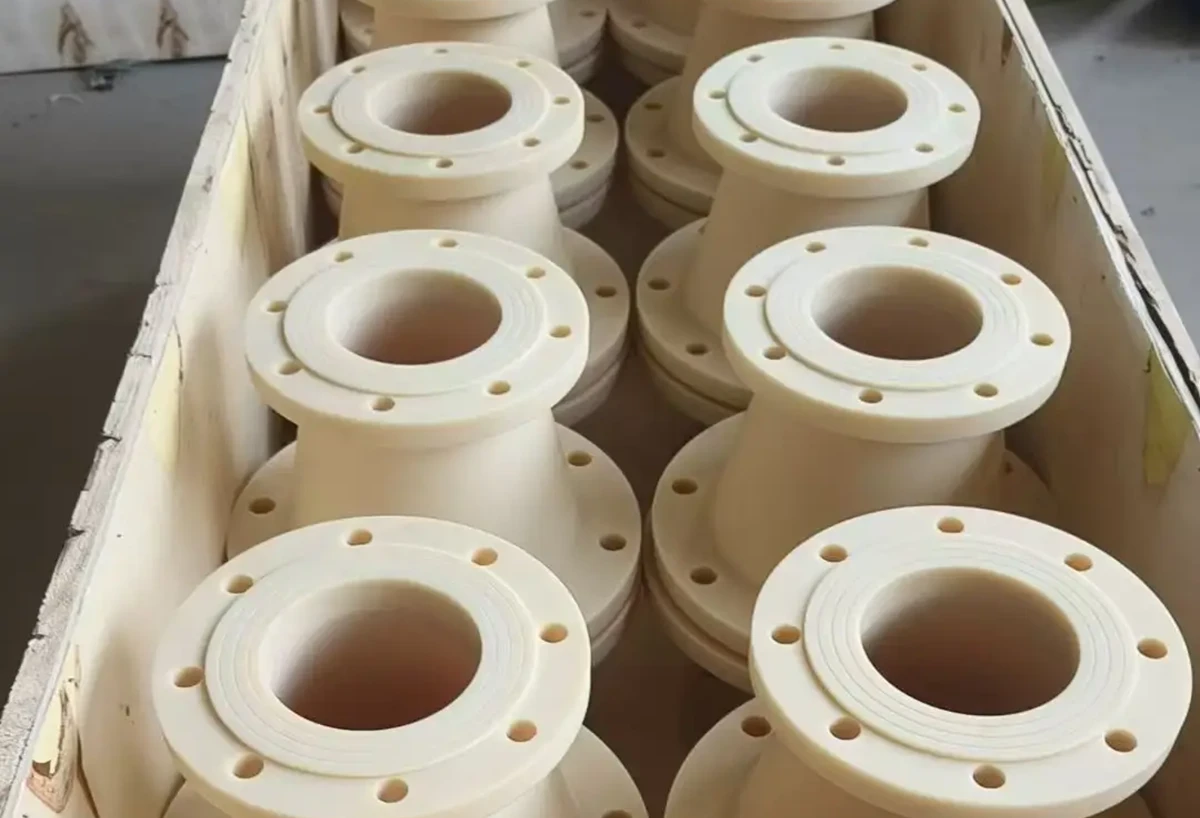
Machinability – Why UHMW and PEI Behave Differently
Machining UHMW-PE
UHMW machines with low cutting forces, but that does not mean it behaves like an easy metal. Its elasticity allows the workpiece to move away from the cutter, and excessive clamping can distort a part during machining only for it to spring after release. Dull edges rub rather than shear, creating heat, smeared surfaces, long chips, and burrs. Large thin plates, rings, wear strips, and long guide rails are particularly sensitive to workholding strategy.
The practical objective is a clean shearing action with minimal heat. Sharp cutters, generous chip space, positive rake, and good chip evacuation are more important than chasing a nominal spindle speed. For precision features, leave a controlled finishing allowance, release or reduce fixture stress when appropriate, allow the part to relax, and then finish or inspect from the functional datum scheme. This is why a blanket tolerance statement for all UHMW parts is technically risky.
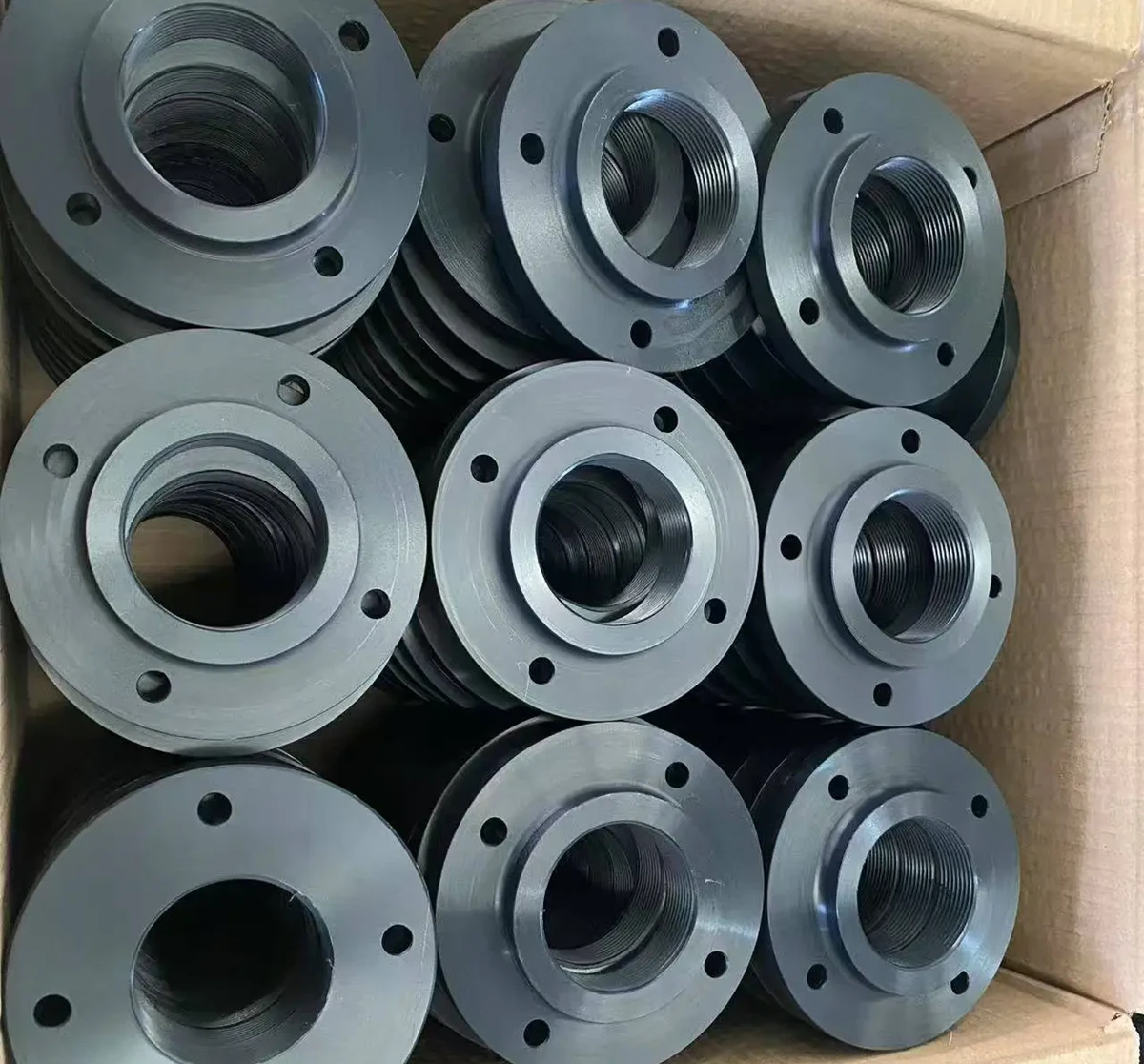
Machining ULTEM / PEI
Unfilled PEI is much stiffer than UHMW and is generally more predictable for pockets, bores, mounting datums, insulating structures, and parts that must retain geometry at elevated temperature. The trade-off is greater sensitivity to machined-in stress and local heat. Amorphous plastics can also be affected by unsuitable cutting fluids, so coolant selection should be verified rather than copied from a metal-machining process.
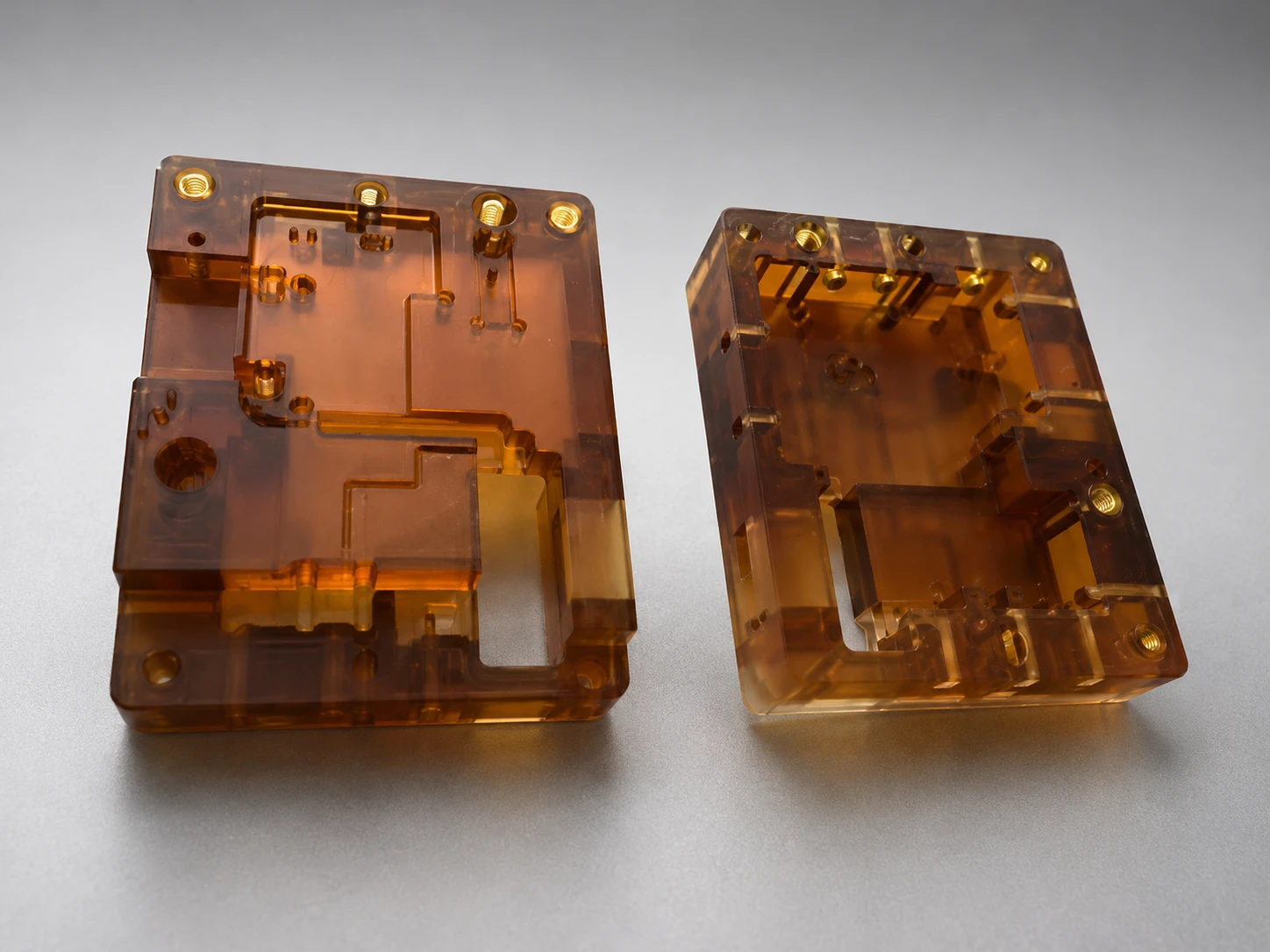
Reinforced PEI is a separate machining case. Glass-filled grades can improve stiffness and reduce thermal expansion, but the reinforcement increases tool wear and may change edge quality, burr behavior, and attainable surface finish. For volume production, wear-resistant carbide or PCD may be justified after a cost and process study. Do not label an amber part as ‘ULTEM 1000’ or ‘ULTEM 2300’ based on appearance: color is not a material certificate, and different resin or stock-shape families can look similar.
Tooling Strategy for UHMW and ULTEM Machining
For UHMW, polished sharp carbide cutters with high positive rake, large flute volume, and minimal edge hone are commonly effective. One- or two-flute geometries can improve chip evacuation in deep slots and pockets. The goal is to cut a real chip rather than rub the polymer. Toolpaths should minimize recutting of stringy swarf, and air blast or a proven plastic-compatible coolant can help remove heat and chips. Very heavy clamping should be avoided because the fixture can become the source of dimensional error.
For unfilled PEI, sharp carbide and positive cutting geometry are also appropriate, but heat management and stress control become more important. Ground and polished cutting edges can reduce material build-up and improve finish. When PEI is glass reinforced, tool life should be monitored more aggressively; PCD is an option for stable, repetitive production, not an automatic requirement for every prototype. Drills should evacuate chips efficiently, and deeper holes may benefit from pecking or staged drilling to prevent localized heating.
Speeds & Feeds – Use a Validated Starting Window, Not a Universal Recipe
Speeds and feeds are one of the highest-risk sections in a machining article because published values depend on cutter diameter, flute count, tool material, depth of cut, stock grade, reinforcement, machine rigidity, coolant, and required finish. A Mitsubishi Chemical Group machining guide places TIVAR UHMW-PE and Duratron PEI in the same broad reference group for several operations, but this should not be interpreted as proof that the two materials should run identically.
As one supplier-published reference point, certain end-milling/slotting setups in that guide use approximately 270-450 surface ft/min (about 82-137 m/min) and chip loads in the neighborhood of 0.002-0.005 in/tooth (about 0.05-0.13 mm/tooth). These numbers are a process-development reference, not Rollyu’s universal production parameters. A safer shop method is to begin with the exact stock supplier’s guidance, select a sharp tool, calculate RPM from cutter diameter, run a short trial, inspect chip formation and temperature, then adjust feed to avoid rubbing while maintaining edge quality.
Moisture – Separate Resin Pellet Drying from CNC Stock Conditioning
A common technical error is to take injection-molding drying instructions for PEI pellets and apply them directly to CNC-machined plate, rod, or block. Resin pellet drying is a molding-process requirement intended to control moisture before melt processing. Machined stock shapes have already been converted into solid shapes and are normally supplied with their own fabrication and stress-relief history. If a drawing or supplier requires drying, pre-conditioning, or a special storage condition for stock shapes, that instruction should be followed specifically; otherwise a pellet-drying cycle should not be presented as a default CNC step.
UHMW has extremely low moisture uptake, so routine moisture conditioning is usually not the dimensional driver it can be for some engineering plastics. PEI stock shapes can absorb measurable moisture. For example, Mitsubishi Chemical Group publishes water-absorption values for one unfilled PEI stock-shape grade that are materially higher than typical UHMW values. For close-tolerance PEI parts, the practical control is to stabilize material and finished parts in a defined inspection environment and to align inspection timing with the customer’s service or conditioning requirement.
Post-Curing vs Post-Machining Annealing
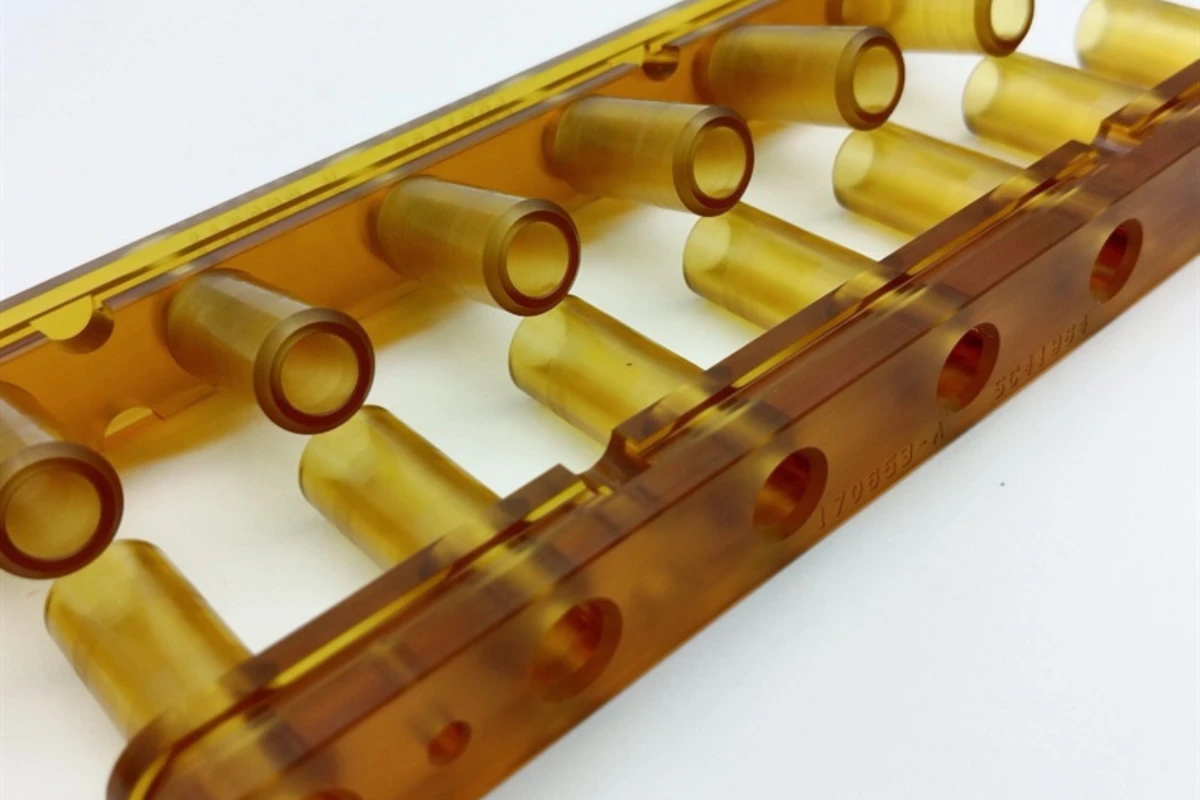
For PEI, ‘post-curing’ is usually the wrong general term. PEI is a thermoplastic; the relevant secondary thermal process is normally described as post-machining annealing or stress relief. It is also inaccurate to state that every ULTEM or PEI machined part must be annealed after machining. Mitsubishi Chemical Group’s fabrication guidance explicitly notes that few machined plastic parts require post-machining annealing, while also explaining that PEI can benefit in specific situations such as reducing residual stress or improving resistance to stress crazing.
A risk-controlled process statement is therefore: consider intermediate or post-machining annealing when geometry, material removal, flatness, chemical exposure, or tolerance stability justifies it, and use the exact stock-shape supplier’s validated cycle. Finish machining of critical dimensions should occur after any required stress-relief step. The decision should be recorded on the routing or control plan rather than embedded as a universal marketing promise.
Inspection and Tolerance Strategy
CMM inspection can be appropriate for both materials, but the measurement plan should reflect polymer behavior. UHMW can deform under fixturing or probing and may relax after removal from a fixture. Thin, flexible features may therefore require low-force contact strategy, non-contact measurement, dedicated supports, or a defined free-state inspection condition. PEI is more rigid, yet its thermal expansion is still far higher than that of common metals, so part temperature, stabilization time, datum definition, and measurement sequence matter when tolerances are tight.
Use the drawing to decide the inspection method: CMM for datums and GD&T, optical measurement for edge profiles, pin or bore gauges for functional holes, thread plug or ring gauges for threads, and surface-finish instruments where Ra/Rz is specified. Do not promise one tolerance such as +/-0.005 mm across every UHMW or PEI feature. Attainable tolerance depends on part size, wall thickness, stock condition, geometry, feature type, environmental condition, and how much material is removed. The correct commercial language is ‘tolerance reviewed by feature and application.
Application and Compliance Claims – What Can Be Said Safely?
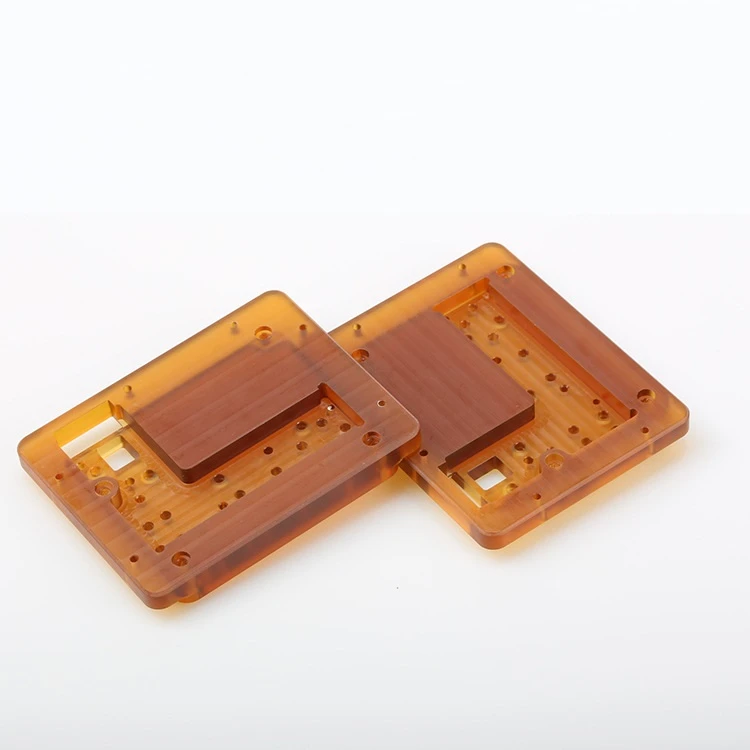
UHMW is widely used for wear strips, guides, liners, chain components, bushings, rollers, and material-handling parts because low friction and impact resistance can extend service life. PEI is used where heat resistance, structural stiffness, electrical insulation, sterilization resistance, or dimensional stability are needed. These are application categories, not certifications. A machined PEI bracket used in aerospace is not automatically ‘aerospace certified,’ and a PEI component used near optical hardware is not automatically qualified for vacuum, low outgassing, or contamination-sensitive photonics service.
The same caution applies to medical, food-contact, FDA, and biocompatibility statements. Some specific UHMW and PEI stock-shape grades have supplier documentation for food-contact requirements, and selected healthcare resin families have biocompatibility or sterilization data. However, approvals can vary by grade, color, thickness, processing history, region, and final application. Website language should therefore identify the exact material grade and supporting document when a compliance claim is important. The finished part or device must be validated under the customer’s applicable requirements; material-family marketing language alone is not sufficient.
Which Material Should You Choose?
Choose UHMW when the part’s job is primarily to slide, absorb impact, resist abrasion, reduce noise, or act as a replaceable wear element at a suitable service temperature. Choose PEI when the component must be stiffer, more dimensionally stable, electrically insulating, or capable of retaining performance at substantially higher temperatures. If the part combines sliding wear with a structural load, or if it has very tight geometry and a demanding thermal cycle, compare not only UHMW and unfilled PEI but also reinforced PEI, PEEK, POM, PPS, or other engineering plastics as appropriate.
For an RFQ, provide the 2D drawing, 3D model, exact resin or stock-shape grade if already specified, operating temperature, chemical or sterilization exposure, critical tolerances, inspection requirements, and any material-certification or traceability requirement. This allows the machining route to be built around the real application rather than a generic material name.
FAQ – UHMW vs ULTEM
ULTEM the same as PEI?
ULTEM is a SABIC trademark for a family of PEI materials. In technical writing, use PEI for the polymer family and use ULTEM only when the grade or source actually belongs to the ULTEM resin family.
Which is easier to machine, UHMW or ULTEM?
Both are machinable, but their problems differ. UHMW is soft and elastic, so burrs, deflection, spring-back, and clamping distortion are common concerns. PEI is stiffer but needs more attention to heat, residual stress, coolant compatibility, and tool wear in reinforced grades.
Can UHMW hold tight tolerances?
It can hold useful precision when the feature, geometry, stock condition, fixture, temperature, and inspection method are controlled. A universal tolerance should not be promised for every UHMW part.
Does every ULTEM machined part need post-curing?
No. PEI is a thermoplastic, and post-machining annealing is not mandatory for every part. It is considered when residual stress, flatness, chemical exposure, or dimensional stability justify the step.
Do ULTEM CNC parts need to be dried before machining?
Do not copy pellet-drying instructions into a CNC stock-shape process. Resin drying before molding and conditioning of machined plate, rod, or block are different topics. Follow the stock supplier and drawing requirements.
Can I use published speeds and feeds directly?
No. Published tables are starting references. Tool diameter, flute count, reinforcement, depth of cut, machine rigidity, workholding, coolant, and finish requirement must be considered and validated by trial.
Are UHMW and ULTEM FDA compliant or biocompatible?
Not as blanket material-family claims. Some specific grades may have supporting food-contact or healthcare documentation. Verify the exact grade, color, supplier declaration, lot traceability, and the requirements of the finished application.
What should I send for a UHMW or PEI machining quote?
Send the drawing and 3D model, material grade, quantity, critical dimensions and GD&T, operating environment, surface requirements, inserts or secondary operations, inspection plan, and any certificate or traceability requirements.
RFQ CTA – Get a Machining Review Before You Lock the Material
Need help deciding between UHMW and ULTEM/PEI for a machined component? Send Rollyu Precision your drawing, 3D model, target material grade, quantity, operating temperature, critical tolerances, and inspection or compliance requirements. Our engineering review can identify machining risks, workholding concerns, likely inspection methods, and whether material conditioning or stress relief should be evaluated before the part enters production.
For the fastest RFQ review, highlight functional datums, mating features, threads, thin walls, sealing surfaces, wear surfaces, and any dimensions that are temperature-sensitive. We will quote the specified material or flag questions before production rather than replacing the customer’s design intent with a generic plastic-machining rule.