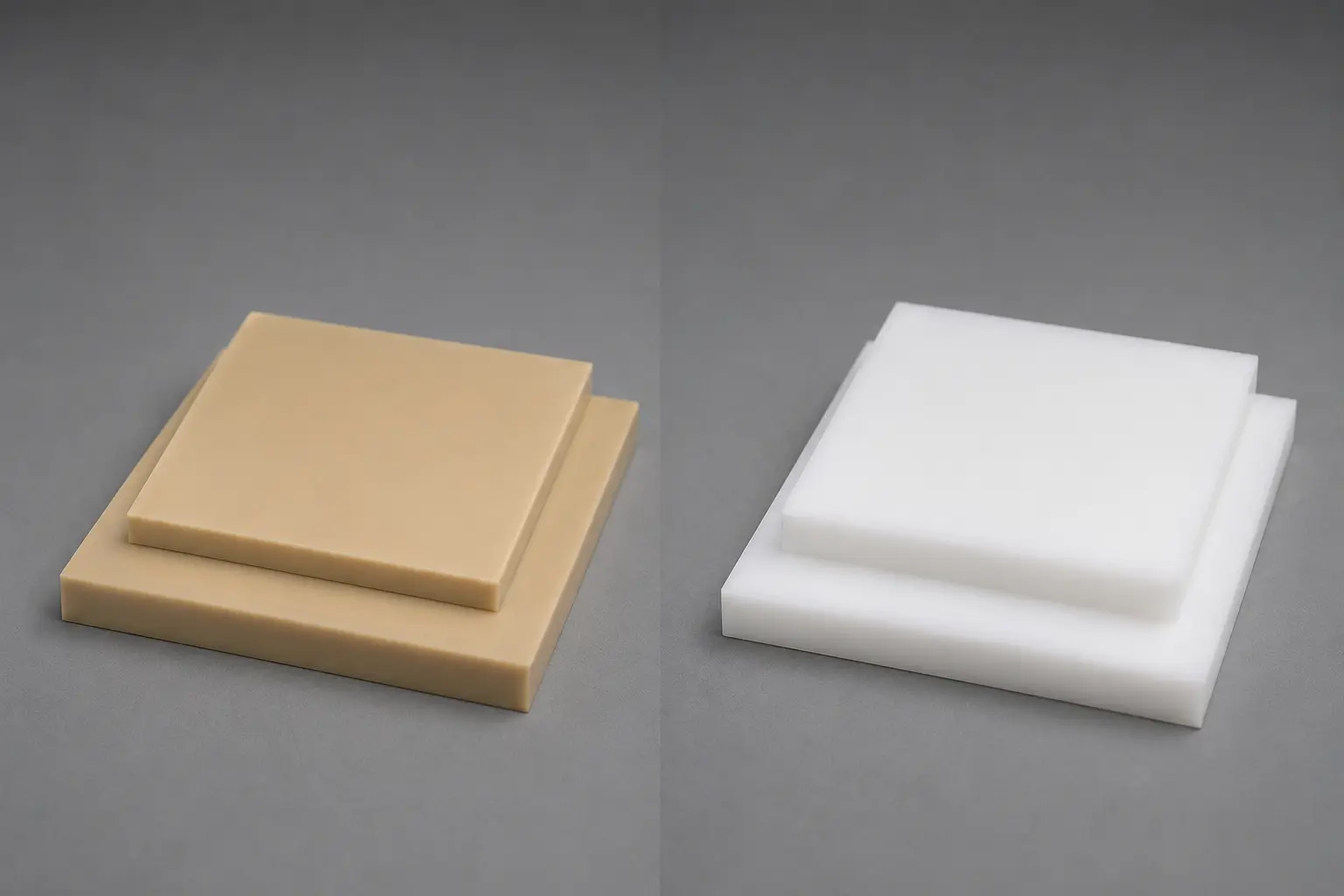
PEEK and Delrin are two popular engineering plastics used in CNC machined components. Although they may appear similar, they serve different operating requirements and design goals.
This article compares their properties, machining characteristics, costs, and applications to help you choose the right material.
Understanding the Materials
What Is PEEK
PEEK (Polyether Ether Ketone) is a high-performance engineering plastic developed for demanding operating environments. It is commonly used in medical devices, semiconductor equipment, aerospace systems, and other applications where standard plastics may not be sufficient.
The material is often selected for components exposed to challenging operating conditions, making it a common choice for high-end engineering applications.
What Is Delrin (POM)
Delrin is a brand name for acetal homopolymer, a type of Polyoxymethylene (POM). In engineering applications, the terms Delrin, Acetal, and POM are often used interchangeably, although Delrin specifically refers to a material originally developed by DuPont.
Delrin has become one of the most widely used engineering plastics because it is easy to machine, cost-effective, and suitable for a wide range of mechanical components. It is commonly used in automation equipment, consumer products, industrial machinery, and general-purpose engineering applications.
Key Performance Differences
PEEK and Delrin are widely used in CNC-machined components, but their performance characteristics are designed for different operating environments. Understanding these differences helps engineers select the most appropriate material for functional and economic requirements.
Strength and Stiffness
PEEK and Delrin offer different levels of mechanical performance, but PEEK generally provides higher strength and rigidity under load.
In applications involving continuous stress, elevated temperatures, or long service life requirements, PEEK is often better at maintaining its original shape and mechanical properties. Delrin remains suitable for many gears, bushings, rollers, and general mechanical components, particularly when operating conditions are less demanding.
For heavily loaded assemblies, PEEK typically offers a greater safety margin, while Delrin is often preferred for cost-sensitive designs.
Temperature Capability
One of the biggest differences between the two materials is their operating temperature range.
PEEK is commonly used in environments where components are exposed to elevated temperatures for extended periods. Delrin performs well in general industrial applications but may experience dimensional changes or reduced mechanical performance when exposed to excessive heat.
As operating temperatures increase, the performance gap between the two materials becomes more noticeable. For applications involving sterilization, process equipment, or heat-generating assemblies, temperature capability often becomes a key factor in material selection.
Chemical Resistance
Resistance to oils, cleaning agents, and industrial chemicals is important in many applications.
PEEK is typically chosen for more aggressive chemical environments, including applications involving solvents, process fluids, and repeated exposure to industrial cleaning chemicals. Delrin performs well in many standard industrial environments but may have limitations depending on the chemical type and operating conditions.
For components used in chemical processing equipment or demanding industrial systems, engineers often evaluate chemical compatibility early in the design stage.
Moisture Absorption and Dimensional Stability
Moisture absorption can influence long-term dimensional accuracy, especially in precision assemblies.
Compared with many engineering plastics, moisture absorption is relatively low for each material. Under changing temperatures, humidity levels, and extended service cycles, PEEK typically maintains dimensional stability more effectively.
This becomes increasingly important in applications requiring precise alignment, controlled clearances, or consistent positioning over time.
Property Comparison
| Property | PEEK | Delrin |
| Continuous Use Temperature | ~250°C | ~85-100°C |
| Tensile Strength | 90-100 MPa | 60-70 MPa |
| Density | 1.30-1.32 g/cm³ | 1.41 g/cm³ |
| Moisture Absorption | ~0.1% | ~0.2% |
| Chemical Resistance | Excellent | Good |
Machining Characteristics
Ease of Machining
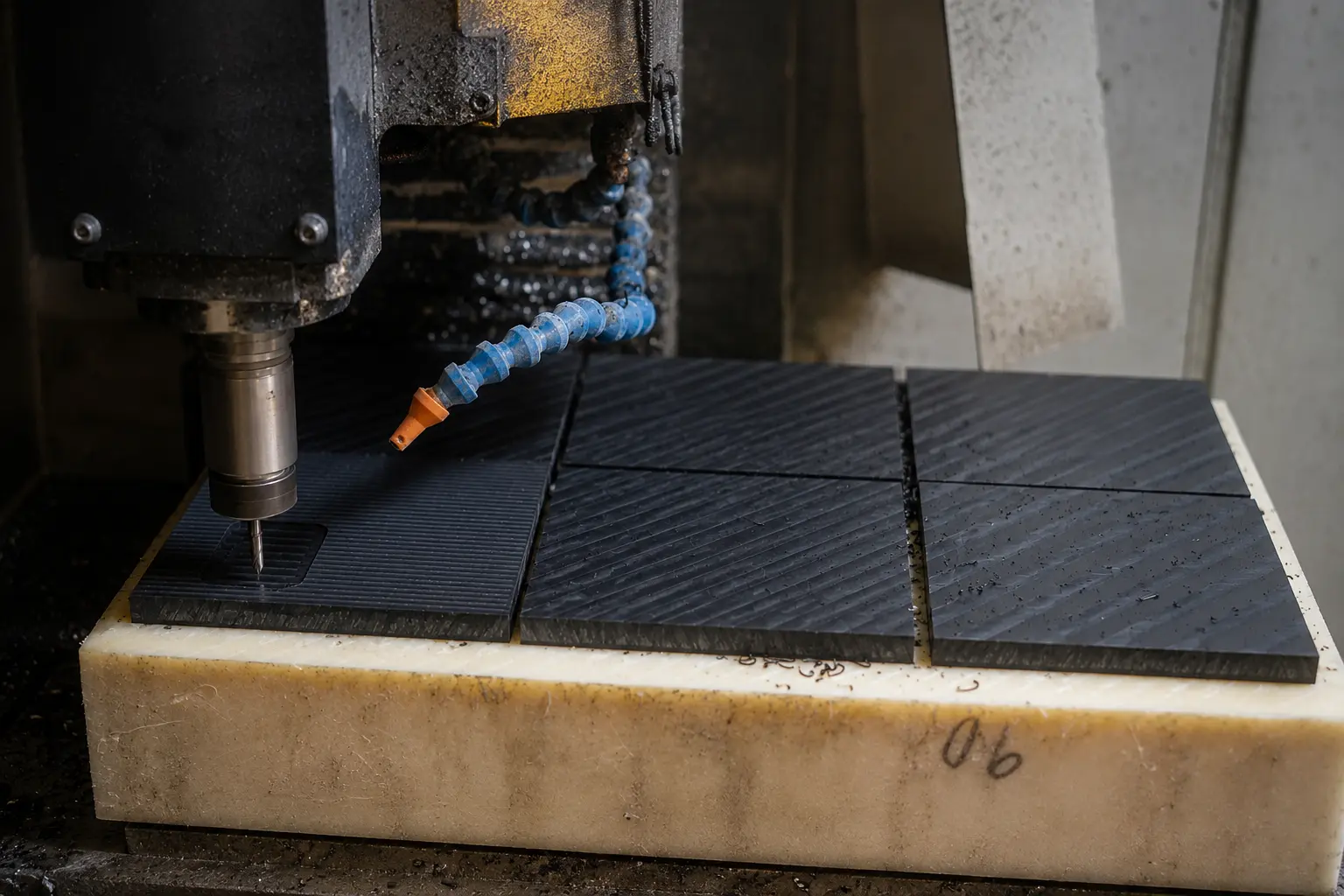
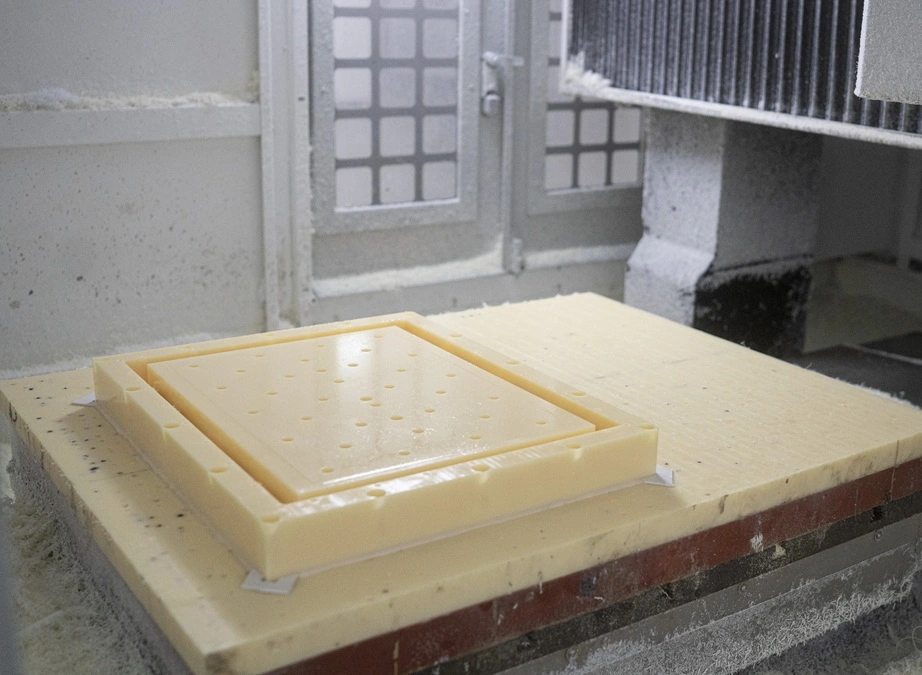
Delrin is generally easier to machine than PEEK. It cuts cleanly, produces stable chips, and typically requires less process control. PEEK can achieve high accuracy but often demands greater attention to heat management and machining parameters.
Tool Wear and Heat Generation
PEEK tends to generate more heat during machining and can accelerate tool wear, particularly in long production runs. Delrin places less stress on cutting tools and is often easier to process efficiently.
Burr Formation and Surface Finish
High-quality surface finishes can be achieved with either material. Delrin typically forms cleaner edges, while PEEK may require additional burr control around small features, threads, and thin-wall sections.
Tight-Tolerance Capability
Tolerance requirements are often determined by the application rather than the material alone. Components used in positioning systems, mating assemblies, and precision motion mechanisms typically require consistent dimensional repeatability throughout production.
Material selection is often driven more by operating conditions than by achievable machining accuracy. When operating conditions involve temperature fluctuations or long service cycles, engineers often place greater emphasis on dimensional stability during material selection.
Machining Comparison
| Factor | PEEK | Delrin |
| Machinability | More Challenging | Easier |
| Tool Wear | Higher | Lower |
| Surface Finish | Excellent | Excellent |
| Dimensional Stability | Excellent | Good |
| Tight Tolerance Capability | Excellent | Excellent |
Cost Considerations
Material Cost
PEEK is significantly more expensive than Delrin. For many applications, raw material cost is often the first factor influencing material selection.
Machining Cost
PEEK generally requires more process control and longer machining times, which can increase manufacturing costs. Delrin is easier to machine and is often more economical for high-volume production.
Long-Term Value
Initial cost is only part of the equation. While Delrin offers a lower upfront investment, PEEK may provide greater long-term value in demanding applications where service life, reliability, or reduced maintenance are important considerations.
Typical Applications
Medical Device Components
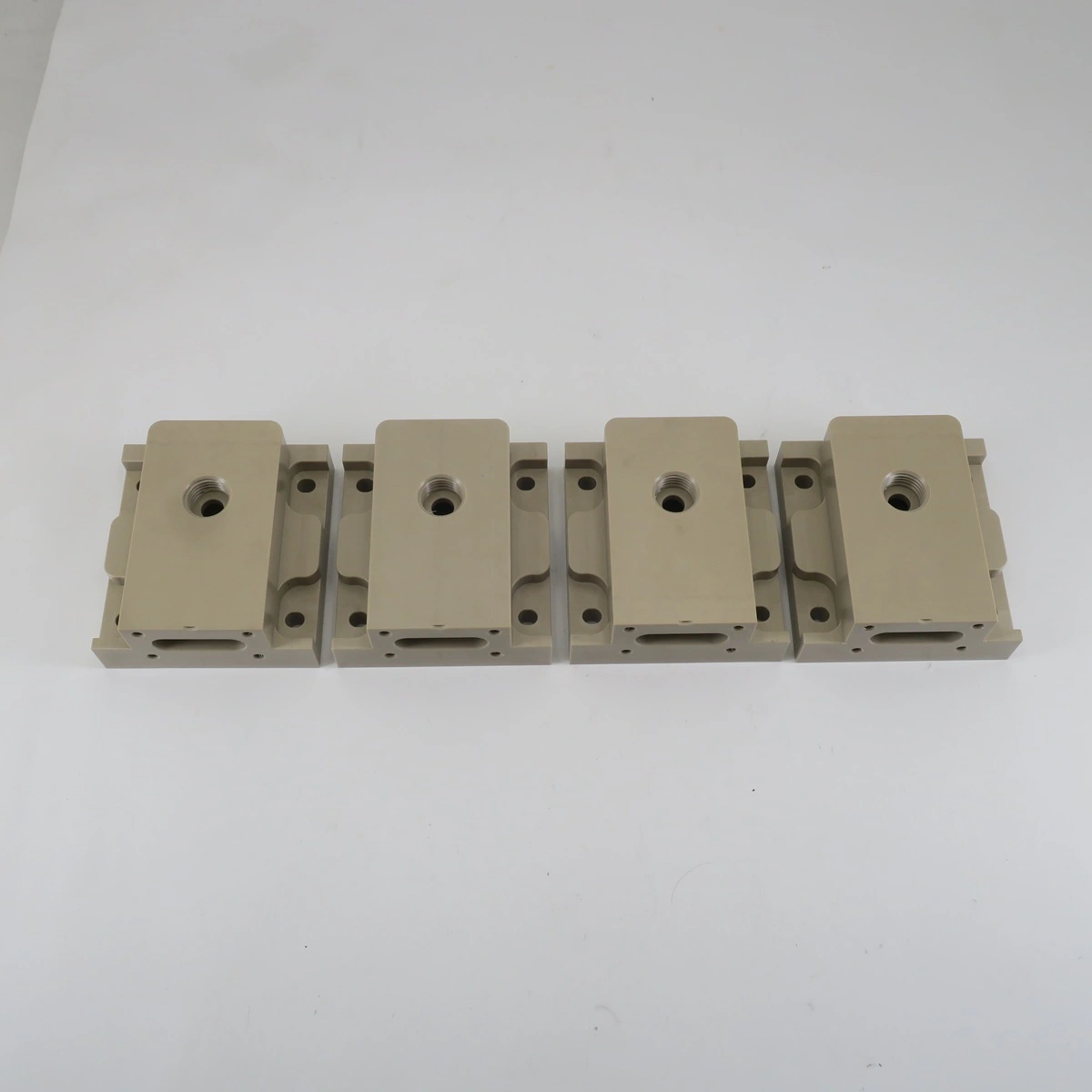
Medical assemblies often require materials that maintain dimensional consistency through repeated cleaning, sterilization, and long service cycles. For these reasons, PEEK is commonly used in surgical instruments, diagnostic equipment, and other medical components where reliability is a primary concern.
Semiconductor Equipment Parts
Many wafer-handling systems operate continuously and require components that maintain stable positioning accuracy over long production cycles. PEEK is frequently selected for wafer-handling systems, insulation structures, and positioning components because it can perform reliably in demanding process environments.
Automation and Motion Systems
Many automation components operate through repeated positioning, sliding contact, and continuous movement. Delrin is widely used for guides, fixtures, rollers, and mechanical assemblies because it is easy to machine and performs well in general industrial applications.
Electrical and Insulation Components
Electrical systems can utilize either material, with the final selection typically determined by operating temperature, performance requirements, and project cost. Delrin is commonly used in standard industrial equipment, while PEEK is typically chosen when higher temperatures or more demanding conditions are involved.
Wear Parts and Sliding Components
Bushings, guide rails, rollers, and gears are frequently manufactured from engineering plastics to reduce friction, noise, and maintenance requirements. Delrin is often preferred for general-purpose wear components, while PEEK is frequently selected when longer service life or more demanding operating conditions justify the additional material cost.
Application Suitability Matrix
| Application | PEEK | Delrin |
| Medical Devices | ★★★★★ | ★★☆☆☆ |
| Semiconductor Equipment | ★★★★★ | ★★☆☆☆ |
| Automation Systems | ★★★☆☆ | ★★★★★ |
| Consumer Products | ★★☆☆☆ | ★★★★★ |
| Wear Components | ★★★★☆ | ★★★★★ |
| High-Temperature Equipment | ★★★★★ | ★☆☆☆☆ |
Choosing the Right Material
When PEEK Makes Sense
PEEK is often selected when operating conditions exceed the capabilities of standard engineering plastics. Applications involving elevated temperatures, continuous mechanical loads, aggressive cleaning chemicals, or demanding industrial environments can justify the higher material and manufacturing costs.
The material is commonly found in medical devices, semiconductor equipment, aerospace systems, and other applications where long-term performance is prioritized over initial cost.
When Delrin Is the Better Choice
Delrin is often the more practical option for general engineering applications. It offers excellent machinability, lower material costs, and reliable performance in many mechanical assemblies operating under normal industrial conditions.
For gears, rollers, spacers, fixtures, automation components, and high-volume production parts, Delrin frequently provides the most economical solution without unnecessary material expense.
Quick Selection Guide
In many projects, material selection comes down to balancing performance requirements against manufacturing cost. The table below provides a simple starting point for comparing common application needs.
Material Selection Guide
| Requirement | Recommended Material |
| High Temperature | PEEK |
| High Strength | PEEK |
| Chemical Exposure | PEEK |
| Low Cost | Delrin |
| Easy Machining | Delrin |
| General Mechanical Parts | Delrin |
| Semiconductor Equipment | PEEK |
| Consumer Products | Delrin |
Quick Decision Rules
If operating temperatures exceed 100°C, PEEK is usually the safer choice.
If minimizing manufacturing cost is the primary objective, Delrin is often the better option.
If chemical exposure is a major concern, PEEK typically provides a greater safety margin.
If the application involves high-volume production of general mechanical parts, Delrin is often preferred.
Real Manufacturing Considerations
Material Availability
PEEK and Delrin are commonly available in rod, sheet, and tube forms. Selecting the most suitable stock shape can reduce material waste, shorten machining time, and improve overall production efficiency.
Thin-Wall Components
Thin-wall geometry often highlights the differences between the two materials. In our experience, PEEK generally maintains dimensional stability more effectively during machining, while thin-wall Delrin components may require additional process control to minimize movement and deformation.
Small Threads and Precision Features
Features such as M2-M4 threads, small bores, and narrow slots frequently require additional attention during machining and inspection. Material behavior can influence burr formation, thread quality, and dimensional repeatability, particularly in precision assemblies.
Design Features That Affect Cost
Part geometry often has a greater impact on manufacturing cost than material selection. Thin walls, deep holes, and fine threads typically require additional machining time, tighter process control, or specialized tooling. Fine threads and deep bores often increase inspection requirements in addition to machining time.
Inspection and Quality Control
Critical dimensions, threaded features, and mating surfaces often require additional inspection during production. Depending on application requirements, manufacturers may perform dimensional verification, thread inspection, and stability checks to ensure consistent part quality. Critical features may require thread gauges, bore measurement, or first-article inspection reports.
Material Selection in Real Projects
At Rollyu Precision, PEEK is most commonly specified for medical devices, semiconductor equipment, and high-performance industrial assemblies. Delrin is more frequently selected for automation systems, wear components, fixtures, and cost-sensitive mechanical parts.
In many projects, the final material choice is determined not by maximum performance, but by balancing performance requirements against manufacturing cost.
Conclusion
Neither material is universally better. PEEK is often selected for demanding operating environments, while Delrin remains a practical and economical choice for many mechanical components.
The right choice ultimately depends on application requirements, operating conditions, and budget considerations.
At Rollyu, we provide precision CNC machining services for PEEK and Delrin, supporting prototypes and production parts across a wide range of industries.
FAQ
What is the difference between PEEK and Delrin
PEEK is a high-performance engineering plastic designed for demanding environments, while Delrin is a cost-effective engineering plastic commonly used for general mechanical components.
Is PEEK stronger than Delrin
Yes. PEEK generally offers higher strength, stiffness, and load-bearing capability than Delrin.
Is PEEK more heat resistant than Delrin
Yes. PEEK can operate at significantly higher temperatures and maintains its properties under heat better than Delrin.
Is Delrin easier to machine than PEEK
Yes. Delrin machines more easily, generates less heat, and typically requires less process control during production.
When should I choose PEEK instead of Delrin
PEEK is often preferred for high-temperature environments, demanding chemical exposure, heavy loads, or critical engineering applications.
Which material is better for CNC machined parts
Neither material is universally better. The best choice depends on performance requirements, operating conditions, and budget.