

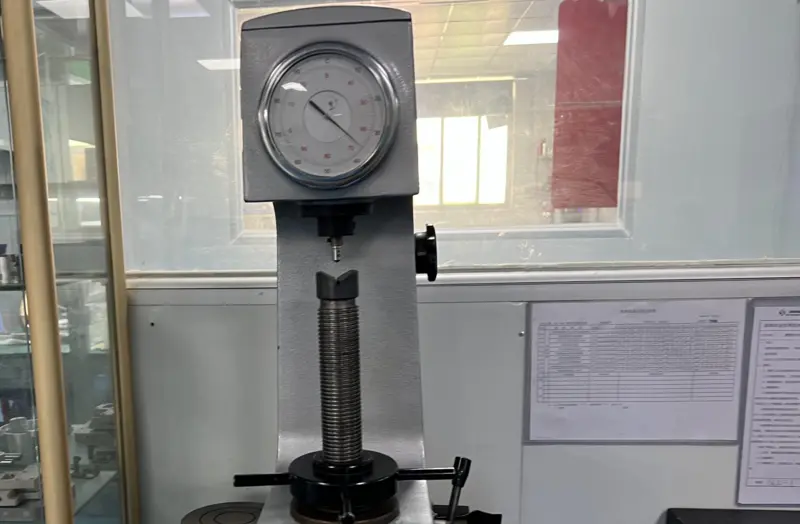
Case hardening and through hardening improve steel performance in different ways. One creates a hard, wear-resistant surface over a tougher core, while the other develops hardness through the part’s effective section. This article compares their processes, properties, materials, and applications.
Case Hardening vs Through Hardening: Quick Comparison
Case hardening and through hardening differ mainly in how hardness is distributed within a steel component. The following comparison shows how each method affects performance, material selection, and typical applications.
Key Differences at a Glance
| Factor | Case Hardening | Through Hardening |
| Hardened area | Surface or controlled case | Most or all of the effective section |
| Hardness profile | Hard surface with a tougher core | Hardness extends deeper through the part |
| Main purpose | Improve wear and contact-fatigue resistance | Increase strength and hardness across the section |
| Typical materials | Low-carbon and case-hardening alloy steels | Medium/high-carbon and hardenable alloy steels |
| Common processes | Carburizing, nitriding, or induction hardening | Austenitizing, quenching, and tempering |
| Typical parts | Gears, pins, cams, and shafts | Bearings, tools, dies, and fasteners |
| Key specification | Surface hardness and case depth | Final hardness and heat-treated condition |
The Main Difference
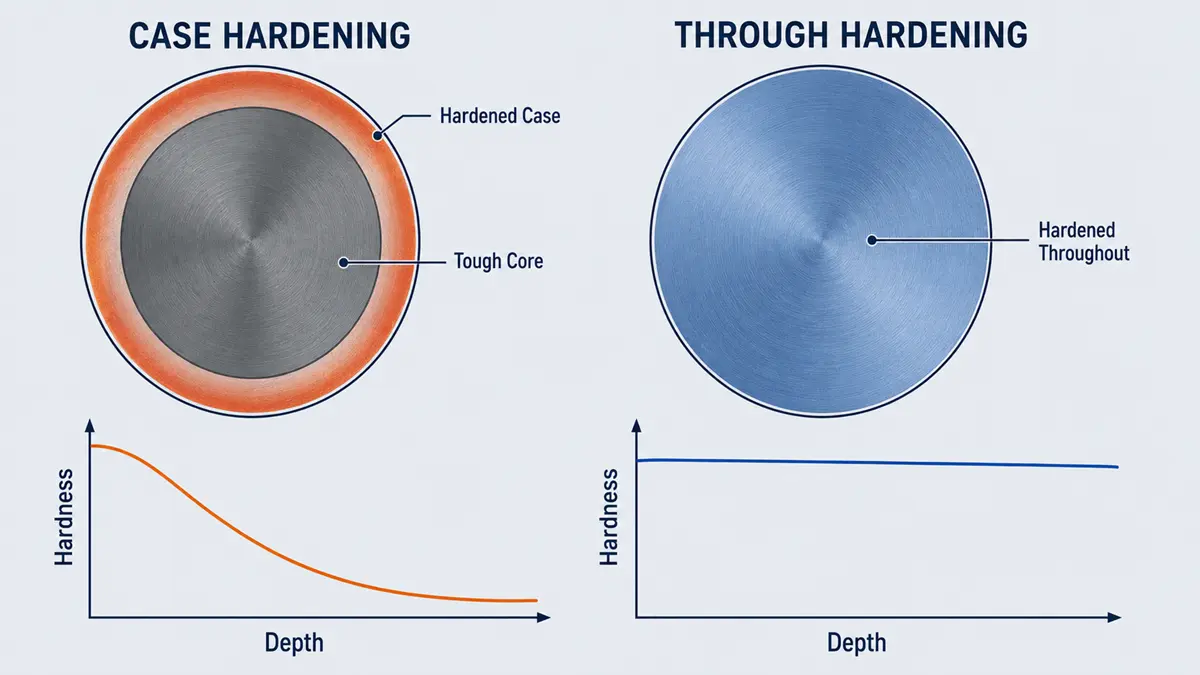
A case-hardened component combines a hard, wear-resistant outer layer with a comparatively tough core. A through-hardened component develops hardness across most or all of its effective section, making it better suited to loads that extend deeper into the part.
Through hardening does not always produce identical surface and core hardness. The final hardness profile depends on the steel’s hardenability, section thickness, and quenching conditions.
What Is Case Hardening?
Case hardening is a surface heat treatment that creates a hard outer layer while retaining a comparatively tough core. It is used when a component requires high surface wear resistance without becoming excessively brittle throughout its section.
How Case Hardening Works
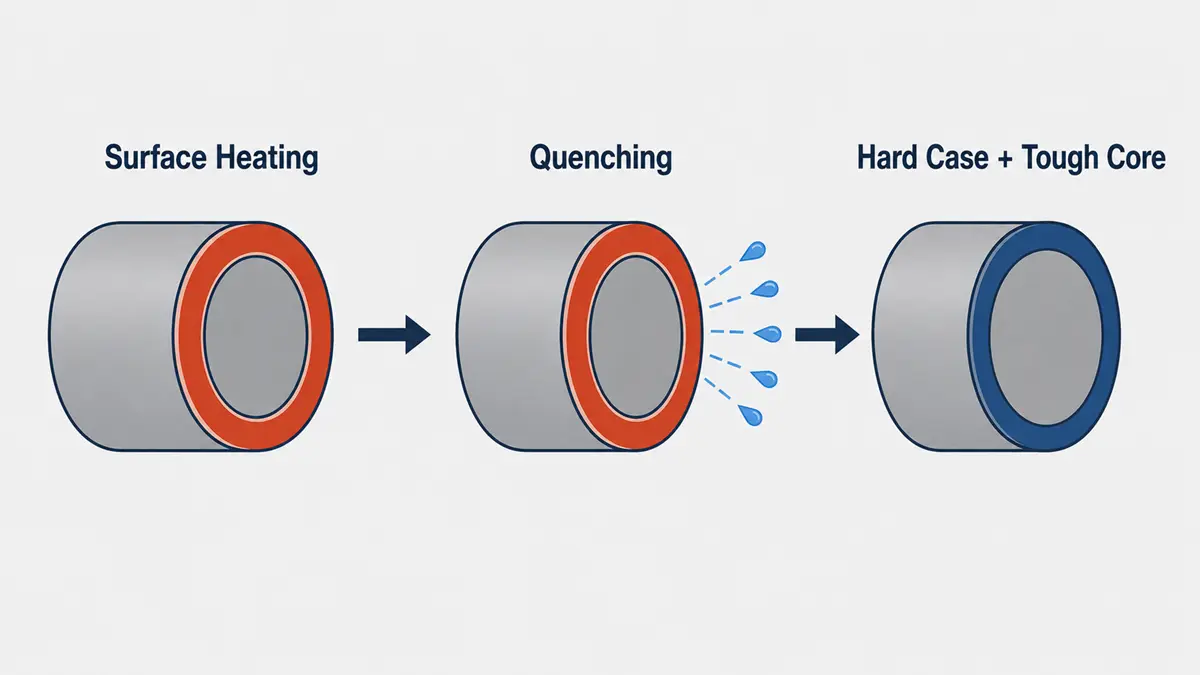
The case hardening process increases hardness at or near the surface rather than uniformly through the part. The hardened case resists friction, scoring, galling, and contact fatigue, while the tougher core supports impact and bending loads. This hardness profile is valuable for gears, pins, cams, and shafts that require both surface durability and structural toughness.
Diffusion Hardening Methods
Diffusion hardening changes the chemical composition of the steel’s surface:
- Carburizing introduces carbon into low-carbon steel before quenching.
- Carbonitriding introduces both carbon and nitrogen and is commonly used to produce a relatively shallow hardened case.
- Nitriding introduces nitrogen to form hard nitrides and generally requires no subsequent quenching.
These methods can produce a controlled case depth, although the achievable depth and hardness depend on the process and steel grade.
Transformation Hardening Methods
Induction and flame hardening rapidly heat a selected surface area before quenching it. This transforms the surface microstructure without normally adding carbon or nitrogen. The steel must therefore contain sufficient carbon to harden effectively.
These methods are useful when only specific areas require hardening or when shorter processing times are preferred. The final result depends on the material, heating depth, cooling rate, component geometry, and target surface hardness.
What Is Through Hardening?
Through hardening is a heat treatment process designed to develop hardness and strength across most or all of a component’s effective section. It is commonly applied to medium-carbon, high-carbon, and alloy steels with sufficient hardenability.
How the Through Hardening Process Works
The process normally involves three stages:
- Austenitizing: The steel is heated into the austenitic temperature range.
- Quenching: The component is cooled rapidly to form a hardened microstructure.
- Tempering: The hardened steel is reheated to reduce brittleness and achieve the required balance of hardness, strength, and toughness.
Unlike case hardening, through hardening does not intentionally preserve a soft core. It is suitable for parts that must resist deformation or carry loads across a larger portion of their section.
The Role of Hardenability
Hardenability describes how deeply a steel can form a hardened microstructure during quenching. It should not be confused with maximum achievable hardness, which is influenced mainly by carbon content.
The final hardness profile also depends on alloy composition, section thickness, part geometry, and cooling rate. A small component may harden through its entire section, while the core of a larger part made from the same steel may remain softer. For this reason, through-hardened steel does not always have identical surface and core hardness. Steels such as 4140 and 4340 are commonly selected when greater hardening depth is required.
Case Hardening vs Through Hardening: Performance Differences
The best hardening method cannot be selected by hardness alone. Surface wear, core strength, impact resistance, and the location of operating stress must also be considered.
Surface Hardness and Wear Resistance
Case hardening can produce a highly wear-resistant surface, making it suitable for rolling contact, sliding friction, scoring, and galling. The wear resistance of through-hardened steel depends on its material, final hardness, and microstructure. However, higher surface hardness does not automatically provide greater overall load capacity because the underlying material and part geometry also affect performance.
Core Strength and Impact Toughness
A case-hardened component usually retains a relatively tough core that can absorb impact and slow crack propagation. Through hardening increases strength and core hardness across the effective section. This supports loads that extend deeper into the part, but excessive hardness or inadequate tempering may reduce impact toughness. Through-hardened steel is therefore not necessarily brittle; its behavior depends on the steel grade, section size, heat treatment, and final hardness.
Contact Fatigue and Bending Fatigue
Case hardening is often used to improve contact-fatigue resistance on gear teeth, bearing raceways, and other repeatedly loaded surfaces. The hard case resists pitting and deformation, while the material beneath it supports the load and helps withstand bending stress.
Through hardening provides mechanical strength across a larger section. Its fatigue performance still depends on microstructure, residual stress, surface finish, geometry, and load type. The final choice should reflect where peak stress occurs and whether the expected failure involves surface contact, bending, impact, or bulk deformation.
Materials for Case and Through Hardening
Material selection depends mainly on carbon content, alloy composition, hardenability, required case depth, and final mechanical properties. Not every steel responds equally well to both methods.
Best Steels for Case Hardening
Low-carbon steels such as AISI 1018 and 1020 are commonly carburized because they are easy to machine before heat treatment and retain a relatively tough core afterward. Alloy steels such as AISI 8620 and 9310 offer better hardenability and core strength, making them suitable for heavily loaded gears, shafts, and pins.
Best Steels for Through Hardening
Through hardening generally requires medium-carbon, high-carbon, or alloy steel with sufficient hardenability. Common choices include:
- AISI 1045 for moderate hardness and strength
- AISI 4140 and 4340 for greater hardening depth and load capacity
- AISI 52100 for high hardness and rolling-contact fatigue resistance
- Tool steels for dies, punches, and cutting tools
Section thickness must still be considered because larger parts are more difficult to harden uniformly.
Can One Steel Use Either Method?
Some medium-carbon and alloy steels can be either through hardened or selectively surface hardened. For example, 1045 and 4140 may be through hardened by conventional quenching or surface hardened by induction or flame treatment.
This choice depends on whether hardness is required only at the working surface or deeper across the section. It also depends on part size, loading, distortion limits, and the required balance between wear resistance and toughness.
Case Depth and Hardness Specifications
Case-hardened parts must be defined by both surface hardness and case depth. A hardness value alone does not show how far the hardened layer extends or whether enough material will remain after finish grinding.
Effective Case Depth vs Total Case Depth
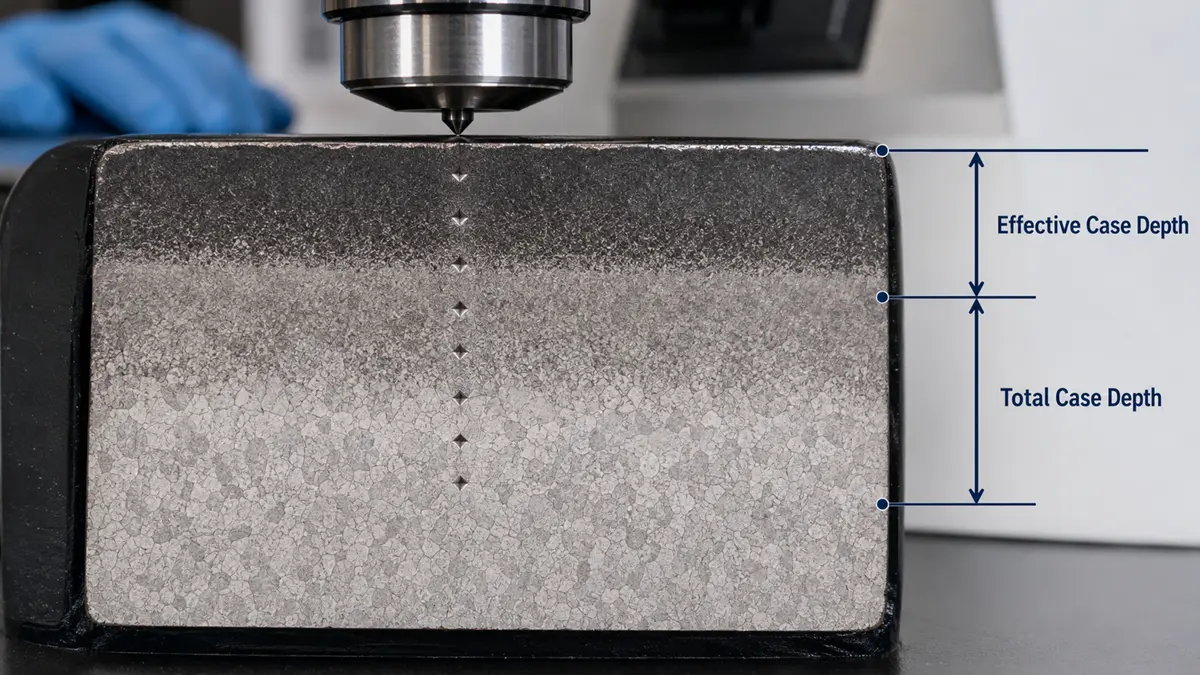
Effective case depth is the distance from the surface to a specified hardness threshold defined by the drawing or applicable standard. The threshold varies with the material and hardening process. Total case depth extends to the point where the hardness or microstructure becomes similar to the core. Because these values are different, the drawing should identify the required depth type and inspection method.
What Does “Case Harden 0.100 Deep (58–60 HRC)” Mean?
A note such as “Case Harden 0.100 Deep (58–60 HRC)” generally requires a surface hardness of 58–60 HRC and a hardened depth of 0.100 inch, or approximately 2.54 mm. However, the note is incomplete unless it defines whether 0.100 inch refers to effective or total case depth. The material, hardening method, test location, and acceptance method should also be confirmed.
Case Depth After Finish Grinding
Grinding removes part of the hardened layer. If case depth is measured before grinding, the finished component may no longer meet the intended requirement. Drawings should therefore state whether case depth applies before or after final grinding.
The machining plan must include sufficient grinding allowance while preserving the specified case depth, surface hardness, dimensional tolerance, and surface finish.
Heat Treatment Distortion and Machining
Heat treatment can change part dimensions, flatness, roundness, and positional accuracy. The manufacturing sequence should therefore account for both expected distortion and the finishing operations required afterward.
Which Method Causes More Distortion?
Neither case hardening nor through hardening always produces less distortion. The result depends on processing temperature, quenching method, material, geometry, and section changes. Carburizing involves prolonged high-temperature exposure followed by quenching, while induction hardening can create local distortion from uneven heating. Nitriding generally causes less dimensional change because it operates at a lower temperature and normally requires no quenching.
Machining Before Heat Treatment
Most rough machining should be completed while the steel remains relatively soft. Critical surfaces can then be left with controlled stock for final grinding or hard turning.
Thin walls, sharp section transitions, deep pockets, and asymmetric geometries are more likely to distort during heating and quenching. Stable fixturing, balanced material removal, suitable radii, and consistent section thickness can reduce this risk.
Machining After Heat Treatment
Heat-treated components may require hard turning, precision grinding, honing, lapping, or EDM to restore critical dimensions and surface finishes. The selected method depends on final hardness, geometry, tolerance, and production volume.
For case-hardened parts, finishing must not remove too much of the hardened layer. Final inspection should verify dimensional accuracy, surface hardness, case depth, and any specified geometric tolerances.
Typical Applications
Applications vary with component size, loading, and service conditions.
Case-Hardened Parts
Case hardening is commonly applied to gears, pinions, cams, shafts, pins, and bearing surfaces. These components need a hard surface to resist sliding or rolling wear while retaining enough internal toughness to carry impact and bending loads. Carburized 8620 gears and induction-hardened shafts are typical examples.
Through-Hardened Parts
Through hardening is used for bearing races, rollers, cutting tools, dies, punches, high-strength fasteners, and wear components. These parts require hardness and strength across a larger portion of the effective section. It is also useful for tools and wear parts that may be reground because newly exposed material must retain adequate hardness.
Gears and Bearings
Gears may be case hardened when high contact stress must be combined with tooth-root toughness. Through-hardened gears can suit moderate loads, smaller sections, or applications where a simpler heat-treatment route is acceptable.
AISI 52100 bearing rings and rollers are commonly through hardened for high hardness and rolling-contact fatigue resistance. Case-hardened bearing steels may be selected for larger components or applications involving shock, misalignment, or heavy loading. The final method should therefore be based on material, component size, stress distribution, and expected failure mode.
When to Use Case Hardening or Through Hardening
Use the following criteria to select the appropriate hardening method.
Choose Case Hardening When
Case hardening is generally preferred when:
- Wear or contact fatigue occurs mainly at the surface.
- The component experiences sliding, rolling, or repeated contact.
- High surface hardness is required with a comparatively tough core.
- The part must withstand impact or bending without becoming hard throughout.
- Only selected surfaces or a controlled case depth require hardening.
Choose Through Hardening When
Through hardening is generally preferred when:
- Strength and hardness are required across the effective section.
- Operating stress extends deeper into the component.
- The part may be reground and must remain hard below the original surface.
- The selected steel has sufficient carbon content and hardenability.
- The design can accommodate the expected quenching distortion and final toughness.
Information Required Before Heat Treatment
Before production, the drawing or purchase specification should define:
- Steel grade and material condition
- Required surface or bulk hardness
- Effective or total case depth
- Areas to be hardened or masked
- Final grinding allowance
- Hardness and case-depth test locations
- Dimensional and geometric tolerances after heat treatment
Clear requirements help prevent incorrect process selection, insufficient case depth, excessive stock removal, and avoidable dimensional variation.
F A Q
Is Case Hardening the Same as Surface Hardening?
The terms overlap. Surface hardening is the broader category, while case hardening generally refers to creating a hard outer layer over a tougher core. Carburizing, carbonitriding, nitriding, induction hardening, and flame hardening can all produce this hardness profile through different mechanisms.
Is Case-Hardened Steel Stronger Than Through-Hardened Steel?
It depends on the requirement. Case-hardened steel provides high surface hardness and a tough core. Through-hardened steel provides strength and hardness across the effective section.
Does Through Hardening Make Steel Brittle?
Not necessarily. Toughness depends on the steel grade, final hardness, quenching conditions, and tempering process.
Can Case-Hardened Steel Be Machined?
Yes. Most machining is completed before hardening. Grinding, hard turning, or EDM may be required after treatment.
Can Through-Hardened Steel Be Machined?
Yes. The method depends on final hardness and tolerance. Hard turning, grinding, or EDM is commonly used after heat treatment.
How Deep Is a Case-Hardened Layer?
Case depth depends on the material, hardening method, treatment conditions, and design requirements. Drawings should specify effective or total case depth.
Conclusion
Successful hardened steel parts require more than selecting a heat-treatment method. Material condition, machining allowance, distortion control, finishing, and inspection must be planned together. Rollyu coordinates CNC machining, heat treatment, precision grinding, and final inspection to help ensure hardened components meet drawing requirements and perform reliably in service.