Choosing between 3+2 machining and simultaneous 5-axis machining can significantly affect manufacturing cost, lead time, and part quality. While both processes use a five-axis CNC machine, they serve different purposes. This guide explains their key differences and helps you select the right machining strategy for your application.
What Is 3+2 Machining?
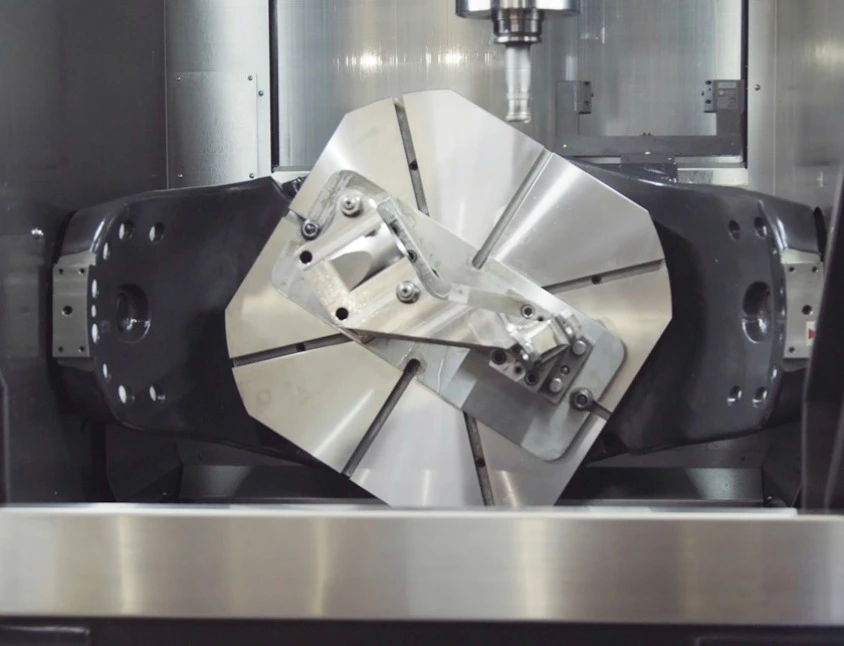
3+2 machining, also known as positional 5-axis machining or indexed 5-axis machining, is a CNC machining method in which the rotary axes position the workpiece at a fixed angle before machining begins. Once the desired osrientation is reached, the rotary axes remain locked while the cutting operation is performed using the three linear axes (X, Y, and Z).
Unlike simultaneous 5-axis machining, where all five axes move continuously during cutting, 3+2 machining separates positioning from machining. This approach allows the tool to access multiple faces of a part without repeated manual setups, while maintaining the stability and simplicity of conventional 3-axis machining.
For many precision components—including housings, brackets, fixtures, and valve bodies—3+2 CNC machining provides an excellent balance of accuracy, efficiency, and manufacturing cost.
How Does 3+2 Machining Work?
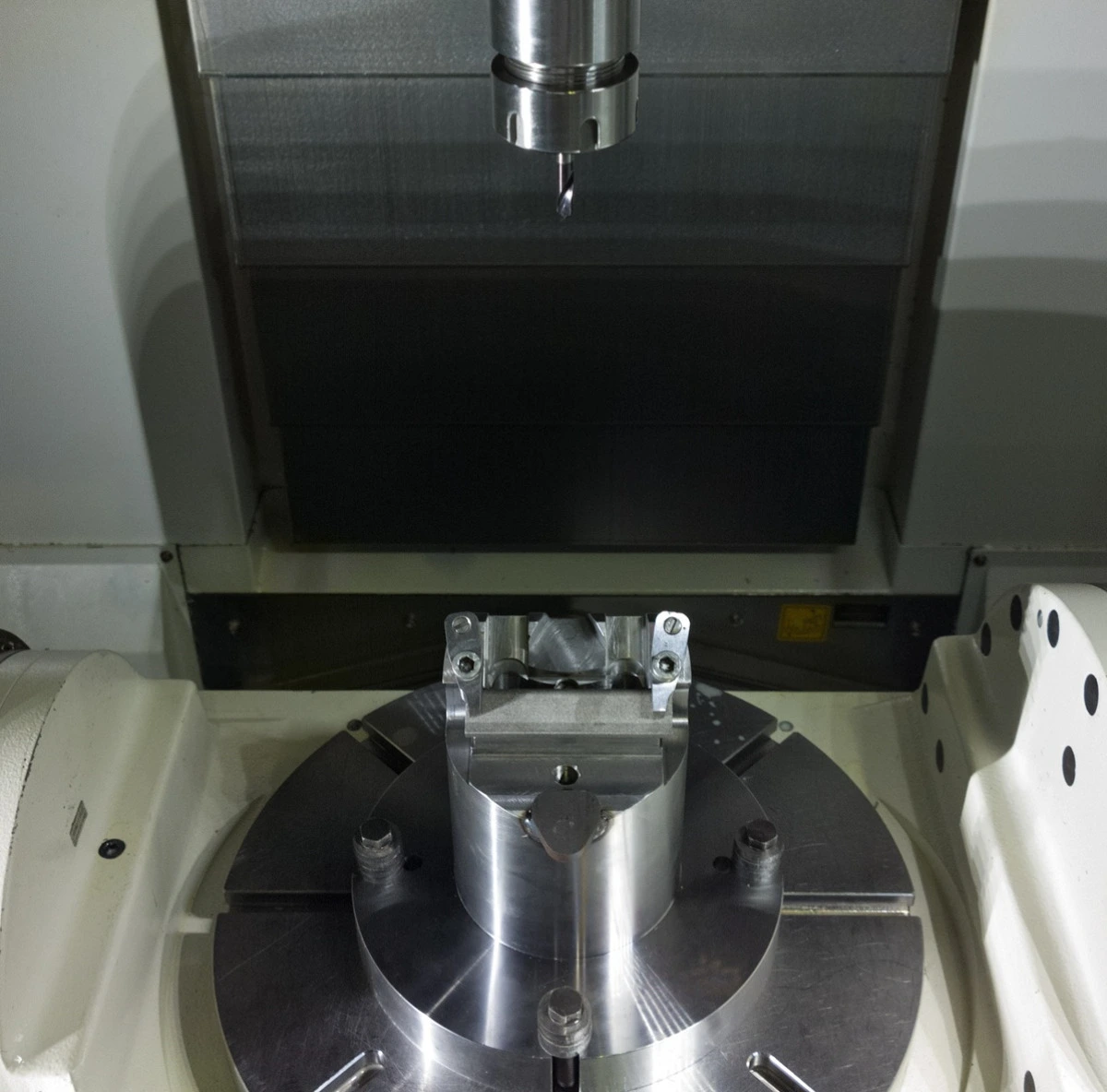
The name “3+2” refers to the combination of three linear axes (X, Y, and Z) and two rotary axes (typically A and B or A and C). Before each machining operation, the machine rotates the workpiece to a predetermined angle using the rotary axes. Once the position is reached, the rotary axes lock in place, and cutting is completed using only the three linear axes.
If additional faces need to be machined, the machine indexes the workpiece to a new orientation and repeats the process. Because the rotary axes are not moving during cutting, the toolpath is simpler to program and the machining process remains highly stable.
This indexed approach eliminates multiple manual setups while providing better tool access than traditional 3-axis machining, making it an efficient solution for parts with features located on several faces.
Advantages of 3+2 Machining
Compared with traditional 3-axis machining, 3+2 machining improves accessibility without significantly increasing programming complexity or machining costs. It is particularly effective for parts that require machining from several fixed angles rather than continuous multi-axis motion.
Key advantages include:
- Fewer setups, improving dimensional consistency and reducing production time
- Better tool access to angled features and difficult-to-reach surfaces
- Higher machining rigidity because the rotary axes remain locked during cutting
- Simpler CAM programming than simultaneous 5-axis machining
- Lower machining costs for many prismatic and multi-face components
- Excellent accuracy for precision parts that do not require continuous tool movement
As a result, 3+2 CNC machining is widely used for precision components in the medical, aerospace, electronics, and industrial equipment industries where multiple machining orientations are required without the complexity of simultaneous 5-axis machining.
What Is Simultaneous 5-Axis Machining?
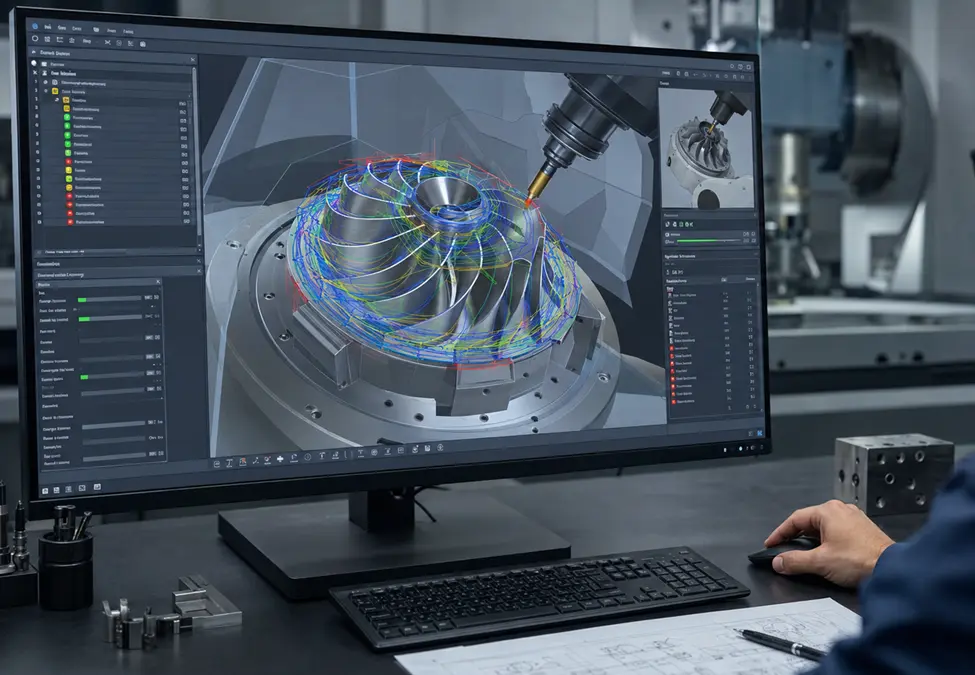
Simultaneous 5-axis machining, also called continuous 5-axis machining, is a CNC process in which all five axes move simultaneously during cutting. The machine continuously adjusts the tool or workpiece angle, allowing the cutter to maintain the optimal machining position throughout the operation.
Unlike 3+2 machining, the rotary axes do not stop before cutting. This enables continuous machining of complex surfaces and difficult-to-reach features in a single setup.
How Does Simultaneous 5-Axis Machining Work?
A simultaneous 5-axis CNC machine combines three linear axes (X, Y, and Z) with two rotary axes. During machining, all five axes move together under a programmed toolpath.
Continuous axis movement allows the cutting tool to follow curved surfaces, maintain consistent tool engagement, and access features that cannot be reached with fixed-angle positioning.
Advantages of Simultaneous 5-Axis Machining
Compared with indexed machining, simultaneous 5-axis machining offers several advantages:
- Machines complex freeform surfaces in one operation
- Produces smoother surface finishes
- Improves access to deep cavities and undercuts
- Reduces multiple setups f or complex parts
- Optimizes tool orientation throughout the cutting process
These advantages make 5-axis CNC machining a preferred solution for aerospace, medical, energy, an d other industries that require high-precision components with complex geometries.
3+2 Machining vs. 5-Axis Machining: Key Differences
| Feature | 3+2 Machining | Simultaneous 5-Axis Machining |
| Axis Movement | Rotary axes index, then lock | All five axes move continuously |
| Part Complexity | Multi-face prismatic parts | Complex freeform geometries |
| Surface Finish | Excellent for flat and angled surfaces | Better for continuous curved surfaces |
| Programming | Simpler CAM programming | More advanced toolpath generation |
| Machining Efficiency | Efficient for indexed features | Efficient for complex continuous cuts |
Machine Movement
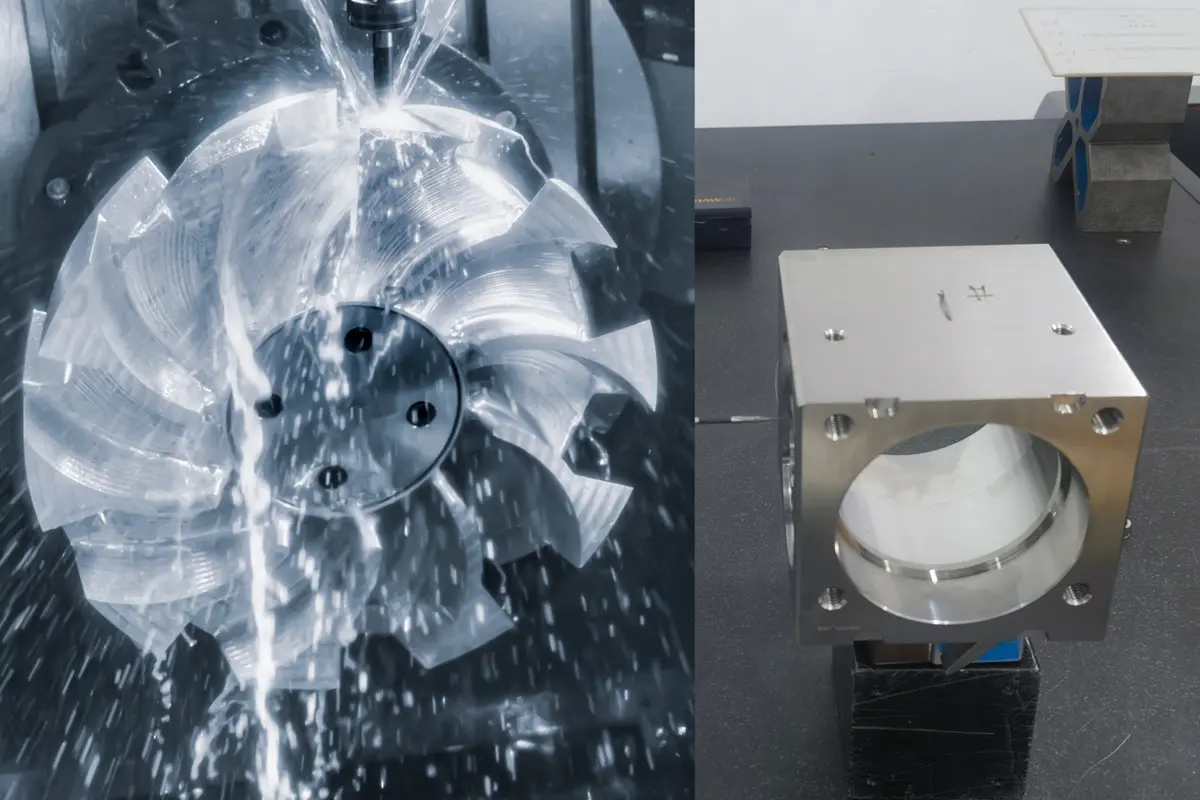
The primary difference is how the rotary axes move. In 3+2 machining, the rotary axes position the part at a fixed angle before cutting begins. During machining, only the three linear axes move.
In simultaneous 5-axis machining, all five axes move together throughout the cutting process. This continuous motion allows the tool to maintain the optimal cutting angle at all times.
Part Complexity
3+2 machining is ideal for parts with features located on multiple faces or fixed angles.
Simultaneous 5-axis machining is better suited for complex geometries, including freeform surfaces, deep cavities, undercuts, and organic shapes that require continuous tool movement.
Accuracy and Surface Finish
Both processes can achieve high machining accuracy when properly programmed.
However, simultaneous 5-axis machining typically produces smoother surface finishes on curved surfaces because the tool maintains a consistent cutting angle. 3+2 machining delivers comparable accuracy on flat and indexed features while using a simpler machining strategy.
Programming and Setup
3+2 machining uses indexed positions, making CAM programming easier and reducing setup complexity.
Simultaneous 5-axis machining requires advanced toolpath calculation, collision avoidance, and machine synchronization, resulting in longer programming times.
Cost and Production Efficiency
For many precision parts, 3+2 machining provides the best balance of cost, accuracy, and efficiency.
When a part requires continuous multi-axis motion, simultaneous 5-axis machining can reduce machining time and eliminate multiple operations, despite its higher programming and machine costs.
When Should You Choose 3+2 Machining?
Choose 3+2 machining when your part requires machining from multiple fixed angles but does not need continuous tool movement. It offers an excellent balance of accuracy, efficiency, and manufacturing cost for many precision components.
Typical applications include:
- Precision housings
- Mounting brackets
- Valve bodies
- Fixtures and jigs
- Electronic enclosures
- Medical device components
For these parts, 3+2 CNC machining reduces setups while maintaining high rigidity and consistent machining accuracy. It is often the most cost-effective solution for low- to medium-complexity components.
Why 3+2 Machining Is Often the Better Choice
Not every part benefits from simultaneous 5-axis machining. If all machining features can be reached through indexed positioning, 3+2 machining can achieve the required precision with simpler programming and lower production costs.
For many industrial, medical, and automation parts, 3+2 machining delivers the required quality without the additional complexity of continuous 5-axis motion.
When Should You Choose Simultaneous 5-Axis Machining?
Choose simultaneous 5-axis machining when your part requires continuous tool movement, complex geometries, or difficult-to-reach features. It is the preferred solution for components that cannot be efficiently machined with indexed positioning.
Typical applications include:
- Impellers
- Turbine blades
- Aerospace components
- Medical implants
- Complex molds and dies
- Precision optical components
For these parts, 5-axis CNC machining improves tool accessibility, reduces multiple setups, and delivers superior surface quality on complex contours.
When Is Continuous 5-Axis Necessary?
If a part contains freeform surfaces, deep cavities, undercuts, or features that require the tool angle to change continuously during cutting, simultaneous 5-axis machining is the better choice.
Although it involves higher programming and machining costs, continuous 5-axis machining provides the flexibility needed for high-precision parts with demanding geometries.
Is 5-Axis Machining Always Better?
No. The best machining strategy depends on the part geometry, tolerance requirements, production volume, and budget—not simply the number of machine axes.
For many precision components, 3+2 machining delivers the same dimensional accuracy as simultaneous 5-axis machining while reducing programming time and manufacturing costs. If all features can be reached through indexed positioning, continuous 5-axis motion often provides little additional value.
Simultaneous 5-axis machining becomes the better choice only when the part requires continuous tool movement, complex freeform surfaces, or features that cannot be machined from fixed orientations.
In practice, selecting the right process is more important than choosing the more advanced machine. Matching the machining strategy to the part design is the most effective way to balance quality, efficiency, and cost.
Typical Parts Comparison
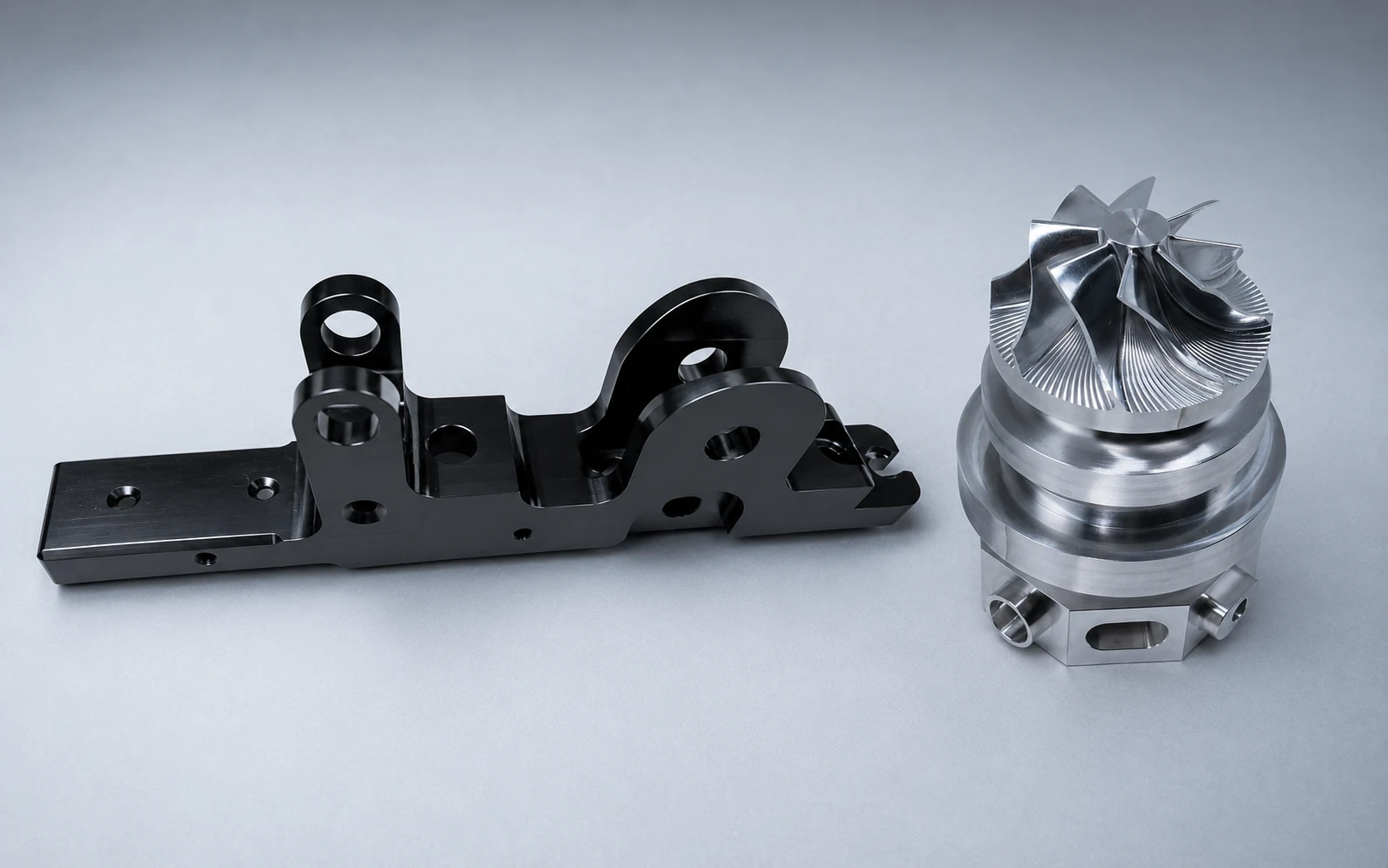
The best machining process depends on the part geometry rather than the machine itself. The table below shows which machining strategy is typically recommended for common precision components.
| Part Type | Recommended Process | Reason |
| Mounting Brackets | 3+2 Machining | Multiple fixed-angle features |
| Precision Housings | 3+2 Machining | Excellent accessibility with indexed positioning |
| Valve Bodies | 3+2 Machining | Multiple machined faces with high rigidity |
| Fixtures & Jigs | 3+2 Machining | High accuracy with lower machining cost |
| Impellers | Simultaneous 5-Axis Machining | Continuous curved blades require synchronized motion |
| Turbine Blades | Simultaneous 5-Axis Machining | Complex freeform surfaces |
| Medical Implants | Simultaneous 5-Axis Machining | Organic geometries and smooth surface requirements |
| Optical Components | Simultaneous 5-Axis Machining | Multi-angle machining with high surface quality |
Choosing the appropriate machining strategy improves manufacturing efficiency while avoiding unnecessary production costs. In many cases, 3+2 machining provides the same functional result as simultaneous 5-axis machining, making it the more economical option for precision parts.
FAQ
What is the difference between 3+2 machining and simultaneous 5-axis machining?
In 3+2 machining, the rotary axes position the workpiece and then remain fixed during cutting. In simultaneous 5-axis machining, all five axes move continuously, allowing the tool to machine complex surfaces in a single operation.
Is 3+2 machining the same as positional 5-axis machining?
Yes. 3+2 machining, indexed 5-axis machining, and positional 5-axis machining refer to the same machining method, where the workpiece is indexed to a fixed angle before cutting begins.
Is 5-axis machining more accurate than 3+2 machining?
Not necessarily. Both processes can achieve high precision. For parts with fixed-angle features, 3+2 machining can provide the same dimensional accuracy while reducing machining costs.
When should I choose 3+2 machining?
Choose 3+2 machining for parts with features on multiple faces that do not require continuous tool movement. It is ideal for brackets, housings, valve bodies, fixtures, and many precision industrial components.
When is simultaneous 5-axis machining necessary?
Use simultaneous 5-axis machining for parts with freeform surfaces, deep cavities, undercuts, or complex geometries that require continuous tool orientation during machining.
Is simultaneous 5-axis machining more expensive?
Generally, yes. Continuous 5-axis machining requires more advanced equipment, CAM programming, and machine time. However, for highly complex parts, it can reduce setups and improve overall manufacturing efficiency.
Conclusion
Choosing between 3+2 and simultaneous 5-axis machining depends on part geometry, tolerance requirements, and production goals. 3+2 machining is ideal for fixed-angle features where accuracy and cost efficiency matter, while simultaneous 5-axis machining is better suited to complex freeform surfaces. At Rollyu, we evaluate each component and select the most suitable machining strategy to achieve reliable quality, efficient production, and cost-effective results.