

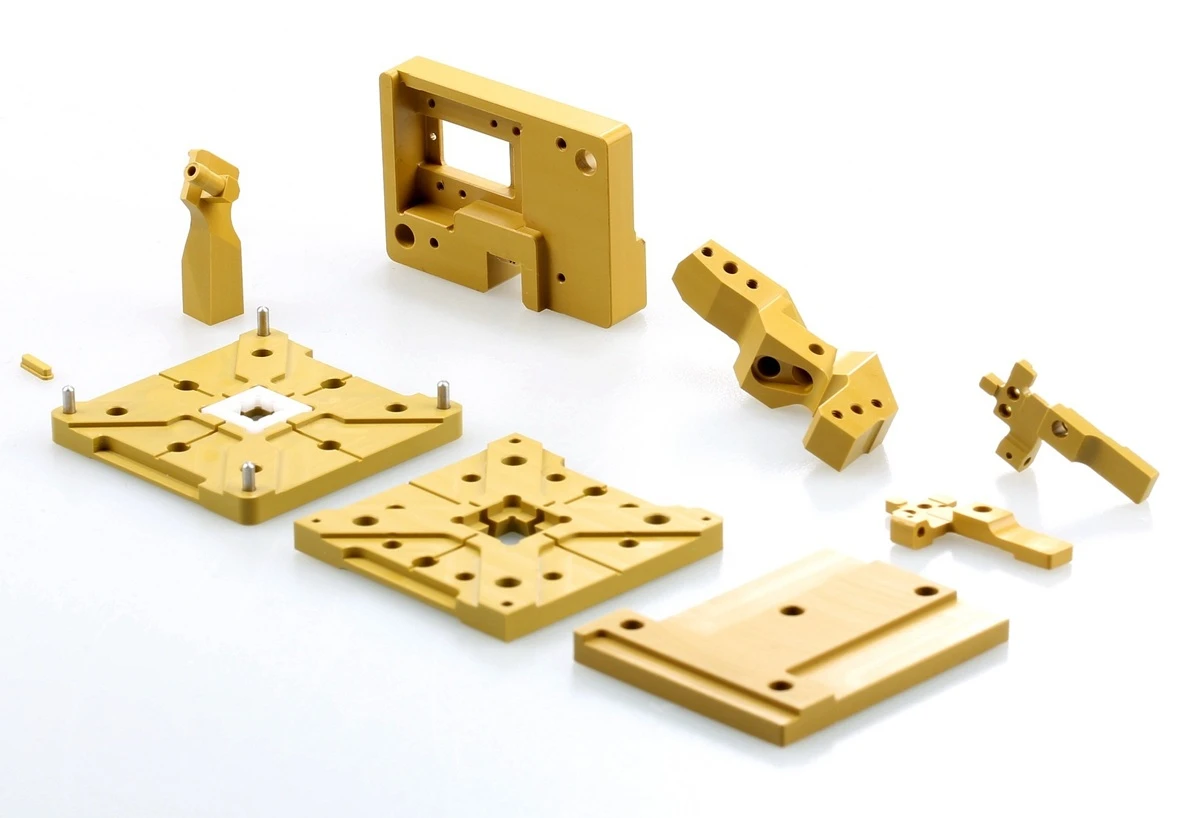
Torlon® machining is a specialized form of high-performance polymer machining. Buyers usually reach this topic with a practical question: can a machine shop produce accurate Torlon PAI parts without creating distortion, burrs, damaged threads, dimensional drift, or avoidable material scrap?
The answer is yes, but Torlon should not be treated like nylon, acetal, or a generic “machinable plastic.” Grade, stock form, reinforcement, moisture condition, machining sequence, tool condition, and final service environment all influence the result. A process that works for an unfilled Torlon 4203 clamp may not be appropriate for a wear-grade Torlon 4301 bushing or a reinforced Torlon 5030 structural component.
This guide focuses on the questions engineers and procurement teams typically ask before sending an RFQ: Torlon machinability, grade selection, cutting tools, starting speeds and feeds, heat and chip control, moisture, post-cure considerations, inspection, and real-world geometry.
What Is Torlon PAI?
Torlon is a trade name for polyamide-imide, commonly abbreviated PAI. It is a high-performance polymer family used when conventional thermoplastics may not provide enough stiffness, creep resistance, temperature capability, wear performance, or electrical performance.
For CNC machining, the important point is that “Torlon” does not describe one identical material. Different grades are designed for different service conditions, and those formulations also change how the material behaves at the cutting edge.
Which Torlon Grade Should You Machine?
| Grade | Type | Machining / Selection Focus | Typical Direction |
| Torlon 4203 / 4203L | Unfilled general-purpose PAI | Toughness, dimensional stability and useful electrical characteristics | Precision clamps, insulators, fixtures and structural parts |
| Torlon 4301 | PTFE/graphite wear grade | Wear and low-friction service; monitor tool condition | Bushings, bearings, wear rings, guides |
| Torlon 5030 | 30% glass-fiber reinforced | High stiffness and creep resistance; more abrasive | High-load structural/electrical parts |
| Torlon 7130 | 30% carbon-fiber reinforced | Very high stiffness; reinforcement increases tool demand | High-stiffness structural and metal-replacement parts |
Torlon 4203 / 4203L
4203 is the unfilled general-purpose grade commonly selected when toughness, dimensional stability, and electrical characteristics are important. The supplied Torlon design information notes that 4203 and 4203L have equivalent properties, while the stock form and manufacturing route may differ. For machined clamps, insulators, fixtures, and precision structural parts, 4203 is often a logical starting point when wear additives or reinforcement are not required.
Torlon 4301
4301 is a wear-resistant grade containing PTFE and graphite. It is designed for applications where friction and wear matter, such as bushings, bearings, wear rings, guides, and other sliding interfaces. From a machining perspective, tool condition deserves extra attention because filled grades can be more demanding on the cutting edge.
Torlon 5030
5030 is a 30% glass-fiber-reinforced grade intended for higher stiffness, strength, creep resistance, and dimensional stability. The glass reinforcement improves structural performance but also makes edge quality and tool wear more important during machining.
Torlon 7130
7130 is a 30% carbon-fiber-reinforced grade with very high stiffness and strong high-temperature stiffness retention. Reinforcement can increase abrasiveness, so tooling, feature fragility, and inspection strategy should be planned for the actual geometry.
Material designation caution: If an RFQ uses another stock-shape designation, including a “5530” designation, do not substitute it automatically. Confirm the exact material manufacturer or stock-shape supplier, certificate, resin designation, and whether substitutions are permitted. A filename or part color is not sufficient material identification.
Why Is Torlon Difficult to Machine?
Tool Wear Can Become a Dimensional Variable
Torlon machining is often discussed as a tooling problem, but the real risk is process drift. The Torlon design guide states that conventional tools wear readily and recommends carbide while strongly favoring diamond-type tooling for production.
For short prototype work, sharp carbide tooling may be practical. For longer production runs, tight-tolerance machining, or abrasive reinforced Torlon grades, polycrystalline diamond (PCD) tooling may provide longer tool life and more consistent dimensional and surface-quality results.
As an edge wears, cutting forces and heat can increase. The visible symptoms may include fuzzing, edge damage, burr formation, a change in surface finish, or gradual dimensional movement. Tool-condition monitoring should therefore be part of the control plan rather than waiting for a cutter to fail completely.
Thin Walls, Slots, and Interacting Features
Many Torlon parts look simple until the machining sequence is considered. Long slots can create flexible arms. Closely spaced holes reduce the remaining section between features. Deep pockets can release material asymmetrically. A bore may be dimensionally correct before a nearby slot is cut but shift after the surrounding stiffness changes.
For these parts, the process should be planned around the final functional geometry. Roughing, stabilization where required, semi-finishing, and final finishing may be more reliable than completing every feature to final size in drawing order.
Heat and Chip Evacuation
Heat generated near the cutting edge has to be controlled, and chips must not be allowed to pack into a slot or drill flute. The manufacturer design guidance recommends spray cooling at the tool and notes that air or vacuum can be used to keep the work area clear.
There is no responsible universal statement that every Torlon part must be dry machined or flood cooled. Coolant strategy should be compatible with the grade, stock condition, cleanliness requirement, machine environment, and final application. For critical polymer components, the shop should also avoid contamination from unsuitable metalworking fluids.
Moisture and Tight Tolerances
Torlon can absorb moisture in humid conditions. The supplied design guide notes that absorption is relatively slow and that drying can allow the material to recover dimensions and properties. This matters when tolerances are tight enough that the measurement condition becomes part of the engineering definition.
For a close-tolerance Torlon part, the drawing review should ask: What is the expected humidity? Will the part be assembled dry or conditioned? At what temperature should inspection take place? Which dimensions are actually functional? Is there a conditioning requirement before final inspection?
Machining a tight number without defining the condition under which that number is verified can create avoidable disputes between supplier and customer.
Does Machined Torlon Need Post-Curing?
Not every machined Torlon part needs the same post-cure or annealing sequence. The decision depends on stock condition, cure state, machining depth, geometry, wear requirements, chemical exposure, and final performance.
The supplied Torlon FAQ notes that fully cured stock has been used successfully for many machined applications without another cure cycle. The manufacturer design guide is more specific for demanding service: it recommends re-curing parts intended for friction, severe wear, or corrosive chemical environments, and strongly recommends re-curing when machining depth in those applications exceeds 1.6 mm.
Molded blanks can also contain internal stress. Symmetrical material removal can help reduce distortion as those stresses are released. For purchasing, the useful question is therefore not “Do you anneal all Torlon?” but “What conditioning and stress-management plan is appropriate for this stock form and this part?”
Recommended Starting Parameters for Torlon Machining
The Torlon design guide provides reference data for turning, milling, and drilling. These values are useful as starting points, not guaranteed production settings.
| Operation | Cutting Speed | Feed | Clearance | Rake / Point | Reference Depth |
| Turning | 90-240 m/min | 0.1-0.6 mm/rev | 5-15° | 7-15° rake | 0.6 mm |
| Milling | 150-240 m/min | 0.2-0.9 mm/rev | 5-15° | 7-15° rake | 0.9 mm |
| Drilling | 90-240 m/min | 0.1-0.4 mm/rev | – | 118° point | Geometry dependent |
Technical caution: these are manufacturer reference ranges. Validate actual parameters for the tool diameter, grade, reinforcement, machine rigidity, wall thickness, cutter geometry, chip evacuation and surface-finish requirement.
Turning Torlon PAI
For turned bushings, sleeves, wear rings, spacers, and threaded adapters, use sharp tools and avoid excessive clamping pressure on thin sections. Concentricity and finished diameter should be checked after the part has stabilized, especially when significant material is removed.
Milling Torlon PAI
Milling commonly combines pockets, precision holes, narrow slots, mounting patterns, and contoured profiles. Multi-sided components benefit from minimizing unnecessary re-clamping and datum transfers. In reinforced grades, watch tool wear and exposed fiber condition at edges.
Drilling and Threading Torlon
Small holes and threads concentrate cutting heat and stress. Use sharp drilling tools, maintain chip evacuation, and inspect the actual thread function rather than relying on appearance alone. Burr removal around narrow slots and threaded holes must be controlled so that deburring does not alter a functional edge.
Real CNC Machining Case: Torlon PAI 4203 Bragg Clamp
A documented example is a Bragg Clamp specified in Torlon PAI 4203 for a photonics or fiber-optic assembly. The supplied drawing identifies the component as “BRAGG CLAMP” and specifies Torlon PAI 4203. Its geometry includes a long narrow relief slot, precision bores, threaded holes, intersecting features, and relatively thin sections.
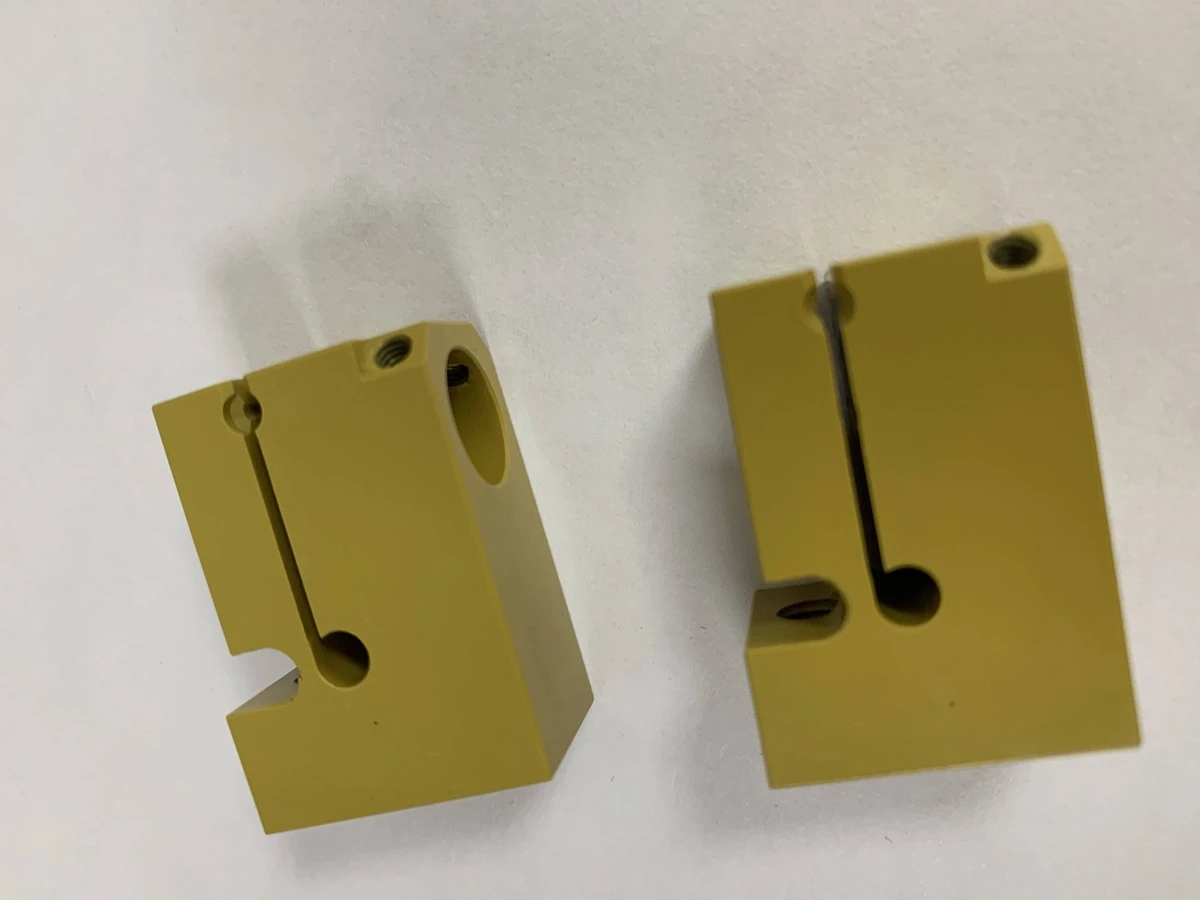
This is a useful example because the machining risks are connected. Cutting the long slot creates two more flexible clamping sections. The large bore, slot, and surrounding wall cannot be treated independently because removing material in one region changes the stiffness of another. Small threaded features add localized machining forces and require clean entry edges.
A suitable process plan for this type of geometry would normally consider rough material removal, stress stabilization where required, controlled finishing of critical bores and the slot, drilling and threading, careful deburring, and final inspection. The inspection focus should include critical bore diameters, slot width and position, thread quality, hole-to-hole relationships, flatness or mating surfaces, and burr-free functional edges.
Applications of Machined Torlon PAI Components
Photonics and Fiber-Optic Hardware
Torlon 4203 can be useful for selected photonics hardware where an assembly needs electrical insulation, mechanical stability, small precision features, and controlled clamping geometry. Examples may include fiber clamps, Bragg-related fixtures, optical test fixtures, sensor positioning components, insulating carriers, and alignment blocks.
For sensitive fiber assemblies, the machining objective is not simply a good surface finish. The clamp geometry must remain repeatable after slots, bores, and threads are completed.
Semiconductor and Electronic Test Equipment
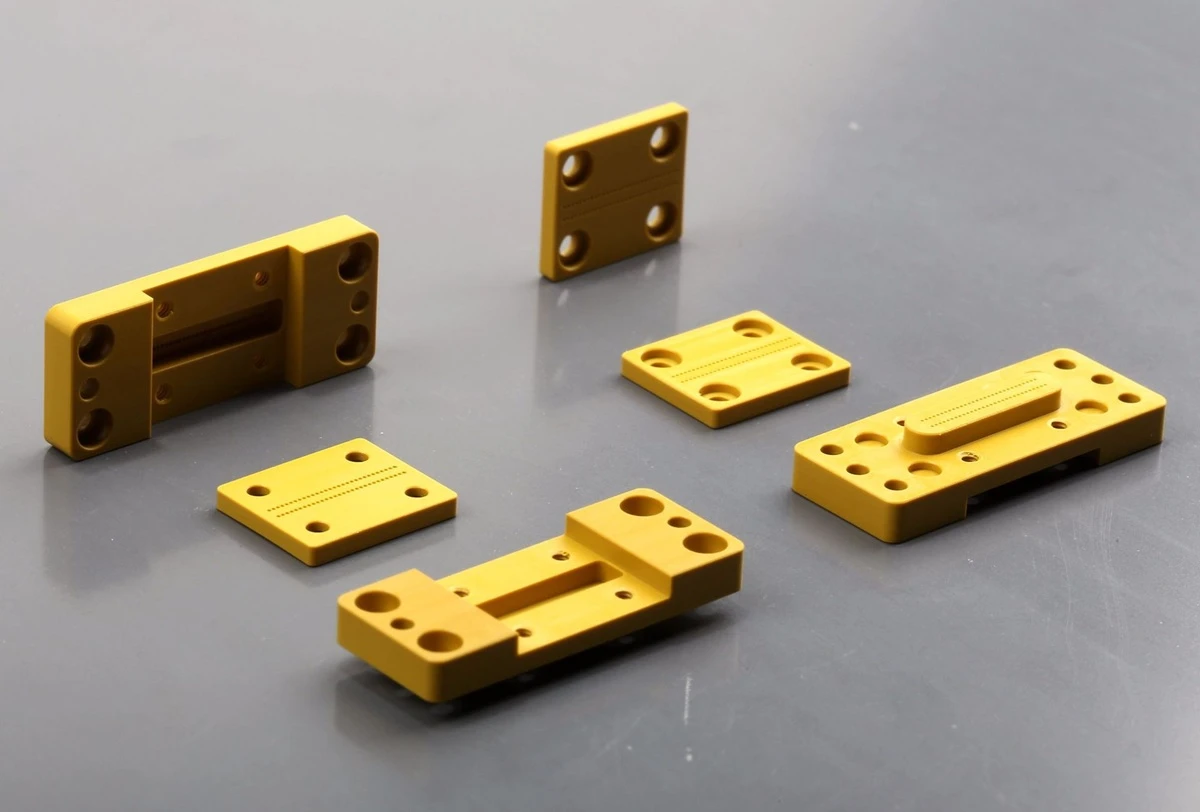
Representative Torlon PAI fixture components often contain mounting holes, counterbores, stepped bores, pockets, long slots, fine feature patterns, and precision mating surfaces. Similar geometries are used in semiconductor equipment, electronic test systems, connector fixtures, precision automation, and high-temperature electrical tooling.
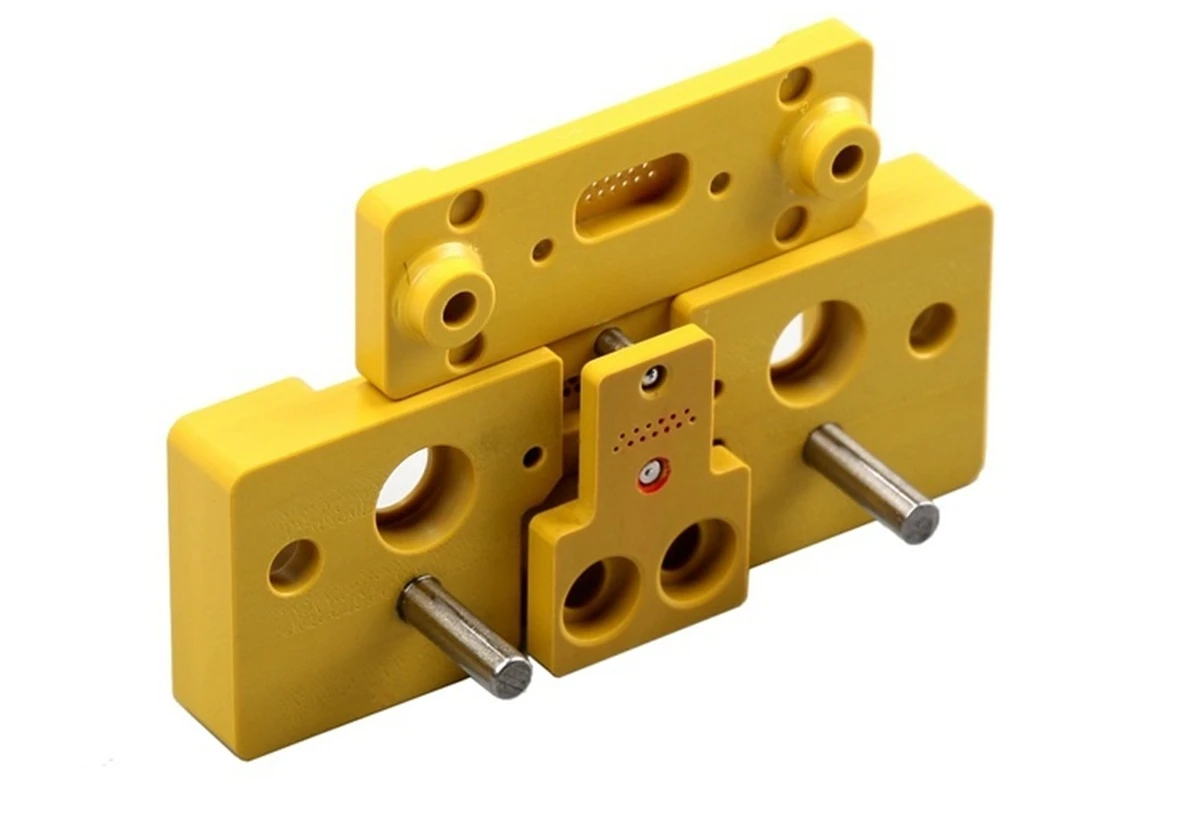
The application claim should remain conservative unless the customer documentation confirms the exact end use. A photograph alone is not enough to label a component a “wafer test socket,” “aircraft part,” or “military part.”
Wear, Motion, and High-Temperature Components
Torlon 4301 and other wear grades are relevant to bearings, bushings, wear rings, guides, and valve or fluid-system components where friction and wear are key design drivers. Reinforced grades such as 5030 and 7130 are more appropriate when stiffness, creep resistance, or dimensional stability under load is the dominant requirement.
How Should Torlon Machined Parts Be Inspected?
A good Torlon inspection plan is based on function, not just a list of drawing dimensions. Depending on the part, inspection may include precision bores, hole position, flatness, slot width, wall thickness, thread gauges, mating surfaces, and overall dimensions.
For moisture-sensitive close-tolerance parts, the measurement condition should also be controlled or at least documented. If the part includes thin sections, the inspection setup should not distort the component while it is being measured.
For a first article or critical prototype, it is useful to identify the dimensions that control assembly before production starts. That allows the machining and inspection plan to focus on the same functional features.
Torlon vs PEEK for CNC Machining
Torlon and PEEK are both high-performance polymers, but neither is universally “better.” Torlon is often chosen when stiffness, creep resistance, wear performance, or high-temperature mechanical capability is the priority. PEEK may be preferred when lower moisture absorption, broader chemical resistance, or specific regulatory requirements matter more.
From a machining perspective, the correct comparison should include the exact grade, stock form, service environment, tolerance, and quantity. Replacing one with the other solely because both are premium engineering plastics is not a sound material-selection method.
DFM Checklist for a Torlon Machining RFQ
- Exact Torlon / PAI grade and approved stock form
- 2D PDF drawing plus 3D STEP model
- Prototype and production quantities
- Critical dimensions, fits and GD&T
- Material certification / traceability requirement
- Operating temperature and humidity
- Fluid or chemical exposure
- Wear, sliding or PV conditions where relevant
- Thread, burr and edge requirements
- Inspection report / FAI requirements
- Any post-cure, conditioning or cleaning requirement
For an expensive high-performance polymer, a short DFM review before material is cut can prevent more cost than trying to recover an unstable machining process after the first parts are already made.
FAQ: Torlon Machining
Is Torlon easy to machine?
Torlon is machinable, but it is more demanding than many conventional plastics. Tool wear, heat, reinforcement, stock condition, internal stress, thin features, and moisture can all affect the final result.
Can Torlon 4203 be CNC machined?
Yes. Torlon 4203 can be milled, turned, drilled, bored, and threaded. The Bragg Clamp case in this article demonstrates a compact 4203 component with a narrow slot, precision bores, threads, and thin interacting sections.
What is Torlon 4301 machinability like?
Torlon 4301 is a filled wear grade containing PTFE and graphite. It can be machined accurately, but tool wear and consistent edge condition deserve particular attention, especially in repeat production.
What tools are recommended for Torlon machining?
The supplied manufacturer guide advises against high-speed-steel tooling, permits carbide, and strongly recommends diamond-type tooling for production economics and tool life. PCD is commonly considered for longer runs, tight-tolerance work, and reinforced grades.
What are the recommended speeds and feeds for Torlon?
Manufacturer reference ranges include 90-240 m/min for turning, 150-240 m/min for milling, and 90-240 m/min for drilling, with operation-specific feed ranges. These are starting references only and must be validated for the actual tool, grade, geometry, and machine.
Does Torlon absorb moisture?
Yes. Torlon can absorb moisture in humid environments. For tight-tolerance parts, conditioning and measurement environment should be considered during drawing review and final inspection.
Do all Torlon parts require annealing or post-cure?
No. The need depends on stock condition and application. Post-cure is especially relevant for severe wear, friction, or corrosive chemical service and should be decided from the material and performance requirements rather than applied as a universal rule.
Can Torlon hold tight tolerances?
Yes, but no single tolerance should be promised for every Torlon part. Achievable tolerances depend on grade, reinforcement, geometry, stock size, wall thickness, moisture condition, machining sequence, and measurement environment.
What industries use machined Torlon components?
Typical application areas include aerospace, semiconductor and electronic test equipment, photonics, industrial wear systems, fluid handling, precision automation, and high-temperature electrical equipment. The exact grade should be selected for the specific service requirement.
What should I send for a Torlon machining quotation?
Send the PDF drawing, STEP model, exact material grade, quantity, critical tolerance information, operating environment, certification requirements, and inspection or conditioning requirements.
Request a Torlon Machining DFM Review
If your project includes Torlon 4203, 4301, 5030, 7130, or another specified PAI grade, send Rollyu Precision your drawing and 3D model for an engineering review.
We can review precision bores, narrow slots, threaded features, thin sections, complex milled geometry, fiber and photonics clamps, positioning components, electronic test fixtures, wear components, and prototype-to-production requirements.
Send your STEP file + PDF drawing + material grade + quantity + critical requirements to request a Torlon machining DFM review and quotation.