According to Chemours, the maker of Teflon, PTFE’s coefficient of friction measures 0.05 to 0.10, among the lowest of any solid. That low friction, plus strong chemical resistance, makes PTFE a common choice for seals and fluid parts. The catch shows up in the shop. PTFE is soft and shifts under tool pressure, so it machines differently from metal.
This guide shows how to machine PTFE well. You will see its properties, why it deforms, and the steps that hold size. It also covers grades, tolerances, common parts, and how to choose a supplier.
What Is PTFE Machining?
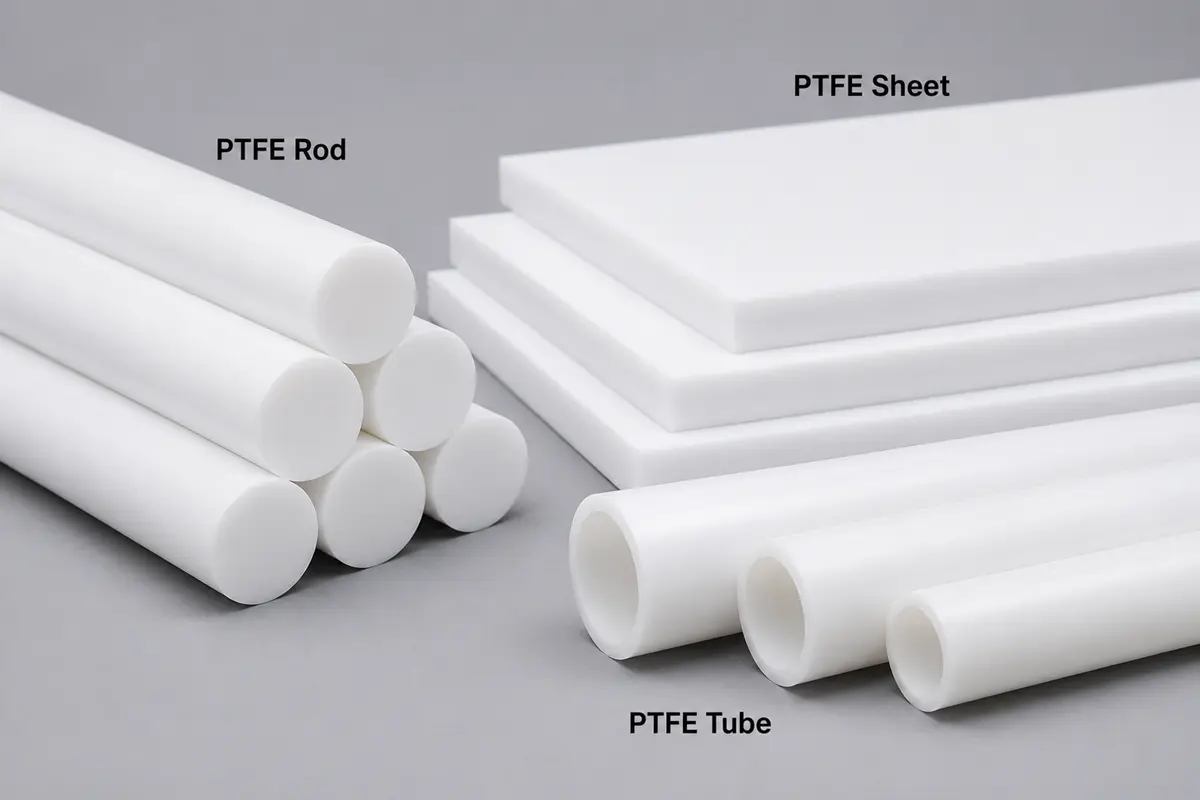
PTFE machining cuts polytetrafluoroethylene into finished parts on CNC mills and lathes. Stock arrives as extruded or molded rod, tube, or plate, then gets turned, milled, drilled, or bored to size. Turning suits round parts like seals, bushings, and valve seats. Milling handles flats, slots, and ports. The soft material cuts fast but resists tight tolerances. For buyers sourcing custom CNC machining parts, PTFE replaces metal where parts corrode, stick, or must not carry current.
What Are PTFE’s Key Properties?
PTFE offers low friction, chemical resistance, a wide temperature range, and electrical insulation.
Low Friction and Non-Stick Surface
PTFE has one of the lowest friction coefficients of any solid. Most substances slide off rather than stick. Low friction makes it a default for seals, bearings, and parts that must release cleanly.
Chemical and Corrosion Resistance
PTFE resists nearly all acids, bases, and solvents. It does not corrode or break down in aggressive fluids. Valves, pumps, and lab equipment use it to survive media that attack metal.
Wide Temperature Range
PTFE stays stable from about -200°C to +260°C. It holds shape and chemistry in cryogenic lines and hot process equipment, where many plastics soften or crack.
Electrical Insulation
PTFE is a strong dielectric, so it blocks current well. Connectors, sensors, and high-voltage standoffs use it for insulation that also takes heat.
Why Is PTFE Hard to Machine?
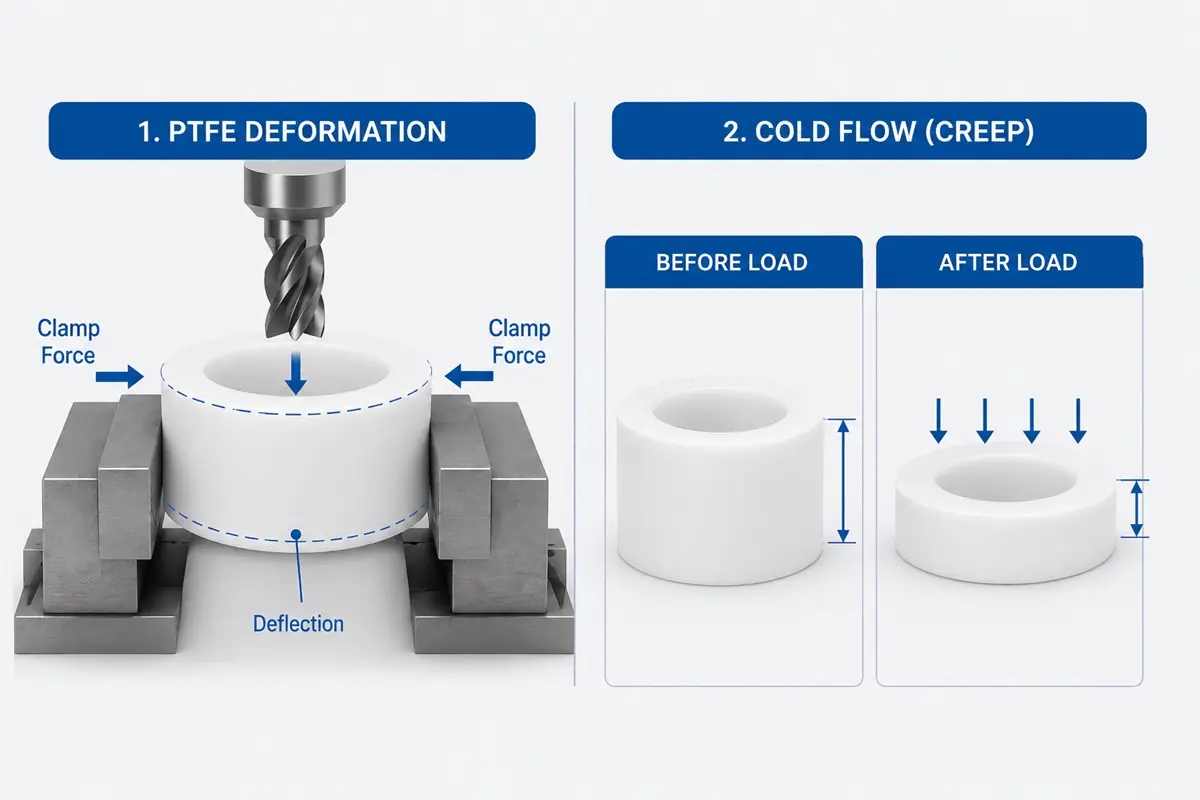
PTFE is hard to machine because it stays soft and deforms under heat and pressure. It cuts easily but holds size poorly.
- Cold flow: PTFE deforms under clamping and tool pressure, then springs back after the cut, which shifts the final size.
- High thermal expansion: PTFE expands and contracts far more than metal as temperature changes, so part size drifts with shop and machine heat.
- Low stiffness: Thin walls and long features flex away from the tool and pick up clamp marks.
- Burrs and stringing: Soft chips smear and leave whiskers on edges and holes, so parts need careful deburring before they ship.
How Do You Machine PTFE Accurately?
You machine PTFE accurately by controlling heat, pressure, and support.
Sharp Tooling and High Rake Angles
Sharp tools with high positive rake slice PTFE instead of pushing it. Dull or low-rake tools smear the surface and raise heat, which feeds cold flow. Many shops keep dedicated plastic tooling to protect edge sharpness.
Light Cuts and Steady Feeds
Light cuts with a steady feed keep heat down and reduce deflection. Steady chip flow limits stringing, and air or coolant carries heat from the cut zone.
Full Support and Stress Relief
Soft jaws and full backing stop thin PTFE parts from flexing under the tool. For tight work, shops rough the part, let it rest, then finish, so internal stress settles before the final cut.
Which PTFE Grades Are Best for Machined Parts?
Virgin PTFE suits most fluid and chemical parts, while filled grades handle load, wear, and tighter tolerances. The filler you pick also changes how the material machines.
Virgin PTFE
Virgin PTFE is unfilled and the purest grade. It carries strong chemical resistance and a clean surface for food, medical, and fluid-contact parts. The trade-off is softness, with more creep and looser tolerances.
Glass-Filled PTFE
Glass fillers cut creep and improve wear and dimensional stability. This grade holds size better under load, though the glass is abrasive and wears tooling faster.
Carbon- and Bronze-Filled PTFE
Carbon adds wear resistance and some conductivity, while bronze adds load capacity and heat transfer for bearings. Both machine more like a stiff composite than soft virgin stock.
When a part needs tighter tolerances than PTFE allows, a stiffer plastic usually fits better. The acetal vs. Delrin comparison weighs two common picks.
What Tolerances Can Machined PTFE Hold?
Machined PTFE typically holds ±0.05 mm (±0.002 in), looser than metal. Its soft structure and high thermal expansion make tighter control hard, especially on large or thin parts. Filled grades and small, stable features can do better, though virgin PTFE rarely matches metal precision.
Tie each tolerance to a function. A seal groove or sliding fit may need tight control in one spot, while the rest of the part runs open. Measure PTFE in a temperature-controlled room, since a warm part reads larger and can fail inspection once it cools. Realistic callouts keep cost down and prevent scrapped parts.
Where Are Machined PTFE Parts Used?
Machined PTFE parts appear wherever low friction, chemical resistance, or electrical isolation matters.
Seals, Gaskets, and Valve Seats
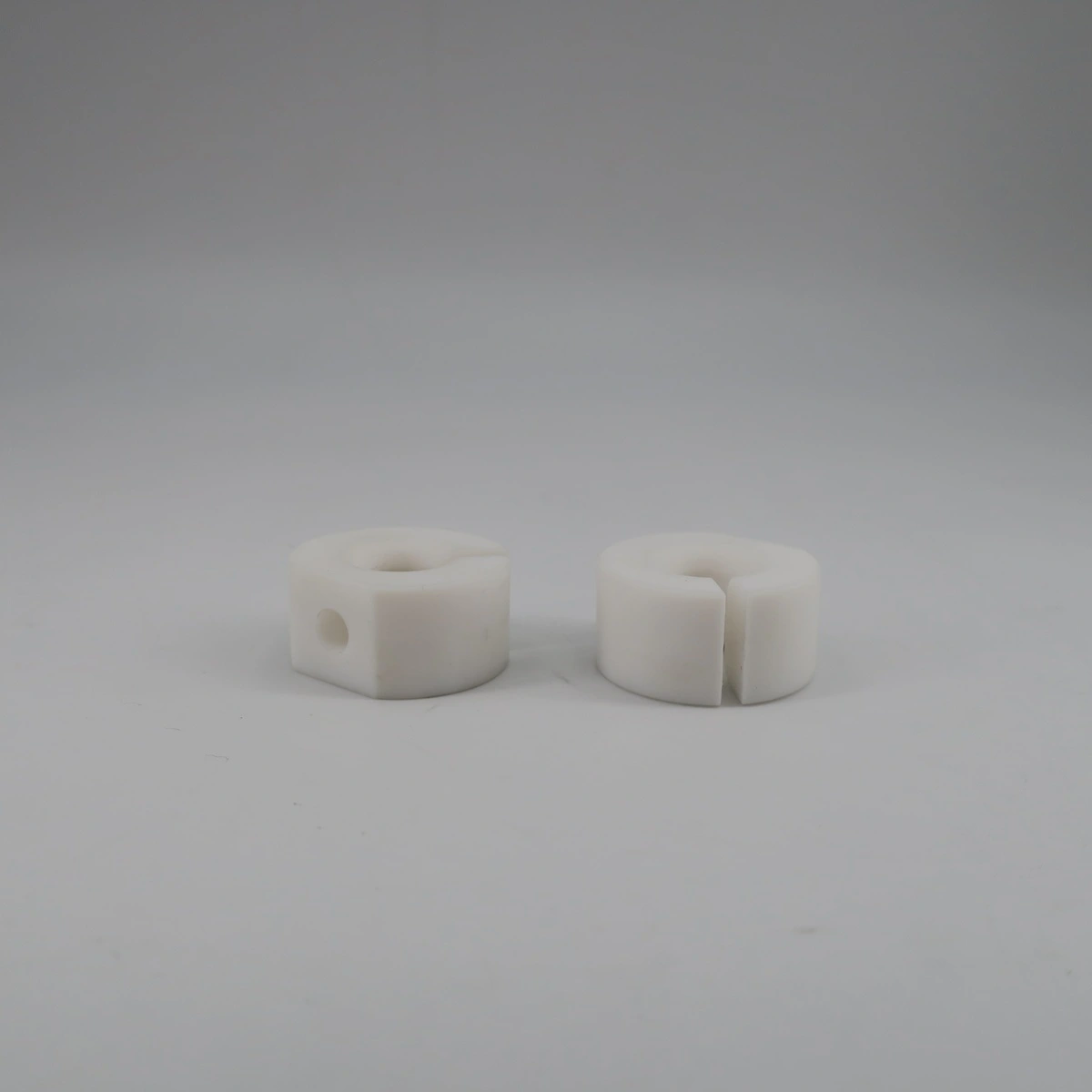
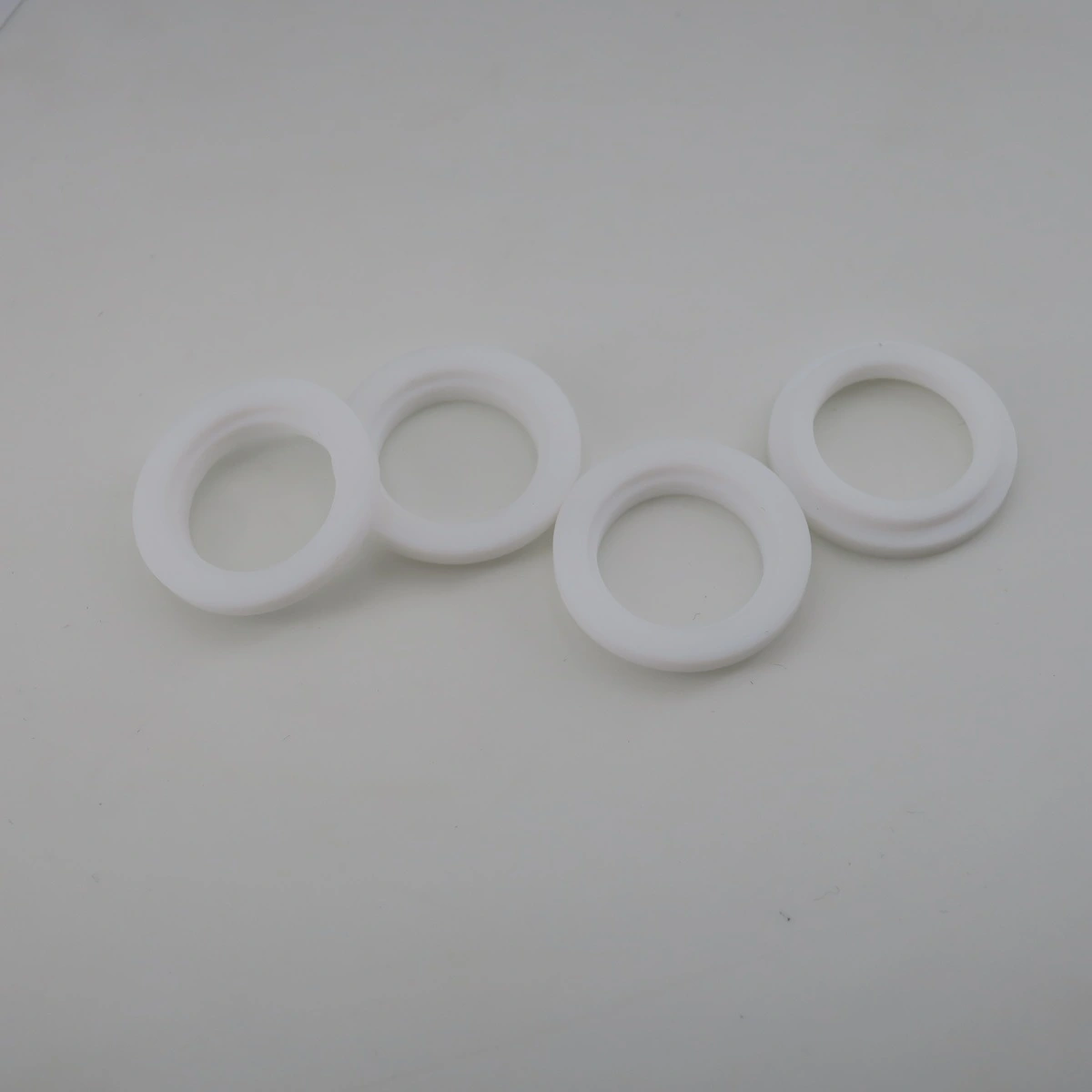
PTFE seals, gaskets, and valve seats hold up against aggressive fluids in medical devices, life sciences instruments, and semiconductor equipment. The non-stick surface helps them release and resist sticking over long service.
Fluid Handling and Microfluidic Components
PTFE suits manifolds, fittings, and microfluidic blocks that route reactive or high-purity fluids. These life sciences fluid handling components rely on its inert surface to avoid contamination.
Electrical and Thermal Insulators
PTFE insulators and standoffs block current and tolerate heat in semiconductor tooling, sensors, and power generation equipment. The wide temperature range keeps them stable near hot parts.
Wear Parts and Bushings
Filled PTFE makes low-friction bushings, slides, and wear pads for robotics and automation systems. Glass or bronze fillers add the load capacity that motion parts need.
How Do You Choose a PTFE Machining Supplier?
Choose a PTFE machining supplier on plastics experience, not metal capability alone. A shop that treats PTFE like aluminum drives up both scrap and cost.
Plastics-Aware DFM and Tolerancing
A strong supplier reviews your drawing for realistic plastic tolerances and flags features that cold flow will distort. This DFM step prevents tight callouts that PTFE cannot hold.
Material Traceability and Certifications
Ask for grade traceability and certificates for food-grade or medical work. Documented stock confirms you receive the PTFE the application needs.
Deburring and Cleaning Capability
PTFE needs proper deburring and often ultrasonic cleaning for particle-free parts. Confirm the shop can remove whiskers without scarring the surface.
Inspection and Dimensional Control
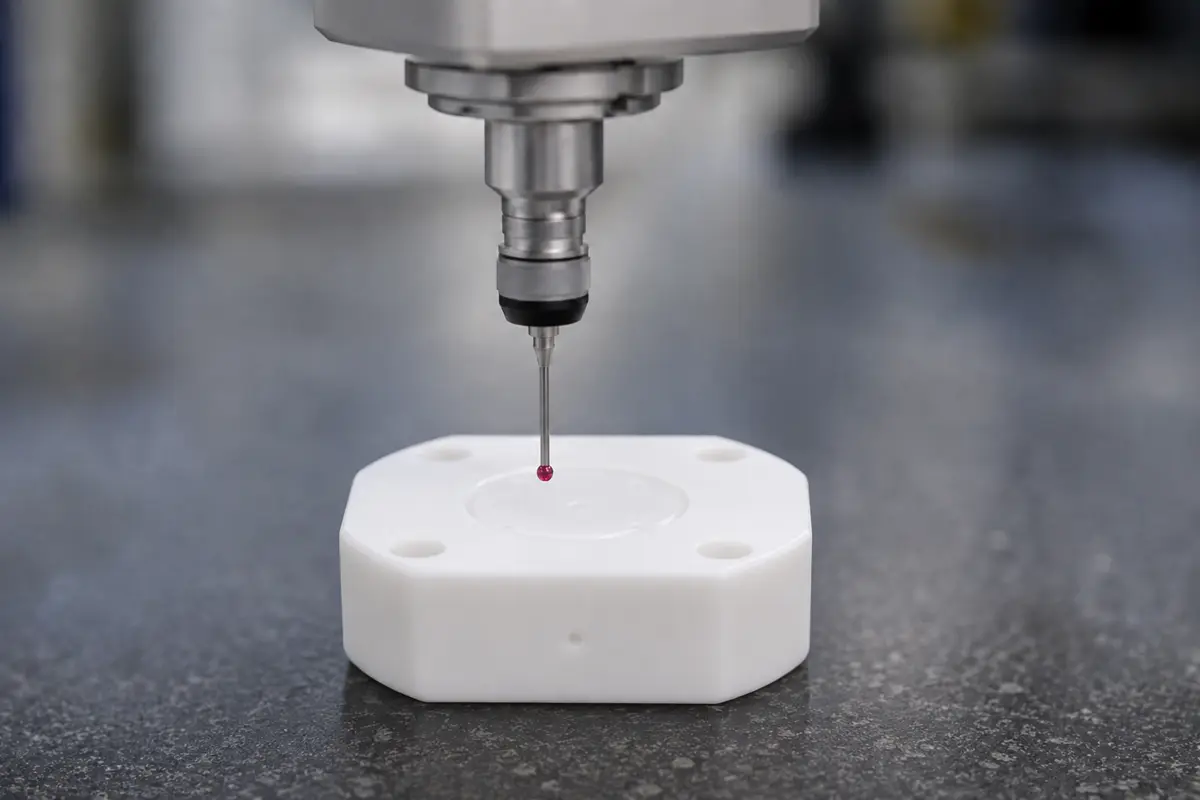
Temperature-controlled measurement and CMM checks verify that soft parts meet size. Inspection records give buyers proof before parts reach assembly.
For buyers comparing partners, Rollyu Precision pairs CNC machining with plastics-aware DFM review, ultrasonic cleaning, and material traceability under ISO 9001 and ISO 13485 certified systems, a useful benchmark for supplier control.
FAQ
Is PTFE the Same as Teflon?
Yes, in everyday use they mean the same material. PTFE is the polymer name, and Teflon is a brand owned by Chemours. You can specify PTFE on a drawing without naming a brand.
Is Machined PTFE FDA Compliant for Food or Medical Parts?
It can be, when you specify a food-grade or medical-grade virgin PTFE with documentation. Compliance depends on the resin and its certificates, not on machining alone. Ask the supplier for material certs that match your application.
Should I Choose PTFE or PEEK for a Machined Part?
Choose PTFE for the lowest friction, strongest chemical resistance, and electrical isolation. Choose PEEK when the part needs higher strength, stiffness, and tighter tolerances at higher temperatures. PEEK costs more but holds size far better.
How Much Does PTFE Machining Cost?
Cost depends on the grade, part size, tolerance, finishing, and volume. Virgin PTFE stock is moderate, while filled and certified grades cost more. Tight tolerances raise cost, since soft material needs slower cuts and more inspection.
Can Machined PTFE Parts Be Bonded or Welded?
Not easily, because the non-stick surface resists most adhesives. Bonding usually needs surface etching or plasma treatment first. Where possible, designers use mechanical fits or fasteners instead of glue.