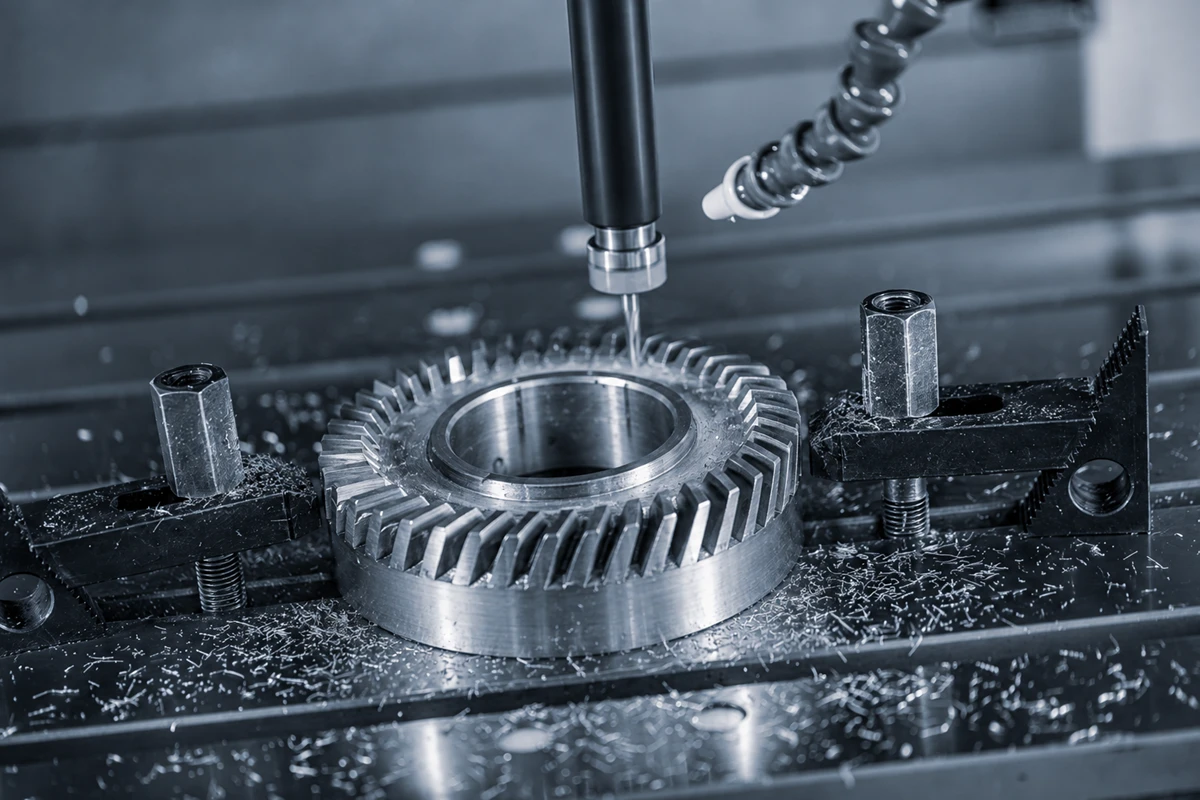
Machining 440C stainless steel is not simply a matter of reducing cutting speed and using stronger tools. For precision parts, the critical decision is the complete process route: material condition, rough machining, heat treatment, finishing, grinding or EDM, and final inspection.
440C is a high-carbon martensitic stainless steel, commonly identified as UNS S44004. Carpenter Technology lists approximately 0.95–1.20% carbon and 16–18% chromium and describes the alloy as a stainless bearing steel capable of reaching approximately Rockwell C 60 after heat treatment.
That combination gives 440C its main advantage—very high hardness and wear resistance—but also makes it considerably more demanding to machine than common stainless grades such as 303, 304, or 316.
For engineers and buyers, the practical question is therefore not simply, “Can 440C be machined?” It can. The better question is:
How should a 440C part be machined so hardness, dimensions, surface finish, and manufacturing cost remain controlled after heat treatment?
At Rollyu Precision, we treat 440C as a material-and-process problem, rather than a generic stainless-steel machining job. The drawing and CAD model should be reviewed first to identify wear surfaces, critical fits, heat-treatment requirements, thin sections, functional sharp edges, and features that may require grinding or EDM after hardening. The source machining plan similarly emphasizes machining most material before heat treatment and reserving final precision work for the hardened condition.
Quick Answer: What Is the Best Way to Machine 440C Stainless Steel?
For most tight-tolerance 440C precision machined parts, a controllable manufacturing route is:
- Start with annealed 440C whenever the material specification permits.
- Rough-machine most of the geometry before hardening.
- Leave controlled stock on bearing fits, sealing surfaces, precision bores, and other critical dimensions.
- Stress-relieve complex or asymmetric parts when distortion risk is significant.
- Heat-treat the component to the specified hardness.
- Finish critical features with hard turning, grinding, reaming, Wire EDM, sinker EDM, or precision milling as appropriate.
- Clean or passivate the component when required.
- Perform final dimensional, hardness, and surface-finish inspection.
This sequence reduces unnecessary cutting-tool wear while giving the machining team an opportunity to correct dimensional movement caused by heat treatment.
What Is 440C Stainless Steel?
440C has the highest carbon content of the commonly used 440A, 440B, and 440C family. Its chemistry enables significantly higher hardenability and wear resistance than the lower-carbon versions.
| Property | 440C Engineering Relevance | |||
| Stainless steel type | High-carbon martensitic stainless steel | |||
| UNS designation | S44004 | |||
| Carbon | Approx. 0.95–1.20% | |||
| Chromium | Approx. 16–18% | |||
| Typical hardened condition | Approx. 58–62 HRC depending on heat treatment | |||
| Key strengths | High hardness, wear resistance, edge retention | |||
| Main machining risks | Tool wear, work hardening, cutting heat, distortion | |||
| Typical precision applications | Bearings, valve parts, wear components, gripping parts, precision mechanisms | |||
| PDF DATA SHEET |
440C Stainless Steel Technical Data Sheet Download the 4SS 440C – Data Sheet40C Stainless Steel Data Sheet (PDF, 2 pages) Includes UNS S44004 / EN 1.4125 / ASTM A276 specifications, chemical composition, typical hardness, heat-treatment guidance, machinability, grinding and weldability. Technical reference: Rolled Alloys, 440C Stainless Data Sheet. |
|||
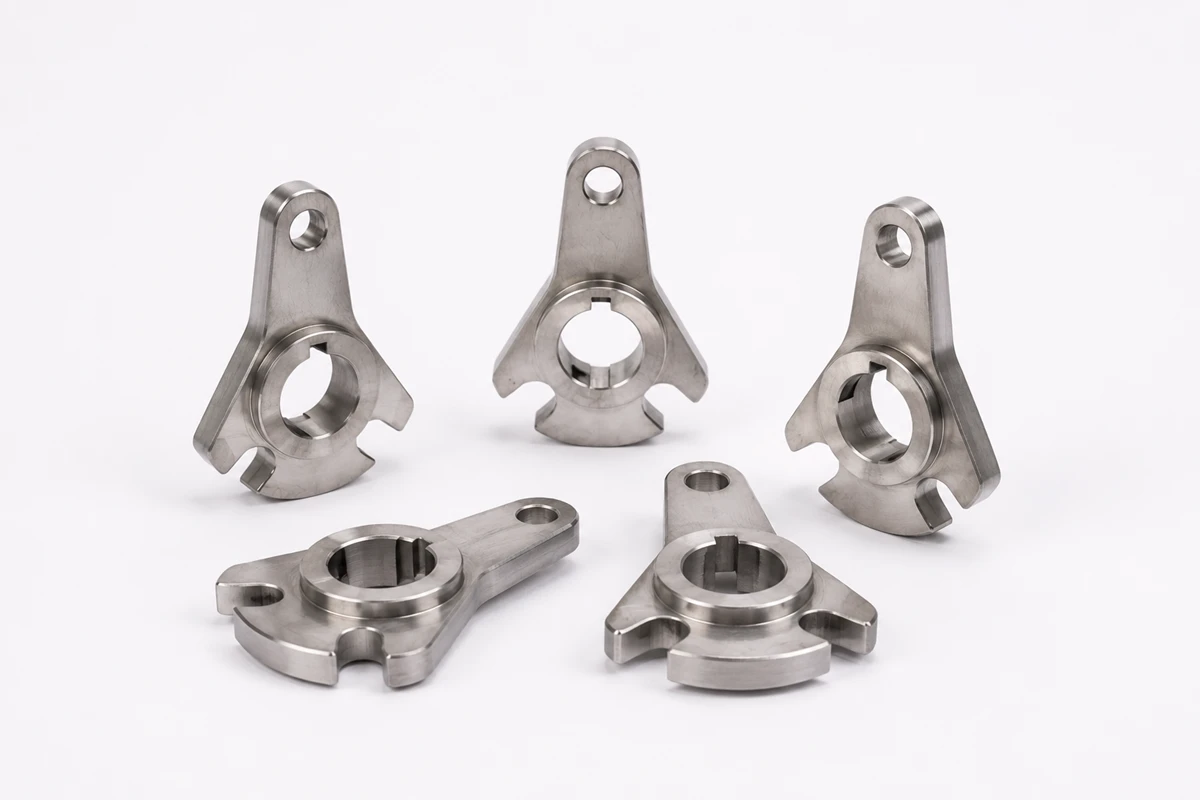
Carpenter Technology identifies bearing assemblies, bearing races, needle valves, valve seats, pump parts, bushings and other wear-resistant components among established 440C applications.
440C is therefore especially attractive where a component experiences repeated sliding, rolling, gripping, clamping, cutting, or abrasive contact.
However, engineers should not automatically replace 316L with 440C. 440C is normally selected because hardness and wear resistance matter more than maximum corrosion resistance. For chloride-rich, aggressive chemical, or demanding hygienic environments, another stainless grade may be more appropriate.
Why Is Machining 440C Stainless Steel Difficult?
Work Hardening
One of the most common causes of unstable 440C machining is allowing the cutting edge to rub instead of cut.
Dull tools, insufficient feed, repeated spring passes, or poor tool engagement can locally harden the workpiece surface. The next tool pass then encounters an increasingly difficult cutting zone, increasing cutting force, temperature, and tool wear.
Rollyu’s source machining notes therefore emphasize sharp cutting edges, positive cutting action, consistent feed, and avoiding repeated passes over work-hardened surfaces.
Abrasive Tool Wear
The chromium-rich carbide structure responsible for 440C’s wear resistance also works against the cutting tool.
As tool wear progresses, a production problem can quickly become a dimensional problem. Diameter, roundness, corner quality, bore size, tooth form, and surface finish may begin drifting even though the CNC program itself has not changed.
For repeat production, tool-life management should therefore form part of the control plan. Tool replacement should occur before critical dimensions leave tolerance, rather than after a visibly failed cutting edge is discovered.
Cutting Heat
Heat generated during machining concentrates heavily around the cutting zone.
High temperature accelerates coating breakdown and edge wear and can affect dimensional stability. Stable coolant delivery, effective chip evacuation, rigid workholding, and controlled engagement are therefore more important than simply increasing spindle speed.
Heat-Treatment Distortion
For many 440C parts, machining is only one stage of the process.
Quenching and tempering can produce dimensional changes, especially in components containing thin arms, interrupted sections, narrow slots, uneven wall thickness, or asymmetric geometry.
Rollyu’s source process notes recommend leaving finishing stock on critical features and, for demanding geometries, considering stress relief after heavy roughing.
Annealed vs. Hardened 440C Machining
How difficult is 440C stainless steel to machine?
The answer depends heavily on its material condition.
| Aspect | Annealed 440C | Hardened 440C |
| Typical purpose | Roughing and general feature creation | Final tolerance and wear-surface finishing |
| Relative difficulty | Moderate | High |
| Preferred tooling | Coated carbide | CBN, ceramic, grinding wheels, specialty carbide |
| Cutting strategy | Positive cutting and stable chip load | Light controlled cuts, high rigidity, low vibration |
| Main risks | Work hardening, chip control, tool wear | Rapid tool wear, chatter, brittle edge damage |
| Suitable processes | Turning, milling, drilling, slotting | Hard turning, grinding, Wire EDM, sinker EDM |
The source manufacturing guide identifies annealed 440C at roughly 20–25 HRC as the preferred state for substantial stock removal, while fully hardened material may reach approximately 58–62 HRC and require hard-machining methods.
For most precision components, removing most stock before hardening is therefore more economical than attempting to machine the entire component after heat treatment.
Practical Cutting Parameters for 440C Stainless Steel
There is no universal 440C stainless steel cutting speed.
Tool manufacturer recommendations, actual material hardness, machine rigidity, coolant delivery, cutting engagement, cutter diameter, and part geometry should determine the final setup.
The following values from the supplied 440C machining notes can be used as process-development starting points, rather than guaranteed production settings.
| Operation | Tool | Starting Cutting Speed | Starting Feed | Depth / Note |
| Turning – annealed | Carbide | 150–200 m/min | 0.10–0.20 mm/rev | 0.50–1.50 mm |
| Turning – hardened | CBN / ceramic | 80–120 m/min | 0.05–0.12 mm/rev | 0.20–0.50 mm |
| Milling – annealed | AlTiN-coated carbide | 100–150 m/min | 0.05–0.10 mm/tooth | 0.50–1.00 mm |
| Drilling – annealed | Carbide | 40–60 m/min | 0.05–0.08 mm/rev | Strong coolant and chip evacuation |
These values should be reduced for unstable workholding, deep holes, thin walls, interrupted cuts, long tool overhang, or harder-than-expected material.
Production optimization should be based on tool wear, spindle load, chip form, surface finish, and dimensional trend—not cutting speed alone.
Tooling for Annealed and Hardened 440C
TiAlN- or AlTiN-coated carbide is a practical choice for many annealed turning and milling operations. The supplied technical guide recommends coated carbide for the annealed stage and CBN or grinding for hardened finishing.
For hardened rotational geometry, CBN or ceramic inserts may be suitable for selected diameters, shoulders, bearing seats, or other cylindrical features.
However, hard turning places much greater emphasis on machine rigidity, runout, workholding, tool overhang, and vibration control.
Grinding Hardened 440C
Grinding is often the safer choice for hardened:
- Bearing seats;
- Precision bores;
- Sealing surfaces;
- Parallel faces;
- Guide surfaces;
- Tight-tolerance diameters.
Grinding allows small amounts of material to be removed after heat treatment while maintaining tight dimensional control.
Wire EDM and Sinker EDM
Wire EDM is particularly useful for hardened 440C parts containing narrow slots, sharp profiles, internal corners, precision outlines, and other complex through-features.
Because Wire EDM does not impose conventional cutting forces, it can also reduce deformation risk on thin or delicate hardened sections.
Sinker EDM is more appropriate for blind cavities, recesses, and complex internal geometry that cannot be reached reliably by milling after hardening.
440C Heat Treatment: Plan It Before Final Machining
Heat treatment should never be treated as an independent operation that happens after machining.
It affects:
- Final hardness;
- Wear resistance;
- Dimensional movement;
- Corrosion behavior;
- Final machining strategy;
- Inspection sequence.
Carpenter Technology describes 440C as an alloy normally used in the hardened-and-tempered condition and notes that approximately Rockwell C 60 can be obtained with suitable treatment.
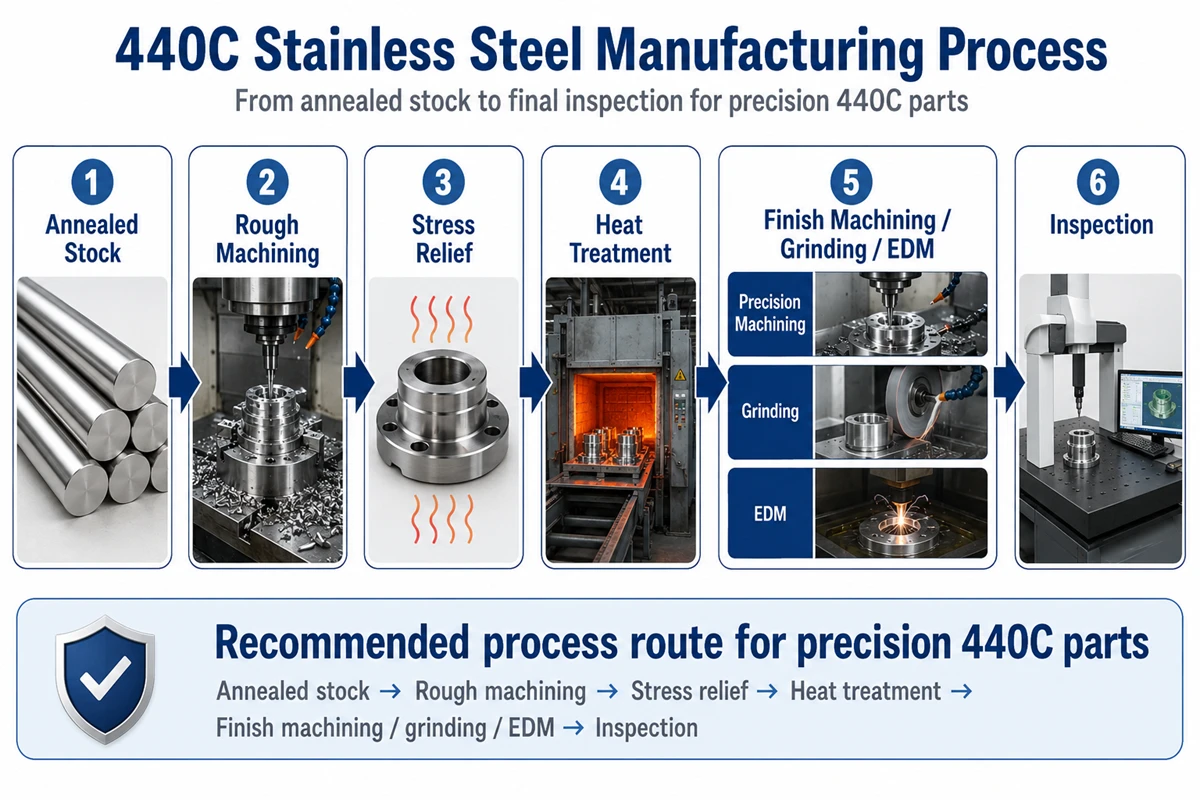
A practical manufacturing sequence is:
Rough Machining → Optional Stress Relief → Heat Treatment → Finish Machining / Grinding / EDM → Final Inspection
For critical wear surfaces and fits, the supplied process notes recommend leaving approximately 0.3–0.5 mm finishing allowance on selected areas before heat treatment.
The actual allowance must be adjusted for part size, wall thickness, geometry, tolerance, heat-treatment process, and expected distortion.
DFM Guidelines for 440C Precision Machined Parts
Define Final Hardness on the Drawing
Writing only “440C Stainless Steel” is not enough.
Specify the required heat-treatment condition or final hardness range because an annealed component and a 55–60 HRC component require very different tooling, manufacturing sequences, and inspection plans.
Identify Critical Fits and Wear Surfaces
Clearly identify:
- Bearing fits;
- Precision bores;
- Sealing diameters;
- Tooth forms;
- Sliding surfaces;
- Locating datums;
- Concentricity or runout requirements;
- Critical GD&T.
These areas are the most likely to require post-hardening finishing.
Control Thin Sections and Functional Edges
Thin arms, deep asymmetric pockets, long unsupported walls, and abrupt thickness changes increase heat-treatment distortion risk.
If the geometry cannot be redesigned, process planning may require stress relief, special fixtures, additional stock, or post-hardening finishing.
Also avoid applying generic deburring requirements to functional teeth.
For gripping components, deliberately sharp teeth may be essential to performance.
Real 440C Machining Examples from Rollyu Production
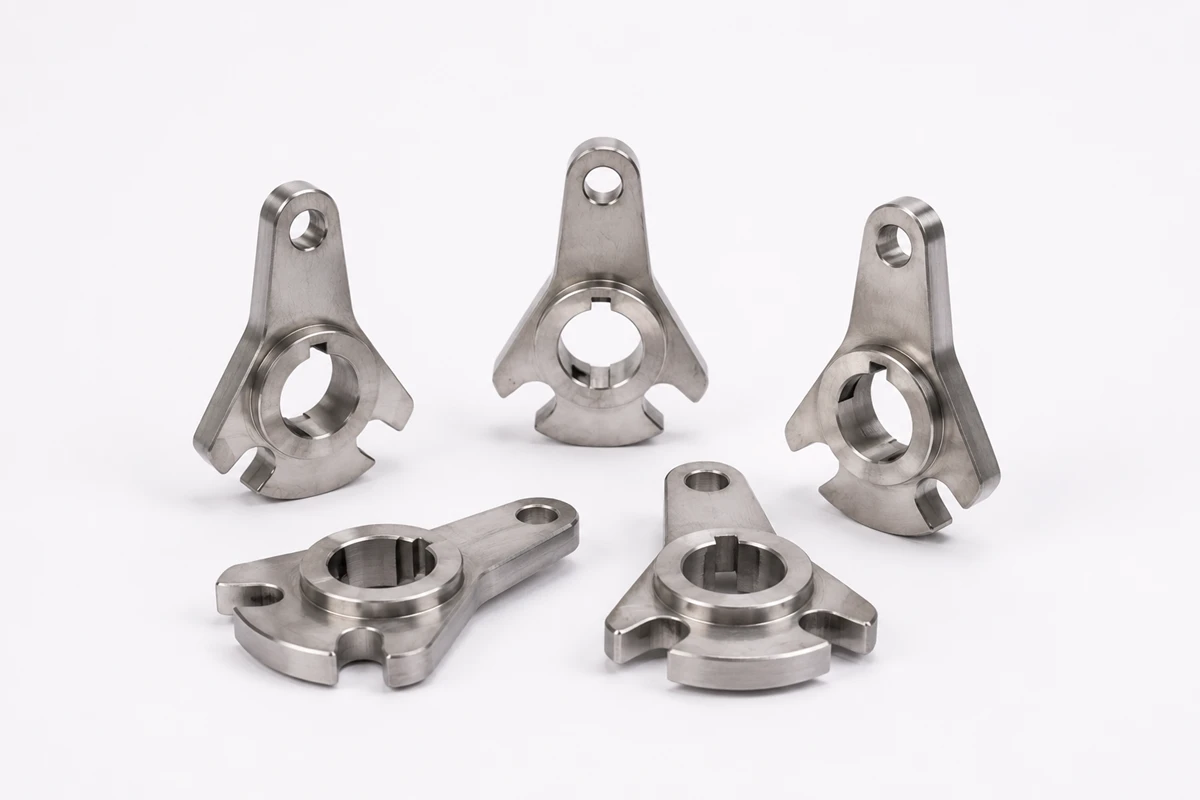
Case Study 1: Hardened 440C Cylinder Arm with an H7 Reamed Hole
A real production drawing supplied for this project specifies a compact 440C stainless steel cylinder arm hardened to 50–55 HRC. The component contains a precision H7 reamed hole, controlled diameters, angular geometry, and a general surface-texture requirement.
The manufacturing challenge is not simply machining the external profile.
The more difficult task is maintaining fit-related geometry through:
Rough machining → heat treatment → final sizing → deburring → dimensional verification.
This type of component demonstrates why 440C precision machining should be planned around the final hardened condition, rather than only the dimensions measured before heat treatment.
Case Study 2: 55 HRC 440C Grip Wedge with Sharp Rack Teeth
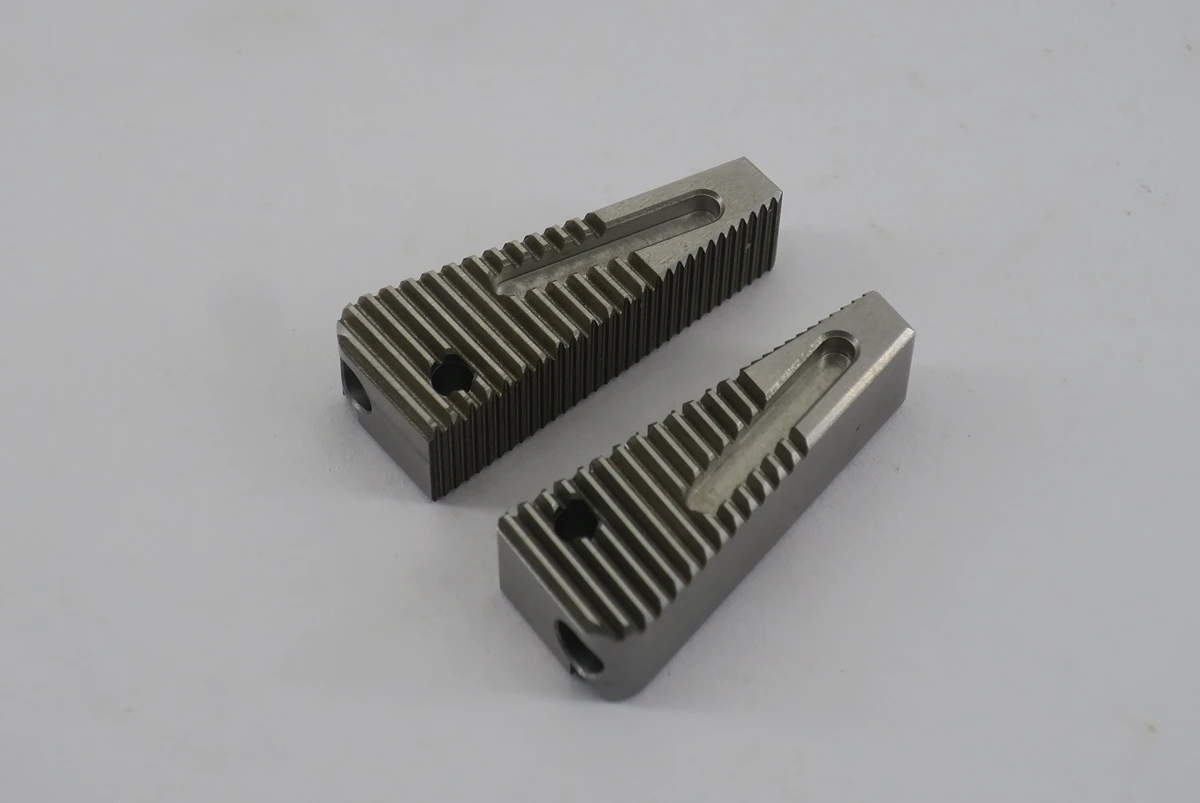
Another real production component is a 440C stainless steel gripping wedge hardened to Rockwell 55.
The design includes a 20° rack with 13 teeth, and the drawing specifically states that the clamping teeth must remain sharp and must not be deburred.
This is a strong example of why machining quality cannot be defined simply as “remove every sharp edge.”
For this part, the sharp teeth are a functional feature.
The manufacturing process must simultaneously control:
- Hardened wear resistance;
- Tooth geometry;
- Sharp gripping edges;
- Hole dimensions;
- Profile accuracy;
- Heat-treatment condition.
A conventional “deburr all edges” instruction would actually make the component perform worse.
440C vs. 316 vs. 17-4PH Stainless Steel
Which stainless steel should an engineer choose?
| Requirement | 440C | 316 / 316L | 17-4PH |
| Maximum hardness / wear | Excellent | Low | High |
| Corrosion resistance | Moderate to good in suitable environments | Excellent in many demanding environments | Good |
| Heat treatable | Yes | Not by conventional hardening | Yes |
| Hardened machinability | Difficult | Not comparable | Generally easier than fully hardened 440C |
| Toughness | Lower when highly hardened | High | Good strength/toughness balance |
| Typical fit | Bearings, gripping, wear and contact parts | Fluid, hygienic and corrosion-focused parts | High-strength structural and mechanical parts |
Rollyu’s stainless-steel material guide similarly positions 416, 420 and 440C where heat-treatable hardness and wear resistance are required, while 316L is more appropriate where corrosion and cleaning resistance dominate.
Choose 440C when wear resistance and hardness drive the design.
Choose 316L when corrosion resistance and cleanability dominate.
Choose 17-4PH when high mechanical strength, toughness, corrosion resistance and dimensional performance require a broader balance.
Surface Finishing for 440C Stainless Steel Parts
Common post-machining options include:
Passivation
Passivation helps remove free-iron contamination introduced during fabrication and supports the natural passive surface.
Carpenter Technology specifically recommends considering cleaning and/or passivation after fabrication when optimum corrosion performance is required.
Mechanical Polishing
Polishing can reduce surface roughness and improve appearance on shafts, sealing surfaces, medical-equipment components, guide parts, and precision mechanisms.
Electropolishing
Electropolishing may improve surface uniformity and cleanability, but engineers must account for material removal around:
- Precision fits;
- Threads;
- Sharp teeth;
- Edges;
- Thin sections.
Grinding and Lapping
Grinding and lapping may be selected where the drawing requires tighter:
- Size;
- Flatness;
- Roundness;
- Parallelism;
- Surface roughness.
Finishing must therefore be included in the tolerance stack.
Do not machine a critical dimension to final size and then apply a material-removing finish without process allowance.
Quality Control for 440C Precision Machined Parts
Rollyu Precision states that its manufacturing operations are supported by ISO 9001 and ISO 13485 quality systems, material traceability, dimensional inspection, CMM capability, and documented quality-control processes.
A typical 440C inspection plan may include:
| Inspection Item | Typical Inspection Method |
| Material verification | Material certificate / MTR review |
| Critical dimensions | CMM, micrometer, bore gauge |
| Precision holes and fits | Plug gauge, bore gauge, CMM |
| Heat-treatment hardness | Rockwell hardness testing |
| Surface roughness | Surface roughness tester |
| Tooth / profile geometry | Optical comparator or CMM |
| Final documentation | Dimensional report / FAI when required |
The critical principle is that hardness and dimensional accuracy must be verified together.
A component can pass dimensional inspection before heat treatment and move out of tolerance afterward.
Likewise, it can meet the specified HRC requirement while failing a bearing fit, bore size, rack profile, or mating interface.
Inspection should therefore follow the actual manufacturing sequence—not just the CAD model.
When Should You Specify 440C Stainless Steel?
440C is a strong candidate when a precision component requires several of the following:
- High hardness;
- Long-term wear resistance;
- Rolling or sliding contact;
- Repeated gripping or clamping;
- Precision bearing surfaces;
- Edge retention;
- Dimensional durability;
- Moderate corrosion resistance.
Carpenter identifies bearings, valves, bushings, pump components, and other wear-resistant applications as established uses of 440C.
440C may be the wrong material when the main priority is:
- Easy welding;
- Severe chloride exposure;
- Maximum corrosion resistance;
- High impact toughness;
- Aggressive chemical exposure;
- Lowest possible machining cost.
Material selection should therefore begin with the functional requirement—not simply the assumption that “harder stainless steel is better.”
What Should Be Included in a 440C Machining RFQ?
To receive a more accurate quotation for 440C stainless steel precision machined parts, provide:
- 3D CAD model, preferably STEP;
- Fully dimensioned 2D drawing;
- 440C / UNS S44004 material specification;
- Required final hardness or HRC range;
- Critical tolerances and GD&T;
- Surface-roughness requirements;
- Functional sharp edges or “do not deburr” features;
- Grinding, passivation, polishing, electropolishing, or other finishing;
- Prototype and production quantities;
- Material-certification requirements;
- FAI or dimensional-report requirements;
- Target delivery schedule.
This allows the machining supplier to quote the actual manufacturing route, instead of assuming a simple “machine and ship” process.
FAQ About Machining 440C Stainless Steel
Is 440C stainless steel difficult to machine?
Yes.
Annealed 440C can be machined with appropriate carbide tooling, but fully hardened 440C is significantly more difficult. Carpenter notes that 440C cuts best for most operations in the fully annealed condition.
For precision parts, rough machining before heat treatment followed by hard machining, grinding, or EDM is often more controllable.
What hardness can 440C stainless steel reach?
Properly heat-treated 440C can reach approximately Rockwell C 60, while production specifications commonly fall in the high-50-HRC range depending on the application and heat-treatment process.
The actual requirement should always be specified on the drawing.
What is the machinability of 440C stainless steel?
440C machinability depends strongly on its hardness.
In the annealed condition, it can be turned, milled, and drilled using suitable carbide tooling and effective chip control.
At approximately 58–62 HRC, conventional machining becomes much more demanding, and CBN, ceramic tooling, grinding, or EDM may be more appropriate.
What cutting tools are best for machining 440C?
Coated carbide tools are commonly used for annealed 440C.
TiAlN and AlTiN coatings help tools withstand heat and abrasive wear.
For hardened turning, CBN or ceramic inserts may be appropriate, while grinding and EDM are often used for high-hardness precision features.
Can 440C be machined after heat treatment?
Yes, but the available processes change.
Depending on geometry and hardness, manufacturers may use:
- Hard turning;
- Precision finish milling;
- Grinding;
- Reaming with appropriate tooling;
- Wire EDM;
- Sinker EDM.
The correct method depends on hardness, tolerance, geometry, surface finish, and production quantity.
Does 440C stainless steel rust?
440C provides useful corrosion resistance in normal and relatively mild environments, but its corrosion performance should not be assumed to equal the most corrosion-resistant austenitic stainless grades.
Surface condition, heat treatment, cleaning, passivation, temperature, contaminants, and the actual operating environment all influence corrosion performance. Carpenter specifically recommends evaluating the real exposure conditions rather than relying only on grade designation.
Is 440C better than 316 stainless steel?
It depends on the engineering requirement.
Choose 440C when hardness, wear resistance, edge retention, or repeated mechanical contact are the main requirements.
Choose 316/316L when corrosion resistance, cleaning chemistry, chloride exposure, or hygienic service is more important.
What is the difference between 440C and 17-4PH?
440C can achieve higher hardness and excellent wear resistance.
17-4PH generally offers a broader combination of high strength, useful toughness, corrosion resistance, and dimensional stability. Rollyu’s 17-4PH engineering guide also notes that its machining behavior depends strongly on heat-treatment condition.
For wear surfaces and bearing-like contact, 440C may be preferred.
For high-strength structural precision components, 17-4PH may provide a better overall balance.
Request a Quote for 440C Stainless Steel Precision Machined Parts
Need a 440C part with hardened wear surfaces, tight fits, precision teeth, small bores, complex profiles, or post-heat-treatment tolerances?
Send Rollyu Precision your:
3D model + 2D drawing + required hardness + critical tolerances + surface finish + quantity + inspection requirements.
Our engineering team can review the:
- 440C machining sequence;
- Heat-treatment allowance;
- Tool access;
- Thin-wall and distortion risks;
- Hard turning requirements;
- Grinding requirements;
- Wire EDM or sinker EDM requirements;
- Functional deburring requirements;
- Surface finishing;
- Final inspection strategy.
Rollyu Precision supports CNC milling, turning, grinding, Wire EDM, finishing, inspection, and documented quality control for demanding stainless steel precision parts, from prototype validation through repeat production.
Send Your 440C Stainless Steel Drawing for DFM Review and Quotation
Email: info@rollyu.com