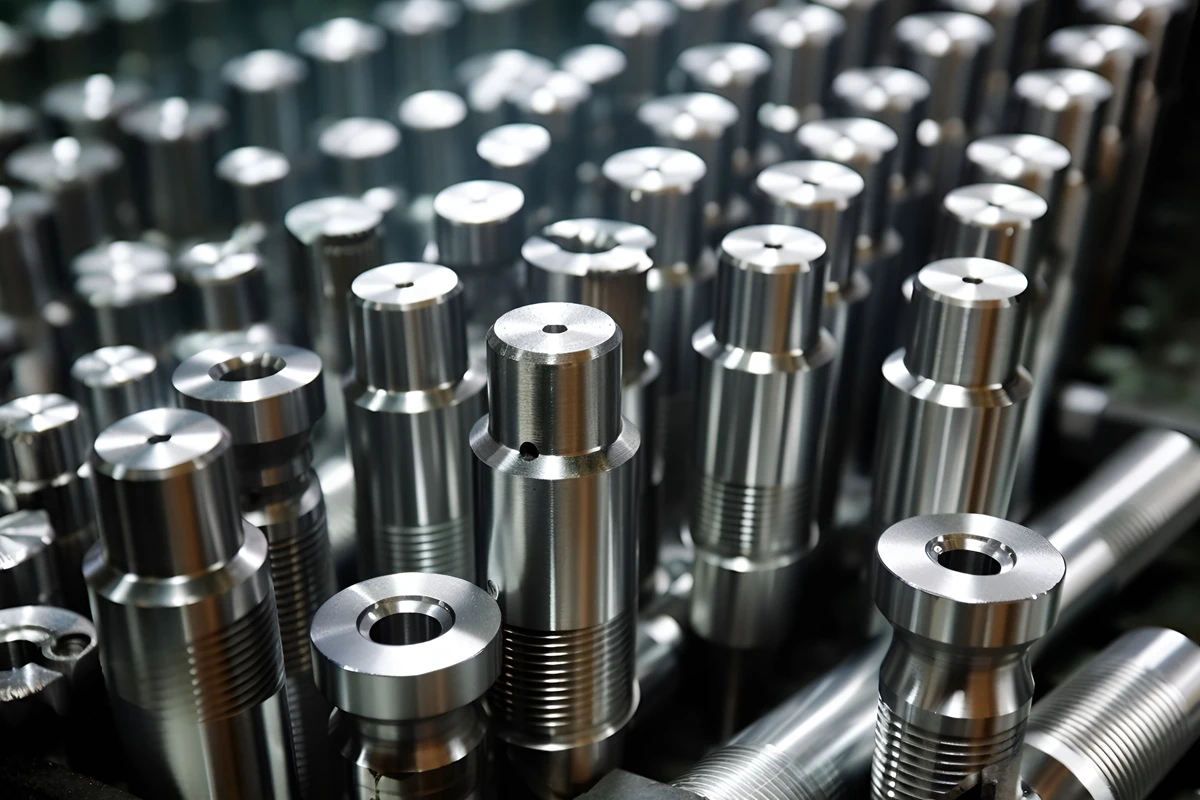
17-4 PH stainless steel machining is commonly specified for precision components that require significantly higher strength than 304 or 316 stainless steel while retaining useful corrosion resistance and dimensional stability.
The most important machining decision is not simply choosing 17-4 PH stainless steel. Engineers must also define the required material condition—such as Condition A, H900, H1025, H1075 or H1150—because heat treatment directly affects hardness, strength, toughness, cutting behavior and the machining sequence.
For tight-tolerance components, the choice between machining before aging, machining after aging, or rough machining before heat treatment followed by precision finishing can directly affect dimensional accuracy, tool life and production cost.
At Rollyu Precision, we manufacture custom 17-4 PH stainless steel components for demanding equipment including motion-control systems, photonics and optical instruments, semiconductor equipment, medical devices, scientific instruments, automation systems and other precision mechanical assemblies.
What Is 17-4 PH Stainless Steel?
17-4 PH is a martensitic precipitation-hardening stainless steel also identified as UNS S17400 and commonly referred to as AISI 630.
Its name comes approximately from its chromium and nickel content. The alloy also contains copper, which plays an important role in precipitation hardening.
Carpenter Technology lists typical composition ranges of approximately 15–17.5% chromium, 3–5% nickel and 3–5% copper. The material can be strengthened through a relatively low-temperature aging treatment after solution treatment.
This combination allows engineers to obtain:
High mechanical strength
Good corrosion resistance
Useful toughness
Good dimensional stability
Heat-treatable mechanical properties
Good performance in highly loaded precision components
This is why 17-4 PH is frequently selected when conventional 300-series stainless steels cannot provide sufficient mechanical strength.
Why Is 17-4 PH Stainless Steel Used for Precision CNC Parts?
The main engineering advantage of 17-4 PH is its ability to combine the corrosion resistance expected from stainless steel with mechanical strength closer to high-strength engineering steels.
This makes it especially useful for components where reducing section thickness, controlling deflection or carrying higher mechanical loads is more important than maximizing corrosion resistance.
Typical applications include:
| Industry | Typical 17-4 PH CNC Machined Parts |
| Motion Control | shafts, actuator components, stage components, couplings, bearing supports |
| Photonics & Optics | structural mounts, high-load adjustment components, precision supports |
| Scientific Instruments | sensor housings, structural components, positioning hardware |
| Semiconductor Equipment | valve components, high-strength fittings, mechanical interfaces |
| Medical Equipment | surgical instrument components, mechanisms, structural components |
| Automation & Robotics | shafts, joints, locking components, high-load brackets |
| Aerospace | fittings, shafts, structural components, high-strength hardware |
| Vacuum Equipment | mechanical interfaces, actuator components and high-strength vacuum hardware |
The correct material should always be selected according to load, corrosion environment, magnetic requirements, fatigue requirements and heat-treatment condition.
17-4 PH Heat Treatment Conditions: Condition A vs H900 vs H1150
This is one of the most important subjects for engineers specifying 17-4 PH stainless steel machined parts.
The same alloy can exhibit substantially different mechanical properties depending on its aging condition.
Typical values published for 17-4 PH show approximately the following relationship:
| Condition | Typical Hardness | Relative Strength | Relative Toughness | Typical Engineering Use |
| Condition A | ~HRC 35 | High | Lower | machining / intermediate manufacturing condition |
| H900 | ~HRC 45 | Highest | Lower | maximum strength and hardness |
| H1025 | ~HRC 38 | High | Medium | strength/toughness balance |
| H1075 | ~HRC 37 | Medium-high | Improved | mechanical components requiring better toughness |
| H1150 | ~HRC 33 | Lower | Higher | improved toughness and stress-corrosion resistance |
Typical values vary according to product form, specification, section size and processing history. Cleveland-Cliffs, for example, reports typical hardness values around HRC 45 for H900, HRC 38 for H1025 and HRC 33 for H1150.
What Does H900 Mean in 17-4 PH?
H900 refers to precipitation aging at approximately 900°F / 482°C.
It produces one of the highest-strength and highest-hardness conditions available for 17-4 PH.
H900 may be suitable for parts such as highly loaded shafts, mechanical interfaces and structural components where strength is the dominant requirement.
However, higher hardness also increases cutting forces and tool wear during CNC machining.
What Is H1025 17-4 PH?
H1025 provides a more balanced combination of strength, hardness and toughness than H900.
For many mechanical components, H1025 can provide sufficient strength while reducing some of the brittleness and machining difficulties associated with maximum-hardness conditions.
What Is H1150 17-4 PH?
H1150 uses a higher aging temperature and produces lower hardness and strength but improved ductility and toughness.
Higher aging temperatures can also improve resistance to stress-corrosion cracking compared with lower-temperature conditions. Carpenter Technology specifically notes improved stress-corrosion cracking resistance when the alloy is hardened at 1025°F / 552°C or higher.
Therefore, specifying only “17-4 PH” on a drawing may be insufficient.
The required condition should normally be defined according to the mechanical properties required by the application.
17-4 PH Stainless Steel Machinability: Condition A vs H900 vs H1150
17-4 PH stainless steel machinability changes substantially with heat-treatment condition. Condition A is often selected for heavy stock removal, while H900 and H1150 may be machined in the hardened condition when dimensional predictability or the purchasing specification requires it.
| Condition | Typical Hardness in This Guide | Relative Machining Difficulty | Primary Process Concern |
| Condition A | ~HRC 35 | Moderate | High cutting force; plan for any post-machining aging movement |
| H900 | ~HRC 45 | Highest of these common conditions | Tool wear, cutting force, heat and finish stability |
| H1025 | ~HRC 38 | Moderate-high | Strength/toughness balance with meaningful tool load |
| H1150 | ~HRC 33 | Generally lower than H900 | Maintain geometry, finish and downstream-process allowance |
What Is 17-4 H900 Hardness?
17-4 PH H900 is one of the highest-hardness common aging conditions. This guide uses approximately HRC 45 as a typical reference, while the actual part must meet the customer drawing and applicable material/heat-treatment specification.
Is H900 Harder to Machine Than H1150?
Generally, yes. H900 is harder and stronger than H1150, so it normally increases cutting force and tool wear. H1150 sacrifices some strength for improved toughness and lower hardness. For tight-tolerance parts, the correct strategy may be to rough machine before aging and finish afterward, or machine material already supplied in the final aged condition when post-machining heat treatment would create unacceptable dimensional risk.
Is 17-4 PH Stainless Steel Difficult to Machine?
17-4 PH is machinable, but machining behavior depends strongly on the material condition.
A common misconception is that Condition A is simply a “soft and easy machining” condition.
In practice, precipitation-hardening stainless steels can still require substantial cutting forces. Carpenter Technology notes that martensitic precipitation-hardening stainless steels are often machined in the solution-treated condition, but they can also be machined after aging when tighter dimensional control is required.
The main machining challenges include:
Tool wear
High cutting forces
Heat generation
Hardness variation between material conditions
Deep-hole chip evacuation
Burr formation
Thin-wall distortion
Dimensional movement during heat treatment
Maintaining fine surface finishes on precision fits
The correct machining process therefore depends on the final tolerance and heat-treatment requirement.
Should 17-4 PH Be Machined Before or After Heat Treatment?
There is no single correct answer.
The best machining sequence depends on final hardness, geometry, tolerance and dimensional-stability requirements.
Option 1 — Machine in Condition A, Then Age Harden
This process can be effective for components whose final tolerances can accommodate the dimensional changes associated with heat treatment.
Typical sequence:
Condition A material → CNC machining → deburring and cleaning → aging → final inspection.
The advantage is that extensive material removal is completed before the final precipitation-hardening treatment.
Option 2 — Rough Machine, Heat Treat, Then Finish Machine
For precision components, a more controlled approach may be:
Condition A stock → rough machining → aging → semi-finish machining → precision finishing → inspection.
This allows critical dimensions to be established after heat treatment.
This strategy is particularly useful for:
Precision bores
Bearing fits
Datum surfaces
Concentric features
Thin-wall components
Precision shafts
Motion-control components
Optomechanical hardware
Option 3 — Machine Pre-Hardened 17-4 PH
Some components can be manufactured directly from material supplied in an aged condition.
The benefit is improved dimensional predictability because no subsequent aging cycle is required.
The tradeoff is increased tool wear and cutting force.
Carpenter notes that aged precipitation-hardening stainless steels can be machined using suitable carbide or coated tooling, and machining in the hardened condition can help maintain closer final tolerances.
How to Machine 17-4 PH Stainless Steel Successfully
Successful 17-4 PH CNC machining depends less on one universal speed-and-feed value and more on controlling heat, chip formation, rigidity and tool engagement.
Use Rigid Workholding
Machine rigidity is important because 17-4 PH generates relatively high cutting forces.
Fixtures should support the workpiece without introducing excessive clamping stress, especially on:
Thin walls
Long shafts
Large pockets
Slender ribs
Precision housings
For distortion-sensitive components, Rollyu may use staged machining and multiple setups rather than attempting to finish every feature in one operation.
Use Appropriate Carbide Tooling
Carbide tooling is commonly used for production machining of 17-4 PH.
Tool geometry should provide controlled chip formation while maintaining edge strength.
Coated carbide tools can help reduce wear when machining aged material.
Avoid Tool Dwell
Allowing the cutting edge to rub rather than cut can increase heat and damage both the tool and workpiece surface.
Positive, continuous cutting engagement is generally preferred.
Control Cutting Temperature
Effective coolant delivery helps control heat at the cutting zone, improves chip evacuation and supports more stable tool life.
This becomes particularly important during:
Deep drilling
Pocket milling
Slotting
Threading
High material-removal operations
Plan Finishing Allowance Around Heat Treatment
When the part will be aged after rough machining, the manufacturing plan should account for potential dimensional movement.
Critical surfaces can then be finished after heat treatment using CNC milling, turning, grinding, lapping or another appropriate finishing process.
Machining 17-4 PH H900 Stainless Steel
Machining H900 requires greater attention to rigidity and tooling because H900 is one of the hardest and strongest common conditions.
Typical applications are components requiring maximum mechanical strength.
For H900 components, Rollyu’s manufacturing planning may prioritize:
Short, rigid tool setups
Carbide tooling
Stable tool engagement
Controlled cutting temperature
Reduced unsupported tool length
Appropriate finishing allowance
In-process dimensional verification
For extremely demanding tolerances, rough machining before aging followed by post-heat-treatment finishing may provide better process control than completing all machining in H900.
Real Machining Case – 17-4 PH H1150 Precision Drive Shaft Blank
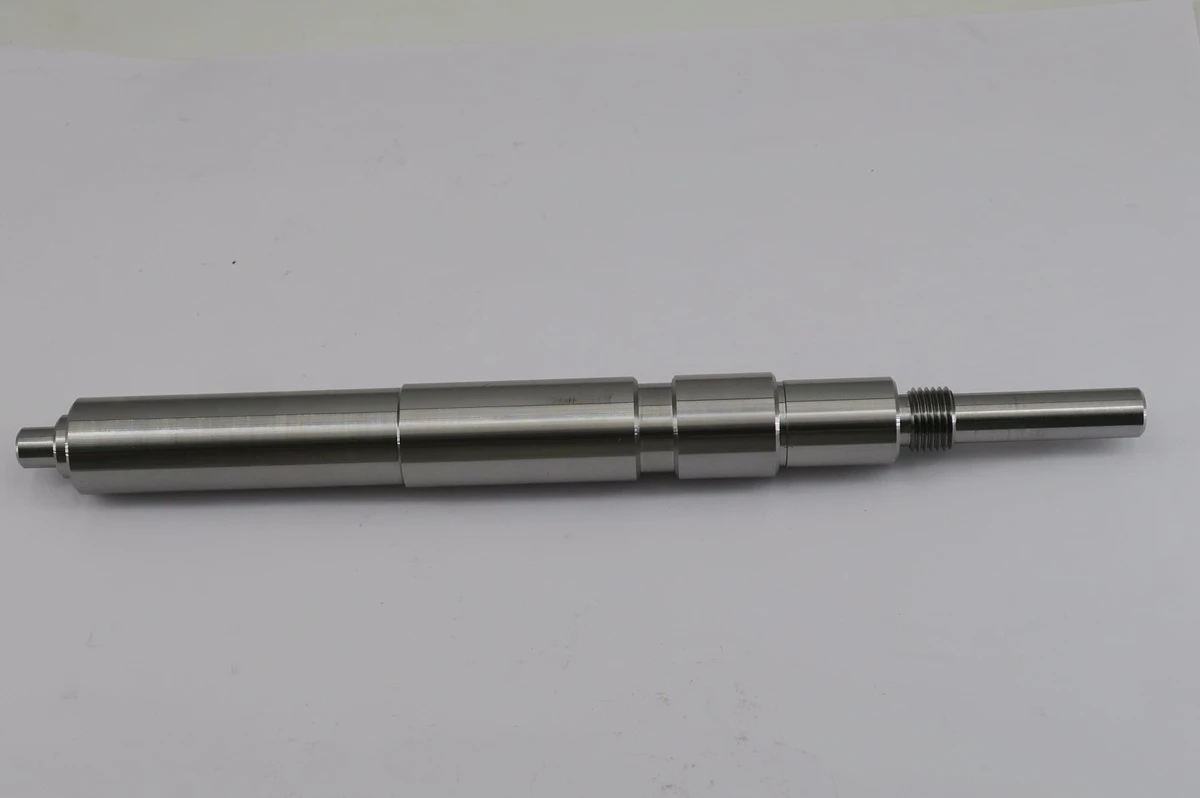
A real Rollyu build-to-print project demonstrates how 17-4 PH machinability, final condition, concentric geometry and downstream finishing requirements come together in production. The customer drawing identifies the component as a Drive Shaft – Blank – 17-4 and specifies 17-4 PH H1150 material.
| Case Requirement | Drawing / Order Detail |
| Part | Drive Shaft – – 17-4 PH |
| Material | 17-4 PH H1150 |
| Customer hardness requirement | HRC 28-32 |
| Overall blank length | 8.653 in. |
| Thread | 1/2-20, Class 2 |
| General .XXX tolerance | ±0.005 in. |
| Geometry note | Concentric, parallel and perpendicular within 0.005 TIR on the machining drawing |
| Machined surface requirement | 125 on all machined surfaces |
| Edge / burr requirement | Remove all burrs; break sharp edges 0.005-0.010 in. |
| Finish | None |
| Quantity | 30 pcs |
Why This H1150 Drive-Shaft Case Is Technically Relevant
The challenge is not simply turning a stainless-steel shaft. The blank contains multiple stepped diameters, shoulders and a threaded feature across an 8.653 in. overall length. Those features must remain dimensionally controlled while leaving the component suitable for the customer’s later grinding and worm-generation operations.
- Long-part support and turning strategy must control deflection and chatter.
- Shoulders and journals must maintain the datum relationships required for later finishing.
- The 1/2-20 thread must be produced without damaging adjacent precision diameters.
- Burr removal and controlled edge breaks matter because the blank becomes the input to another precision process.
- H1150 material condition and the customer hardness range must be verified against the purchasing requirement before machining begins.
- Inspection planning should focus on features that affect downstream grinding, worm machining and final shaft runout.
What Would Change if the Same Shaft Were Specified H900?
If a similar shaft were required in H900 rather than H1150, the higher hardness would normally increase tool wear and cutting force. Rollyu would review whether the part should be rough machined before aging, finish machined after aging, or machined from pre-hardened H900 stock. The final choice would depend on the drawing tolerance, available stock condition, heat-treatment specification, grinding allowance and dimensional-stability risk.
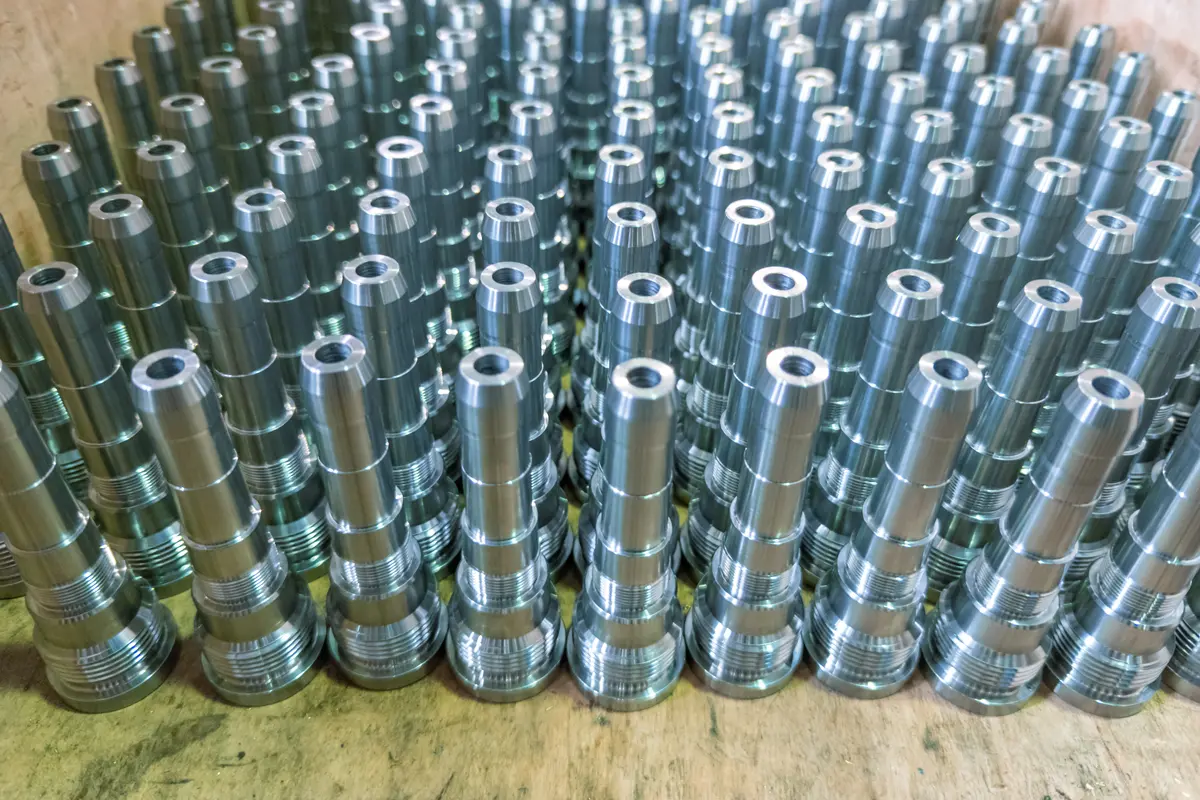
Additional First-Party 17-4 PH H1150 Production Examples
17-4 PH vs 304 vs 316 Stainless Steel for CNC Machining
Choosing stainless steel based only on corrosion resistance can result in either unnecessary cost or insufficient mechanical performance.
| Property | 17-4 PH | 304 | 316/316L |
| Heat Treatable for High Strength | Yes | No | No |
| Strength Potential | Very High | Moderate | Moderate |
| Corrosion Resistance | Good | Good | Very Good |
| Chloride Resistance | Moderate | Moderate | Better |
| Typical Precision Application | loaded mechanical components | general-purpose components | corrosive / vacuum / fluidic components |
| Typical Components | shafts, structural parts, mechanisms | brackets, housings, fixtures | vacuum parts, manifolds, medical/fluid components |
If the main engineering requirement is maximum corrosion resistance in chloride-rich environments, 316L may be more appropriate.
If the application requires high mechanical strength together with stainless-steel corrosion resistance, 17-4 PH may offer a better balance.
17-4 PH vs 15-5 PH Stainless Steel
17-4 PH and 15-5 PH are both precipitation-hardening stainless steels.
17-4 PH is widely available and used across aerospace, industrial and medical applications.
15-5 PH is often selected for applications requiring more consistent transverse properties and demanding aerospace mechanical performance.
The appropriate choice should be based on:
Required mechanical properties
Material specification
Section size
Load direction
Fatigue requirements
Corrosion environment
Material availability
Qualification requirements
Rollyu can machine both 17-4 PH and 15-5 PH components according to customer drawings and material specifications.
How Rollyu Controls Distortion in Precision 17-4 PH Parts
Dimensional control becomes particularly important when machining thin-wall or high-aspect-ratio 17-4 PH components.
A typical Rollyu process may include:
Drawing and material-condition review
We review whether the drawing specifies Condition A, H900, H1025, H1075, H1150 or another required condition.
Manufacturing sequence planning
The engineering team determines whether the component should be fully machined before aging, rough machined before aging, or machined from pre-hardened material.
Balanced material removal
For distortion-sensitive geometry, material can be removed in controlled stages rather than aggressively machining one side of the component.
Semi-finishing before final tolerance
Critical dimensions may be left with controlled finishing allowance.
Final precision machining
Critical bores, surfaces, threads and fits are finished according to the drawing requirements.
Dimensional inspection
CMM and other precision measuring equipment can be used to verify critical dimensions, geometric tolerances and datum relationships.
Surface Finishing for 17-4 PH Stainless Steel Parts
Machining is only one stage of manufacturing a high-performance 17-4 PH component.
Depending on the application, finishing may include:
Passivation
Electropolishing
Precision grinding
Mechanical polishing
Bead blasting
Laser marking
Specialized coatings
Passivation is particularly relevant after machining because free iron and machining contamination should be properly controlled on corrosion-resistant stainless-steel surfaces.
Carpenter recommends appropriate cleaning and/or passivation after fabrication to optimize corrosion resistance.
For engineering drawings, specifications such as ASTM A967 should be clearly identified when required.
Where Are CNC Machined 17-4 PH Parts Used?
Motion Control and Precision Positioning
17-4 PH can be used for shafts, high-load stage components, bearing interfaces, couplings and actuator hardware.
Its high strength helps reduce elastic deformation in heavily loaded mechanisms.
Photonics and Optical Instruments
High-strength stainless-steel components may be required in optical positioning systems, precision adjustment mechanisms and structural optomechanical assemblies where stiffness and dimensional stability are important.
Semiconductor Equipment
17-4 PH can be used in mechanically loaded fittings, valve hardware, fasteners, shafts and equipment mechanisms.
Carpenter has documented the use of 17-4 PH components in semiconductor gas-handling hardware.
Medical and Surgical Equipment
17-4 PH is used in medical applications requiring high strength and corrosion resistance, including instrument components and mechanical assemblies. Carpenter lists medical as one of the alloy’s application areas.
Material condition, surface treatment, cleaning and regulatory requirements must be defined according to the specific medical application.
Scientific and Quantum Instrumentation
Scientific instruments frequently require compact mechanical structures with high stiffness and repeatable dimensional performance.
Potential 17-4 PH components include:
Precision shafts
Load-bearing mounts
Mechanical adjustment components
Sensor-support structures
Actuator hardware
Precision instrument interfaces
For magnetic-field-sensitive systems, however, material magnetic properties must be evaluated before specifying 17-4 PH.
What Information Should Be Included in a 17-4 PH Machining RFQ?
A complete RFQ allows the machining supplier to plan heat treatment, tolerances and finishing correctly.
For faster engineering review, provide:
3D CAD model
2D engineering drawing
Material specification
17-4 PH condition
Required heat-treatment specification
Critical tolerances and GD&T
Surface-finish requirements
Passivation or electropolishing requirement
Quantity
Inspection requirements
FAI or inspection-report requirements
Material certification requirements
Required delivery schedule
One particularly important point is to specify both the material specification and required heat-treatment condition.
For regulated aerospace, medical and other critical components, meeting a hardness value alone may not be equivalent to meeting a specified heat-treatment process or certification requirement.
Why Source 17-4 PH CNC Machined Parts from Rollyu Precision?
Rollyu Precision supports custom high-precision stainless-steel parts from prototype development through repeat production.
Our manufacturing capabilities include:
3-axis, 4-axis and 5-axis CNC milling
Precision CNC turning
Swiss turning
EDM
Precision grinding
Complex multi-operation machining
CMM dimensional inspection
Surface-finishing coordination
Heat-treatment coordination
Prototype and low-to-medium volume production
We work with stainless steels including:
17-4 PH
15-5 PH
303
304
316 / 316L
416
420
440C
Rollyu Precision operates under ISO 9001 and ISO 13485 quality-management systems and supports precision components for medical devices, motion control, photonics, scientific instrumentation, semiconductor equipment, robotics and other demanding applications.
FAQ: 17-4 PH Stainless Steel Machining
Is 17-4 PH stainless steel easy to machine?
17-4 PH is machinable with appropriate tooling and process control, but its machinability depends strongly on the heat-treatment condition. Hardened conditions require higher cutting forces and normally increase tool wear.
What is the best condition for machining 17-4 PH?
There is no universal best condition. Condition A is often used when substantial machining will be completed before final aging. Pre-hardened material can be useful when eliminating post-machining heat treatment and maintaining final dimensions are more important.
Can 17-4 PH be machined after H900 heat treatment?
Yes. H900 can be machined using rigid setups and suitable carbide tooling, but its higher hardness increases tool wear and cutting force. For demanding parts, rough machining before aging followed by finishing after heat treatment may be preferable.
What is the difference between 17-4 PH H900 and H1150?
H900 provides higher strength and hardness, while H1150 generally provides lower strength but improved toughness and ductility. Material condition should therefore be selected according to the mechanical requirements of the component.
Does 17-4 PH need heat treatment after machining?
Not always. Parts machined from Condition A material can be precipitation hardened after machining, while parts manufactured from material already supplied in the required aged condition may not require another aging cycle. The drawing and applicable specification should control the process.
Is 17-4 PH stronger than 316 stainless steel?
Yes, precipitation-hardened 17-4 PH can achieve substantially higher mechanical strength than 316 stainless steel. However, 316 generally provides better corrosion resistance in chloride-rich environments.
Is 17-4 PH magnetic?
17-4 PH is a martensitic precipitation-hardening stainless steel and is generally magnetic. It should therefore be evaluated carefully for magnetically sensitive photonics, scientific and quantum-instrument applications.
Can 17-4 PH stainless steel be passivated?
Yes. Passivation is commonly used after machining to remove surface contamination and support corrosion resistance. The required process should be defined according to the drawing and applicable standard, such as ASTM A967 where specified.
What tolerances can be achieved when machining 17-4 PH?
Achievable tolerances depend on geometry, part size, heat-treatment condition, wall thickness and inspection requirements. Rollyu Precision can support tight-tolerance machining projects, with critical features evaluated individually during DFM review.
What files should I send for a 17-4 PH CNC machining quote?
Send a 3D CAD model and 2D drawing whenever possible. Include the material specification, heat-treatment condition, GD&T, surface finish, passivation requirements, quantity and inspection requirements.
What is typical 17-4 H900 hardness?
This guide uses approximately HRC 45 as a typical H900 hardness reference. Actual acceptance requirements should follow the applicable material specification, product form, heat-treatment procedure and customer drawing.
Is 17-4 PH H900 harder to machine than H1150?
Generally, yes. H900 has higher hardness and strength, which tends to increase cutting force and tool wear. H1150 is lower in hardness and generally provides improved toughness, although the machining plan must still account for geometry, tolerance and the actual supplied condition.
Can Rollyu machine long 17-4 PH H1150 drive shafts?
Yes, subject to drawing review. The uploaded case includes an 8.653 in. 17-4 PH H1150 drive-shaft blank with multiple diameters, shoulders and a 1/2-20 thread. For similar parts, Rollyu reviews support strategy, runout risk, tool access, finishing allowance and downstream grinding requirements before quotation.
Why should downstream grinding be defined in the RFQ?
Because turning dimensions, datum relationships and stock allowance may need to be planned around the later grinding process. A machining supplier should know which surfaces are final at CNC machining and which are intentionally left for subsequent precision finishing.
CTA: Need a Quote for 17-4 PH Stainless Steel Machined Parts?
Looking for a reliable supplier for precision 17-4 PH stainless steel machining?
Rollyu Precision supports complex prototypes and production components in 17-4 PH Condition A, H900, H1025, H1075, H1150 and other specified conditions, with CNC milling, turning, 5-axis machining, grinding, heat-treatment coordination, surface finishing and dimensional inspection.
Whether you are developing components for motion control, photonics, semiconductor equipment, scientific instrumentation, medical devices, robotics or automation, our engineering team can review your drawing, material condition, tolerance strategy and manufacturing sequence before production.
Send your 3D CAD model and 2D drawing to Rollyu Precision for a DFM review and CNC machining quotation.
Website: www.rollyu.com
Precision CNC Machining | Heat Treatment Coordination | CMM Inspection | Prototype to Production