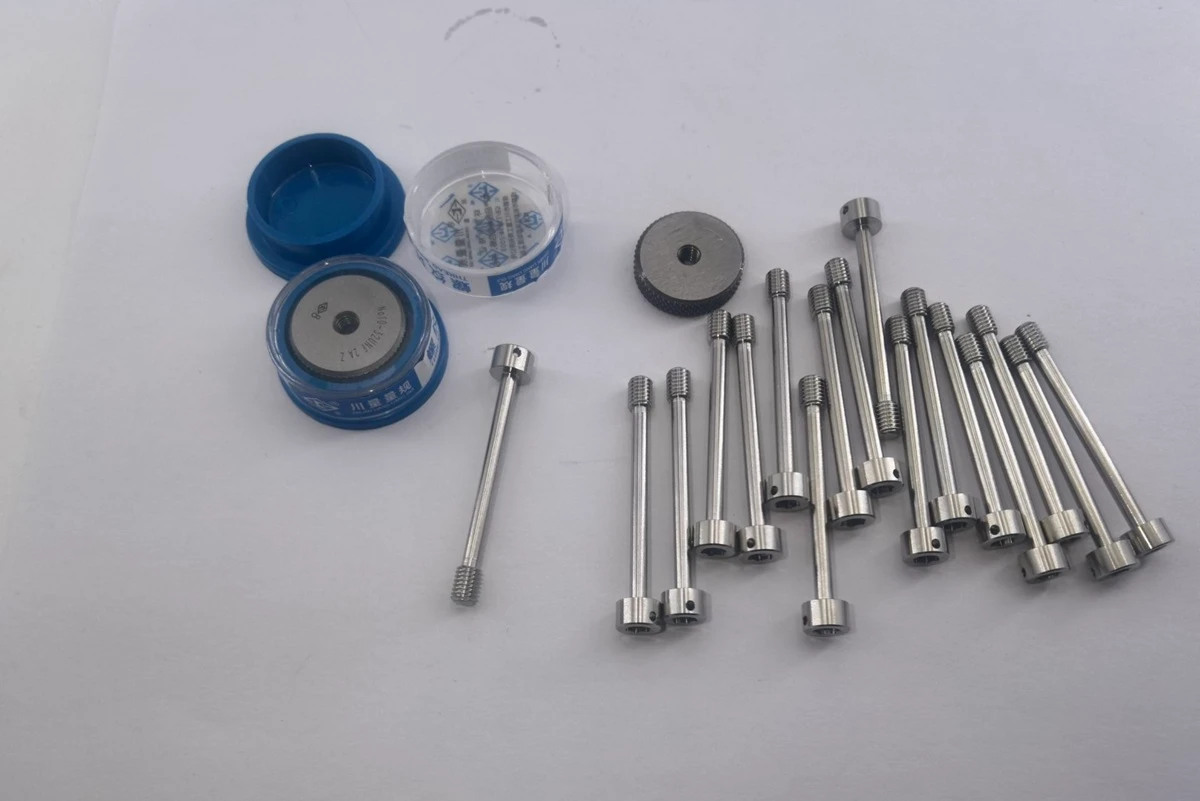
18-8 stainless steel is widely used for corrosion-resistant fasteners, threaded shafts, sensor hardware, adjustment components and precision mechanical parts.
However, for an OEM mechanical engineer or sourcing team, specifying only “18-8 stainless steel” may not provide enough information for a precision CNC machining project.
18-8 generally refers to a family of austenitic stainless steels containing approximately 18% chromium and 8% nickel. Type 304 is the grade most commonly associated with 18-8 stainless steel, but “18-8” itself is a composition-based commercial description rather than a complete engineering specification.
That distinction becomes important when a machined component requires:
- tight dimensional tolerances
- precision threads
- small cross holes
- controlled runout
- material traceability
- low burr levels
- vacuum compatibility
- controlled magnetic behavior
- passivation or electropolishing
- repeatable prototype-to-production quality
For applications in photonics, motion control, UHV systems, force measurement, quantum instrumentation and semiconductor equipment, the real question is not simply: Can 18-8 stainless steel be machined?
A better engineering question is: Can the selected stainless grade, machining process, surface condition and inspection plan meet the functional requirements of the assembly?
What Is 18-8 Stainless Steel?
18-8 stainless steel is a commonly used commercial description for chromium-nickel austenitic stainless steels containing approximately 18% chromium and 8% nickel.
Chromium contributes to the passive surface layer responsible for corrosion resistance, while nickel helps stabilize the austenitic microstructure and improves toughness and ductility.
For general-purpose hardware, the description “18-8” may be sufficient. For high-precision CNC components, however, the exact material grade should normally be confirmed before production.
Is 18-8 Stainless Steel the Same as 304?
Not exactly. 18-8 describes a general chromium-nickel stainless steel family, while 304 stainless steel is a defined engineering grade.
Many commercial 18-8 stainless steel products are Type 304 or close to Type 304, which is why the terms are frequently used interchangeably. For a commodity screw, this distinction may not matter.
For a precision component used in a vacuum stage, photonics instrument, semiconductor tool or measurement system, the drawing should preferably define:
- exact stainless steel grade
- applicable ASTM, UNS or EN specification
- material condition
- material certification requirements
- dimensional tolerances
- GD&T requirements
- thread specification
- surface roughness
- passivation or electropolishing requirements
Why Use 18-8 Stainless Steel for CNC Machined Parts?
| Requirement | Engineering Benefit |
| Corrosion resistance | Better general environmental resistance than carbon steel |
| Toughness | Suitable for mechanically loaded hardware |
| Thread capability | Useful for screws, studs, adjusters and shafts |
| Surface quality | Can be machined, polished and passivated |
| Cleanability | Suitable for many instrumentation applications |
| Availability | Commonly available as bar, rod and other stock forms |
| Prototype production | Practical for custom low-volume components |
| Repeat production | Suitable for controlled production machining |
This makes the material useful for custom fasteners, shafts, spacers, instrument hardware and precision mechanical components. However, material selection should always depend on the operating environment rather than the name of the alloy alone.
What Makes 18-8 Stainless Steel Difficult to Machine?
18-8 stainless steel is machinable, but it behaves differently from aluminum and free-machining steels. The major machining challenges are associated with work hardening, heat concentration, tool wear, chip control and burr formation.
Work Hardening
Austenitic stainless steels can work-harden when the cutting tool rubs against the surface instead of continuously cutting material. This may cause:
- increased cutting force
- accelerated tool wear
- dimensional drift
- poor surface finish
- excessive heat
- reduced tool life
For precision production, machining strategy should emphasize sharp cutting tools, rigid workholding, stable feed rates, appropriate cutting speeds, effective coolant delivery, good chip evacuation and minimal tool rubbing.
The objective is not merely to remove material quickly. The objective is to maintain dimensional consistency across the entire production batch.
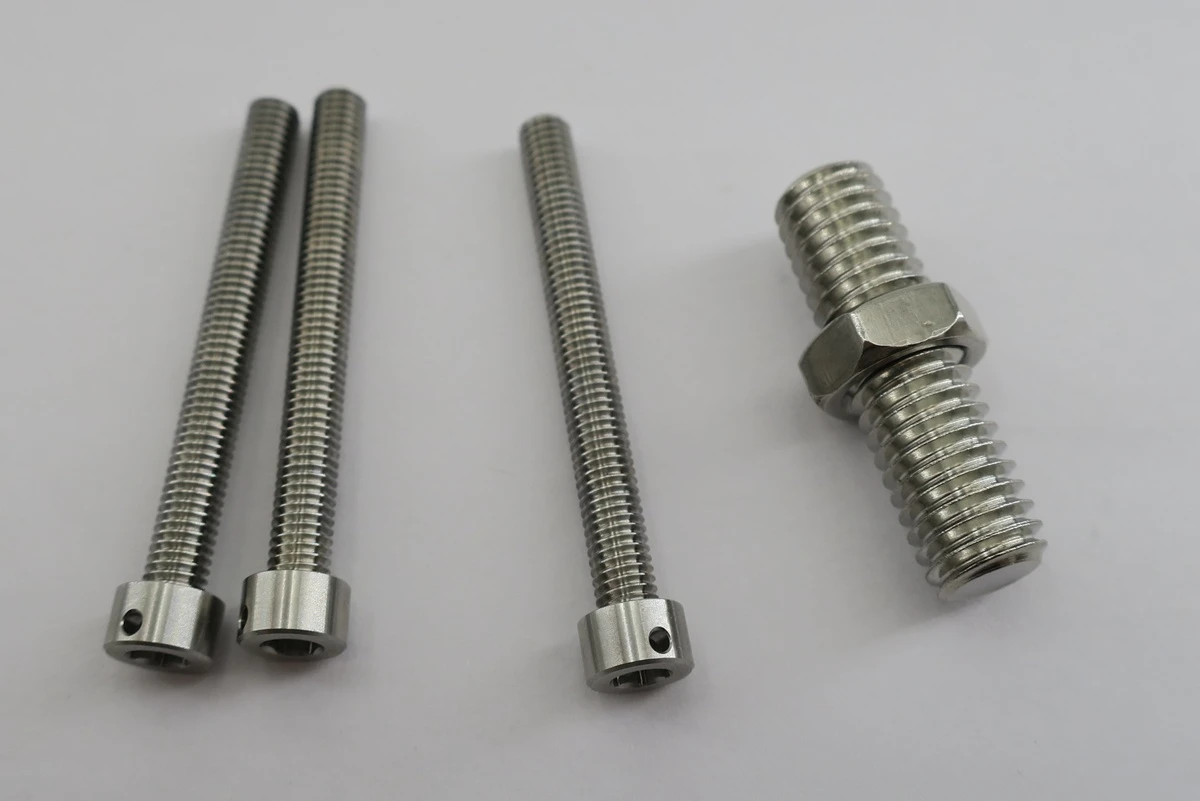
Heat Concentration and Tool Wear
Austenitic stainless steel retains more cutting heat around the cutting zone than many easier-to-machine metals. This becomes especially important when machining deep bores, narrow grooves, small threaded holes, long threaded shafts, shoulder features and thin-wall sections.
Progressive tool wear can produce a subtle manufacturing problem: the first parts may pass inspection while later parts begin to drift. For repeat production, tool-life management and inspection frequency should therefore be linked to the critical dimensions of the drawing.
Thread Machining and Galling
Many 18-8 stainless steel parts are fundamentally threaded functional components. Typical examples include captive panel screws, shoulder screws, threaded shafts, adjustment screws, sensor mounting studs, locating screws, optical adjustment hardware, mounting fasteners and threaded spacers.
Common problems include incorrect pitch diameter, damaged first threads, burrs at thread exits, incomplete threads, poor engagement, galling during assembly and particles generated by burrs.
A precision thread should be treated as a functional mechanical interface, not simply as another geometric feature.
Long, Slender Parts and Runout
Long stainless steel shafts and screws may appear simple on a drawing, but their length-to-diameter ratio can make them difficult to manufacture consistently. Potential problems include deflection, chatter, taper, runout, thread variation and bending during machining or handling.
This is especially important for optical adjustment screws, motion-control components, sensor hardware and precision positioning mechanisms. Manufacturing planning may require staged turning, optimized support, controlled cutting loads and intermediate inspection.
Cross-Hole and Burr Control
Small cross-drilled features deserve special attention. Burrs around an intersecting hole can affect assembly, generate particles or interfere with safety-wire and retention functions. This makes controlled drilling and deburring part of the functional manufacturing plan.
Real Machining Example: Custom 18-8 Stainless Steel Captive Panel Screw
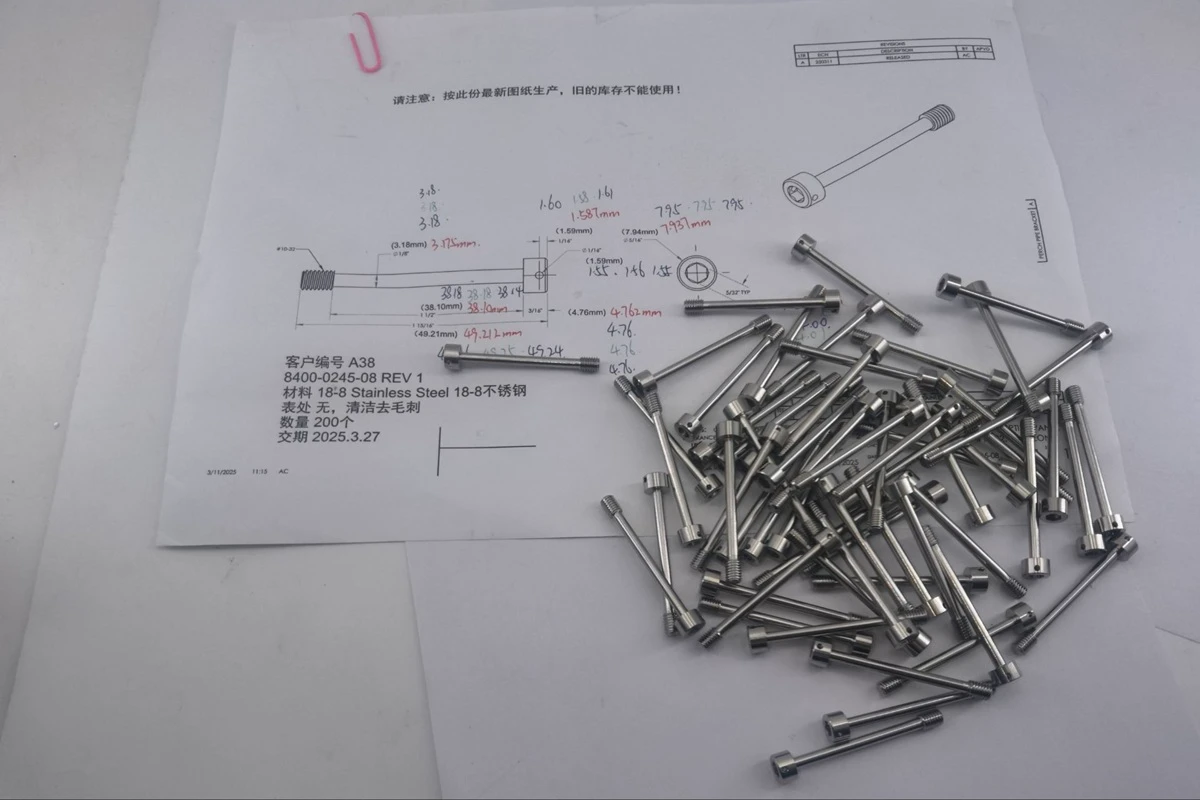
| Requirement | Specification |
| Component | Wire Drilled Captive Panel Screw |
| Material | 18-8 Stainless Steel |
| Thread | #10-32 |
| Length | 1-3/4 in. |
| Feature | Cross-drilled / wire-drilled head |
| Finish | No coating |
| Post-process | Clean and deburr |
| Prototype quantity | 10 pcs |
| Drawing tolerance | .XXX dimensions: ±0.005 in. |
This seemingly simple component creates several manufacturing questions:
- Will the long shaft remain straight?
- Will the #10-32 thread gauge correctly?
- Can the head geometry remain concentric with the shaft?
- Will the cross hole break through cleanly?
- Can internal and external burrs be removed without damaging the part?
- Will every component remain consistent from prototype through repeat production?
These questions illustrate the difference between buying a standard stainless steel screw and sourcing a custom build-to-print precision machined component.
18-8 Stainless Steel CNC Machining for Precision Industries
Photonics and Optical Systems
- optical adjustment mechanisms
- mirror mounts
- lens holders
- detector assemblies
- laser systems
- optical benches
- positioning mechanisms
- alignment assemblies
Typical components include fine-thread adjusters, shafts, locating pins, mounting studs, precision spacers, captive screws and sensor hardware. Critical requirements are thread consistency, runout, positional accuracy, surface finish and repeatability. Even small variations in an adjustment screw or shaft can affect alignment repeatability in a precision optical assembly.
Motion Control Systems
- adjustment screws
- locking screws
- precision shafts
- locating pins
- spacers
- threaded inserts
- sensor mounts
- stage hardware
- actuator hardware
Important drawing requirements may include runout, position, thread quality, concentricity, surface finish and batch-to-batch repeatability. These parts are relevant to linear stages, nanopositioning systems, optical motion platforms and precision actuator assemblies.
Load Cell and Force Measurement Equipment
- mounting studs
- precision fasteners
- sensor housings
- instrument hardware
- spacers
- fixture hardware
- cable and panel components
18-8 stainless steel should not automatically be specified for the elastic sensing element of a load cell. Flexures and spring elements may require alloys selected specifically for fatigue behavior, elastic properties and heat-treatment response.
UHV and Vacuum Systems
- vacuum-compatible screws
- vented fasteners
- spacers
- flange hardware
- feedthrough mounting components
- sensor fixtures
- instrument brackets
- threaded adapters
UHV customers care about more than dimensional tolerance. Trapped volumes, blind threads, machining oil residues, particles, burrs, surface contamination, material traceability, surface roughness, vacuum cleaning, passivation, electropolishing and packaging may all matter. UHV sourcing should be viewed as a machining + cleaning + surface treatment + documentation problem.
Quantum Instruments
- atomic magnetometers
- NV-diamond magnetometers
- magnetic imaging instruments
- precision magnetic-field sensors
- quantum optics experiments
- low-field measurement systems
Annealed austenitic 18-8 stainless steel is typically nonmagnetic or only weakly magnetic. Machining, forming or cold working can introduce measurable magnetic response. Magnetically sensitive applications may therefore need an exact grade, material condition, maximum magnetic permeability, permitted cold work and post-machining verification requirements.
Semiconductor Equipment
- chamber-related fasteners
- vacuum hardware
- precision shafts
- alignment hardware
- sensor mounts
- equipment brackets
- stage components
- wafer-handling mechanism hardware
- cleanroom-compatible threaded parts
Semiconductor equipment combines precision, cleanliness, vacuum compatibility, repeatability and traceability. Machining and inspection should be planned together with cleaning, surface finishing and packaging requirements.
18-8 vs 304 vs 303 vs 316L vs 17-4PH for CNC Parts
| Material | Main Advantage | Main Limitation | Typical CNC Applications |
| 18-8 | General corrosion resistance and availability | Not one exact engineering grade | Fasteners, shafts, general instrument hardware |
| 304 | Clearly defined general-purpose austenitic grade | Work hardens during machining | Vacuum hardware, brackets, equipment parts |
| 303 | Better machinability | Lower corrosion resistance than 304/316 | Turned parts, adjusters, threaded components |
| 316/316L | Better chloride corrosion resistance | More difficult and costly to machine | Vacuum, fluid, medical and clean-processing parts |
| 17-4PH | High strength and heat-treatable | Different magnetic/corrosion characteristics | High-load shafts and structural precision components |
Engineering rule: Do not ask “Which stainless steel is best?” Ask which grade best matches the load, environment, magnetic requirement, geometry, cleaning process and lifecycle of the component.
Surface Finishing for CNC Machined 18-8 Stainless Steel
Passivation
Passivation removes free iron contamination and helps maintain the stainless steel’s naturally corrosion-resistant surface. It can be particularly useful for instrumentation, clean assemblies, medical-equipment hardware, vacuum components and corrosion-sensitive parts.
Electropolishing
Electropolishing can improve surface smoothness and cleanliness and may be specified for certain vacuum, fluidic, semiconductor and clean-processing applications.
Precision Deburring
For cross holes, small threads, intersecting drilled features and internal edges, deburring is not cosmetic. It is a functional requirement because residual burrs can affect assembly, generate particles or damage mating components.
How Rollyu Precision Controls 18-8 Stainless Steel Machining Risk
Material Verification
Confirm the exact stainless steel grade whenever corrosion resistance, magnetic behavior, strength or traceability is important.
DFM Review
Review excessive thread depth, deep narrow slots, thin walls, small cross holes, high length-to-diameter ratios, difficult internal corners and unnecessarily restrictive surface requirements.
Controlled CNC Turning and Milling
Control work hardening, heat, tool wear, chip formation, burrs and distortion.
Precision Thread Inspection
Check threaded components with appropriate thread gauges and dimensional inspection methods according to drawing requirements.
Deburring and Surface Finishing
Support mechanical deburring, polishing, passivation, electropolishing, ultrasonic cleaning and laser marking according to the project.
Dimensional Inspection
Use dimensional inspection, CMM inspection, material traceability and inspection documentation where required.
What Should You Send for an 18-8 Stainless Steel CNC Machining RFQ?
| RFQ Requirement | Recommended Information |
| 3D CAD | STEP, STP or X_T |
| 2D Drawing | PDF or DWG |
| Material | Exact stainless grade whenever possible |
| Material Standard | ASTM, UNS, EN or customer specification |
| Quantity | Prototype quantity + production quantity |
| Critical Tolerances | Clearly marked on drawing |
| Threads | Size, class and inspection requirement |
| Surface Roughness | Required Ra where functional |
| Surface Finish | Passivation, polishing, electropolishing, etc. |
| Cleanliness | Standard, ultrasonic, vacuum or cleanroom requirement |
| Inspection | Standard inspection, FAI or CMM report |
| Application | Photonics, UHV, semiconductor, motion control, etc. |
| Special Requirements | Magnetic, particle, vacuum or cosmetic requirements |
Frequently Asked Questions About 18-8 Stainless Steel CNC Machining
Is 18-8 stainless steel the same as 304 stainless steel?
Not exactly. 18-8 describes a general chromium-nickel stainless steel family, while 304 is a defined stainless steel grade. Many commercial 18-8 products are 304 or close to 304, but precision CNC components should specify the exact grade when material properties or traceability are important.
Is 18-8 stainless steel easy to machine?
18-8 stainless steel is machinable but more difficult than aluminum or free-machining steel because of work hardening, heat concentration and chip-control challenges. Sharp tools, rigid workholding, controlled feeds and effective coolant are important.
Is 18-8 stainless steel magnetic?
Annealed 18-8 stainless steel is generally nonmagnetic or weakly magnetic. Cold working and machining may increase magnetic response, so magnetically sensitive sensor or quantum applications should specify magnetic requirements separately.
Is 18-8 stainless steel suitable for UHV applications?
Properly specified 18-8-family grades such as 304 or 304L can be used for many vacuum components. UHV performance also depends on cleaning, surface condition, trapped volumes, burr removal, contamination control, passivation or electropolishing and packaging.
Should I specify 18-8 or 304 on a CNC machining drawing?
For general hardware, 18-8 may be sufficient. For custom precision components requiring traceability or controlled properties, specify the exact grade such as 304/304L and the applicable material standard.
Is 18-8 stainless steel better than 316 stainless steel?
Neither is universally better. 18-8/304 is suitable for many general industrial environments, while 316/316L normally provides better resistance to chloride-rich and more aggressive corrosive environments.
Can 18-8 stainless steel be passivated?
Yes. Passivation is commonly used after machining to remove free iron contamination and improve the condition of the stainless steel surface.
Can Rollyu manufacture custom 18-8 stainless steel screws?
Yes. Build-to-print applications can include captive panel screws, threaded shafts, adjustment screws, shoulder components, studs, pins and other custom precision threaded parts.
What industries use CNC machined 18-8 stainless steel parts?
Applications can include photonics, laboratory instrumentation, motion control, force measurement, vacuum equipment, semiconductor equipment, automation and selected quantum-instrument applications.
Need Custom 18-8 Stainless Steel CNC Machined Parts?
If your project requires custom 18-8 stainless steel fasteners, precision threaded components, captive panel screws, sensor hardware, optical components, motion-control parts, vacuum hardware or semiconductor equipment components, send your drawings to Rollyu Precision for an engineering review.
Send us:
- 3D CAD file
- 2D drawing
- material specification
- quantity
- surface finish
- inspection requirements
Material → Machinability → Tolerances → Threads → Surface Finish → Inspection → Production Risk
REQUEST A QUOTE FOR YOUR 18-8 STAINLESS STEEL CNC PARTS
| From prototype quantities to repeat production, Rollyu Precision supports build-to-print precision stainless steel machining for demanding OEM applications.
Send your drawings to Rollyu Precision for DFM review and quotation. |