
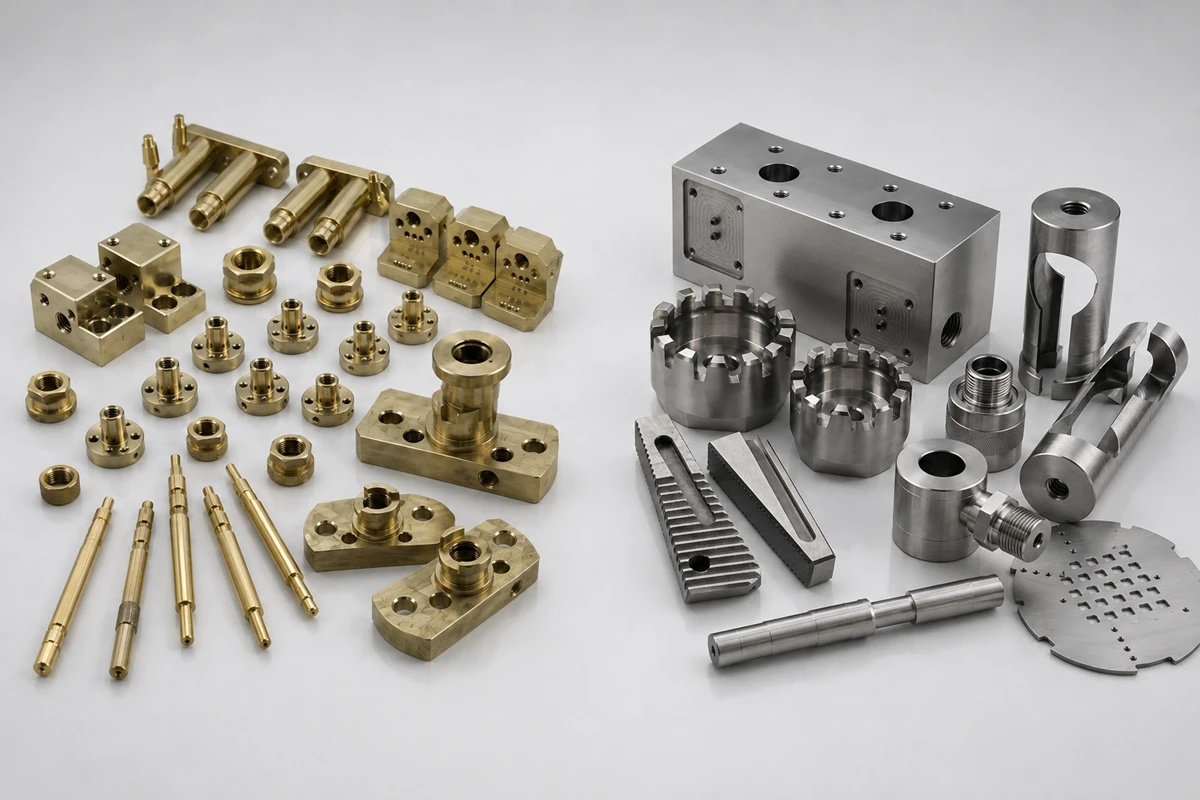
Brass and stainless steel can both produce accurate, durable CNC machined components, but they solve different engineering problems. Brass is a copper-zinc alloy family valued for machinability, conductivity and low-friction performance. Stainless steel is an iron-based alloy family containing sufficient chromium to form a protective passive film; depending on the grade, it can provide corrosion resistance, strength, hardness, wear resistance and cleanability.
The practical sourcing question is not “Which material is better?” It is “Which material gives this part the lowest total risk across function, machining, finishing, cleaning, assembly and service life?” A component that is inexpensive to machine but unsuitable for its environment can become the most expensive choice after redesign, corrosion, distortion, galling or field failure.
Key Differences Between Brass and Stainless Steel
| Decision Factor | Brass | Stainless Steel | Practical Impact |
| Machinability | Excellent in free-machining grades such as C360 | Grade-dependent; 303 machines more readily than 304/316L | Brass may reduce cycle time; stainless requires disciplined tooling and heat control. |
| Strength & rigidity | Moderate; alloy-dependent | Generally higher; precipitation-hardening and martensitic grades can be much stronger | Stainless is preferred for loaded shafts, frames, clamps and pressure-bearing parts. |
| Corrosion resistance | Good in many indoor, water and non-aggressive environments; sensitive to some ammonia and dezincification conditions | Strong overall; 316/316L improves resistance in chloride and washdown environments | Environment and cleaning chemistry must be reviewed by grade. |
| Electrical conductivity | Much higher than stainless steel | Low compared with copper alloys | Brass is useful for contacts, grounding features and conductive hardware. |
| Thermal conductivity | Higher | Lower | Brass spreads heat more readily; stainless can reduce heat transfer. |
| Hygiene & cleaning | Can be cleaned and some copper alloys have antimicrobial behavior, but chemistry and surface change must be considered | Smooth, non-porous and compatible with many sanitation routines | 304/316L dominate cleanable food, medical and dental hardware. |
| Vacuum suitability | Possible when alloy chemistry, outgassing, plating and cleanliness are controlled | Common choice, especially 304/316L, for vacuum-facing components | Vacuum projects need documented cleaning, trapped-volume review and surface requirements. |
| Surface appearance | Warm gold tone; can tarnish or be plated | Silver-gray; brushed, polished, passivated or electropolished | Finish affects aesthetics, corrosion, cleanability and dimensions. |
| Relative machining cost | Often lower for comparable geometry | Often higher due to slower cutting, tool wear and work hardening | Compare total delivered cost, not material price alone. |
What Is Brass CNC Machining?
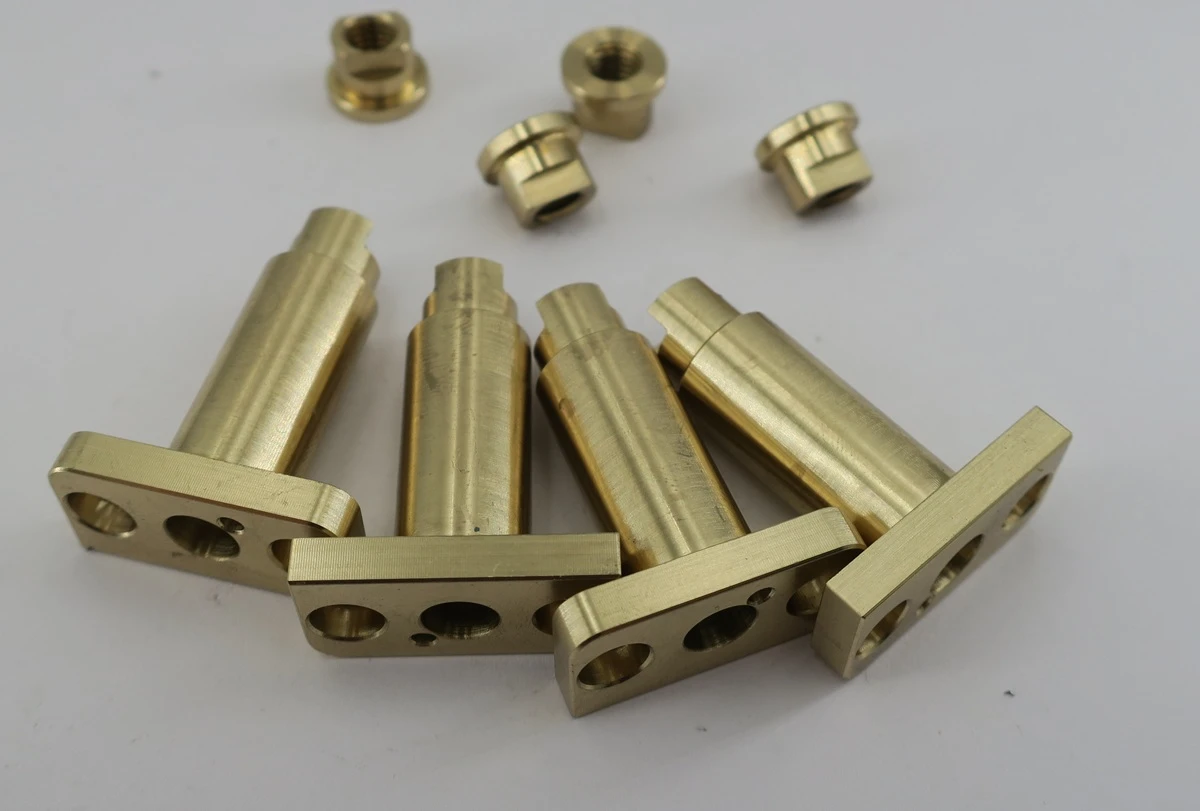
Brass CNC machining uses turning, milling, drilling, tapping and related processes to produce components from brass alloys. C360 free-cutting brass is widely selected for high-throughput turned parts, while lead-free or lower-lead brass grades may be required when regulations, potable-water contact or customer specifications restrict lead content. Naval brass and aluminum bronze may be considered for demanding corrosion or wear conditions, but they should not be treated as interchangeable with standard free-machining brass.
Where Brass Performs Best
- Fine threaded fittings, inserts, nuts, nozzles and adapters
- Electrical contacts, grounding hardware and conductive instrument components
- Bushings, adjusters, worm gears and low-friction interfaces
- Photonics alignment hardware and compact optical-instrument fittings
- Pogo-pin mounts, test-system contact blocks and measurement hardware
- Decorative or customer-facing components that benefit from a warm metallic finish
Brass Machining Risks to Control
Material certification matters because “brass” covers many chemistries with different lead content, strength, corrosion behavior and cutting characteristics. Sharp edges can form burrs on small holes or cross-drilled features; thin sections may distort during clamping; and surface appearance can change with fingerprints, oxidation or cleaning chemicals. If a part will be plated, the drawing should define masking, coating thickness and whether dimensions apply before or after plating.
What Is Stainless Steel CNC Machining?
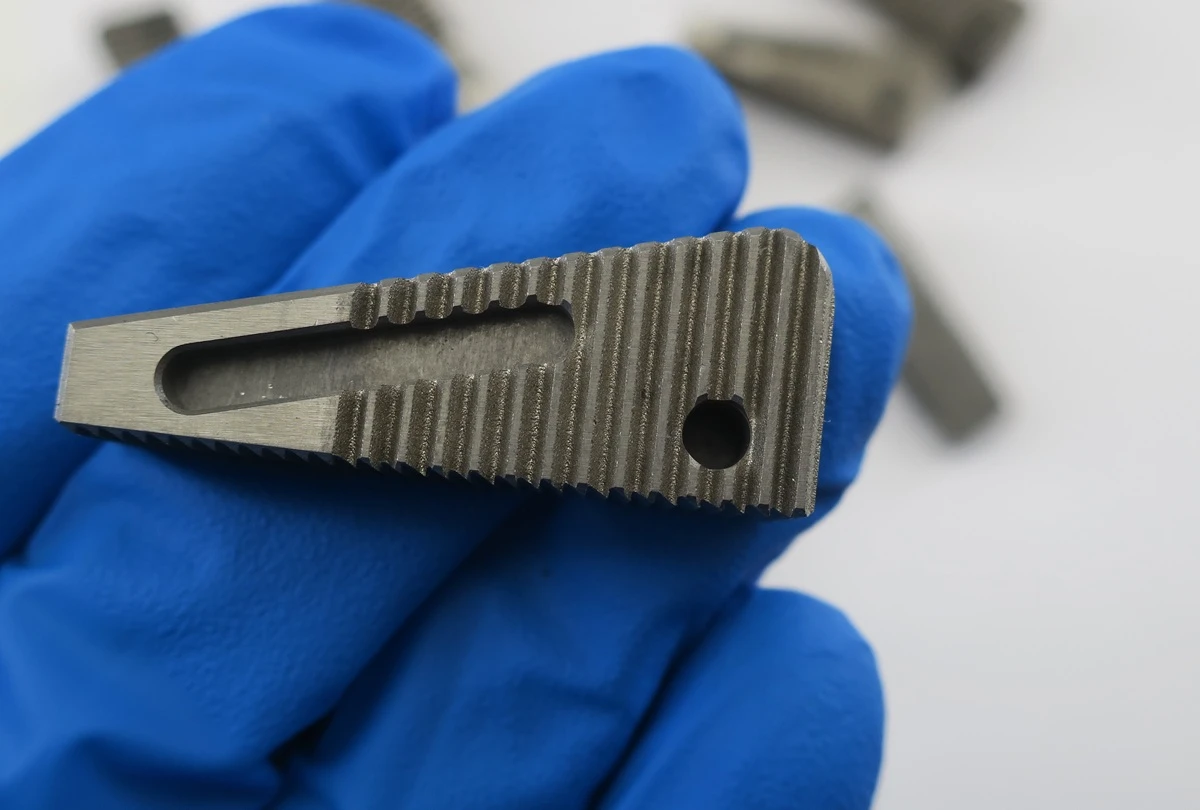
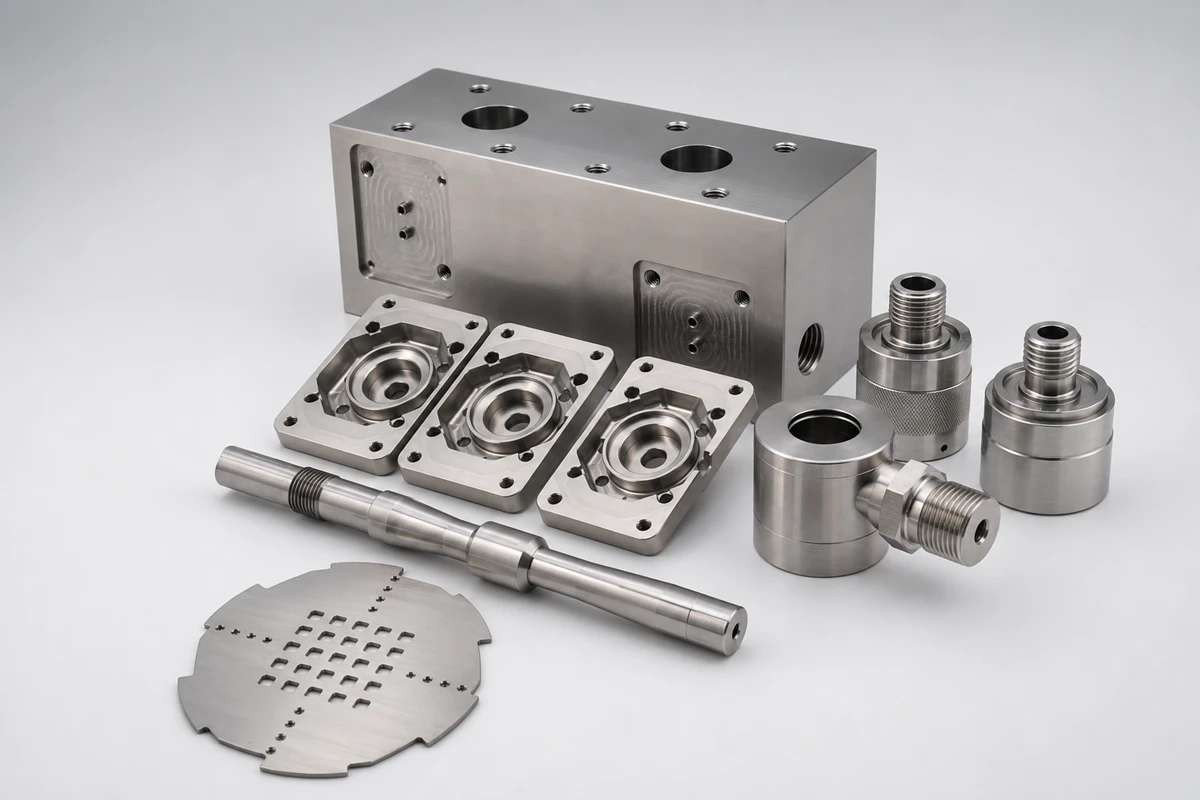
Stainless steel CNC machining converts corrosion-resistant stainless alloys into precision turned, milled, ground or Wire EDM components. Austenitic grades such as 304 and 316L are widely used for cleanable and corrosion-resistant hardware, but they can work-harden if tools rub instead of cut. 303 improves machinability for controlled environments. Martensitic grades such as 416, 420 and 440C support hardness and wear requirements. Precipitation-hardening grades such as 17-4PH and 15-5PH provide higher strength and dimensional performance when the heat-treatment condition is planned correctly.
Common Stainless Steel Grades for Precision Parts
| Grade | Why Engineers Choose It | Typical Precision Components |
| 303 | Best machinability among common austenitic stainless grades; suitable where maximum corrosion resistance is not required | Optical mounts, threaded adjusters, bushings, instrument hardware |
| 304 | Versatile corrosion resistance, formability and weldability | Equipment housings, brackets, guides, food-machine components |
| 316 / 316L | Improved resistance in chloride, washdown, high-purity and many medical environments; 316L supports welding with lower carbon content | Fluid manifolds, dental parts, medical hardware, vacuum interfaces, sanitary components |
| 416 | Free-machining martensitic stainless that can be heat treated | Shafts, pins, wear components, precision turned parts |
| 420 / 440C | Higher hardness and wear resistance after appropriate heat treatment | Cutting, bearing, valve and wear-related components |
| 17-4PH / 15-5PH | High strength with controlled aging conditions |
Why Stainless Steel Is More Difficult to Machine
Many stainless grades combine work hardening, toughness and relatively low thermal conductivity. Heat tends to remain near the cutting edge, while a hesitant tool path can harden the next layer of material. Stable workholding, sharp carbide tools, appropriate chip load, controlled coolant delivery and consistent tool engagement help protect tolerance and surface finish. For deep holes, small threads or thin walls, process sequencing and intermediate inspection become especially important.
Which Material Should You Choose by Application?
Photonics and Optical Systems
Photonics assemblies require stable interfaces, accurate threads, repeatable positioning and controlled surface finish. Brass is useful for small adjusters, conductive mounts, inserts and fittings that benefit from smooth machining. Stainless steel—often 303 for machinability or 304/316L for corrosion performance—is better for rigid posts, load-bearing clamps, lens-holder bases, vacuum-side hardware and components that must retain geometry through repeated assembly.
Typical Photonics Parts
- Lens-holder bases and clamps
- Mirror-mount posts and adjusters
- Fiber-coupling hardware
- Detector housings and sensor fittings
- Optical-bench adapters and threaded inserts
Quantum Technology and Vacuum Instrumentation
Quantum sensing, atomic physics, cryogenic measurement and quantum-optics platforms often combine vacuum, magnetic, thermal and alignment constraints. Stainless steel is frequently selected for UHV-compatible flanges, manifolds, chamber interfaces, shafts and structural hardware. Brass or other copper alloys may be used for conductive interfaces, contact blocks, adjustment hardware and components where thermal transfer or non-sparking behavior is valuable. The final selection should consider magnetic permeability, cleaning, outgassing, trapped volumes, dissimilar-metal contact and the complete assembly environment.
Typical Quantum-System Parts
- Vacuum manifolds and chamber interface blocks
- Optomechanical mounts and alignment hardware
- Cryogenic instrument brackets and sensor fixtures
- Non-standard threaded fittings and feedthrough bodies
- Contact blocks, pogo-pin mounts and conductive adapters
Food Machinery
Food machinery parts must tolerate product contact, frequent washdown and cleaning chemicals while avoiding crevices that trap residue. 304 stainless steel is widely used for general food-equipment components, while 316/316L may be selected for more aggressive chloride exposure, salt, acidic products or demanding sanitation regimes. Brass may suit non-product-contact bushings, valves or fittings when regulations and cleaning compatibility allow, but lead content and dezincification risk must be reviewed.
Typical Food-Machinery Parts
- Filling and depositing nozzles
- Valve bodies, manifolds and sanitary adapters
- Guide shafts, rollers and change parts
- Pump and dosing components
- Washdown-resistant sensor housings
Medical Devices
Medical-device machining requires more than a tight tolerance. Material traceability, documented inspection, clean handling, risk controls and change management influence supplier selection. 316L is common for corrosion-resistant medical hardware and fluid-contact components; 17-4PH may be appropriate when higher mechanical strength is needed; and 303 may be suitable for non-patient-contact instrument mechanisms in controlled environments. The drawing and device risk analysis—not a generic “medical grade” label—should define the approved alloy, standard and finish.
Typical Medical Components
- Surgical-navigation housings and tracking hardware
- Diagnostic-instrument manifolds and fluidic blocks
- Instrument shafts, couplings and alignment pins
- Sterilizable brackets and fixtures
- Medical imaging and laboratory automation components
Dental Equipment
Dental devices combine small features, repeated sterilization, fluid exposure, ergonomic assembly and cosmetic expectations. 316L stainless steel is often chosen for reusable components exposed to cleaning or bodily fluids, while hardened stainless grades may support wear interfaces. Brass can be useful inside dry, enclosed mechanisms, air fittings or adjustment hardware when the design and applicable regulatory requirements permit it.
Typical Dental Components
- Handpiece and instrument housings
- Irrigation or fluid-control fittings
- Dental navigation and optical tracking components
- Implant-tool interfaces and alignment parts
- Chairside equipment manifolds, shafts and adapters
Surface Finishes: Specify Function, Not Appearance Alone
Surface finishing can change corrosion behavior, cleanability, wear, appearance and final dimensions. Critical bores, threads, sealing faces, electrical contacts and datum surfaces should be identified before finishing. When a drawing states only “polish” or “passivate,” suppliers may interpret the result differently; specify the applicable standard, target roughness, masking and acceptance criteria whenever those details affect function.
| Material | Finish / Treatment | What It Can Achieve | Drawing Considerations |
| Stainless steel | Passivation | Removes free iron contamination and supports the natural passive surface | State the required standard and method when controlled; define post-treatment testing if needed. |
| Stainless steel | Electropolishing | Smooths microscopic peaks, improves cleanability and can enhance corrosion performance | Allow for material removal; protect fits, threads, edges and critical dimensions. |
| Stainless steel | Mechanical polish / brush / bead blast | Controls roughness and visual texture | Define Ra where functional; control direction and avoid contamination from carbon-steel media. |
| Brass | Nickel, tin, silver or other plating | Changes corrosion, conductivity, solderability, wear or appearance | Specify plating system, thickness, underplate, masking and after-plating dimensions. |
| Brass | Polish / brush / protective coating | Improves appearance and helps manage tarnish | Clarify whether color change over time is acceptable. |
How Rollyu Controls Precision and Quality
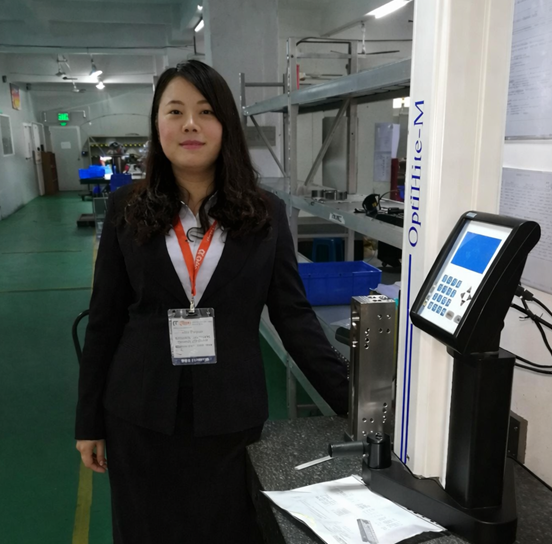
Rollyu Precision supports prototypes and production parts through CNC turning, 3-axis to 5-axis milling, Swiss-type turning, EDM, grinding, finishing coordination and inspection. Our ISO 9001:2015 and ISO 13485:2016 systems support customers that need documented quality controls for precision equipment and medical-device supply chains.
- Engineering review of material, tolerance, datum structure, thread callouts and finishing requirements before production
- Process planning for work-hardening stainless steel, burr-sensitive brass features, thin walls, deep holes and small threads
- CMM, optical and dimensional inspection selected to match feature risk
- Material certificates, inspection reports and first-article documentation when required by the purchase order
- Typical machining capability down to ±0.005 mm (0.0002”) for suitable geometry, material and inspection conditions
- One point of contact for machining, finishing, quality coordination and delivery
| Important tolerance note: A blanket ±0.005 mm (0.0002”) tolerance is not appropriate for every feature. Part size, wall thickness, grade, heat treatment, finish, datum access and inspection method must be reviewed. Rollyu’s engineering team will identify high-risk callouts and propose a practical control plan before production. |
Design-for-Manufacturing Tips That Reduce Cost and Risk
Choose the exact alloy and condition. “Stainless steel” or “brass” alone is not a complete material specification.
Separate functional tolerances from general tolerances. Reserve the tightest limits for interfaces that drive fit, sealing, alignment or motion.
Define whether dimensions apply before or after passivation, electropolishing, plating or other finishing.
Avoid unnecessarily deep pockets, extreme tool-length ratios and tiny internal corner radii unless they are functionally required.
Provide realistic thread depth and relief. Blind micro-threads, deep tapped holes and intersecting passages need early review.
Specify burr and edge requirements. Cross holes, slots, fluid passages and optical assemblies may need targeted deburring and cleanliness controls.
Identify sealing faces, optical datums, electrical contact zones and no-touch cosmetic surfaces on the drawing.
Plan inspection access. A tolerance that cannot be reliably measured may need a different datum scheme or verification method.
What to Include in Your RFQ
A complete RFQ helps Rollyu quote faster and reduce assumptions. Send:
- 3D CAD files (STEP is preferred) and a controlled 2D drawing
- Material grade, standard and condition or temper
- Required quantity, prototype quantity and expected production volume
- Critical dimensions, GD&T, threads and surface-roughness requirements
- Passivation, electropolishing, plating, polishing or masking requirements
- Application environment: vacuum, washdown, sterilization, food contact, chloride, cryogenic or thermal cycling
- Inspection and documentation needs: CMM report, FAI, material certificate, certificate of conformity or traceability
- Target delivery date and packaging/cleanliness expectations
Frequently Asked Questions
Is brass easier to CNC machine than stainless steel?
Generally, yes. Free-machining brass such as C360 can support high cutting speeds, short chips and good surface finish. Stainless steel usually requires lower cutting speeds, more robust tooling and careful control of heat and work hardening. However, geometry, grade, tolerance and finish can outweigh the base material difference.
Which is stronger: brass or stainless steel?
Stainless steel is generally stronger and more rigid than common machining brasses. The exact comparison depends on alloy and condition. If the component carries structural load, resists pressure or must survive repeated mechanical cycles, a suitable stainless grade is often the safer starting point.
Which material is better for photonics components?
Both can be appropriate. Brass is useful for precision adjusters, inserts and conductive hardware. Stainless steel is preferred for rigid mounts, shafts, clamps, vacuum-side parts and corrosion-resistant structures. Thermal stability, magnetic behavior, mass and interface materials should be reviewed at the assembly level.
Which stainless steel grade is best for medical and dental equipment?
316L is commonly selected for corrosion resistance, cleaning and reusable medical or dental hardware, but there is no universal “best” grade. 17-4PH may suit higher-strength mechanisms, while 303 may suit non-patient-contact instrument components in controlled environments. The device requirements and applicable standards determine the final choice.
Is 304 or 316 stainless steel better for food machinery?
304 is widely used for general food-equipment components. 316 or 316L may be better where chlorides, salt, acidic products, repeated chemical cleaning or aggressive washdown increase corrosion risk. Surface design and cleanability are as important as alloy selection.
Can stainless steel be used in ultra-high-vacuum systems?
Yes. Properly specified and processed 304 or 316L stainless steel is widely used in high-vacuum and UHV hardware. Success depends on material condition, joint design, trapped-volume control, surface finish, cleaning, handling and assembly—not the alloy name alone.
Can Rollyu machine both prototype and production quantities?
Yes. Rollyu supports rapid prototypes, engineering validation quantities and repeat production. The recommended process and inspection plan are adjusted to geometry, volume, tolerance risk and documentation requirements.
What files should I send for a CNC machining quote?
Send a STEP model plus a PDF drawing whenever possible. Include material, quantity, tolerances, GD&T, threads, finish, critical-to-function features, inspection requirements and the operating environment. If the design is early-stage, Rollyu can review it for manufacturability before final quotation.
Request a Quote for Brass or Stainless Steel CNC Machined Parts
| Ready to move from design to production? Send your 3D CAD file, 2D drawing, material specification, quantity and application requirements to Rollyu Precision. Our engineering team will review manufacturability, critical tolerances, surface finishing and inspection needs, then provide a clear quotation and production plan. |