
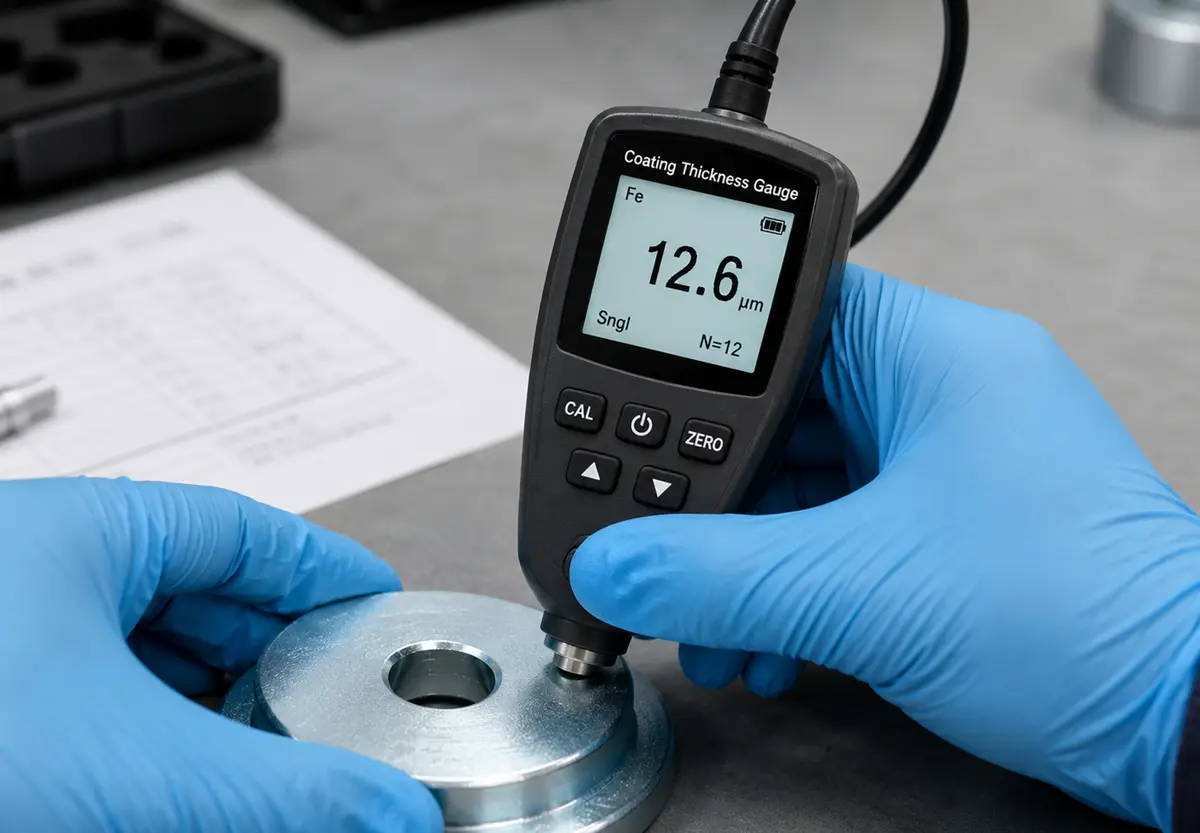

Specify zinc plating by base metal, exposure, thickness, supplementary finish, and masked features before CNC steel parts reach quote review. ASTM B633-23 covers electrodeposited zinc coatings on iron and steel for corrosion protection and advises users to review the full specification before setting coating requirements.
Zinc plating protects steel, but coating buildup can break fits when drawings leave thickness, masking, or inspection open. The main design checks are thread fit, bearing seats, contact faces, hydrogen embrittlement risk, and post-plating verification.
What Is Zinc Plating for CNC Parts?
Zinc plating for CNC parts is a thin electroplated zinc coating used on machined steel parts to slow corrosion without burying precision features. It fits small hardware, brackets, spacers, shafts, and housings where the finished size still matters.
Zinc plating changes hole sizes, thread fit, bearing seats, and contact faces, so drawings should define coating thickness, passivate color, masking, and post-plating inspection before quoting and machining plans are locked.
Why Do Machined Steel Parts Use Zinc Plating?
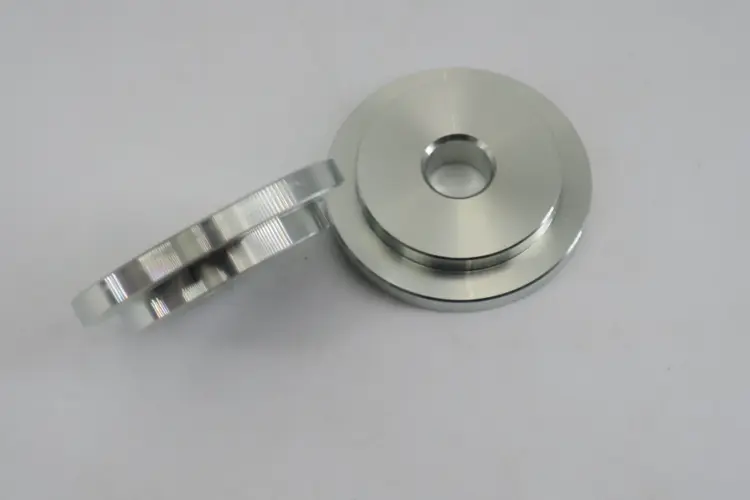
Machined steel parts use zinc plating when the part needs low-cost corrosion protection without the thickness of hot-dip galvanizing or paint. Zinc plating fits steel hardware that sees storage, handling, indoor service, light outdoor exposure, or assembly contact with other components.
Sacrificial Corrosion Protection
Zinc plating gives steel sacrificial corrosion protection: zinc corrodes before the steel substrate in many service conditions. Small scratches may still leave nearby zinc available to corrode first, which helps delay red rust on steel.
This protection fits machined brackets, fixture parts, spacers, and housings that do not justify stainless steel. Severe salt spray, outdoor exposure, and chemical contact may need thicker zinc, zinc-nickel plating, paint, stainless steel, or another coating system.
Cost-Effective Protection for Steel Hardware
Zinc plating often costs less than switching every part to stainless steel or adding a multilayer coating system. The zinc plating process adds a thin protective layer while preserving machined detail better than thick coatings, so buyers can keep carbon steel or alloy steel where strength, machinability, and cost matter.
Cost savings disappear when the drawing ignores masking, threads, baking, or inspection. Replating, thread chasing, rework, and lot sorting can exceed the price of a better finish note.
Storage, Handling, and Assembly Protection
Zinc plating helps protect steel brackets, fixture blocks, spacers, and other automation equipment components during shipping, shelf storage, glove handling, and repeated assembly trials. Bare steel can flash rust from fingerprints, humidity, or wet packaging, and early corrosion can make a new lot look old before the parts reach incoming inspection.
Storage protection depends on passivation, drying, packaging, and part geometry. Trapped rinse water in blind holes or crevices can still cause staining or white corrosion products, so design details matter as much as the coating choice.
How Thick Should Zinc Plating Be on CNC Parts?
Zinc plating thickness should match exposure and dimensional risk. Many zinc-plating callouts fall around 5 to 25 micrometers, but the right minimum depends on service environment, thread class, mating fits, masking, and the coating standard named on the drawing.
Thickness by Exposure Condition
Use thickness as an engineering input, not a decoration note. A thicker coating can improve corrosion life, but it also tightens threads, bores, slots, and close-fit faces.
| Exposure condition | Common zinc plating target | Design note |
|---|---|---|
| Clean indoor handling | 5 to 8 micrometers | Lower buildup for light storage and handling risk |
| Industrial indoor use or repeated handling | 8 to 12 micrometers | Better protection for shelves, assembly trials, and mild humidity |
| Outdoor, humid, or higher corrosion exposure | 12 to 25 micrometers | Check passivate type, corrosion test target, and fit impact |
| Severe salt, chemical, or heat exposure | Consider zinc-nickel plating or another finish | Standard zinc may age too quickly for harsh service |
Confirm the exact class, minimum thickness, and test requirement against the purchased standard or customer specification. A supplier should not guess the exposure category from the part name.
Coating Buildup on Precision Features
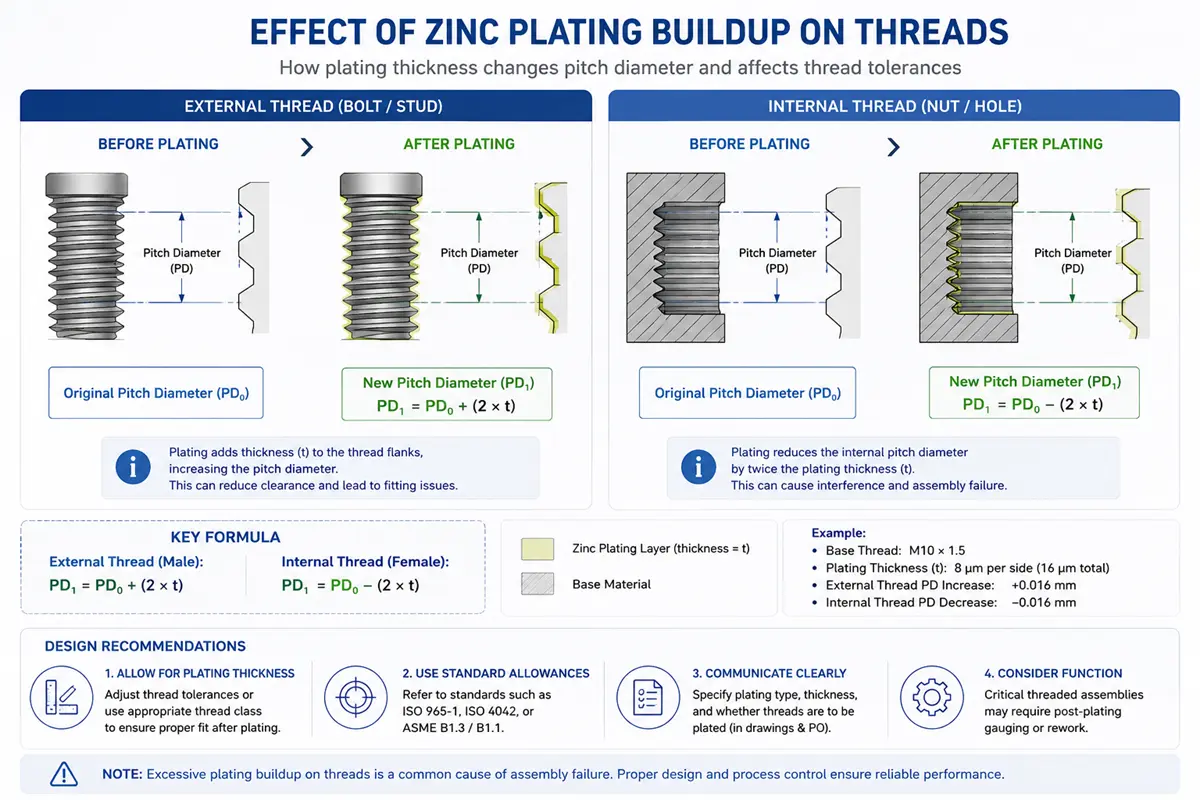
Every micrometer of zinc plating adds material to outside surfaces and reduces open space inside holes, slots, and grooves. On a round shaft, 10 micrometers per side can add about 20 micrometers to diameter if deposition is even. Electroplating is rarely even on complex geometry.
For tight CNC features, assign tolerances after finish or define which dimensions apply before and after plating. This detail matters for dowel bores, slip fits, bearing seats, gasket faces, alignment shoulders, and any feature measured at incoming inspection.
Threads, Holes, and Tight-Fit Surfaces
Threaded features need plating review: external threads grow, and internal threads tighten after zinc builds on the flanks. A thread that gauges correctly before plating can bind after plating, especially on fine-pitch threads or close class fits.
Call out thread condition clearly: machine oversize or undersize before plating, mask selected threads, chase after plating only when allowed, or inspect with go/no-go gauges after plating. If the drawing mixes threaded holes, tapped holes, and close-fit mating hardware, review the difference between a tapped hole and threaded hole before the plating allowance is locked.
Masking Areas That Must Stay Unplated
Masking keeps zinc off surfaces that must stay at bare-metal size or maintain electrical, sealing, bearing, or cosmetic function. Masked areas should be named on the drawing with feature IDs, not left to a plating shop guess.
Use masking notes for precision bores, datum pads, press fits, bearing seats, ground faces, sealing lands, sliding rails, contact faces, and internal threads with little tolerance room. Masking adds handling time, so avoid masking every surface when only two features control assembly.
What Design Risks Should Engineers Check Before Zinc Plating?
Engineers should check zinc plating risks before release because plating follows current flow, fluid access, material strength, and part geometry. The main failure modes are thin coverage in recesses, excess buildup on exposed edges, trapped solution, bad fits, and hydrogen embrittlement in high-strength steel.
Sharp Edges and Uneven Coating Coverage
Sharp edges create uneven coating as current concentrates on exposed corners while recesses receive less deposit. Burrs can plate over, break loose later, or hold corrosion products at the edge.
Add small chamfers or radii where the design allows. Clean edge quality also matters before finishing because deburring CNC parts reduces burrs that trap plating chemistry, cut gloves, or break loose during assembly.
Blind Holes, Pockets, and Trapped Solution
Blind holes, deep pockets, and closed slots can trap cleaner, acid, rinse water, or plating solution. Trapped liquid can stain the finish, cause white rust, or bleed out after packaging.
Add drain paths where possible. Avoid deep blind features that do not need to be blind. Review hole depth, pocket access, thread location, and racking direction before the finish plan is locked.
Press Fits, Bearing Seats, and Contact Faces
Press fits, bearing seats, dowel bores, and contact faces often need masking or post-plating machining. Zinc plating changes size and surface feel, and the finish can crush or scrape during interference assembly.
Define whether the mating face must remain bare steel, accept plating, or be machined after plating. For electrical contact faces, zinc and passivate can change contact resistance, so the drawing should name the required contact condition instead of relying on finish color.
Hydrogen Embrittlement in High-Strength Steel
High-strength steel can crack after acid cleaning and electroplating because atomic hydrogen can enter the steel and reduce ductility under stress. ASTM B633-23 states that high-strength steels above 1700 MPa, 247 ksi, or 46 HRC should not be zinc electroplated under that specification.
Risk review should happen before quoting 4130, 4140, 17-4 PH, spring steel, hardened shafts, or loaded threaded parts. If a design team is still choosing between 4130 and 4140 steel, the plating plan should be checked along with hardness, heat treatment, and service load instead of added after material selection.
How Should Zinc-Plated CNC Parts Be Specified and Inspected?
A zinc plating callout should tell the supplier what to plate, how thick the coating must be, what supplementary finish is required, and what surfaces must stay unplated. A vague “zinc plate all over” note creates quote gaps, tolerance disputes, and inspection misses.
Drawing Notes for Plating Thickness and Finish Type
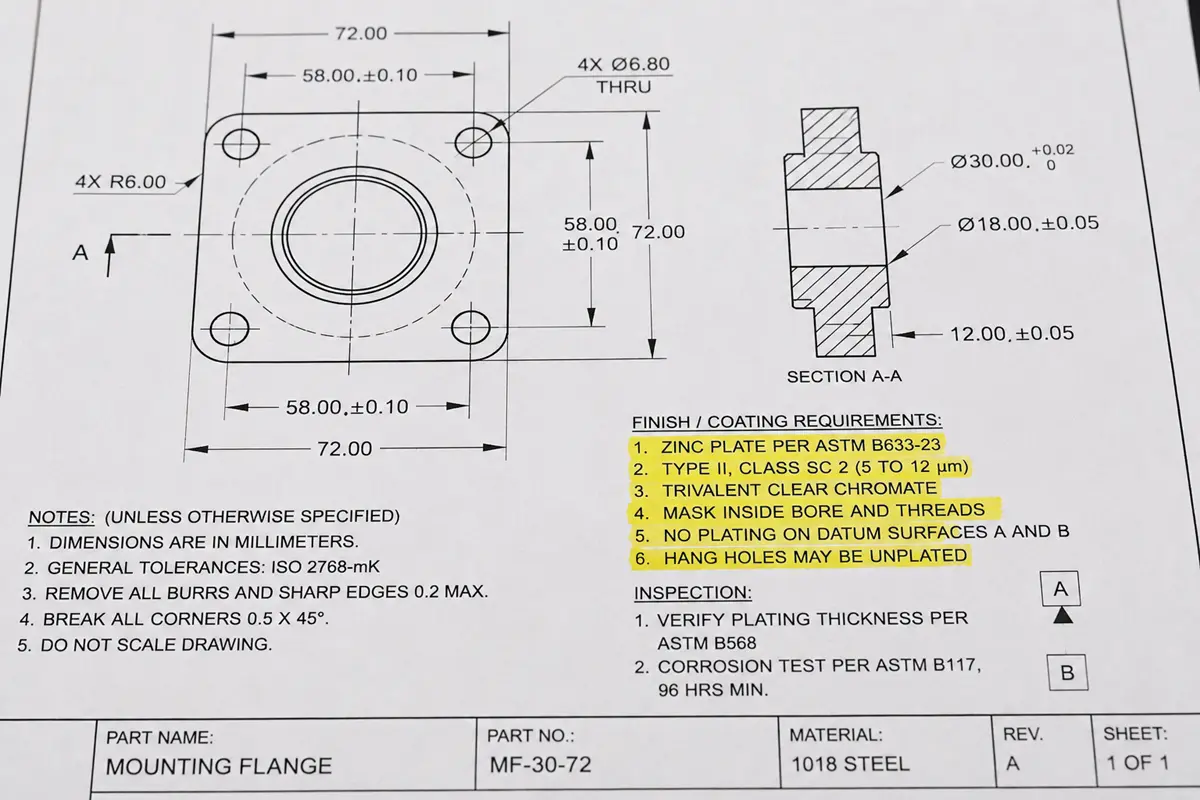
A useful drawing note names the base material, standard, thickness or class, supplementary finish, color, RoHS or hexavalent-chromium restriction, masked features, post-bake requirement, and inspection method. The note should also state whether dimensions apply before or after plating.
Example: Zinc plate steel parts per ASTM B633, 12 micrometers minimum unless noted, trivalent clear passivate, mask bearing bores and datum pads, bake high-strength steel parts per approved process, inspect thickness after plating. Adjust the wording to match the purchased standard, customer contract, and coating supplier capability.
When buyers quote custom CNC machining parts, the finish note should travel with the CAD file, 2D drawing, material grade, target quantity, and inspection requirements. This package gives the machining supplier enough context to review plating buildup before cutting steel.
ASTM B633 and ISO 2081 Callouts
ASTM B633 and ISO 2081 are common references for electroplated zinc on iron or steel. ASTM B633-23 covers electrodeposited zinc coatings for corrosion protection and includes supplementary finish types. ISO 2081 is commonly used for electroplated zinc coatings with supplementary treatments on iron or steel.
Do not mix standards inside one vague note. Choose the governing standard, use the exact designation from that standard, and define any customer-specific passivation, RoHS, salt-spray, hydrogen embrittlement, or appearance requirement outside the standard callout when the contract needs more detail.
Post-Plating Baking Requirements
Post-plating baking is a risk-control step for susceptible high-strength steel, not a universal repair. Baking time and temperature depend on material strength, hardness, coating process, part section, and the governing customer or industry requirement.
Put the baking requirement in the purchase order when hydrogen embrittlement risk matters. A supplier cannot infer the correct bake from a generic zinc plating note, and missing bake records can block acceptance for loaded hardware.
Coating Thickness, Adhesion, and Corrosion Checks
Inspection should verify coating thickness, adhesion, appearance, thread function, corrosion requirement, and masked areas. ASTM B633-23 lists coating requirements for appearance, thickness, adhesion, corrosion resistance, and hydrogen embrittlement, so inspection should match the risk named on the drawing.
For inspection-heavy RFQs, Rollyu Precision can review machined dimensions, custom finishing notes, CMM inspection needs, dimensional reports, and material traceability before production. That supplier review matters most when zinc-plated parts combine close fits, post-plating gauges, and customer documentation requirements.
FAQ
Is zinc plating the same as galvanizing?
Zinc plating is different from hot-dip galvanizing. Zinc plating is usually a thinner electroplated coating. Hot-dip galvanizing immerses steel in molten zinc and normally creates a much thicker coating. If a drawing says “galvanized,” confirm whether the buyer means zinc electroplating, hot-dip galvanizing, or another zinc coating.
Can aluminum CNC parts be zinc plated?
Standard zinc electroplating is usually a poor fit for aluminum CNC parts. Aluminum forms a different surface oxide and needs its own pretreatment route, so anodizing, chemical conversion coating, nickel plating, painting, or powder coating usually fits better. Confirm the finish by base material before quoting.
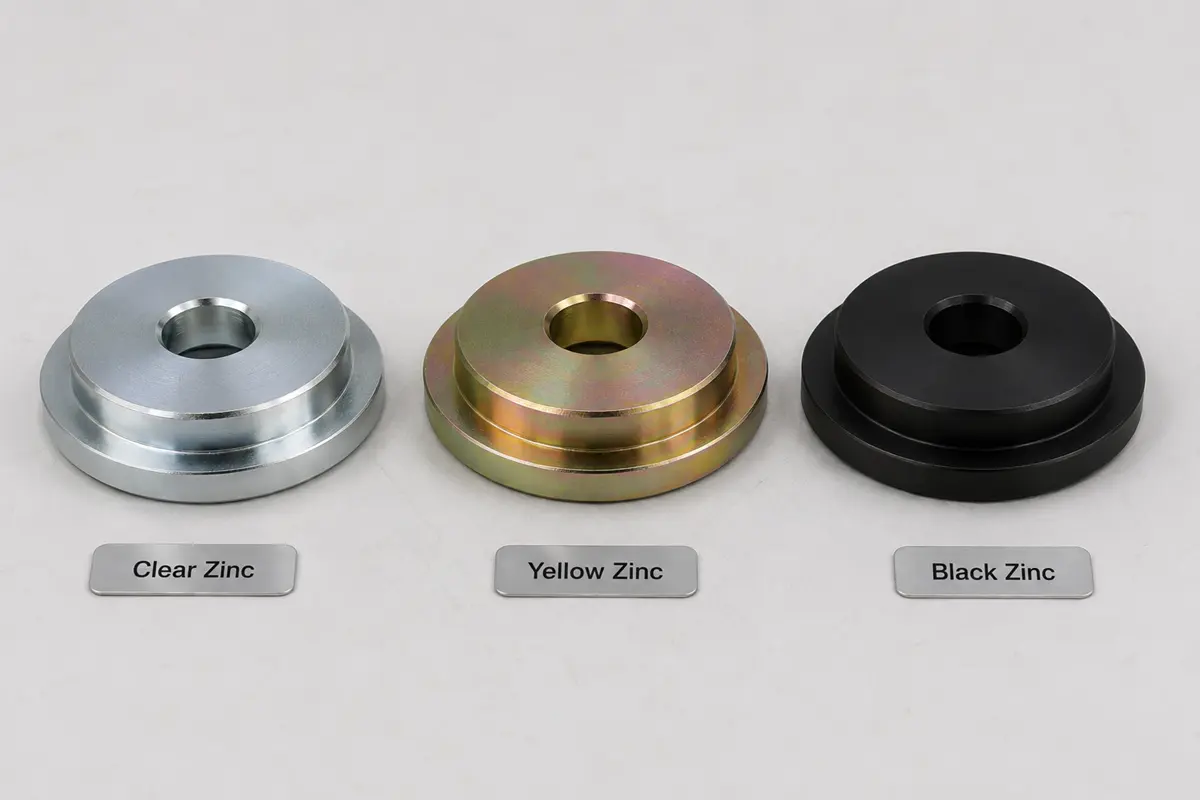
What is the difference between clear zinc, yellow zinc, and black zinc plating?
Clear, yellow, and black zinc refer to zinc plating with different passivate or conversion treatments. Finish color affects appearance and can relate to corrosion performance, but color alone does not define thickness, salt-spray requirement, RoHS status, or hexavalent-chromium restrictions. The drawing should name both color and performance requirement.
What causes white rust on zinc plated parts?
White rust is zinc corrosion on the plated surface. White rust often comes from moisture, poor drying, trapped rinse, sealed packaging, or storage before the passivate has stabilized. White rust may start as a cosmetic issue, but visible corrosion can signal poor drying, storage, or process control issues.
When is zinc-nickel plating better than standard zinc plating?
Zinc-nickel plating fits parts that need more corrosion, temperature, or galvanic protection than standard zinc can provide. Automotive hardware, salt-exposed parts, and higher performance steel components often use zinc-nickel plating because the alloy protects longer in harsher service. Cost, supplier availability, and inspection requirements also increase.