
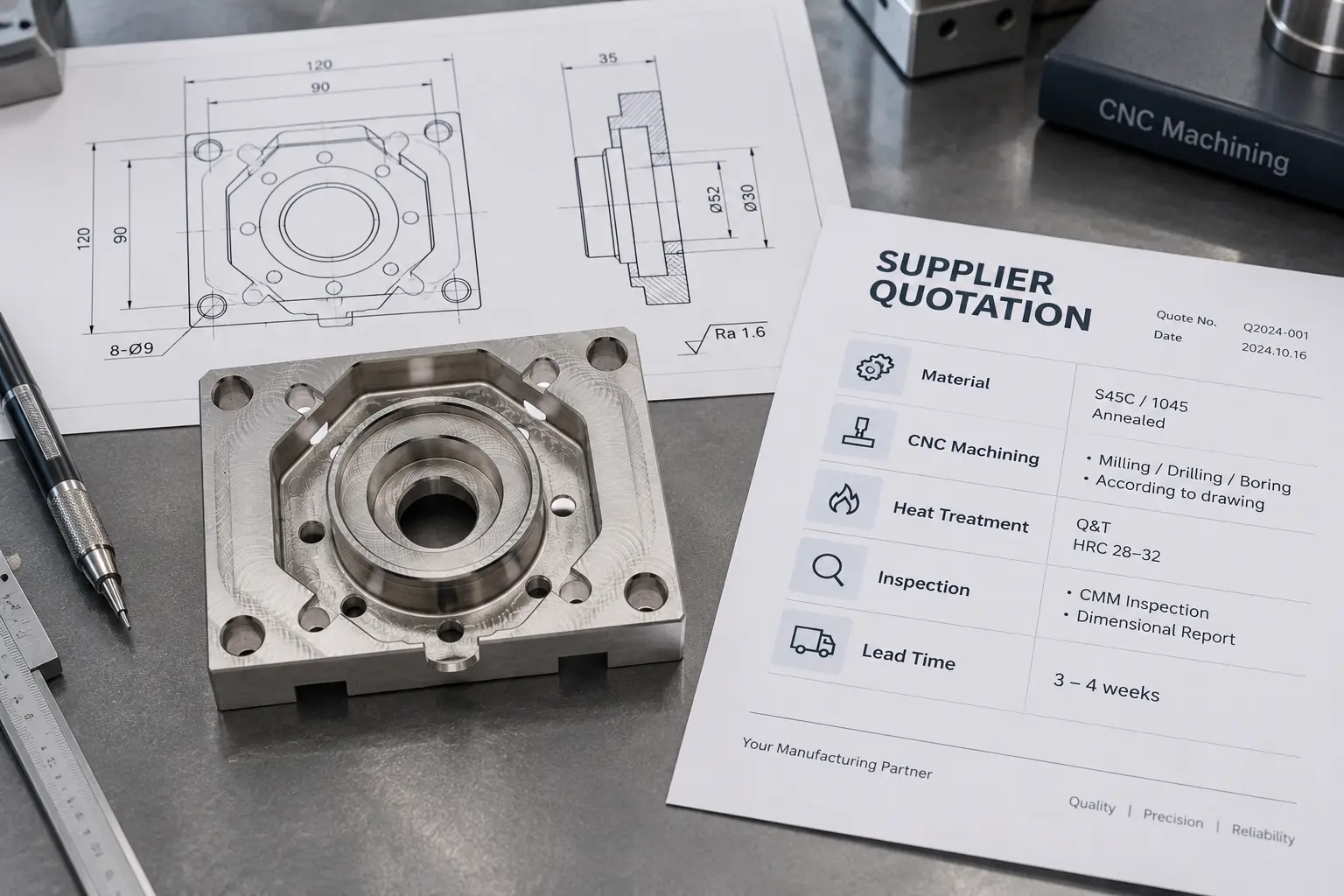

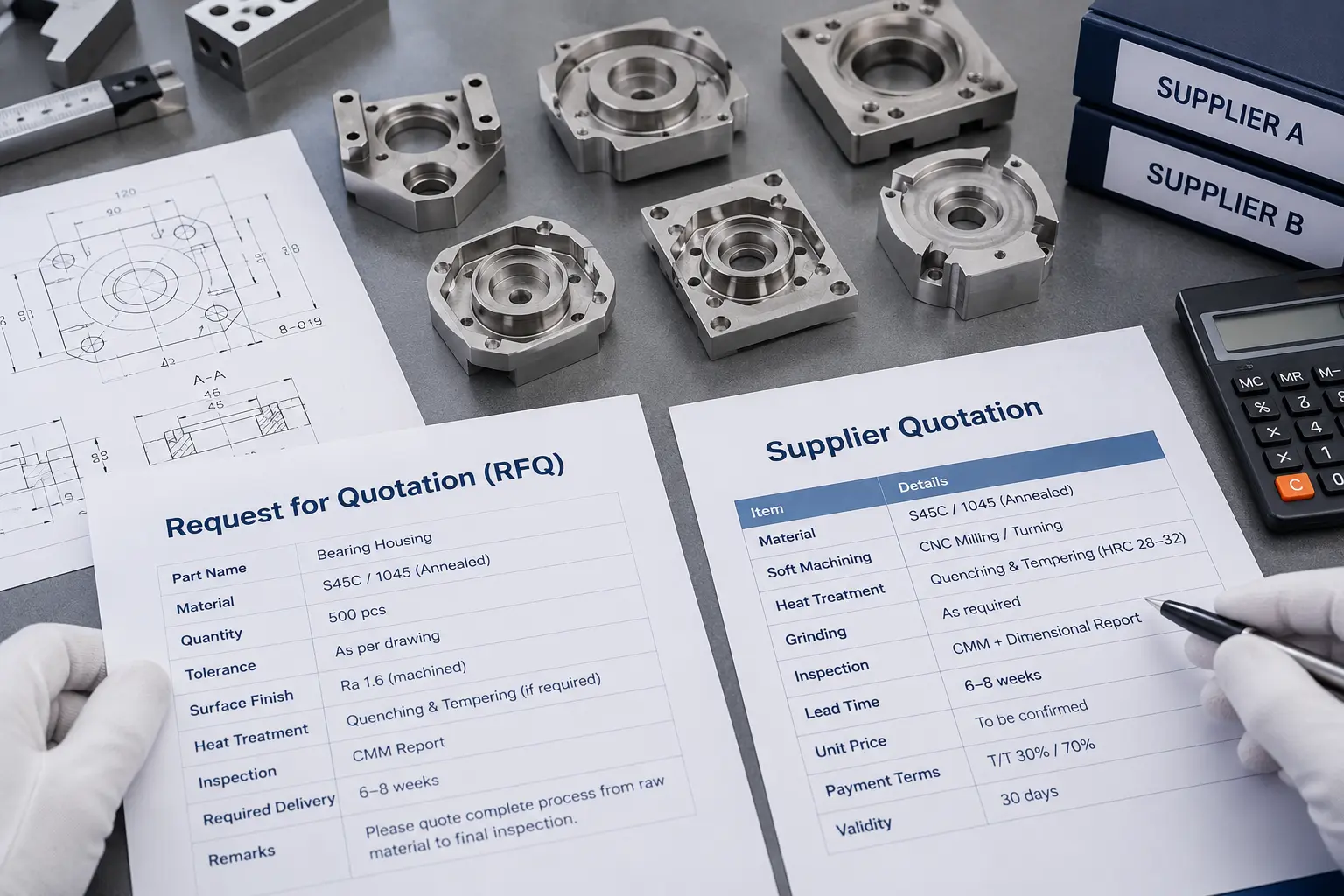
Compare soft machining quotes only after both suppliers price the same complete route from incoming stock through final inspection. A low unit price can omit heat-treatment coordination, post-treatment cutting, grinding, process records, or rework that another supplier has included.
Sourcing Engineers, Project Buyers, and Procurement Managers need a consistent method to normalize scope, test schedule credibility, expose unpriced secondary operations, and assign nonconformance risk before issuing a purchase order.
What Does a Complete Soft Machining Quote Cover?
Soft machining removes the bulk of material before heat treatment hardens a steel part. Milling, turning, drilling, or boring operations rough and semi-finish the near-net geometry while the workpiece remains in a machinable condition. Once thermal processing increases hardness, hard turning, wire EDM, or finish grinding brings critical datums, bearing journals, and tight bores to final tolerance.
Comparing supplier proposals requires confirming where pre-hardening work ends. A quote for soft machining alone covers only early material removal; it leaves subsequent distortion control, intermediate logistics, finish stock allowances, and final dimensional validation unaddressed. Because quenching and tempering induce thermal and metallurgical movement, the agreed route must specify an intermediate state with adequate stock allowance to clean up distortion during finish machining.
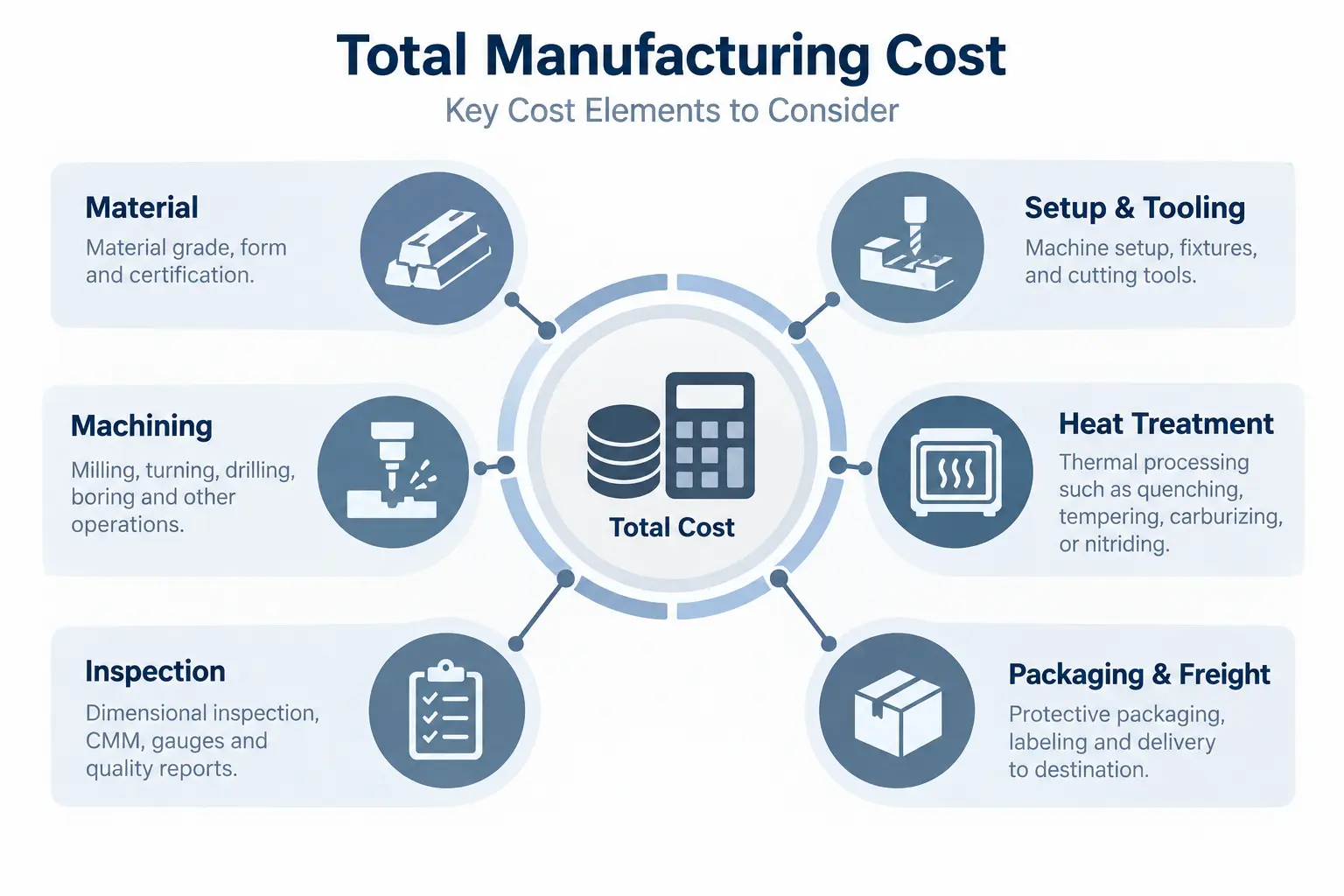
Normalize Both Quotes to One Manufacturing Route
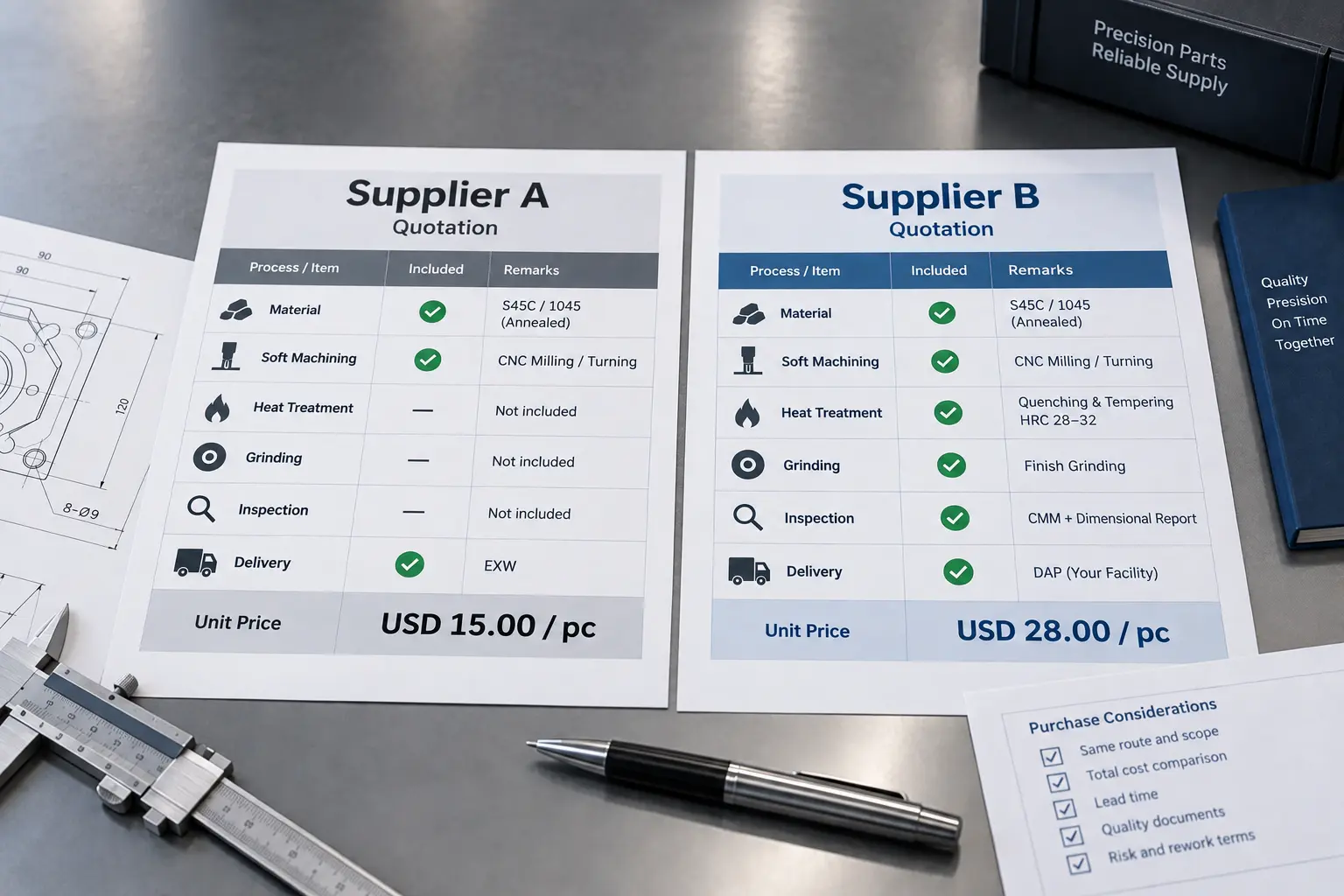
Build one route matrix before comparing prices. If Quote A and Quote B assume different starting material conditions, operation splits, inspection gates, or delivery boundaries, their unit prices describe entirely different deliverables.
| Route Stage | What the Quote Should Identify | Cost Exposure if Unclear | Award Question |
|---|---|---|---|
| Material and starting condition | Grade, stock form, supplied condition, certification, quantity | Substitution, added stock, minimum mill charge | Are both suppliers pricing the same material condition? |
| Soft machining | Included operations, setups, fixtures, features left oversize | Added setup, tooling, or later stock removal | Does the price create the same pre-treatment geometry? |
| Heat treatment | Process specification, responsible party, handling, transport, records | Outside-process minimum, freight, queue time | Is heat treatment included, coordinated, or excluded? |
| Intermediate verification | Part identity, visual check, hardness or process evidence when specified, dimensional baseline | Extra inspection, sorting, or rejected transfer | What evidence releases the part to final machining? |
| Hard machining or EDM | Features, process, setup, tooling, and allowance | Higher tool cost, slower cutting, additional setup | Which features does the supplier complete after treatment? |
| Grinding | Surface or diameter, finish, geometry, stock removal, inspection method | Grinding setup, wheel dressing, minimum charge | Is grinding required, and is it included? |
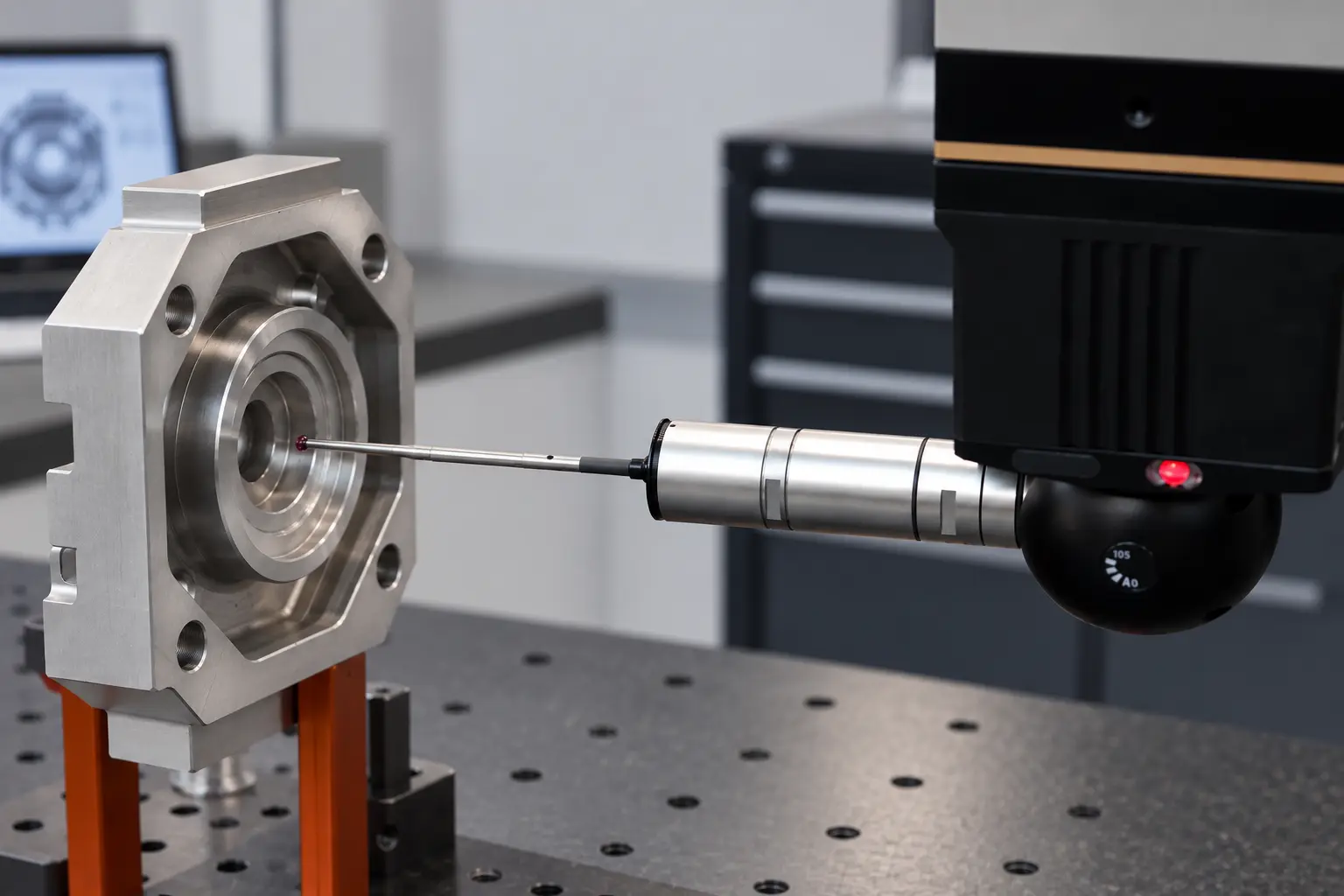
| Final inspection | Characteristics, sampling, instruments, actual-value report | CMM time, gauges, programming, report preparation | Does final inspection match the released drawing? |
| Quality documents | CoC, MTR, heat-treatment record, dimensional report, FAI, or other named records | Document fees, delayed acceptance, missing evidence | Which records ship with the parts? |
| Packaging and delivery | Protection, labeling, freight, Incoterm, destination | Packaging upgrades, taxes, freight, handling | Are both totals compared at the same delivery point? |
| Nonconformance and rework | Notice, disposition, reprocessing, resubmission, scrap, freight | Unpriced correction and schedule risk | Who pays when work fails the agreed requirement? |
Material Condition and Soft Machining Scope
Evaluate the incoming stock specification before checking machining operations. Quoting annealed bar stock for pre-hardening machining entails different cycle times, tool wear, and downstream distortion compared to machining pre-hardened material. Both options can be valid, but their manufacturing economics and finishing requirements are not interchangeable.
The line item for soft machining should clearly indicate which surfaces remain oversized. Unfinished datums, deep bores, or threaded holes left for post-hardening operations require dedicated setups later. Vague line items such as “CNC machining” obscure whether a quote includes basic roughing or pre-finishes every feature ready for final grinding.
Heat-Treatment Handoff
Thermal processing requires clear commercial ownership. The quote must define whether the machining vendor coordinates outside heat treatment, manages intermediate transit, and assumes custody during thermal cycles. Logistics and technical acceptance serve distinct functions: a shipping manifest verifies delivery, whereas metallurgical conformance requires documented furnace runs, hardness test reports, or certified heat-treat records before downstream cutting begins.
Hard Machining and Grinding
Post-treatment operations require explicit process definitions. Finishing hardened components through hard turning differs significantly from abrasive surface or cylindrical grinding in machine setup, tooling consumption, and cycle time.
Quotes that group secondary operations under “finish machining” conceal substantial cost variables. Sourcing teams should verify whether the quote includes specialized abrasive grinding setups, wire EDM for complex internal profiles, or subcontracted lapping. These operational distinctions dictate machine-hour rates and scrap exposure.
Final Inspection and Quality Documents
Inspection pricing mirrors drawing complexity and documentation rigor. Providing a standard Certificate of Conformance involves minimal overhead, whereas recording actual point data, building dedicated inspection fixtures, or completing CMM programs demands dedicated quality engineering hours. Sourcing teams should itemize each required CNC machining quality document in the initial RFQ to ensure all candidates quote identical verification deliverables.
Read Every Cost Behind the Unit Price
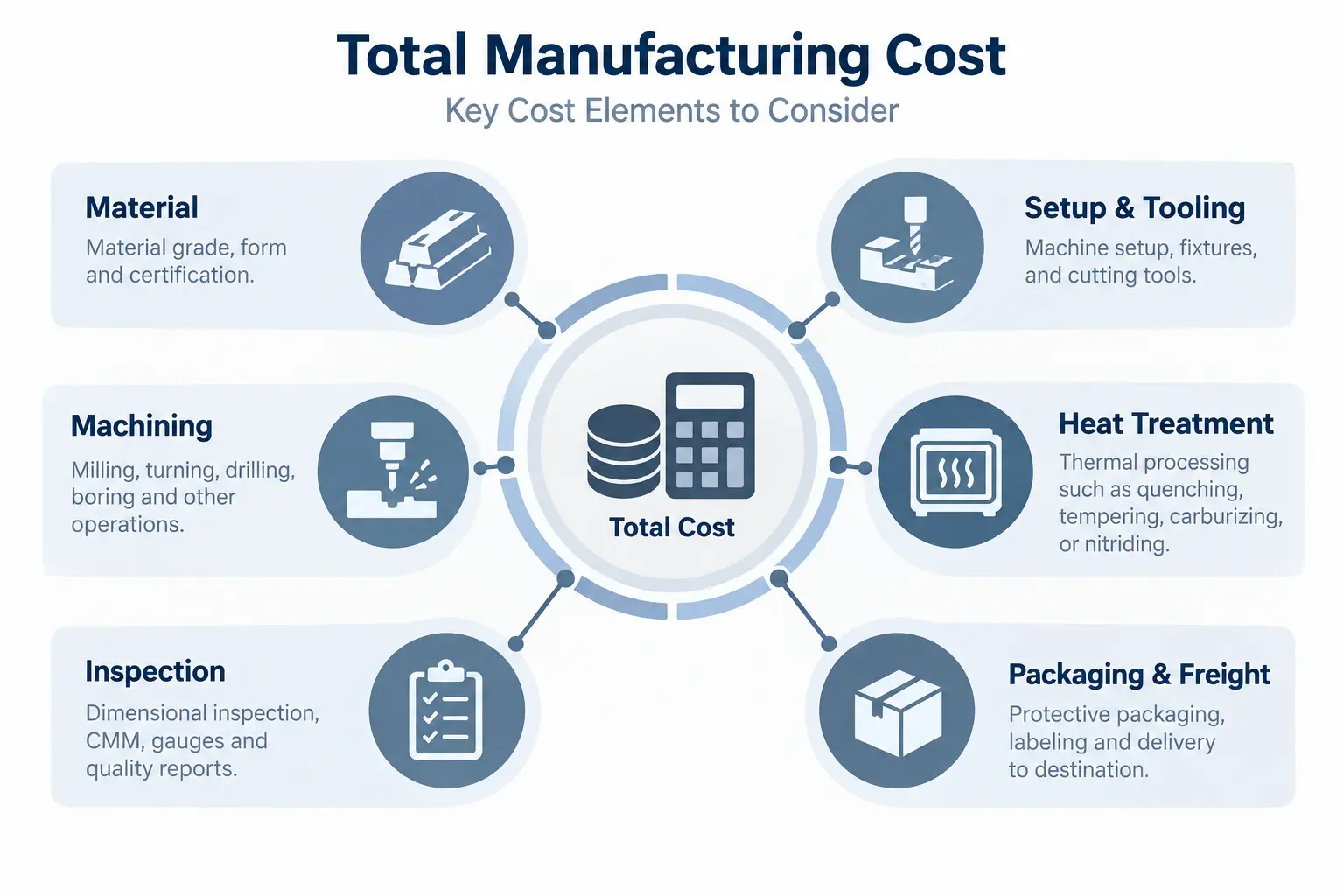
Comparing soft machining costs requires looking past piece-part pricing to establish the landed cost of an accepted workpiece. Sourcing teams should separate nonrecurring engineering charges, volume baselines, outside processing, quality verification, and freight into distinct cost buckets.
Setup, Tooling, and Batch Assumptions
Nonrecurring charges directly skew unit price comparisons. A comprehensive CNC machining cost model separates machine programming, custom fixture fabrication, dedicated cutters, and grinding wheel preparation from recurring run rates. Batch assumptions are equally critical: quoting an annual volume of 1,200 parts as a single continuous run yields significantly lower setup allocation than fulfilling twelve monthly releases of 100 parts requiring repeated tear-downs and setups.
Outside Processing and Intermediate Logistics
Outsourced thermal and surface treatments incur costs well beyond the processor’s invoice. Small batch sizes often trigger minimum lot fees, while multi-facility routing adds specialized protective packaging, transit charges, and incoming receiving inspections. Clarify whether the machining supplier absorbs these logistics and administrative costs within the quoted unit rate or passes them through as separate line items.
Inspection, Documentation, and Packaging
Quality reporting and component preservation represent measurable production expenses. Preparing full First Article packages, programming CMM routines, and logging lot traceability require dedicated engineering time. Packaging requirements also impact landed cost: hardened and ground precision surfaces require vapor-corrosion inhibitors, dedicated compartmentalized containers, or protective edge sleeves to prevent transit damage prior to assembly.
Challenge the Lead Time Against the Full Route
A credible delivery schedule accounts for total elapsed turnaround through final quality sign-off rather than spindle cutting hours alone. Sourcing teams should evaluate the milestone schedule before assuming a shorter quote represents faster delivery.
Stage Dates and Queue Ownership
Request milestone dates for raw stock delivery, soft machining, heat treatment, post-treatment finishing, final CMM inspection, and document release. While shops do not need to share internal machine schedules, their committed turnaround must account for transit days and outside supplier queue times. When outside operations slip, having a single accountable vendor responsible for end-to-end schedule management eliminates disputes over subcontractor delays.
Rework and Resubmission Time
Establish how the project schedule accommodates potential deviations. Heat-treatment distortion may necessitate mechanical straightening, additional finishing passes, or formal engineering concession reviews. When orders require customer approval of a first article inspection package before batch release, quote lead times must incorporate document review and sign-off periods to avoid unexpected production holds.
Put Rework Responsibility and Hidden Fees in Writing
Commercial disputes typically arise when technical assumptions remain undocumented. Project agreements should explicitly assign financial and operational liability across three primary defect categories: pre-hardening machining errors, heat-treatment distortion exceeding allowances, and finish grinding damage such as surface burns or chatter.
Purchase terms must establish clear authorization protocols for rework, scrap replacement, or concessions. Generic statements such as “rework included” introduce commercial ambiguity unless tied to specific boundaries: does the supplier cover replacement raw material, expedited freight, and repeated outside processing, or merely in-house machine labor? Defining correction paths and nonconformance costs in advance protects both budget and schedule.
Choose the Quote That Is Ready for a Purchase Order
Evaluate soft machining supplier quotes through a systematic gating process rather than selecting the lowest headline price:
- Verify scope alignment. Disqualify proposals that fail to price the correct drawing revision, material condition, mandatory secondary processes, or specified delivery terms.
- Normalize total landed cost. Incorporate separate line items for raw stock surcharges, fixture tooling, outsourced processing, document fees, and freight into both offers.
- Audit schedule milestones. Confirm that the committed lead time covers outside thermal processing, queue buffers, and final inspection sign-off.
- Clarify nonconformance liability. Formalize ownership of scrap replacement, secondary processing costs, and rework authorization before issuing the order.
- Assess operational capability. Select the winning partner based on demonstrated technical fit, process control, inspection depth, and transparent commercial communication.
Documenting this normalized evaluation creates an objective audit trail that protects procurement teams if engineering revisions or schedule adjustments occur later in production.
Use Rollyu Precision as a Manufacturing Benchmark
When evaluating custom manufacturing partners, Rollyu Precision provides an established benchmark for complex machining programs requiring tight dimensional control, traceable material, and rigorous quality documentation.
Manufacturing and Inspection Fit
Rollyu Precision’s core capabilities span 3-axis, 4-axis, and 5-axis CNC milling, high-precision CNC turning, and wire EDM. For pre-hardening work, multi-axis machining enables complex geometries and critical datum references to be established efficiently in minimal setups. On post-treatment and finished components, in-process and final inspection protocols rely on coordinate measuring machines (CMM), optical measurement, and surface profilometry backed by Material Test Reports and Certificates of Conformance.
Review project drawings against Rollyu’s documented CNC machining capabilities to confirm process alignment. For components requiring specialized heat treatment, hard turning, or precision grinding, project-specific confirmation establishes which stages Rollyu performs directly, coordinates through qualified partners, or excludes from the quote.
A Quote Package That Exposes Every Assumption
To receive a fully normalized quotation, provide a complete RFQ package: native 3D CAD models, fully dimensioned 2D prints with datum structures, material grade and starting temper, delivery quantities, heat-treatment specifications with case or core hardness targets, and required inspection reports. Rollyu returns structured proposals detailing machine routing, intermediate finishing allowances, lead-time assumptions, and clear commercial boundaries, allowing sourcing teams to compare manufacturing scope transparently against any competing offer.
Frequently Asked Questions
Can You Compare Pre-Hardened Stock With a Machine-Then-Heat-Treat Route?
Yes, provided engineering verifies that both manufacturing paths satisfy drawing requirements for core strength, surface hardness, and geometric stability. Pre-hardened tool steels eliminate the schedule risk and dimensional distortion of a subsequent thermal cycle, but higher cutting forces increase machining time and tool consumption. The evaluation should contrast the higher raw material and machining costs of pre-hardened stock against the cumulative cost of separate heat treatment and post-hardening grinding.
Does One Supplier Need to Perform Every Process In-House?
No. Many precision machining suppliers successfully coordinate outside heat treatment and specialized grinding through qualified partner networks. However, the commercial quote must clearly assign single-point accountability for vendor management, intermediate freight, queue schedules, and nonconformance handling to prevent split liability if defects emerge during downstream finishing.
Should Prototype and Production Quotes Use the Same Process Route?
Prototypes intended to validate high-volume manufacturing should replicate the production route, including soft machining, hardening, and finish grinding. If prototypes are machined from alternate pre-hardened stock or soft aluminum simply to confirm physical form and fit, their pricing and lead times cannot serve as commercial baselines for production tooling, cycle times, or yield.