

Brass and aluminum are both widely used for CNC machined components, but they solve very different engineering problems.
Aluminum is usually selected when low weight, a high strength-to-weight ratio, fast machining and flexible surface finishing are priorities. Brass is often preferred when a component requires excellent machinability, clean threads, dimensional stability, electrical performance, low friction or an attractive metallic appearance.
The right choice is therefore not simply the harder or less expensive metal. Engineers must consider the actual alloy and temper, part geometry, operating environment, production quantity, finishing requirements and critical functional features.
This guide compares brass vs aluminum from the perspective of CNC machining and helps engineers and purchasing teams select the more suitable material for precision parts.
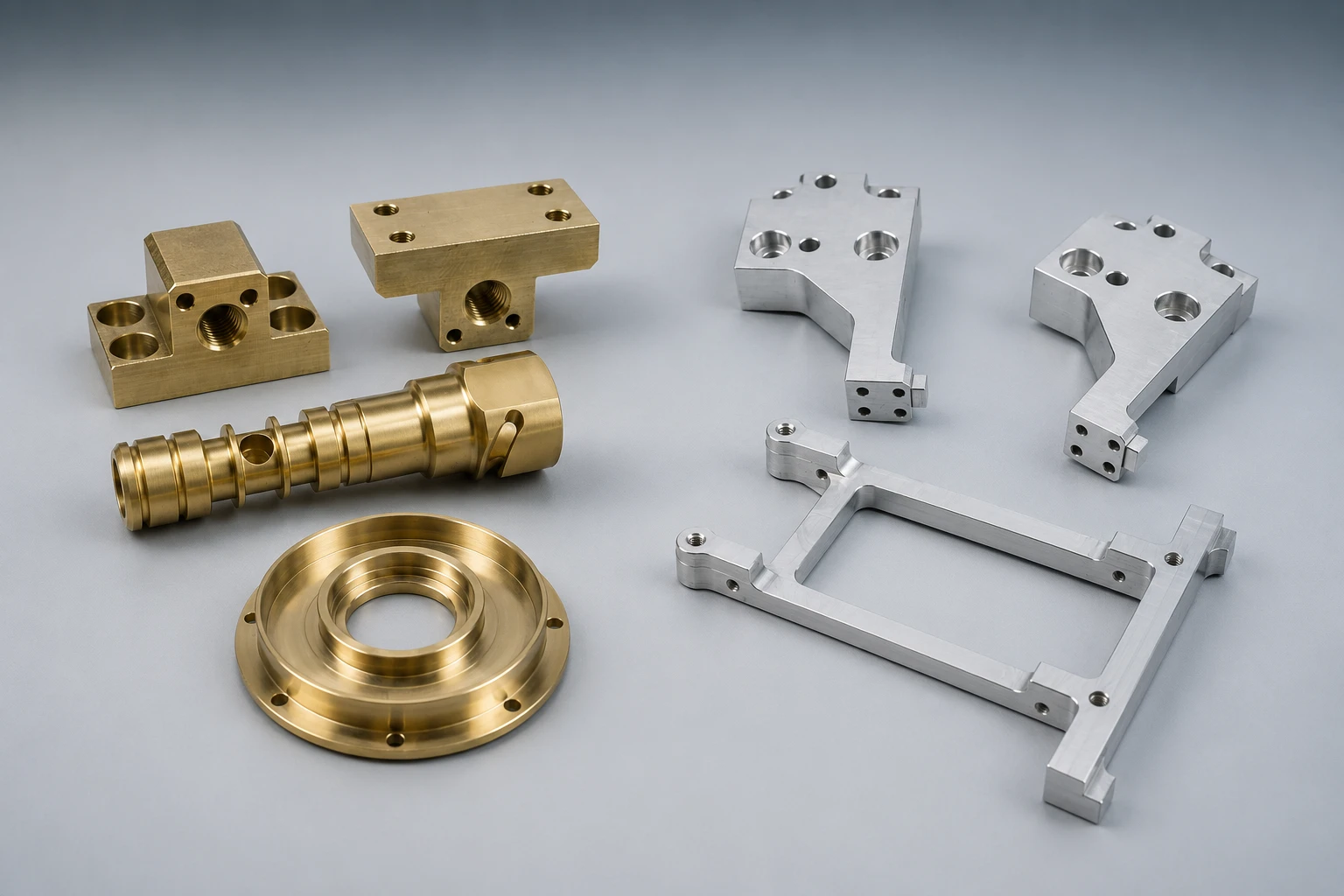
Brass vs Aluminum at a Glance
| Property | Brass | Aluminum |
| Material type | Copper-zinc alloy | Aluminum alloy family |
| Typical density | Approximately 8.3–8.7 g/cm³ | Approximately 2.7–2.8 g/cm³ |
| Weight | Heavy | About one-third the density of brass |
| Machinability | Excellent, especially C360 | Very good, especially 6061 |
| Strength-to-weight ratio | Moderate | High |
| Hardness | Depends strongly on alloy and temper | Depends strongly on alloy and temper |
| Electrical conductivity | Generally higher than most structural aluminum alloys | Moderate; varies by alloy |
| Thermal conductivity | Good | Good; 6061 is widely used for heat-dissipating parts |
| Corrosion resistance | Good in many indoor, water and industrial environments | Good due to its protective oxide layer |
| Surface appearance | Natural gold-like appearance | Silver-grey; accepts many finishes |
| Common finishes | Polishing, plating, brushing, clear coating | Anodizing, hard anodizing, Chemfilm, bead blasting, powder coating |
| Typical applications | Fittings, connectors, bushings, valves, threaded components | Housings, brackets, frames, optical mounts, robotic components |
| Raw-material cost | Generally higher | Generally lower |
| Best reason to choose | Stable, clean precision machining and functional wear or electrical properties | Lightweight design, fast production and finishing flexibility |
Property values vary considerably between grades. For example, free-cutting C360 brass should not be compared as if it represents every brass alloy, just as 6061-T6 does not represent 7075-T6 or commercially pure aluminum.
What Is Brass?
Brass is a family of copper-zinc alloys. Its properties change according to the copper and zinc content and the addition of other elements intended to improve machining, forming, corrosion resistance or mechanical performance.
Common CNC-machined brass grades include:
C360 Free-Cutting Brass
C360 is one of the most machinable engineering metals. It produces controlled chips, supports efficient turning and milling and can deliver smooth surfaces and consistent threads.
The Copper Development Association uses C360 as the reference material with a machinability rating of 100. It is commonly supplied under specifications such as ASTM B16 for free-cutting brass rod, bar and shapes. Copper Development Association: C36000 Copper Development Association: C36000
C360 is frequently used for:
Precision turned fittings
Threaded inserts
Electrical terminals
Connectors
Valve components
Spacers and bushings
Small Swiss-machined parts
Because conventional C360 is a leaded free-machining brass, engineers must review applicable RoHS, REACH, potable-water and medical-device requirements. A lead-free brass grade may be necessary for regulated applications.
C353 and Other Machinable Brass Grades
C353 offers excellent machinability and is used for components such as nuts, screws, adapters, gears, couplings, instrument parts and valve stems. Copper Development Association: C35300
Other brass grades may be selected when forming, dezincification resistance, marine performance or lead-free compliance is more important than maximum cutting speed.
What Is Aluminum?
Aluminum is a low-density metal typically alloyed with magnesium, silicon, zinc, copper or manganese to obtain different combinations of strength, corrosion resistance, machinability and thermal performance.
The most relevant grades for precision CNC machining include:
Aluminum 6061-T6 and 6061-T651
6061 is a versatile, heat-treatable aluminum alloy with a practical balance of:
Machinability
Strength
Corrosion resistance
Weldability
Dimensional stability
Cost
Anodizing capability
The Aluminum Association describes 6xxx-series alloys as heat-treatable, formable and weldable materials with moderately high strength and excellent corrosion resistance. It also identifies 6061 as the most widely used alloy in this series. The Aluminum Association The Aluminum Association
6061 is commonly used for instrument housings, optical mounts, robot frames, motion-control components, medical-equipment housings, brackets, fixtures and electronic enclosures.
Aluminum 7075-T6 and 7075-T651
7075 provides much higher strength than 6061 and is often selected for aerospace, satellite, robotics and motion-control components exposed to higher structural loads.
It is more expensive than 6061 and usually provides lower corrosion resistance and weldability. Its higher strength may also require closer attention to tool loading, internal stress and distortion control.
Aluminum MIC6 and Cast Tooling Plate
MIC6 or similar cast aluminum tooling plate is useful when flatness, thickness stability and reduced residual stress are important. Typical applications include fixture plates, inspection bases, equipment platforms and large precision panels.
Brass vs Aluminum Weight
Weight is one of the clearest differences between brass and aluminum.
Aluminum has a density of approximately 2.7 g/cm³, while common brass alloys are generally around 8.3 to 8.7 g/cm³. A brass component with the same geometry may therefore weigh more than three times as much as an aluminum component.
Choose aluminum when reduced mass helps improve:
Robotic acceleration and payload capacity
Motion-stage response
Aerospace and satellite launch weight
Portable medical-equipment handling
Drone endurance
Assembly ergonomics
Shipping cost
Brass may still be preferred when additional mass improves stability, vibration behavior or the feel of an adjustment mechanism.
Brass vs Aluminum Hardness
Is Brass Softer Than Aluminum?
There is no universal answer because hardness depends on the specific alloy, temper and manufacturing condition.
Some brass alloys are harder than soft or annealed aluminum. However, high-strength aluminum grades such as 7075-T6 may be significantly harder and stronger than many common brass grades. Even C360 brass and 6061-T6 aluminum can have overlapping hardness ranges depending on their supplied conditions.
For engineering selection, the correct comparison is not simply “brass versus aluminum.” It should be:
C360 half-hard brass versus 6061-T6 aluminum
Lead-free brass versus 6061-T651 aluminum
High-strength brass versus 7075-T6 aluminum
The specified mill condition versus the required wear and load conditions
Hardness also does not automatically determine machinability. C360 brass is famous for excellent machining even though it is not necessarily softer than every aluminum alloy.
Brass vs Aluminum Strength
Brass generally provides good rigidity, wear resistance and resistance to thread damage. It can be valuable for fittings, bushings, adjustment components and repeated mechanical connections.
Aluminum provides a better strength-to-weight ratio. Although a brass part may feel more rigid and substantial, a properly designed aluminum part can carry structural loads at much lower mass.
Choose Brass When the Part Requires
- Durable internal or external threads
- Good bearing or sliding behavior
- Resistance to repeated assembly
- Dimensional stability in small precision features
- Electrical contact performance
- Added mass for stability
Choose Aluminum When the Part Requires
- Lightweight structural performance
- Fast acceleration or movement
- Large housings or frames
- Lower material mass
- High-strength 7075 construction
- Anodized wear or corrosion protection
For critical load-bearing parts, the engineer should compare certified mechanical-property data for the exact alloy, temper, stock form and material specification.
Brass vs Aluminum Machinability
Both materials are highly machinable, but their cutting behavior differs.
CNC Machining Brass
Free-cutting brass typically forms short, controlled chips. This makes it suitable for CNC turning, Swiss machining, drilling, reaming and threading.
Its machining advantages include:
Clean chip formation
Stable dimensional control
Excellent thread quality
Low tendency to produce long stringy chips
Good surface finish directly from machining
Efficient production of small turned components
However, brass is dense, so large parts can carry a high raw-material cost. Alloy composition must also be reviewed because leaded and lead-free grades behave differently during machining.
CNC Machining Aluminum
Aluminum generally allows high spindle speeds and fast material-removal rates. Its low cutting forces make it efficient for large housings, pockets, frames and complex multi-axis parts.
Its machining advantages include:
Fast milling and turning
Lower component weight
Efficient removal of large material volumes
Good suitability for thin-wall components
Broad stock availability
Strong compatibility with anodizing and other finishes
Aluminum can adhere to a cutting edge if tool geometry, lubrication and chip evacuation are inadequate. Sharp tools, suitable flute geometry and effective coolant delivery help prevent built-up edge, burrs and poor surface finish.
Which Material Produces Better Threads?
Brass often produces exceptionally clean threads and resists galling better than many soft aluminum conditions. It is well suited to precision fittings, threaded connectors and components that will be assembled and removed repeatedly.
Aluminum threads can also perform reliably, but thread design becomes important when the part is exposed to high torque, repeated assembly or concentrated loading.
Possible solutions for aluminum components include:
Increasing thread engagement
Using a coarser thread
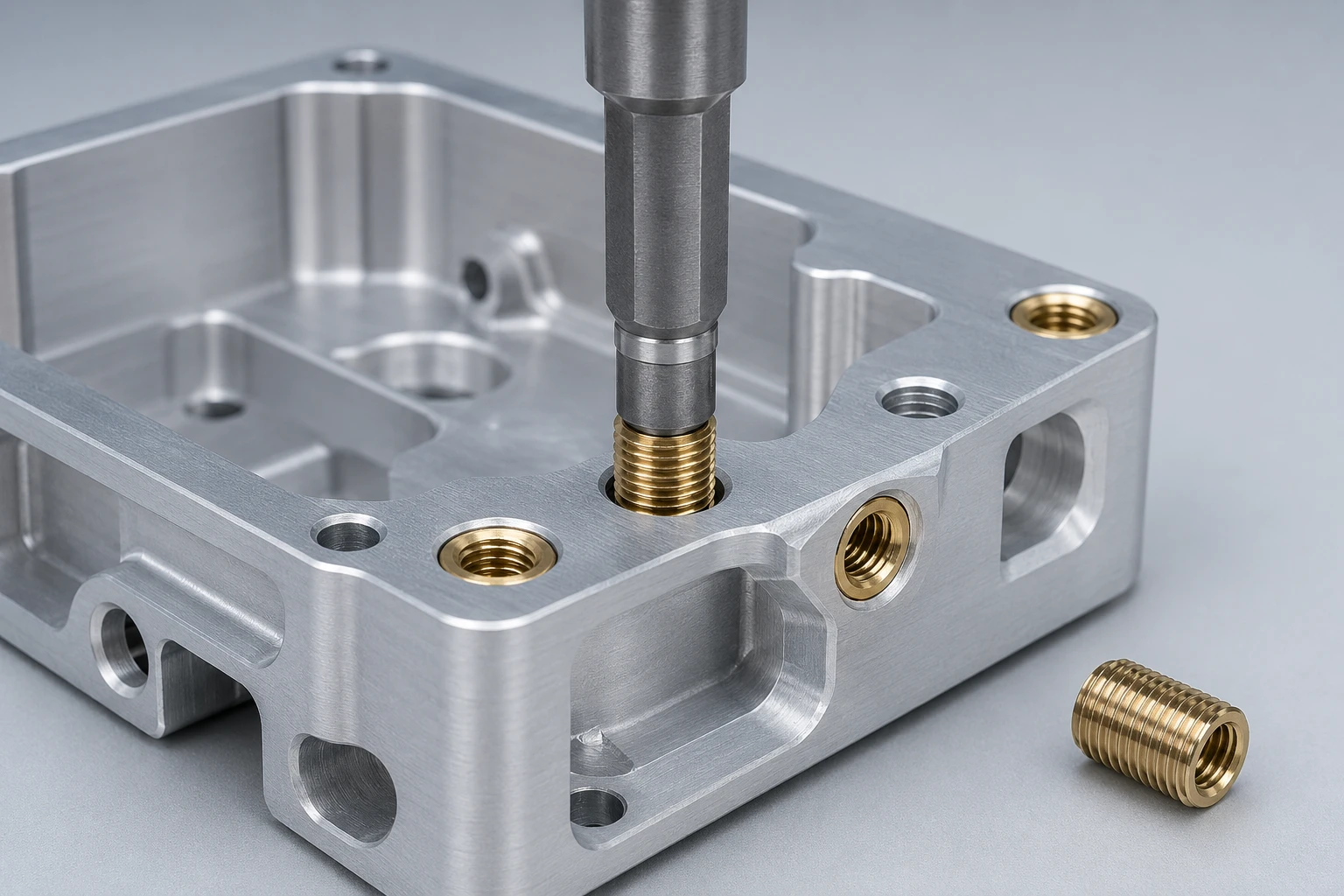
Adding a threaded insert
Selecting 7075 instead of a lower-strength alloy
Hard anodizing the functional surface
Controlling burrs and coating buildup in threaded areas
Thread inserts can allow an aluminum housing to retain its lightweight structure while providing a more durable fastening interface.
Corrosion Resistance
Both brass and aluminum naturally develop protective surface films, but neither material is immune to every environment.
Brass performs well in many indoor, water-handling and general industrial applications. However, certain brass grades may experience dezincification or stress-corrosion cracking in aggressive chemical, ammonia-containing or marine environments.
Aluminum develops a thin oxide film that provides good general corrosion resistance. Anodizing, hard anodizing and chemical conversion coating can further improve surface protection.
Galvanic Corrosion Warning
Direct contact between brass and aluminum can create galvanic-corrosion risk when moisture or an electrolyte is present. In this combination, the aluminum is normally the more vulnerable material.
Risk reduction measures may include:
Electrically isolating the two metals
Using nonconductive washers, sleeves or coatings
Applying compatible sealants
Preventing water accumulation
Increasing the aluminum surface protection
Reviewing the galvanic area ratio
Selecting compatible fasteners
This issue should be reviewed early when a brass insert, fitting or connector will be installed in an aluminum housing.
Electrical and Thermal Performance
Brass is electrically conductive, but its conductivity is much lower than that of pure copper and varies significantly between brass grades. It is commonly selected for terminals and connectors because it combines conductivity with strength, formability and machinability.
Aluminum also provides useful electrical and thermal conductivity at a much lower density. It is therefore attractive for lightweight electrical housings, heat sinks and thermal-management components.
For a current-carrying component, evaluate:
Conductivity of the exact alloy
Cross-sectional area
Contact resistance
Connection method
Operating temperature
Oxidation at the contact surface
Coating or plating requirements
For thermal components, compare conductivity together with weight, geometry, surface area and interface design rather than selecting a material from conductivity alone.
Surface Finishing Options
Finishes for Brass Parts
Brass components may be supplied as-machined or finished with:
Mechanical polishing
Brushing
Nickel plating
Tin plating
Silver plating
Chrome plating
Clear protective coating
Chemical blackening
Laser marking
Plating can improve electrical contact, solderability, wear resistance or appearance. Critical dimensions should be identified before the plating thickness is specified.
Finishes for Aluminum Parts
Common aluminum finishes include:
Type II anodizing
Type III hard anodizing
Chemical conversion coating
Bead blasting
Brushing
Polishing
Powder coating
Painting
Nickel plating
Laser marking
When a part will be anodized, the drawing should identify masked threads, precision bores, electrical grounding points, sealing faces and other features where coating thickness matters.
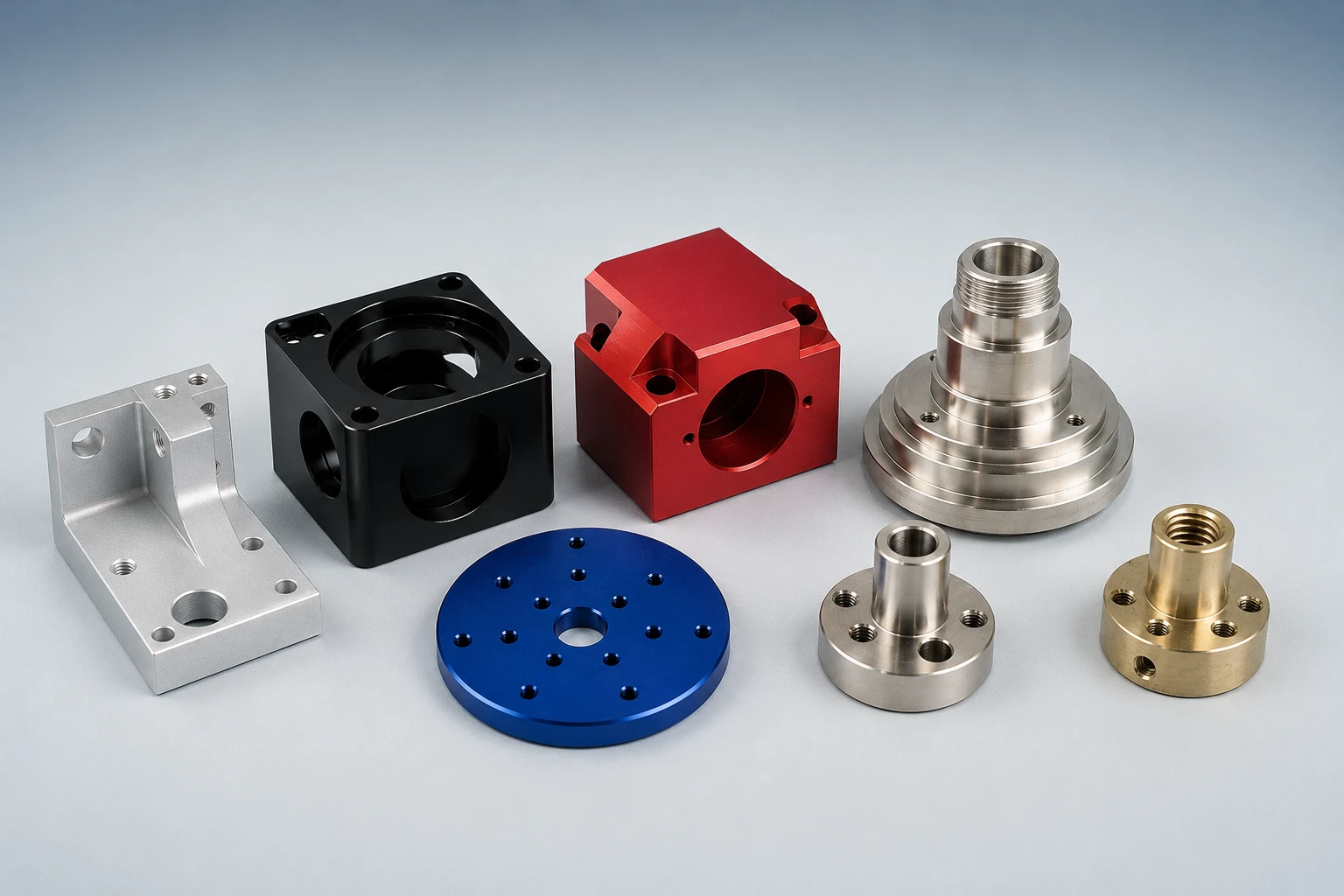
Brass vs Aluminum Cost
Aluminum is normally less expensive per unit of raw-material weight and produces a much lighter finished part. Fast machining and broad availability can make it cost-effective for housings, frames and large milled components.
Brass usually has a higher raw-material cost. However, excellent chip control, fast turning, clean threads and reduced secondary finishing can make C360 economical for small precision parts and production quantities.
The correct cost comparison should include:
Stock size and material yield
Finished-part weight
Milling or turning cycle time
Tool life
Deburring requirements
Thread inserts
Surface finishing
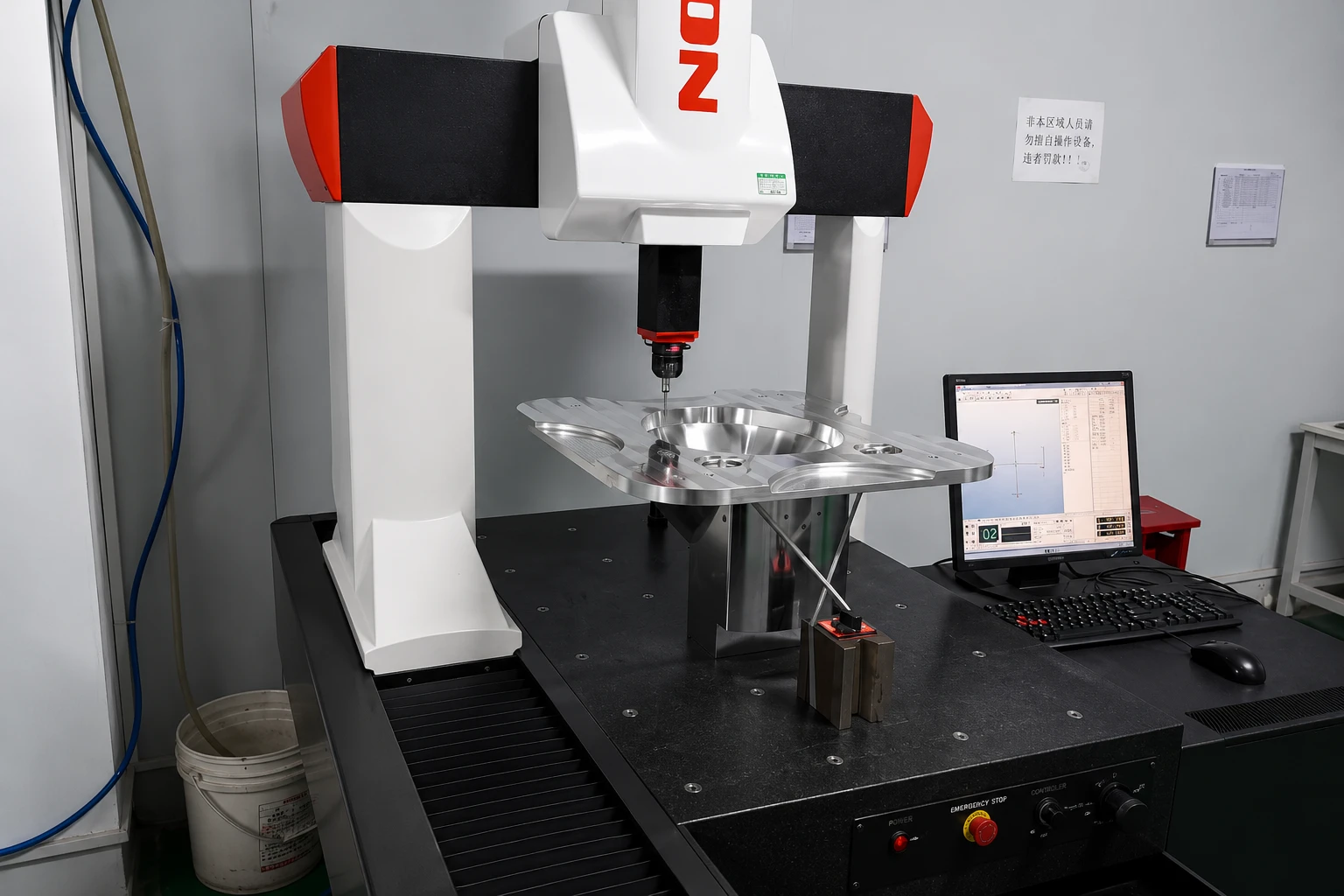
Inspection time
Scrap risk
Recycling value
Expected service life
A less expensive metal does not always result in the lower-cost finished component.
Applications by Industry
Photonics and Quantum Technology
Aluminum is commonly selected for optical mounts, laser housings, baseplates, lens holders and motion-stage structures because it is lightweight, thermally conductive and compatible with black anodizing.
Brass may be suitable for fine adjustment components, threaded rings, bushings, counterweights and interfaces that benefit from smooth motion or added mass.
Robotics and Motion Control
Aluminum is often the first choice for robot frames, motor housings, stage bodies, gripper brackets and moving structures.
Brass can be used for bushings, threaded adjusters, wear interfaces, connectors and small precision turned parts.
Medical and Life-Science Equipment
Aluminum is widely used for equipment housings, positioning components, diagnostic-instrument frames and non-patient-contact structural parts.
Conventional leaded brass should be carefully reviewed for medical or fluid-contact applications. Material compliance, cleaning requirements and biocompatibility must be defined before a brass grade is selected.
Electronics and Instrumentation
Aluminum is suitable for enclosures, heat sinks, mounting plates and lightweight instrument structures.
Brass is useful for terminals, RF-related components, connectors, threaded fittings and conductive precision parts.
Aerospace and Satellite Systems
Aluminum 6061, 7075 and aerospace-specific grades are generally more suitable when weight reduction is essential.
Brass use is normally limited to specialized connectors, bushings, inserts or balance components where its higher density and specific functional properties are acceptable.
How to Choose Between Brass and Aluminum
Select brass when the component prioritizes:
Precision threads
Clean small-part machining
Wear resistance
Electrical contact performance
Low-friction behavior
Dimensional stability
A natural gold-like appearance
Select aluminum when the component prioritizes:
Low weight
High strength-to-weight ratio
Fast CNC milling
Large or complex structures
Anodized surface protection
Thermal management
Lower overall material cost
If the decision remains unclear, compare two specific grades rather than two broad material families. A useful DFM review should assess the CAD model, critical dimensions, operating loads, environment, finish and production quantity together.
Design Tips for Brass and Aluminum CNC Parts
Avoid Unnecessarily Tight Tolerances
Apply tight tolerances only to mating, alignment, sealing and motion-critical features. General dimensions can follow an appropriate drawing tolerance standard.
Identify Functional Surfaces
Clearly mark critical bores, threads, sealing faces, optical datums, electrical contacts and bearing interfaces.
Consider Finishing During Design
Allow for anodizing or plating thickness where it can affect fits, bores, threads or electrical contact points.
Review Thin Walls and Deep Pockets
Thin aluminum walls may distort if stock stress, workholding and toolpaths are not controlled. Deep brass features may increase material cost, cutting load and chip-removal requirements.
Specify the Complete Material Condition
“Aluminum” or “brass” is not sufficient for a production drawing. Specify the alloy, temper or condition, applicable material standard and certification requirements.
How Rollyu Precision Supports Brass and Aluminum CNC Projects
Rollyu Precision manufactures custom aluminum and brass components using CNC milling, CNC turning, Swiss machining, drilling, threading and multi-axis machining.
Typical projects include:
Optical mounts and lens holders
Motion-stage components
Robotic brackets and housings
Electronic and sensor enclosures
Precision connectors and adapters
Threaded fittings
Bushings, spacers and adjustment components
Medical and life-science equipment parts
Aerospace machining parts
Frequently Asked Questions
Is Brass Softer Than Aluminum?
Not always. Hardness depends on the exact alloy and temper. Some brass grades are harder than soft aluminum, while high-strength 7075-T6 aluminum can be harder and stronger than many common brass alloys.
Is Brass Stronger Than Aluminum?
Brass may provide greater rigidity, thread durability and wear resistance than some aluminum grades. Aluminum, however, normally has a better strength-to-weight ratio. The correct answer requires comparing two specified grades and conditions.
Which Is Easier to Machine: Brass or Aluminum?
C360 brass is often considered one of the easiest metals to machine because it produces controlled chips and clean surfaces. Aluminum also machines rapidly, particularly in milling operations, but requires good chip evacuation and sharp cutting tools to prevent built-up edge.
Which Is Heavier, Brass or Aluminum?
Brass is significantly heavier. Its density is normally more than three times that of aluminum, depending on the selected alloys.
Does Brass Corrode Aluminum?
Brass does not directly “corrode” aluminum, but contact between them can create a galvanic cell in the presence of moisture. The aluminum may corrode preferentially unless the metals are isolated or protected.
Is Brass More Conductive Than Aluminum?
Many brass alloys offer useful electrical conductivity, but the exact result depends on alloy composition. Some electrical-grade aluminum materials may outperform specific brass grades by volume, while aluminum generally offers attractive conductivity relative to its weight. Do not use pure-copper values to represent brass.
Is Brass or Aluminum Better for Threaded Parts?
Brass often produces cleaner, more durable threads, especially for small fittings and frequently assembled components. Aluminum can still be suitable when weight is important, particularly when longer thread engagement or threaded inserts are used.
Can Aluminum and Brass Be Used Together?
Yes, but the assembly should be designed to control galvanic corrosion. Isolation washers, sleeves, coatings, sealants and moisture management may be required.
What Information Should Be Included in a CNC Machining RFQ?
Include:
3D CAD model
2D drawing
Material grade and temper
Critical tolerances and datums
Surface-finish requirements
Coating, anodizing or plating specification
Quantity
Inspection and certification requirements
Application and operating environment
READY TO START YOUR PROJECT?
Not Sure Whether Brass or Aluminum Is Right for Your Part?
Send Rollyu Precision your CAD model, 2D drawing, application requirements and target quantity. Our engineering team will review the material, machining process, critical tolerances, surface treatment and inspection requirements before quotation.
CTA BUTTON:
| Upload Your Drawings for a DFM Review |
SECONDARY CTA:
| Request a Brass or Aluminum CNC Machining Quote |