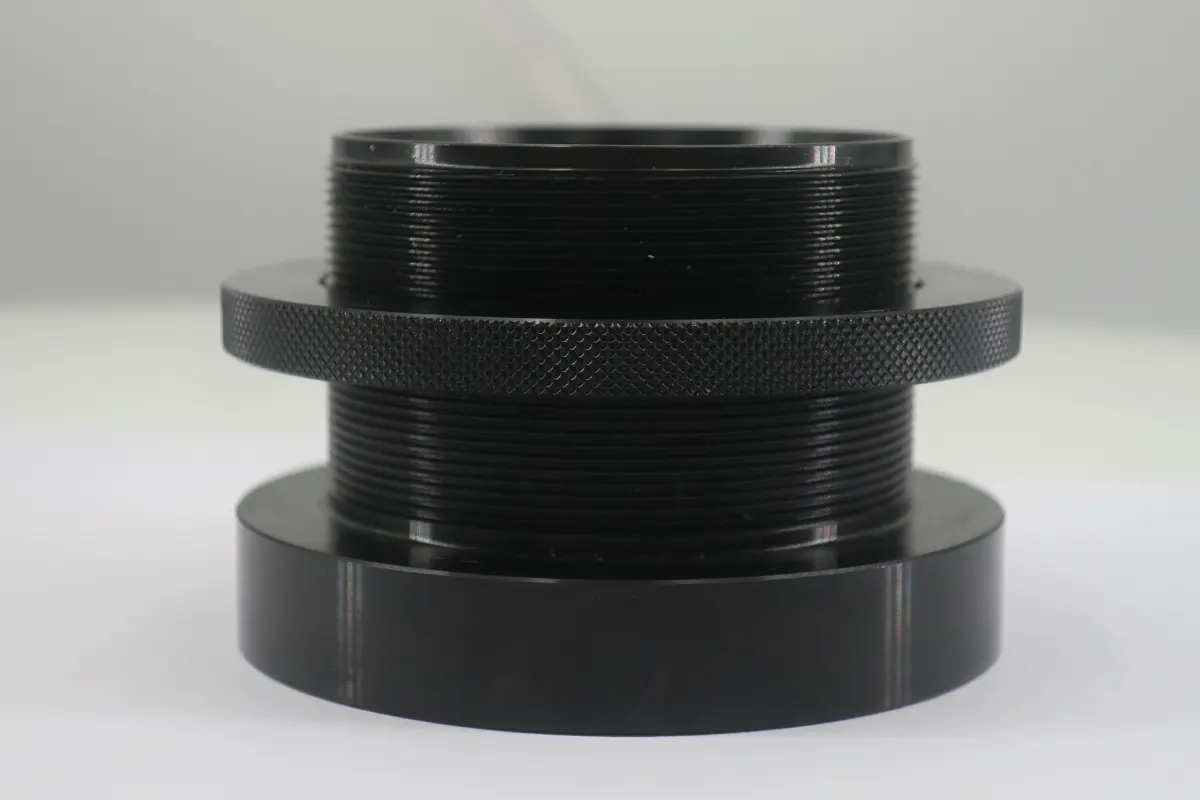
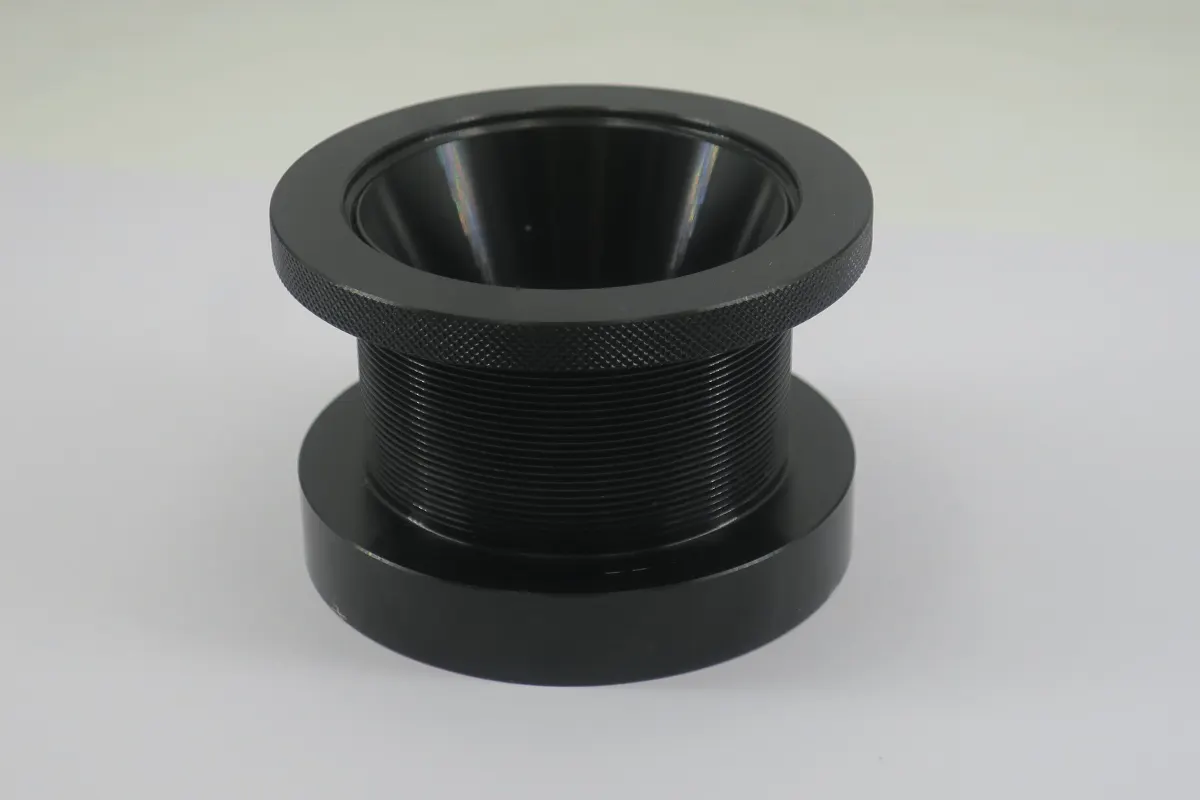
A custom lens barrel holds its optics in place only when the bores share one axis, the seats sit square to that axis, and the material’s thermal expansion has been planned against the glass. A lens barrel is the housing that centers, spaces, and protects the lenses in a camera, laser, machine vision module, or laboratory instrument. Settle the material, the alignment features, and the drawing callouts together, because a few micrometers of decenter or tilt can show up as lost image sharpness or beam pointing error.
What a Lens Barrel Controls
A lens barrel controls each lens in three ways: radial position (centering on the optical axis), axial position (the air gap between elements), and tilt (how square the lens sits to the axis). Decentered or tilted lenses add aberrations such as coma and astigmatism, and wrong air gaps shift focus. The barrel also protects the optics from dust and handling damage.
In a fixed-focus assembly, every lens references one datum bore and stays put. In a zoom or autofocus assembly, inner barrels slide along cam tracks or helicoid threads to move lens groups, and the clearance in those sliding fits counts against the alignment budget.
Choosing a Lens Barrel Material
Choose the barrel material by how its thermal expansion compares with the glass, then by weight, stiffness, finish, and machining cost.
| Property | 6061-T6 Aluminum | 304 Stainless Steel | Ti-6Al-4V | Invar 36 | N-BK7 Glass (Reference) |
|---|---|---|---|---|---|
| CTE (µm/m·°C) | 23.6 (20 to 100 °C) | 16.9 (0 to 100 °C) | 8.6 (20 to 100 °C) | 0.5 to 1.1 (25 to 93 °C) | 7.1 (−30 to 70 °C) |
| Density (g/cm³) | 2.70 | 8.03 | 4.43 | 8.05 | 2.51 |
| Black Finish Options | Type II or Type III black anodize | Black coating or black oxide | Black coating | Black coating | Not applicable |
Aluminum and the Glass Expansion Gap
6061-T6 aluminum is the usual starting point because it machines fast, black anodizes well, and keeps the barrel light. Its expansion is about three times that of N-BK7. A temperature rise therefore opens the radial clearance around each lens and changes the axial spacing between seats. Designers handle this by sizing the bore clearance for the operating temperature range, or by bonding the lens in an elastomer layer whose thickness offsets the expansion mismatch. 7075-T6 has similar expansion and higher strength, which helps when thin walls must resist clamping or vibration loads.
Stainless Steel, Titanium, and Invar
Stainless steel lowers expansion and adds corrosion resistance at roughly three times the density of aluminum, and free-machining 303 is a common choice for turned barrels. Ti-6Al-4V comes closest to N-BK7 in expansion among these metals, at a little over half the density of stainless steel. Invar 36 does not match the glass; its expansion sits well below N-BK7. Designers choose it to keep the barrel’s own length nearly constant, which holds lens spacing and focus over wide temperature swings. Invar is heavy and cannot be anodized, and because it work-hardens when the tool rubs, the tooling and cutting methods for Invar 36 make it slower and more expensive to machine than aluminum.
Machined Features That Set Optical Alignment
Four feature groups decide whether the barrel holds its optics where the optical design put them: coaxial bores, lens seats and spacers, retaining threads, and stray-light surfaces.
Coaxial Bores and Runout
Every lens bore should run true to one datum axis, usually the main bore or the mounting diameter. Turning the outer diameter, the bores, the seat faces, and the retaining threads in one setup keeps them on one spindle axis and avoids the error added each time a part is re-chucked. When a second setup is unavoidable, machine a datum feature in the first operation and indicate it before cutting the next one. Set the runout limit from the optical tolerance analysis, and confirm it in DFM review against the CNC machining tolerances, which list ±0.01 mm for metal features.
Lens Seats and Spacers
Each lens rests on a turned shoulder, the lens seat, that sets its axial position, and any tilt in that face tilts the lens. Call out the seat’s perpendicularity to the bore axis and its surface finish. For convex lens surfaces, many designs use a tangent or rounded seat contact instead of a sharp corner, which spreads the retaining-ring preload over a wider band of glass. Spacers between lens groups set the air gaps. Make them from the barrel material so they expand at the same rate, and grind or lap them when the axial stack is tight.
Retaining Threads, Reliefs, and Vents
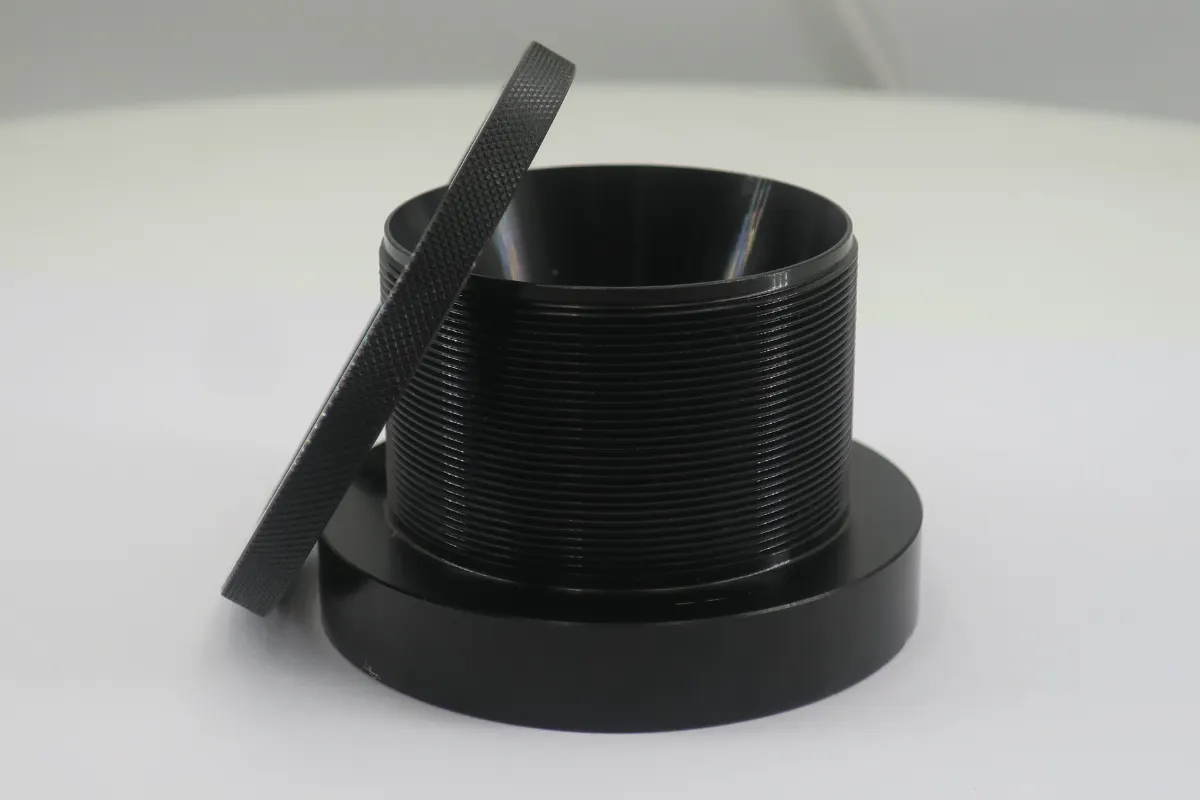
Threaded retaining rings clamp the lens stack against the seats, and the thread’s pitch diameter, depth, and engagement length decide whether the ring seats evenly and how far it can travel. Leave a thread relief so the ring can reach the lens without running out of full thread. Barrels used in vacuum, or with tightly fitted rings, need a vent path such as a small radial hole or slot so trapped air can escape. Deburr every cross hole where it breaks into the bore, because a burr there can scratch a lens or fall onto it during assembly.
Stray-Light Baffles and Black Finishes
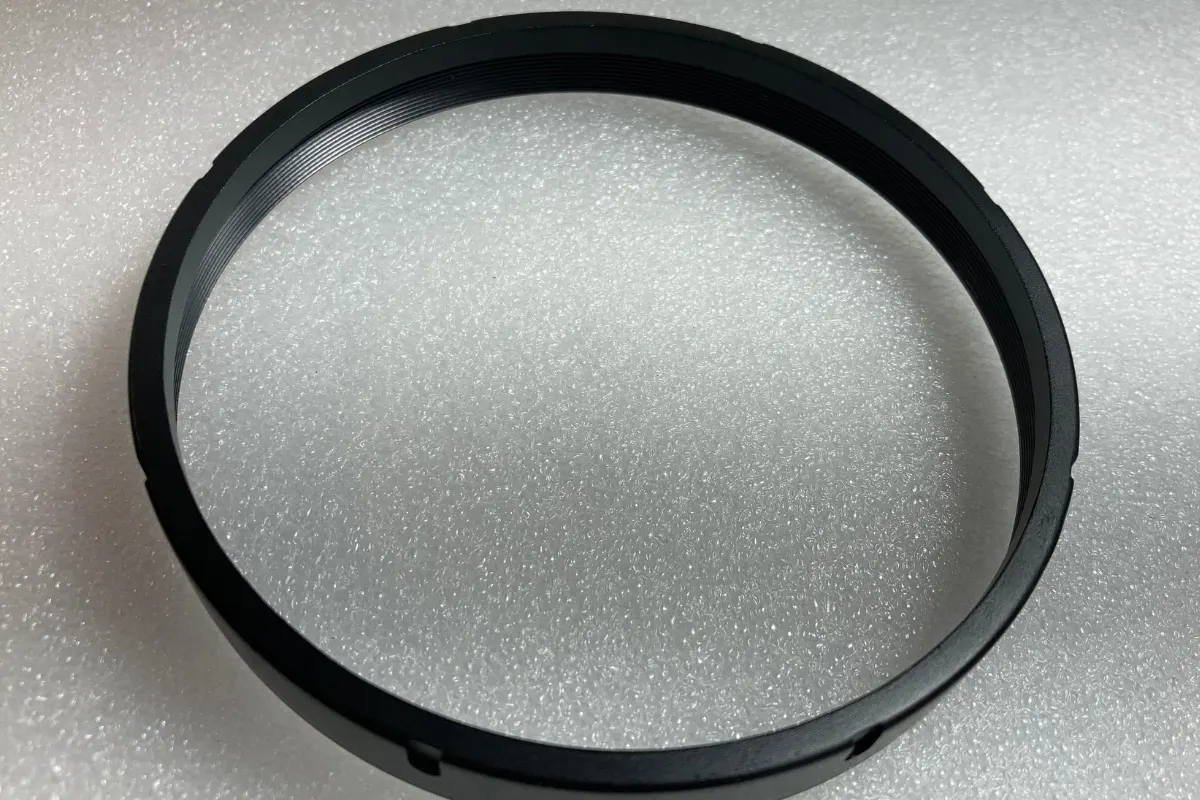
Light reflecting off the bore wall lowers contrast and can form ghost images. Common controls are knife-edge baffle grooves turned into the bore, bead blasting, and matte black anodizing on aluminum barrels. Deeper grooves block more off-axis light but thin the wall and trap debris, which means wall thickness, tool reach, and anodize coverage set the limits of the groove design. Even black anodized finishes on precision aluminum parts can reflect at the system wavelength while looking fully black. Test a coated sample at that wavelength when stray light matters.
Standard Lens Tubes vs. Custom Lens Barrels
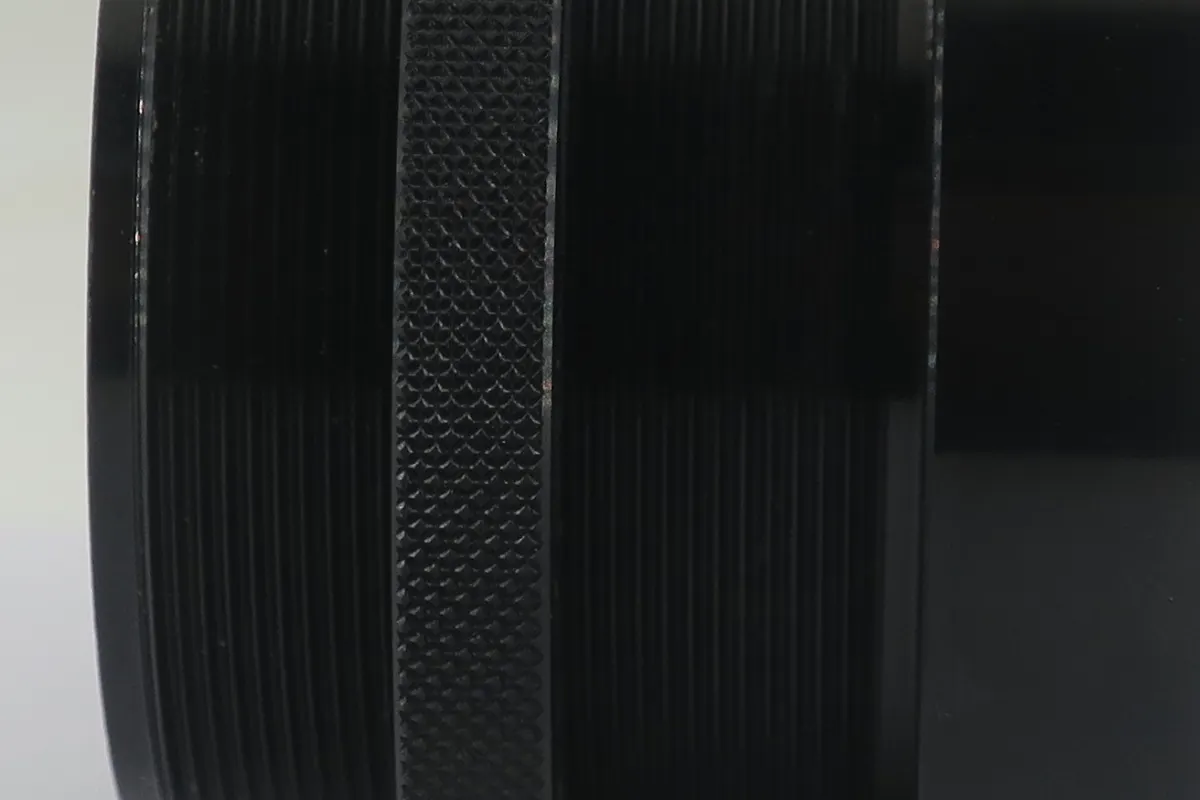
Standard lens tubes suit laboratory setups and prototypes built around catalog optics. SM1-threaded lens tubes, sold by Thorlabs, Edmund Optics, and others, use a 1.035 in. × 40 TPI thread and hold 25 mm and 25.4 mm optics, with retaining rings sold separately. A custom barrel becomes the better choice when any of these apply:
- The optics are non-standard diameters, or several lens groups need different bores in one housing.
- The outer envelope has to fit a tight package or include mounting flanges, flats, or adjustment features.
- The assembly sees thermal cycling, shock, vibration, or vacuum, which calls for a matched-expansion material, venting, or sealing.
- Stray-light baffles must be machined into the bore.
- Production quantities make one machined part cheaper and more repeatable than stacked catalog tubes.
What to Put on a Lens Barrel Drawing
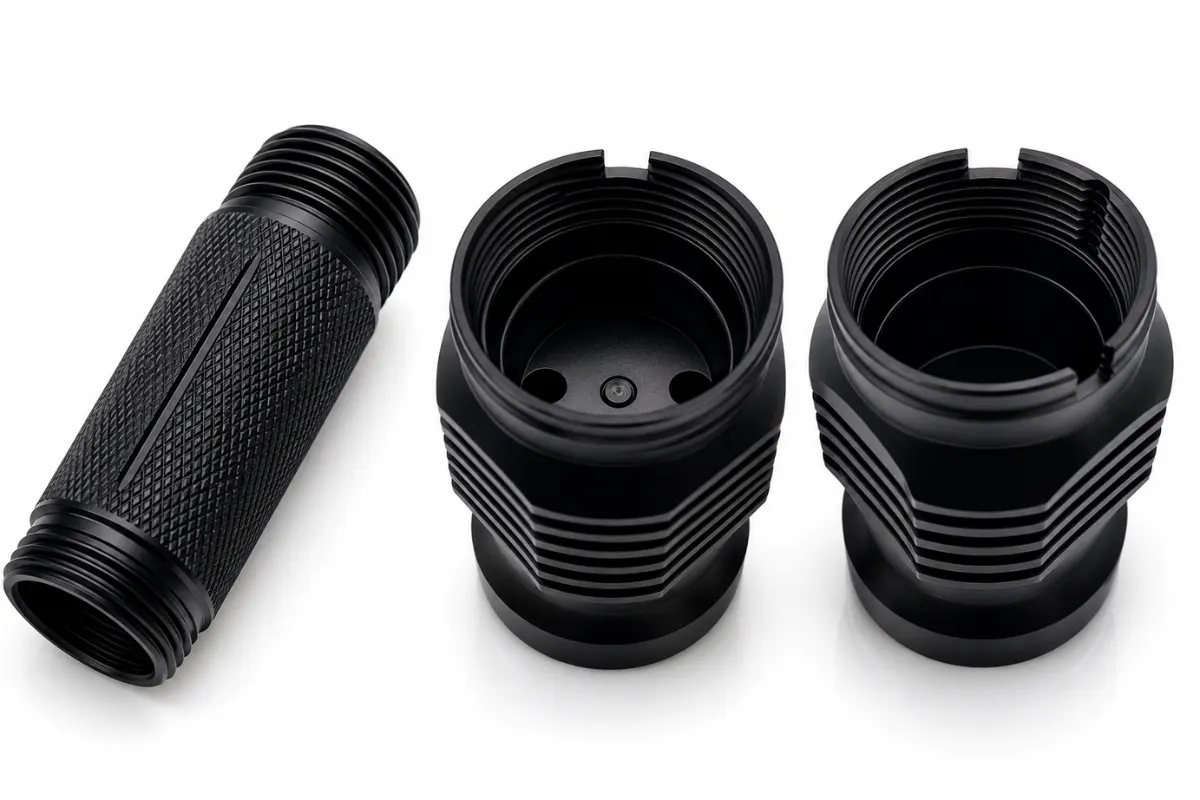
A complete drawing lets the machinist plan setups, fixturing, and inspection before the first cut:
- A primary datum, usually the main bore axis, with every runout, concentricity, and perpendicularity callout referenced to it
- Runout or position tolerances for each lens bore, plus cylindricity where bore form affects the lens fit
- Seat perpendicularity and surface finish, and a separate finish note for baffled surfaces
- Thread designation, class of fit, depth, engagement length, and relief dimensions for retaining rings
- Alloy, temper, and any stress-relief requirement for barrels with tight form tolerances
- Anodize or coating type, color, and masking zones, with a note stating whether dimensions apply before or after finishing
- The mechanical interface to the mating housing or detector mount, including any datum transfer features
How Rollyu Precision Machines Custom Lens Barrels
Rollyu Precision’s CNC machining services include CNC turning and milling, 3-, 4-, and 5-axis machining, and Swiss screw machining for optical components. The company states that its quality management system is certified to ISO 9001:2015 and ISO 13485:2016. A DFM review before machining should settle bore depth against tool reach, thread reach behind the seats, baffle groove access, and the anodize allowance on finished bores.
For precision parts in photonics and quantum systems, Rollyu machines lens holders, optical mounts, and baffles, offers black anodizing for stray-light control, and supplies CMM reports with traceable material certifications.
Small cross holes into a bore show why inspection order matters on tube-shaped parts. In a 416 stainless steel collimator tube case study, Ø0.50 mm side holes broke into the bore, and Rollyu found that plug gauging pushed burrs back into the holes and hid them. Inspecting the small holes first with a micro pin, checking each part under a microscope from two angles, and deburring the hole intersections removed the burrs before delivery.
Frequently Asked Questions
Does Black Anodizing Change Lens Bore Dimensions?
Yes. Anodic oxide grows both into and out of the aluminum surface, which leaves a coated bore smaller than the machined bore. The Aluminum Anodizers Council’s rule of thumb is about two-thirds inward and one-third outward for conventional (Type II) anodizing, and about half and half for hardcoat (Type III). Actual growth depends on the alloy and process. State whether bore and seat dimensions apply before or after anodizing, or mask the seats and threads that carry tight fits.
How Much Radial Clearance Should a Lens Have in Its Bore?
Use enough clearance to insert the lens across the full operating temperature range, and no more than the decenter budget allows. Start from the lens diameter tolerance, add the bore tolerance and the differential expansion between barrel and glass, and compare the worst-case clearance with the decenter limit from the optical tolerance analysis. When that leaves almost no clearance, an elastomer bond or a centered bonding process can be easier than a near-zero fit.
Can a Custom Lens Barrel Use Standard SM1 Threads?
Yes. Specifying the 1.035 in. × 40 TPI SM1 thread on a custom barrel lets it accept standard retaining rings, adapters, and lens tubes, which simplifies prototyping and service. Call out the thread class, depth, and any relief on the drawing so catalog rings seat fully.
Sources
- Aluminum 6061-T6, ASM Aerospace Specification Metals: CTE and density of 6061-T6.
- 304/304L Stainless Steel Product Data, Cleveland-Cliffs: Mean CTE and density of 304.
- Titanium Ti-6Al-4V (Grade 5), Annealed, ASM Aerospace Specification Metals: CTE and density of Ti-6Al-4V.
- ATI 36 Technical Data Sheet, ATI: CTE ranges and density of Invar 36 (Alloy 36).
- N-BK7 Optical Glass, PGO: CTE and density of N-BK7.
- Anodized Aluminum FAQ, Aluminum Anodizers Council: Inward and outward growth of Type II and Type III anodic coatings, and masking of bores.
- ID1 Lens Tube, 15 mm, Edmund Optics: SM1 thread specification, compatible optic diameters, and separately sold retaining rings.