

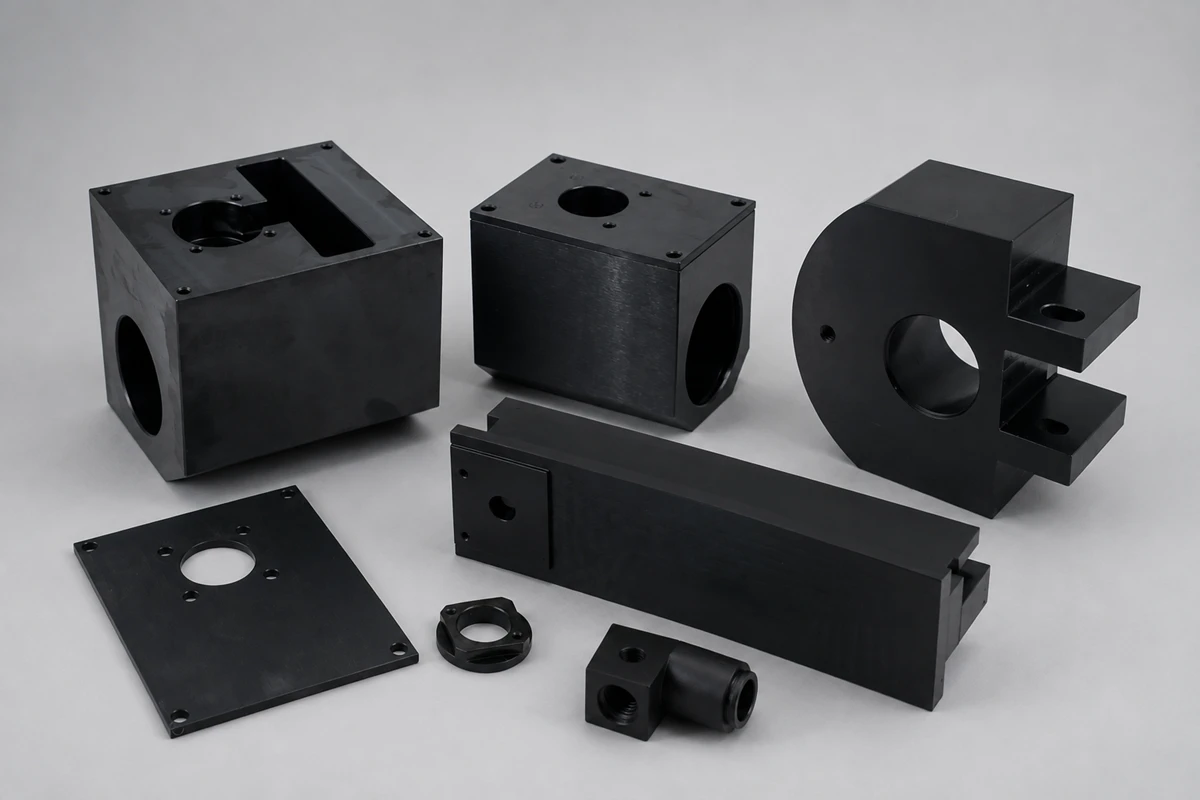
When a mechanical engineer specifies black oxide, the decision is rarely about color alone. The finished shaft, spacer, clamp, gear, fastener, bracket, fixture, optical hardware component, or sensor mount must still fit, remain clean enough for the system, resist its real environment, and arrive with documentation that matches the drawing. A vague note such as “BLACKEN” can leave the processor free to choose a hot, mid-temperature, cold, stainless-steel, or proprietary blackening route with materially different results.
This guide is written for engineers and buyers sourcing black oxide CNC machined parts. It connects the finish to substrate, heat treatment, tolerances, corrosion exposure, supplementary sealant, inspection, packaging and application qualification. The goal is not to make black oxide look universally superior; it is to help you decide when it is appropriate, when another finish is safer, and what Rollyu Precision needs to quote the part responsibly.
| Send Rollyu Precision the 3D CAD, controlled 2D drawing, steel grade and heat-treatment condition. We can flag finish ambiguity, tight-fit risks, oil restrictions, inspection gaps and packaging requirements before pricing. |
What Is Black Oxide Coating?
For carbon and alloy steels, conventional hot black oxide chemically converts the surface to a black iron-oxide layer commonly described as magnetite. It is a conversion process rather than conventional electroplating or paint. Because the converted layer is very thin, black oxide is often considered for close-fitting machined features, threads and tooling where a thicker plated or painted layer would require more dimensional allowance.
The black appearance alone is not the primary corrosion barrier. Protection commonly relies on a supplementary oil, wax or other specified post-treatment retained by the converted surface. If that supplementary film is removed by cleaning, handling, heat, solvent, vacuum preparation or repeated service, corrosion performance can fall sharply. Therefore “black oxide” and “black oxide with an approved post-treatment” should not be treated as identical procurement requirements.
Are Blackening and Black Oxide the Same?
They are often used as synonyms for steel parts, but blackening is the broader commercial term. It may refer to hot black oxide, mid-temperature blackening, room-temperature or cold blackening, stainless-steel blackening, gun bluing, or another proprietary process that creates a dark surface. Cold blackening may form a different deposited reaction layer rather than the same magnetite conversion produced by traditional hot processing. Aluminum “blackening” also requires a different chemistry and must not be confused with steel black oxide or black anodizing.
| DRAWING RULE Use “black oxide” or “blackening” as a search term, not as the complete engineering requirement. The controlled drawing should identify the governing specification and revision, material/process class where applicable, required supplementary treatment, appearance limits, masked areas, and acceptance records. |
Hot, Mid-Temperature and Cold Blackening
| Process family | Engineering value | Limit or sourcing risk |
| Hot black oxide | Traditional conversion route for many carbon and alloy steels; dark appearance and minimal buildup | High-temperature alkaline processing; alloy response, prior heat treatment, cleaning and approved processor matter |
| Mid-temperature black oxide | Lower operating temperature than traditional hot processing; may provide similar commercial appearance | Chemistry and performance are process-specific; do not assume equivalence without specification and qualification |
| Cold / room-temperature blackening | Convenient for touch-up or appearance-driven applications; lower processing temperature | May be a deposited copper/selenium-based layer; wear, uniformity and corrosion performance may differ from hot black oxide |
| Stainless-steel blackening | Specialized chemistry for stainless grades | Must be qualified for the exact grade, heat treatment, corrosion requirement and cleaning route |
| Non-ferrous blackening | Specialty treatments for copper alloys or other metals | Not automatically black oxide; aluminum usually requires a separate conversion or anodizing system |
Which CNC Materials Are Good Candidates?
| Material group | Typical decision | RFQ question |
| 1018, 1045 and other carbon steels | Common candidates when modest corrosion protection and dark appearance are acceptable | What post-treatment and service environment are required? |
| 4130, 4140, 4340 and alloy steels | Common for shafts, fixtures and motion components | What is the heat-treatment condition, hardness and allowable process route? |
| Tool steels | Possible depending on grade and condition | Will the process affect appearance, residues, temper concerns or precision surfaces? |
| Cast iron | Can be processed, but porosity and surface condition affect appearance and retained chemistry | Are pores, oil retention and cleaning requirements compatible with the application? |
| Stainless steels | Require a stainless-specific blackening system | Which grade, condition and corrosion benchmark must be maintained? |
| Aluminum, titanium, brass | Do not assume the steel black oxide process applies | Is the intended finish black anodize, PVD, paint, chemical blackening or another defined system? |
Why CNC Features Change the Finishing Risk
- Threads and close fits: black oxide has minimal buildup, but cleaning residue, sealant, corrosion products and inspection timing can still affect assembly.
- Blind holes and deep pockets: trapped chemistry, rinse water or oil can leak later and contaminate adjacent assemblies or packaging.
- Ground bearing and seal surfaces: define whether they are processed, masked, polished after treatment, or protected by another route.
- Hardened parts: identify material condition and process restrictions before finishing; never assume all heat-treated steels respond identically.
- Broad cosmetic faces: alloy, heat treatment, surface roughness and prior processing can create shade variation. A color photograph is not a quantitative acceptance standard.
- Laser marking, brazing, welding and adhesive bonding: define the manufacturing sequence because heat and surface preparation can change the finish or adhesion.
Corrosion Resistance: What Black Oxide Can and Cannot Do
Black oxide can improve short-term corrosion behavior when preparation and supplementary treatment are appropriate, but it is not a high-barrier coating like many plated or engineered coating systems. Performance changes with alloy, surface finish, sealant type, film retention, humidity, salt, condensation, cleaning chemicals, packaging and handling. A universal statement such as “100 hours salt spray” is unsafe unless a controlling specification, specimen preparation, post-treatment, test method and acceptance criteria are all defined.
If a part will see outdoor exposure, salt, coolant, disinfectant, repeated washing, condensation or long storage, compare black oxide with zinc plating, electroless nickel, phosphate plus oil, PVD/DLC, paint or a corrosion-resistant material. The correct decision is based on the system and failure consequence, not the desired black color.
| Requirement | Black oxide may fit when… | Choose or qualify another option when… |
| Minimal dimensional impact | Threads, fits and precision geometry make thick coatings undesirable | The alternate finish can be designed into dimensional allowances and gives needed barrier performance |
| Low reflectance / dark appearance | Glare reduction and industrial appearance matter | Optical stray-light performance requires measured reflectance or validated optical black treatment |
| Corrosion protection | Indoor, controlled service and maintained post-treatment are acceptable | Outdoor, saline, wet, chemical or maintenance-free service is required |
| Lubricity | The approved oil or wax is compatible with the mechanism | Oil is prohibited, migrates into optics/sensors, attracts particles or cannot survive cleaning |
| Wear resistance | The finish is not relied upon as the wear surface | Sliding or abrasive contact requires nitriding, PVD/DLC, hard chrome, engineered plating or material change |
| Tell Rollyu Precision what the part will contact: humidity, coolant, disinfectant, vacuum cleaning, optics, sensors, bearings or packaging. That application context is often more important than the words “black oxide” when selecting the post-treatment and inspection plan. |
Industry Decisions: Application + Pain Point + Design Risk + Selection Judgment
Photonics and optical systems
Application: steel adjustment screws, clamps, apertures, mounts, retainers and instrument hardware. Pain point: glare, particle control and stable alignment. Design risk: standard oiled black oxide can migrate, collect particles or outgas; black appearance does not prove low reflectance across the required wavelength. Selection judgment: use black oxide only when the approved sealant and cleanliness route fit the optical system; specify measured reflectance or a qualified optical-black finish when stray-light control is critical.
Quantum hardware
Application: fixtures, precision fasteners, structural steel components and magnetic-mechanical interfaces. Pain point: contamination, magnetic behavior and drift can dominate system performance. Design risk: black oxide does not make a steel nonmagnetic, vacuum clean or magnetically characterized. Selection judgment: separate the finish decision from base-material permeability, remanence, cleaning, bake and outgassing requirements; validate the complete component when sensitivity is high.
Motion control
Application: shafts, couplings, bearing retainers, motor hardware, pins, gears and fixture components. Pain point: close fits, rust prevention and controlled friction. Design risk: retained oil may help assembly but interfere with encoders, adhesives or clean mechanisms; unsealed areas can rust. Selection judgment: define processed/masked surfaces, final gauges, approved lubricant and storage condition. Use a harder finish where sliding wear controls life.
Robotics
Application: joint hardware, fasteners, sensor brackets, gripper components and internal mechanisms. Pain point: vibration, service access, mixed environments and cosmetic consistency. Design risk: repeated handling or abrasion can polish or remove the supplementary treatment; field cleaning can reduce corrosion protection. Selection judgment: black oxide can suit protected internal steel parts; use zinc, nickel, PVD, paint or stainless steel for exposed wet or maintenance-free service.
Sensors
Application: threaded housings, target flags, mounts, actuator pieces and low-glare hardware around sensing zones. Pain point: contamination, electrical behavior and optical interference. Design risk: oil migration can reach lenses, encoder scales or sensitive electronics; the finish does not define electrical contact resistance. Selection judgment: specify a compatible dry or low-migration post-treatment only after verification, or choose another finish/material for cleanliness-critical interfaces.
Medical devices
Application: non-implantable equipment frames, adjustment hardware, fixtures and enclosed mechanisms. Pain point: traceability, cleanability and change control. Design risk: black oxide and its oil/wax do not establish biocompatibility, cytotoxicity, patient-contact safety, sterilization resistance or regulatory approval. Selection judgment: restrict claims to documented machining and finish requirements; the device manufacturer must define exposure category, biological evaluation, cleaning and sterilization validation.
Dental equipment
Application: imaging mechanisms, chairside assemblies, positioning hardware and service tools. Pain point: disinfectant exposure, appearance and reliable motion. Design risk: repeated wiping can remove post-treatment or cause staining/rust; oil may be unacceptable near clinical or optical zones. Selection judgment: qualify actual chemicals and cycles. For visible or frequently disinfected surfaces, stainless steel, PVD, plating or another validated finish may be safer.
Space and vacuum-adjacent hardware
Application: tooling, ground-support fixtures, instrument fasteners and selected internal components. Pain point: contamination control, bake, outgassing and mission approval. Design risk: conventional oil- or wax-sealed black oxide is not automatically vacuum compatible; residue and corrosion risk may increase if sealant is removed. Selection judgment: never label a part “space qualified” or “UHV ready” from the finish name. Define approved process source, cleaning, sealant restrictions, outgassing, bake, particulate and corrosion controls through the program authority.
Black Oxide vs Other Black or Protective Finishes
| Alternative | Why engineers choose it | Why it is not automatically interchangeable |
| Black zinc plating | Greater sacrificial corrosion protection with a black appearance | More buildup; color/process chemistry, hydrogen-embrittlement controls and dimensional allowances matter |
| Manganese phosphate + oil | Oil retention, break-in behavior and wear-oriented applications | Different layer structure and dimensional/texture effects |
| Electroless nickel | Uniform barrier coating and improved corrosion/wear performance | Adds measurable thickness and changes fit; black appearance requires another system |
| Black PVD / DLC | Low friction, wear resistance and controlled appearance options | Higher cost; line-of-sight, substrate hardness, adhesion and geometry constraints |
| Black paint / powder coat | Broad color and environmental barrier options | Much thicker; masking and edge coverage affect precision features |
| Black anodize | Appropriate black finish for aluminum | Not a steel black oxide process; anodic growth affects dimensions and electrical insulation |
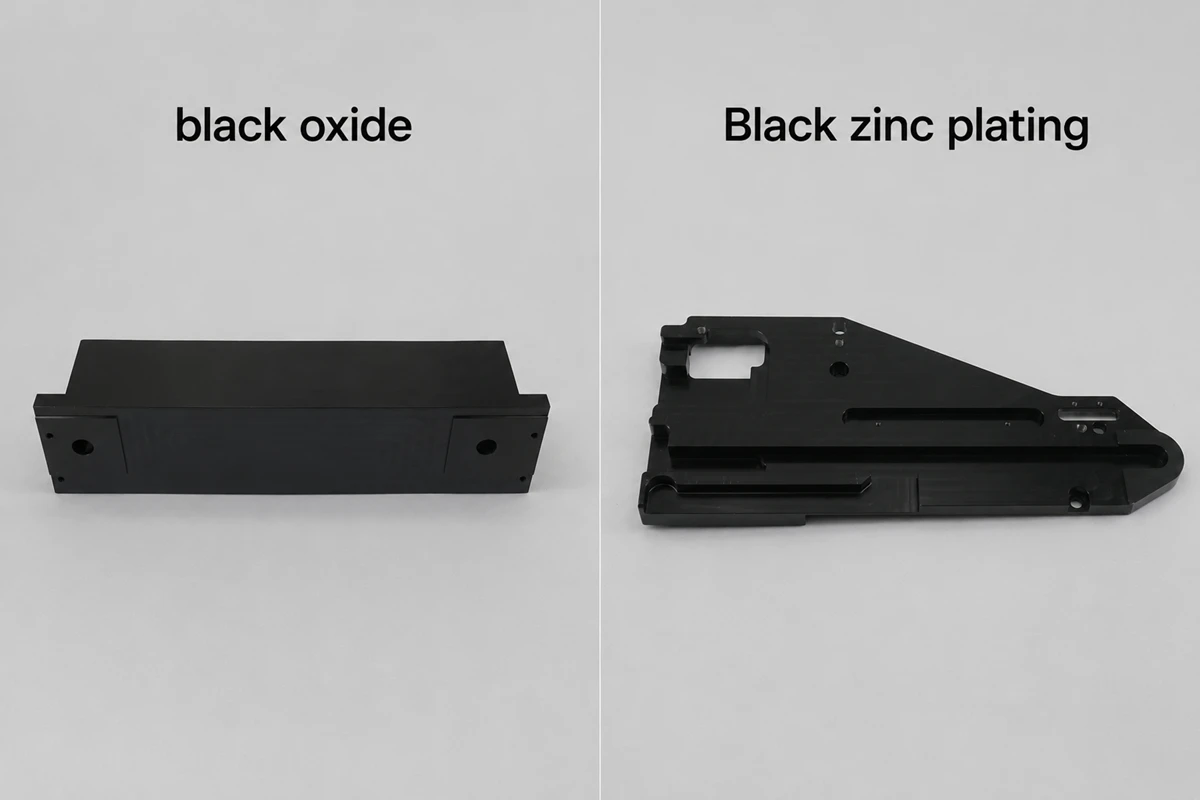
How to Specify Black Oxide on a Drawing
The design authority should adapt the following pattern to the actual program. Do not copy a class or supplementary treatment without checking material compatibility and the controlling specification:
| DRAWING-NOTE PATTERN BLACK OXIDE PER [GOVERNING SPECIFICATION AND REVISION], [CLASS/TYPE IF APPLICABLE], WITH [OIL/WAX/OTHER APPROVED SUPPLEMENTARY TREATMENT]. APPLY/MASK AS SHOWN. CRITICAL DIMENSIONS AND THREAD ACCEPTANCE APPLY [BEFORE/AFTER] FINISH AS DEFINED. PROVIDE [CoC, LOT TRACEABILITY, TEST/INSPECTION RECORDS]. |
- State the steel grade, heat-treatment condition and hardness range.
- Identify the exact specification and revision; MIL-DTL-13924 may apply to certain US defense requirements, but it is not a universal default.
- Define the supplementary treatment. “Black oxide” without oil/wax/sealant information may not establish expected corrosion performance.
- Map surfaces that must remain uncoated, dry, electrically functional, adhesive-ready, ground or polished.
- Define critical post-finish thread gauges, bores, fits, flatness and surface condition.
- Specify cosmetic limits with an approved sample or measurable criteria when color uniformity matters.
- Request current product/process declarations for RoHS, REACH or restricted substances only when contractually required.
Inspection, Documentation and Packaging Controls
- Incoming material: reconcile grade, condition, heat treatment and material certificate with the PO and drawing.
- Pre-finish inspection: verify critical geometry before outsourced processing and protect precision datums.
- Process control: confirm processor, specification revision, bath family, supplementary treatment and customer approvals.
- Visual inspection: check for red/brown areas, gray or mottled conversion, powdery smut, bare spots, staining, corrosion and handling damage using agreed criteria.
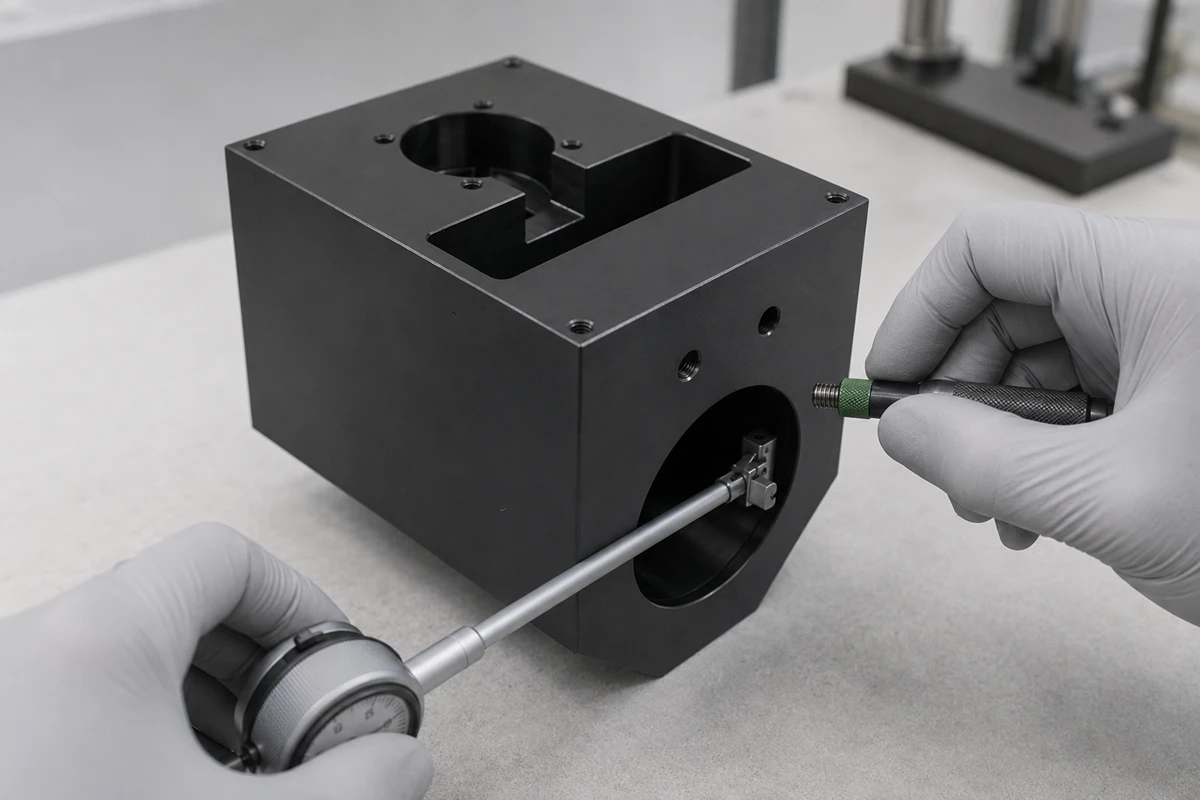
- Functional inspection: gauge defined threads, bores and fits; do not substitute a thickness reading for assembly verification.
- Corrosion testing: use only the drawing/PO method, specimen, conditioning, duration and acceptance criteria. Do not infer service life directly from salt-spray hours.
- Cleanliness and residue: check blind holes, pockets and threads for trapped rinse water, oil or loose residue when the application requires it.
- Packaging: use non-abrasive separation, suitable VCI/desiccant only when compatible, and clear storage/maintenance instructions for oiled finishes.
Common Failures and DFM Responses
| Observed problem | Possible contributors | Engineering response |
| Red or brown areas | Incorrect process control, alloy response, incomplete conversion or early corrosion | Hold the lot; verify material, bath records, rinse/seal and acceptance criteria |
| Powdery black smut / rub-off | Poor cleaning, loose reaction products or cold-blackening limitations | Define rub/smut acceptance; clean and reprocess only through approved disposition |
| Uneven or gray appearance | Surface finish, heat treatment, alloy variation, contamination or loading | Use a representative sample and control machining/pretreatment; avoid color-only acceptance |
| Rust after shipment | Insufficient sealant, damaged film, condensation, corrosive packaging or long storage | Review post-treatment, drying, packing, route, storage and maintenance requirements |
| Oil contamination | Over-application, trapped geometry or incompatible sealant | Specify drain/dry condition, low-migration option or alternate finish; inspect pockets and threads |
| Tight assembly | Residue, sealant, corrosion products or undefined post-finish acceptance | Gauge critical features after finish and define assembly-clean condition |
What to Send for an RFQ
- 3D CAD and controlled 2D drawing with revision.
- Material grade, condition, heat treatment and hardness.
- Prototype and production quantities plus delivery schedule.
- Black oxide/blackening specification, revision, class/type and approved processor restrictions.
- Supplementary oil, wax, sealant or dry-condition requirement.
- Masked zones, ground surfaces, adhesive/electrical/optical interfaces and cosmetic faces.
- Critical dimensions and gauges that apply after finishing.
- Corrosion, cleanliness, medical, vacuum, space or restricted-substance requirements stated separately.
- CoC, material certificate, FAI, dimensional report, lot traceability and test records required for receiving inspection.
| Upload your CAD, drawing, quantity and application notes to Rollyu Precision. We will review CNC machinability, finish selection, post-treatment, inspection and packaging as one sourcing package so the quotation reflects the real engineering requirement. |
Drawing-Backed Manufacturing Examples
The supplied project drawings reveal the type of information that turns a generic black oxide request into a quotable manufacturing route. These examples are presented without customer names and do not imply that a photograph alone proves specification compliance. The controlled drawing, purchase order, processor records and receiving evidence remain authoritative.
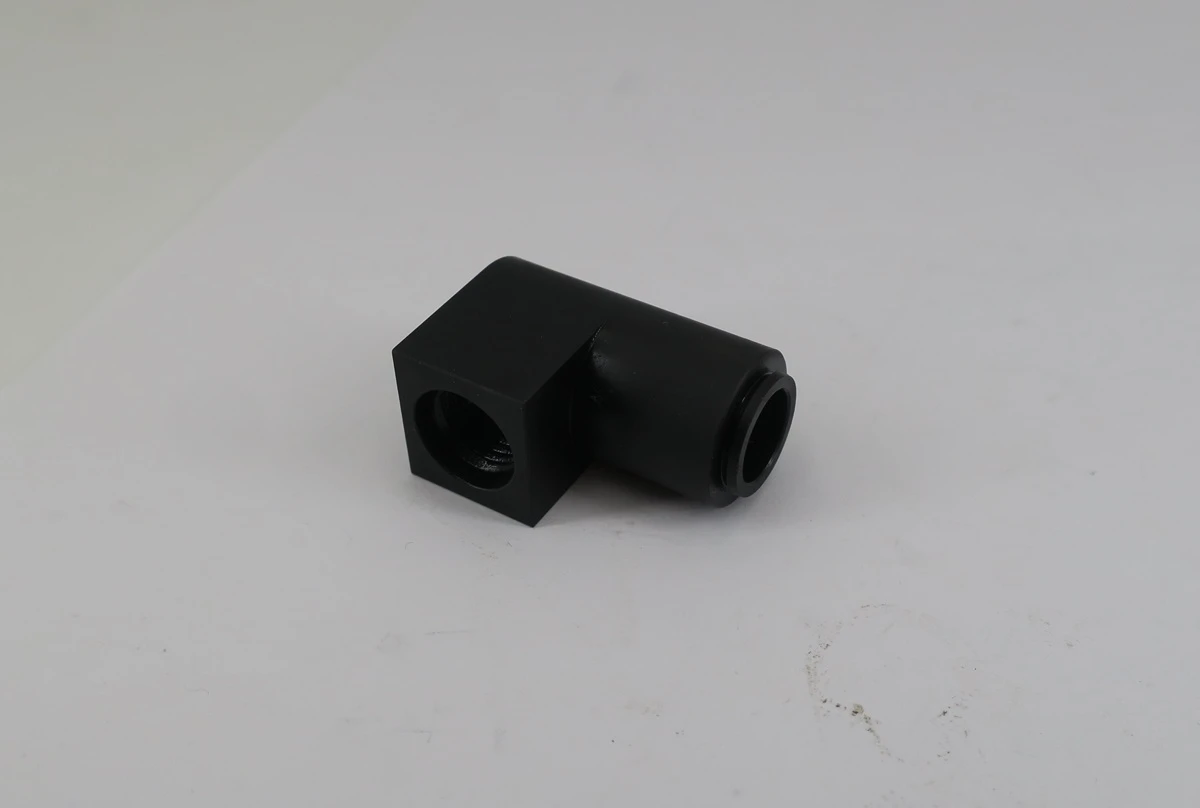
4140 Adapter Fitting: Black Oxide + Pre-Heat-Treated Minimum 28 HRC
The drawing identifies 4140, black oxide, a pre-heat-treated minimum hardness of 28 HRC, 7/16-20 UNF interfaces and tolerances after coating and heat treatment. A responsible quotation should confirm the actual hardness range, machining allowance and sequence, thread gauges after all processing, fluid-path cleanliness and whether supplementary oil is acceptable inside the ports. This is a practical example of black oxide machining where finish, hardness and fit cannot be reviewed separately.
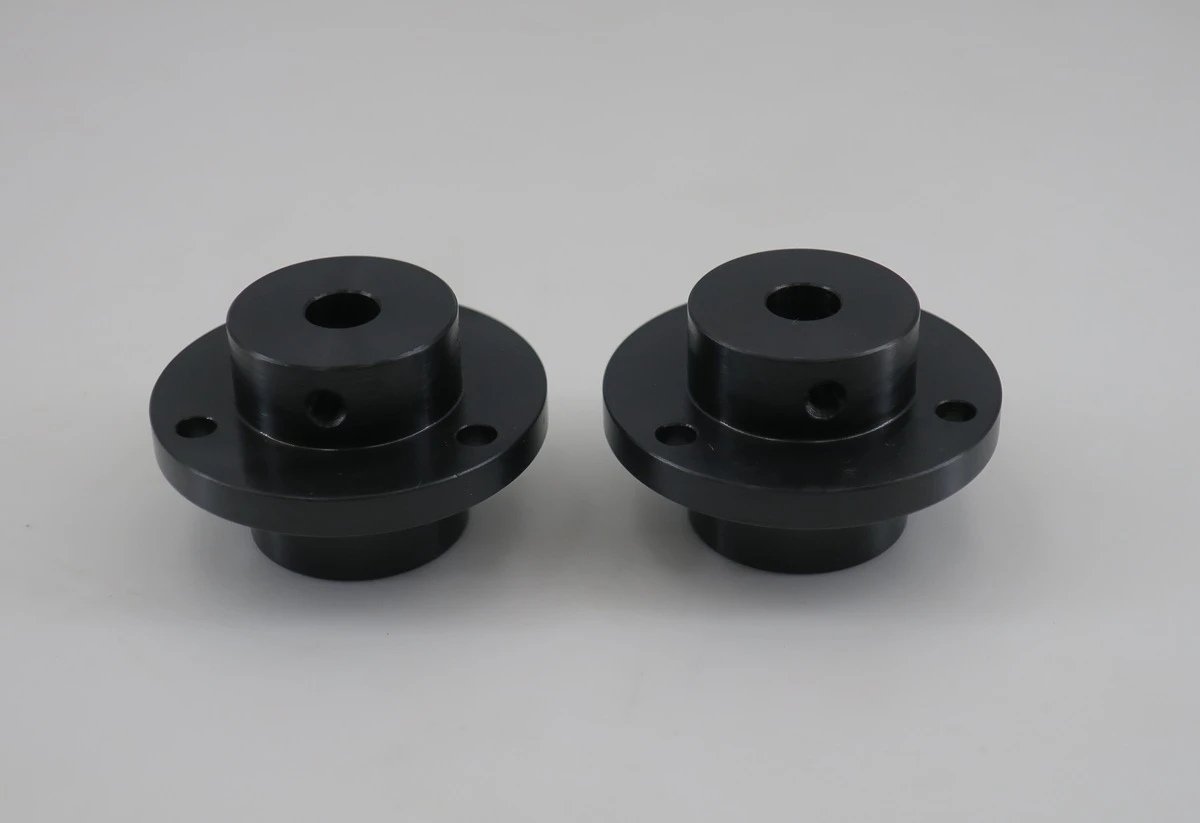
AISI 1010 Clutch Hub: MIL-DTL-13924E, Class 1
The clutch-hub drawing identifies AISI 1010 hot-rolled bar and black oxide per MIL-DTL-13924E, Class 1. This is more useful than a color-only note because it names a controlling specification and class. The RFQ should still resolve revision control, supplementary treatment, processor approval, cosmetic limits and required certification. Functional inspection of the bore, tapped holes and perpendicular faces is more meaningful than appearance alone.
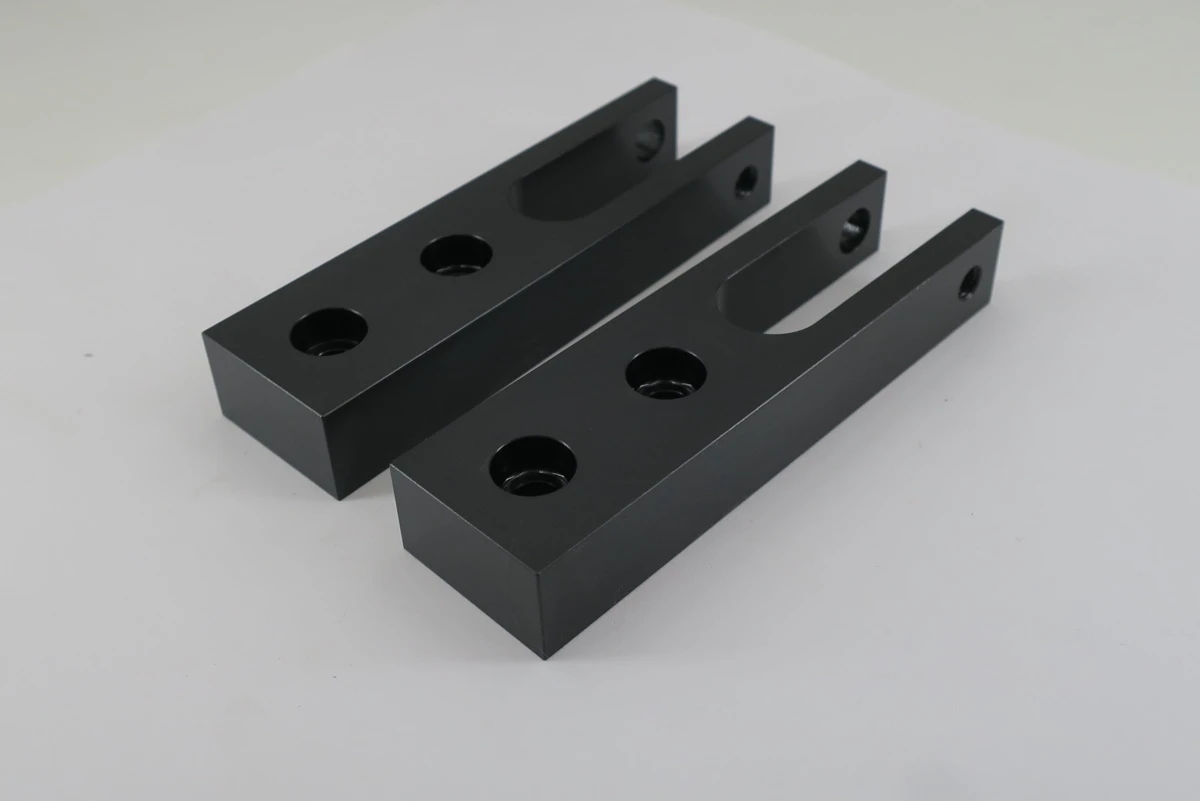
AISI 1020 Stopper Anchors: Lot Consistency and Traceable Evidence
The stopper-anchor drawing identifies AISI 1020 and the same MIL-DTL-13924E Class 1 requirement. For repeated parts, mechanical engineers may need interchangeability, post-finish thread acceptance and controlled appearance across the lot. A dark photo cannot establish conversion quality or corrosion performance; receiving evidence should link drawing revision and lot to material, final inspection and finish certification when required.
S45C Assembly: Why “Black Oxide” Alone Leaves Open Questions
The S45C assembly drawing calls for black oxide but does not, in the extracted note, define the process standard, class or supplementary treatment. That makes it a strong DFM example: Rollyu should ask about oil/wax, corrosion exposure, cosmetic expectations, threaded-feature gauging and documentation rather than silently choose a route. This protects both the engineer and the manufacturer from accepting a black-looking part that does not meet service needs.
FAQ: Black Oxide CNC Machined Parts
What is black oxide on CNC machined steel parts?
It is a thin surface-conversion finish used primarily on ferrous metals to create a dark appearance with minimal dimensional buildup. Corrosion performance commonly depends on an oil, wax or other supplementary treatment.
Is blackening the same as black oxide?
Often in commercial steel-part language, but blackening is broader. It can include hot, mid-temperature, cold, stainless-specific and other proprietary processes. Specify the controlled process rather than relying on the name.
Does black oxide prevent rust?
It can improve corrosion behavior when correctly processed and sealed, but it does not make steel rustproof. Humidity, salt, cleaning, handling, sealant retention and packaging control performance.
Does black oxide change dimensions?
The conversion layer has minimal buildup compared with many plated or painted finishes. However, “zero dimensional effect” is an unsafe guarantee because residues, sealants, corrosion and process preparation can affect critical features.
Is black oxide wear resistant?
It is not normally selected as a primary hard-wear coating. For sliding or abrasive contact, compare nitriding, PVD/DLC, engineered plating, hard materials or lubrication systems.
Can stainless steel be black oxidized?
Yes, with stainless-specific chemistry and process control. Suitability depends on grade, condition, corrosion target, appearance and cleaning requirements.
Can aluminum receive black oxide?
Not through the conventional ferrous-metal magnetite process. Black anodizing, chemical blackening, PVD or paint may be relevant, but they are different finishes.
Is black oxide RoHS or REACH compliant?
Do not assume universal compliance. Obtain current, product- and process-specific declarations for the applicable destination, restricted substances and supplementary treatment.
Is black oxide suitable for medical devices?
It may be used on certain non-patient-contact equipment components, but the finish does not establish biocompatibility, sterilization durability or regulatory approval.
Is black oxide suitable for vacuum or space hardware?
Not by the finish name alone. Conventional oils or waxes may conflict with cleanliness and outgassing requirements. The program must define approved processing, cleaning, sealant restrictions, bake and qualification evidence.
What causes black oxide parts to rust after delivery?
Possible causes include incomplete conversion, insufficient or removed sealant, trapped moisture, condensation, corrosive packaging, fingerprints, storage time or an exposure beyond the finish’s intended capability.
What should an RFQ include?
Send CAD, drawing, material/heat treatment, quantity, specification/revision, supplementary treatment, masked interfaces, post-finish gauges, environmental requirements and required certificates/reports.
Conclusion: Specify the System, Not Just the Color
A reliable black oxide RFQ connects the finish to material, heat treatment, geometry, environment, supplementary treatment and evidence. That prevents a dark-looking part from being accepted even though it carries the wrong process, contaminates an optical or sensor assembly, rusts in transit, or fails to assemble after finishing.
Rollyu Precision can coordinate machining, finishing, inspection and packaging requirements as one engineering workflow. The most useful RFQ is not the one with the longest finish note; it is the one that clearly identifies function, risk and acceptance criteria before production begins.