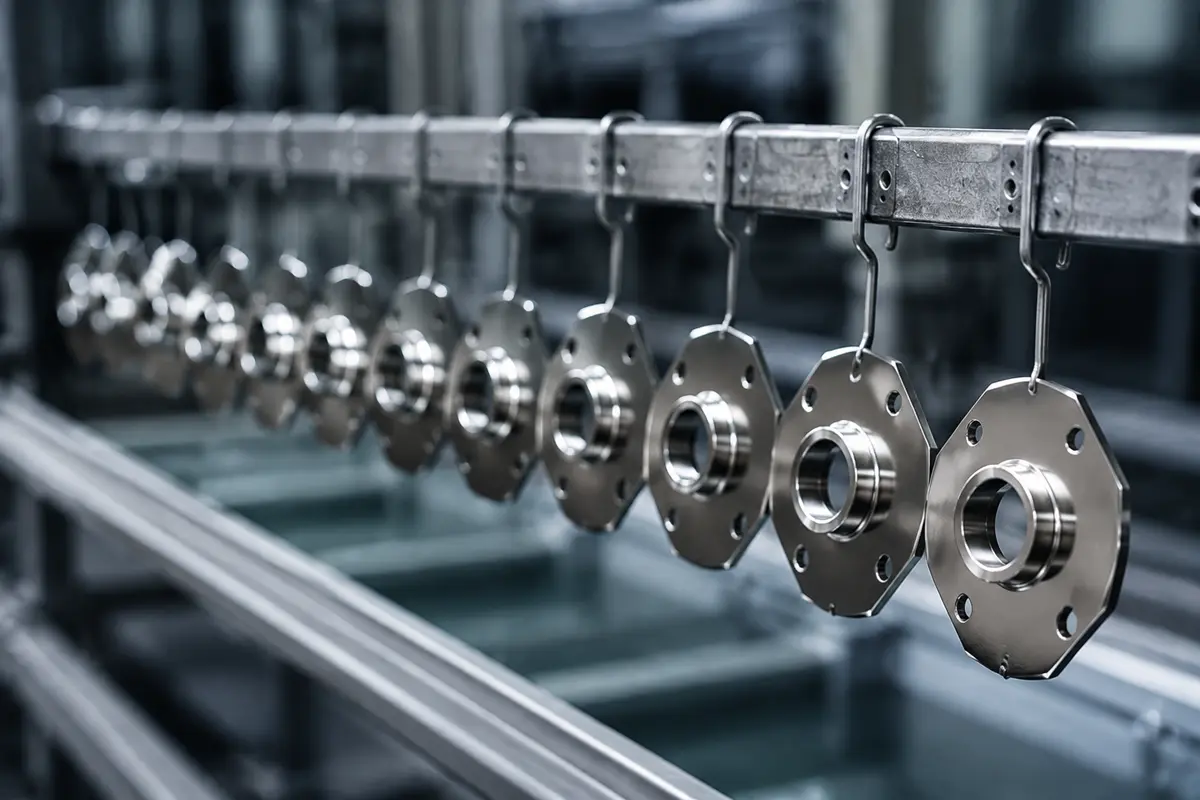
Electropolishing is an electrochemical finishing process that removes a thin, controlled layer from a metal surface. The workpiece acts as the anode in an electrolytic cell. Under controlled current, temperature, chemistry, time, agitation, and electrode geometry, microscopic high points dissolve faster than valleys. The result can be a smoother, brighter, cleaner surface with reduced micro-burrs and improved corrosion performance.
For precision components, electropolishing is not simply “making stainless steel shiny.” The process changes the finished dimensions, edge condition, surface texture, and chemical cleanliness. It must therefore be planned together with CNC machining, welding, mechanical pre-polishing, passivation, inspection, and packaging.
What Is Electropolishing?
Electropolishing is often described as reverse electroplating. Electroplating deposits material; electropolishing selectively removes it. The stainless steel part is connected to the positive side of a DC power source, while a suitable cathode is connected to the negative side. Both are immersed in a controlled electrolyte. Metal ions leave the workpiece surface, and the process preferentially levels microscopic peaks.
| Stage | What Happens | Engineering Control |
| Pre-cleaning | Oil, soil, oxide, and handling residue are removed | Cleanliness, compatible chemistry, complete rinsing |
| Racking and masking | Part is electrically contacted; protected zones are masked | Contact location, current path, rack marks, dimensional protection |
| Electropolishing | Controlled anodic dissolution smooths exposed surfaces | Current density, voltage, temperature, time, bath condition, agitation |
| Rinsing / neutralization | Residual electrolyte and reaction products are removed | Rinse quality, neutralization, internal drainage |
| Drying / inspection | Surface and dimensions are evaluated | Ra, appearance, dimensions, contamination, corrosion testing if specified |
How the Electropolishing Process Works
Engineering Review and Process Allowance
Review alloy, geometry, tolerances, roughness, welds, burrs, critical datums, blind features, internal passages, rack points, and masked areas before machining is released. Dimensions should be defined as before-finish or after-finish values. Tight fits may require machining compensation based on the qualified removal range.
Pre-cleaning and Surface Preparation
Electropolishing does not correct deep scratches, pits, weld undercut, heavy scale, or major machining marks. These defects may require grinding or mechanical polishing first. Parts must be free of oil and visually detectable contaminants before they enter the bath.
Fixturing, Electrical Contact, and Masking
The rack must support the part securely and provide consistent electrical contact. Contact locations can leave witness marks, so they should be placed in noncritical areas. Threads, sealing surfaces, sharp optical features, and close-tolerance bores may require masking or special process development.
Controlled Anodic Dissolution
The processor controls bath chemistry, temperature, current density, voltage, time, agitation, cathode geometry, part spacing, and total load area. Current concentrates at exposed peaks and edges. Without suitable fixtures and parameter control, complex shapes can polish unevenly.
Rinse, Neutralize, Dry, and Inspect
After electropolishing, parts are rinsed thoroughly, neutralized where required, and dried using a controlled method. Inspection should cover surface roughness, brightness consistency, pitting, rack marks, edge condition, critical dimensions, cleanliness, and packaging protection.
Benefits of Electropolishing Stainless Steel
- Reduced microscopic roughness: preferential removal of peaks can improve surface smoothness and cleanability.
- Micro-deburring: small burrs and sharp micro-projections can be reduced, including features that are difficult to reach mechanically.
- Improved corrosion performance: removal of free iron and surface contamination supports formation of a chromium-rich passive surface.
- Lower residue retention: smoother product-contact surfaces can reduce buildup and simplify cleaning in hygienic and high-purity equipment.
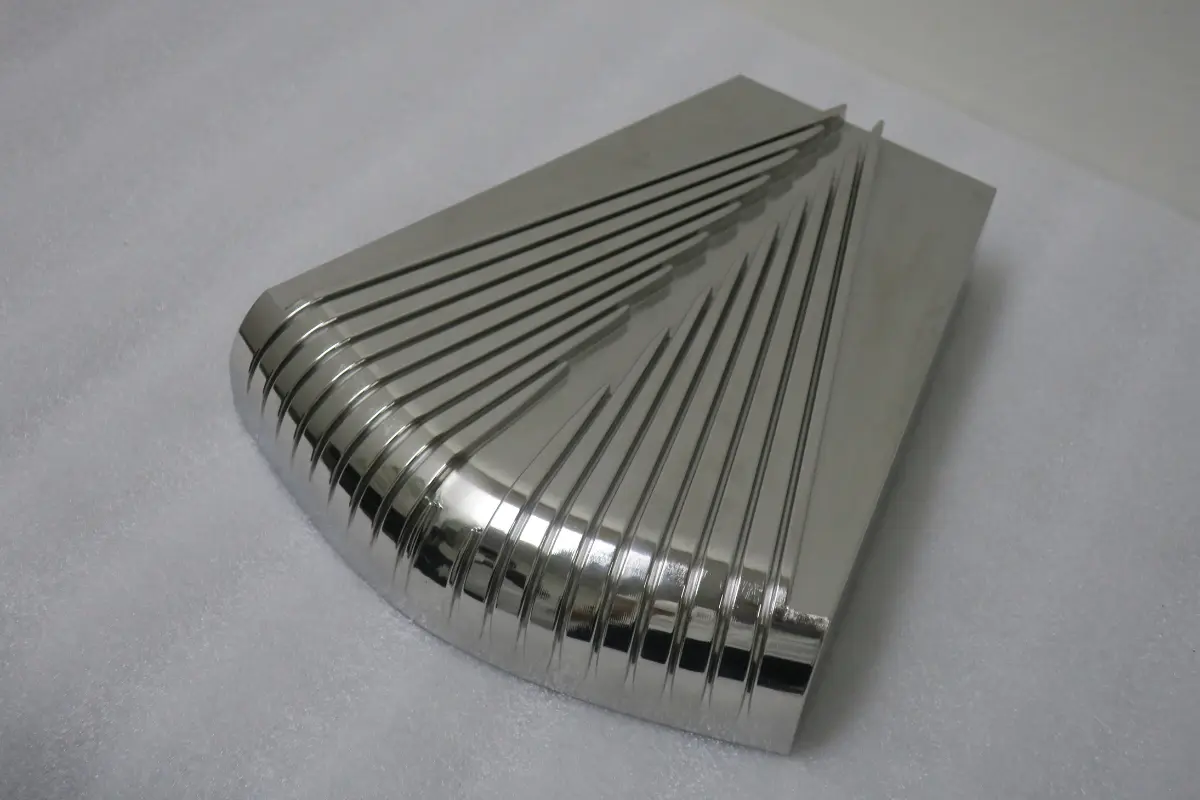
- Bright, uniform appearance: electropolished stainless steel has a distinctive smooth and reflective finish.
- No directional abrasive grain: exposed surfaces are smoothed electrochemically rather than by a sanding path.
- Batch processing potential: qualified racks and loads can deliver repeatable finishing across production quantities.
What Electropolishing Cannot Fix
Electropolishing follows the underlying surface and is not a substitute for good design, machining, welding, or pre-polishing. It may make deep scratches, pits, porosity, weld defects, and uneven grinding more visible. It also removes material from exposed surfaces and can accentuate current concentration at edges. Very tight tolerances, blind features, dissimilar-metal assemblies, poorly drained cavities, and interrupted electrical paths require engineering review.
Electropolishing vs. Passivation vs. Mechanical Polishing
| Factor | Electropolishing | Passivation | Mechanical Polishing |
| Primary action | Electrochemically removes a controlled surface layer | Chemically removes free iron; supports passive film | Abrasively removes and levels material |
| Surface appearance | Bright, smooth, no directional grain | Usually little intentional visual change | Brushed, satin, bright, or mirror |
| Material removal | Yes; must be included in tolerance planning | Minimal intentional removal | Localized and operator/tool dependent |
| Micro-burr reduction | Good for exposed micro-burrs | No | Good where tools can reach |
| Complex geometry | Can treat electrically exposed areas | Treats wetted areas | Limited by access |
| Best specification | Removal allowance, Ra, masks, rack marks, cleanliness | Standard, chemistry, test, cleanliness | Grit, lay, Ra, protected dimensions, visual sample |
Key Variables That Control Electropolishing Quality
| Variable | Why It Matters | Typical Failure When Uncontrolled |
| Alloy and heat condition | Different alloys dissolve and passivate differently | Uneven brightness, pitting, poor response |
| Incoming surface | Electropolishing cannot erase major defects | Visible scratches, pits, or weld irregularities remain |
| Current density and time | Control removal rate and smoothing action | Under-polish, burning, excessive removal |
| Temperature and bath chemistry | Affect viscosity, conductivity, dissolution, and finish | Nonuniform finish, etching, unstable results |
| Cathode geometry and spacing | Shape the electrical field | Shadows, edge attack, uneven internal surfaces |
| Racking and contact | Provide current and determine witness locations | Arcing, poor contact, rack marks, part damage |
| Agitation and loading | Support heat and gas removal and bath uniformity | Streaks, bubbles, inconsistent lot-to-lot appearance |
Electropolishing Applications by Industry
Photonics and Optical Systems
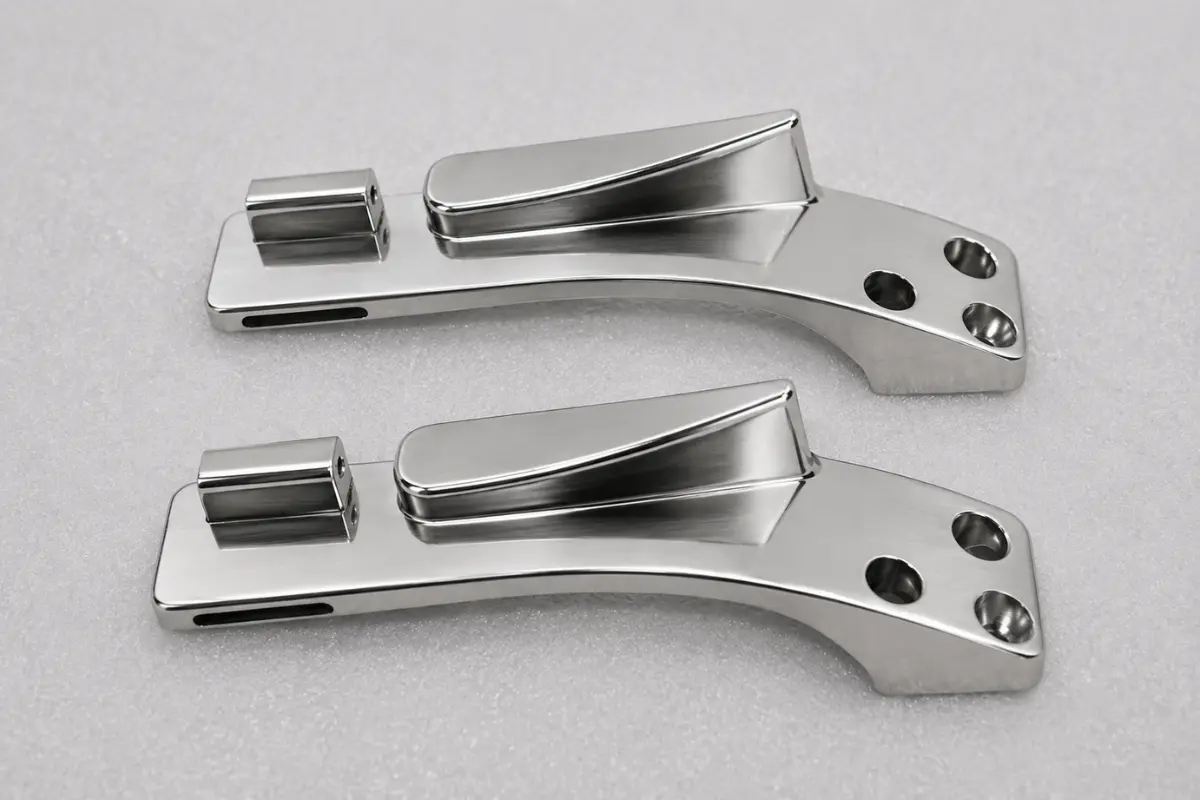
Electropolishing can support clean stainless steel mounts, brackets, vacuum hardware, optical instrument structures, and laser-system components. The design must distinguish surfaces that benefit from a smooth clean finish from optical-path surfaces where high reflectivity could increase stray light. Protect precision bores, threads, knife edges, alignment datums, and sealing features.
Semiconductor Equipment
Semiconductor process equipment may require low particle retention, cleanable surfaces, corrosion resistance, and controlled contamination. Candidate parts include gas-handling components, manifolds, chamber hardware, wafer-handling mechanisms, fluid components, brackets, and cleanroom assemblies. Electropolishing requirements should align with the equipment maker’s material, cleaning, particle, packaging, and vacuum specifications.
Pharmaceutical and Bioprocess Equipment
Product-contact tubing, manifolds, valve components, pump parts, nozzles, filling equipment, and vessel hardware may use electropolished 316L surfaces to support cleanability and repeatable sanitation. Surface roughness, weld finishing, drainage, crevice control, documentation, and validated cleaning remain essential; a bright appearance alone is not a sanitary acceptance criterion.
Quantum Instruments
Quantum sensing, cryogenic, UHV, and precision-measurement systems may use electropolished stainless steel for clean vacuum-compatible components, sensor structures, chambers, mounts, feedthrough hardware, and nonmagnetic assemblies. Review magnetic permeability, alloy condition, vacuum cleaning, bakeout, outgassing, dimensional change, and optical reflectivity as separate engineering requirements.
Food Machinery
Electropolished stainless steel is used in depositor parts, nozzles, pump components, mixing hardware, guides, manifolds, and sanitary fittings. Smoother surfaces can reduce product retention and make cleaning easier, but hygienic performance also depends on radii, welds, joints, dead legs, drainage, and the cleaning process.
Medical Devices
Medical-device components may use electropolishing to reduce micro-burrs, improve corrosion behavior, support cleanability, and create a consistent finish. Requirements depend on whether the part is an external housing, reusable instrument component, fluid-contact part, or implantable component. Work must follow the approved drawing, material specification, risk controls, cleaning validation, and applicable regulatory requirements.
Dental Equipment
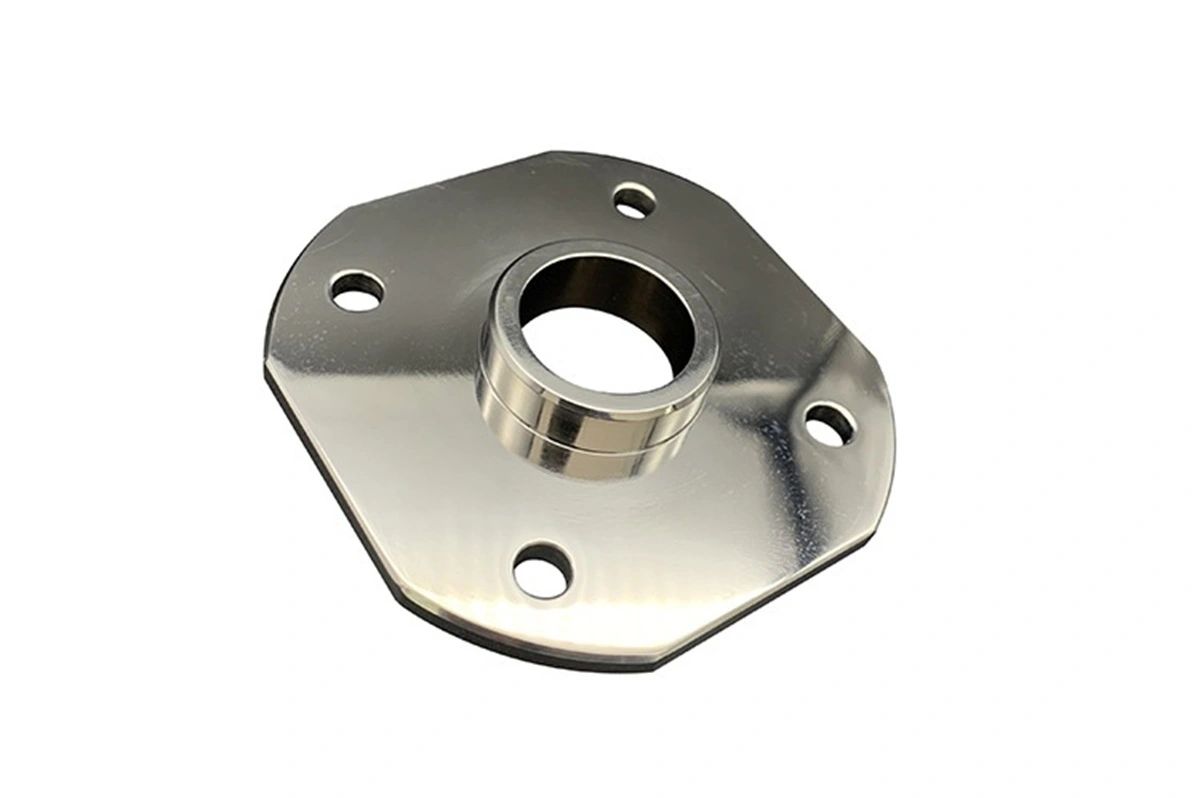
Dental handpiece parts, instrument components, brackets, fluidic parts, housings, and sterilizable equipment may combine bright cosmetic surfaces with small features and tight fits. Electropolishing allowance, rack marks, passivation response, repeated cleaning exposure, and finished dimensions should be confirmed during first-article approval.
Designing CNC Parts for Electropolishing
- Dimension after finishing: identify which dimensions apply after electropolishing and compensate machining stock where required.
- Define surface zones: mark product-contact, vacuum, cosmetic, protected, and noncritical surfaces separately.
- Specify roughness correctly: state Ra target, locations, measurement direction, instrument, cutoff, and sampling plan.
- Provide drainage and access: avoid trapped electrolyte in blind cavities, narrow gaps, and undrainable assemblies.
- Control edges: high current density at edges can increase removal; define critical sharp features and allowable edge break.
- Plan rack points: provide contact areas that are electrically effective but outside critical cosmetic or functional zones.
- Avoid mixed-material surprises: dissimilar metals, brazes, weld filler, heat tint, and heat-affected zones may respond differently.
- Package individually: bright surfaces can scratch through part-to-part contact after finishing.
Example Engineering Specification
An anonymized 316L stainless steel precision component illustrates the difference between a useful drawing specification and a generic “electropolished” note. The project required dimensions to apply after finishing, selected faces polished to Ra 0.4 μm, and the finished part to be free of oil and visually detectable contaminants. These requirements connect surface performance to dimensional inspection and cleanliness rather than appearance alone.
| Drawing / RFQ Field | Example Requirement |
| Material | 316L stainless steel with required certification |
| Dimensional state | Critical dimensions apply after electropolishing |
| Surface roughness | Selected marked faces: Ra 0.4 μm; measurement method defined |
| Protected areas | Mask threads, precision fits, sealing faces, or optical datums as marked |
| Appearance | Uniform finish; no pits, burns, heavy rack marks, or staining in controlled zones |
| Cleanliness | Free of oil, visible contaminants, polishing residue, and trapped chemicals |
| Documentation | Material certificate, dimensional report, Ra results, finishing certificate, first article as required |
| Packaging | Individual nonabrasive protection; prevent contact damage |
Quality Control After Electropolishing
- Dimensional inspection of critical fits, bores, thickness, flatness, threads, sealing lands, and edge features after finishing.
- Surface roughness measurement at specified locations using a method appropriate to the feature and expected Ra range.
- Controlled visual inspection for pitting, streaking, burning, discoloration, water marks, uneven brightness, and rack marks.
- Cleanliness inspection for oil, electrolyte residue, fingerprints, particles, and material trapped in holes or channels.
- Corrosion or passivation verification when required by the customer specification or applicable standard.
- Lot traceability linking material, machining route, electropolishing batch, inspection records, and packaging.
Frequently Asked Questions
What is electropolishing?
Electropolishing is controlled electrochemical removal of a thin metal layer. The workpiece is the anode, and microscopic high points dissolve preferentially, producing a smoother and often brighter surface.
How does electropolishing stainless steel work?
The cleaned part is racked, masked where necessary, and immersed in a qualified electrolyte with a cathode. DC current, temperature, time, bath chemistry, agitation, and electrode geometry control anodic dissolution. The part is then rinsed, neutralized, dried, and inspected.
Is electropolishing the same as passivation?
No. Electropolishing removes material and changes surface topography. Passivation primarily removes free iron and supports the passive film with minimal intentional material removal. Electropolished parts may still receive a specified passivation or final chemical treatment depending on the process route.
How much material does electropolishing remove?
There is no universal value. Removal depends on alloy, current density, time, temperature, chemistry, geometry, edge exposure, rack position, and process qualification. The allowable range must be agreed for the actual part and included in tolerance planning.
Does electropolishing always reduce Ra?
It generally smooths microscopic peaks, but the result depends on the incoming surface and process. Deep machining marks, pits, weld defects, or waviness may remain. Specify the final Ra and measurement method rather than assuming a result from appearance.
Can electropolishing remove burrs?
It can reduce exposed micro-burrs and sharp microscopic projections. It is not a substitute for removing heavy burrs, large rollover, incomplete holes, or unsafe macro-edges during machining.
Which stainless steel grades can be electropolished?
Many austenitic and precipitation-hardening grades can be electropolished, including commonly specified 304, 316/316L, and 17-4PH, but response varies with alloy chemistry, heat treatment, welding, surface condition, and the qualified process.
Is electropolishing suitable for semiconductor, pharmaceutical, food, medical, and dental parts?
It can be suitable when alloy, geometry, dimensional allowance, cleanliness, roughness, testing, and regulatory requirements are properly controlled. Suitability must be determined from the equipment or device specification.
What should I send for an electropolishing quotation?
Send the 3D CAD model, controlled 2D drawing, alloy and condition, quantity, final dimensions, target Ra, marked surface zones, masked areas, allowed rack points, cleanliness and testing requirements, documentation, and annual demand.
Why Choose Rollyu Precision?
Rollyu Precision integrates CNC milling, turning, EDM, grinding, sheet-metal fabrication, finishing coordination, and dimensional inspection for stainless steel components. Our engineering review considers machining allowance, pre-finish surface quality, electropolishing removal, critical tolerances, cleanliness, and after-finish inspection as one manufacturing plan. We support prototype and production projects under ISO 9001:2015 and ISO 13485:2016 quality management systems.
- CNC machining and electropolishing planning through one point of contact
- Support for 304, 316/316L, 17-4PH, 15-5PH and other project-specific stainless steels
- CMM and surface-finish inspection planning after finishing
- Engineering review for rack points, masking, drainage, edges, bores, threads, and sealing features
- Documentation and protective packaging matched to the project
| Need Electropolished Parts That Still Meet the Drawing?
Send your CAD files, 2D drawing, material grade, target Ra, masked areas, cleanliness requirements, and quantity. Rollyu Precision will review machining allowance, finishing risk, inspection, and the most suitable process route. Request a Quote → www.rollyu.com |