Choose die casting for repeatable thin-wall aluminum parts at stable production volumes. Choose sand casting for larger parts, lower quantities, or designs that need broader alloy and heat-treatment options. Compare total program cost because casting price alone can hide tooling, machining, and inspection expenses.
Select the process before tooling begins, when geometry changes still cost less.
What Are the Main Differences Between Die Casting and Sand Casting?
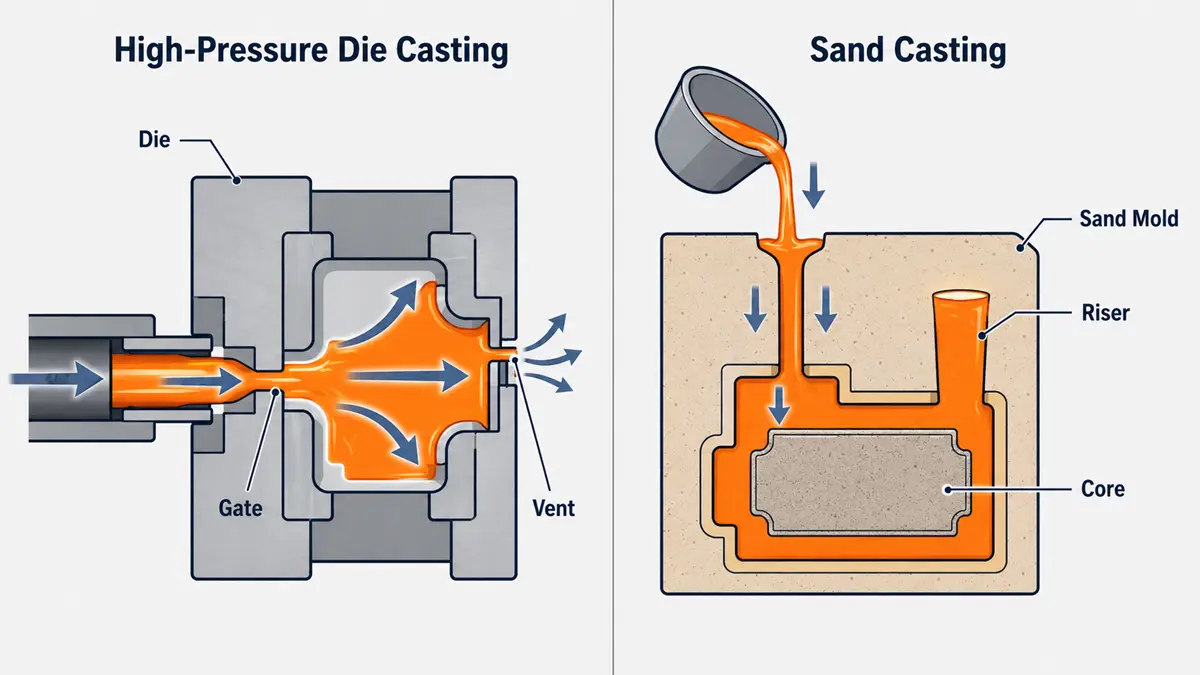
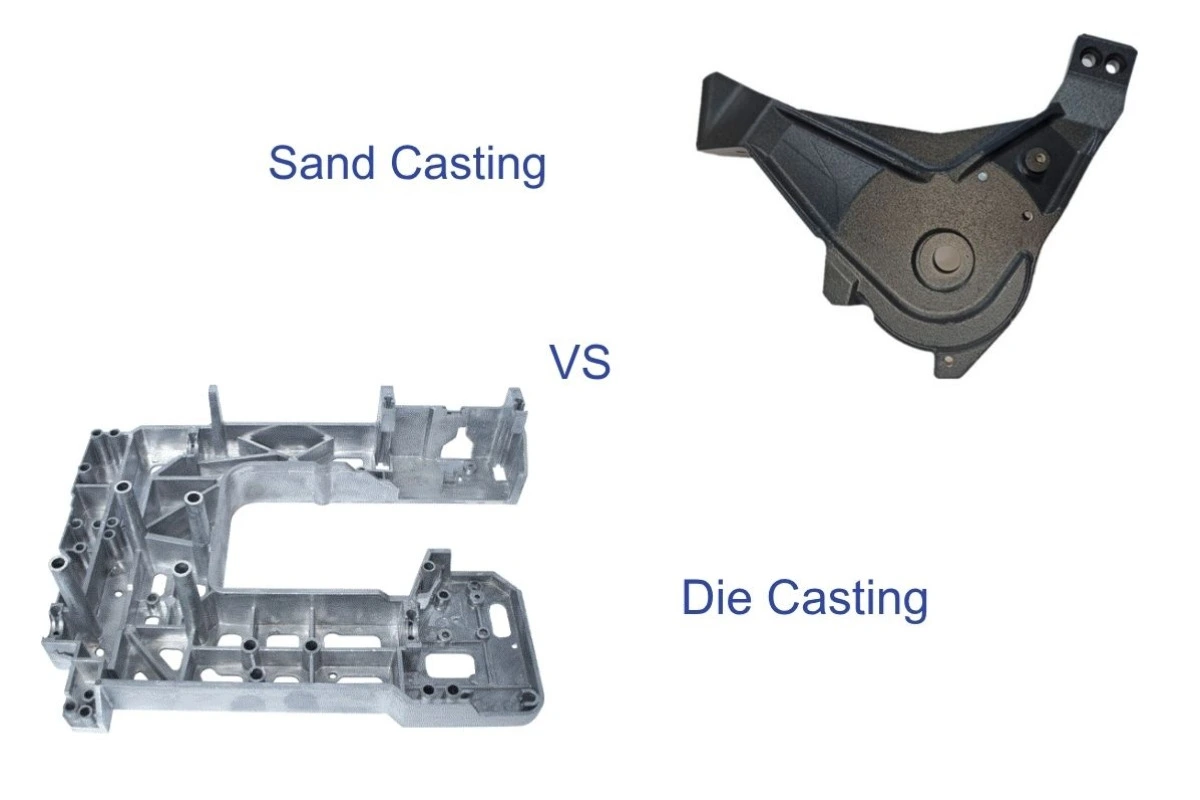
This comparison uses die casting to mean high-pressure die casting. The process uses a reusable steel die, while sand casting uses a new sand mold for each pour. Mold type and fill method affect wall thickness, part size, surface finish, cycle time, and cost.
| Decision Factor | Die Casting | Sand Casting |
|---|---|---|
| Mold | Reusable steel die | Expendable sand mold |
| Metal fill | High-pressure, fast fill | Usually gravity fill |
| Production fit | Repeated production runs | Prototypes, lower volumes, and large castings |
| Wall capability | Better for thin, complex walls | Usually requires heavier sections |
| As-cast result | Tighter repeatability and smoother surfaces | More dimensional and surface variation |
| Upfront tooling | Higher | Lower |
| Design changes | Costly after hard tooling | Easier before production tooling |
Mold Type and Metal Flow
Die casting forces molten aluminum into a closed steel die. Fast filling helps the metal reach thin ribs and detailed features before it solidifies. The die casting process uses gates, runners, vents, and overflows to manage flow and move trapped air away from critical areas.
Sand casting usually relies on gravity to fill a bonded-sand cavity, although assisted methods also exist. The slower fill favors heavier sections. Long, thin flow paths may solidify before the cavity fills.
Both processes can produce porosity. Die casting may trap gas when venting or shot control is poor. Sand casting may develop gas or shrinkage defects when melt quality, mold conditions, feeding, or solidification control is weak.
Aluminum Alloy Options and Mechanical Requirements
Sand casting generally supports more aluminum casting alloys and heat-treated tempers. Die-casting alloys must also suit fast filling, die-soldering resistance, solidification, and cycle stability. Specify the alloy and temper instead of writing only “cast aluminum.”
Strength and ductility depend on alloy chemistry, temper, local solidification, porosity, wall thickness, and test location. Define the required properties and verification method. If the part needs welding or solution heat treatment, flag that requirement before quoting because trapped gas in conventional high-pressure die castings can expand during heating.
Part Size and Wall Thickness Limits
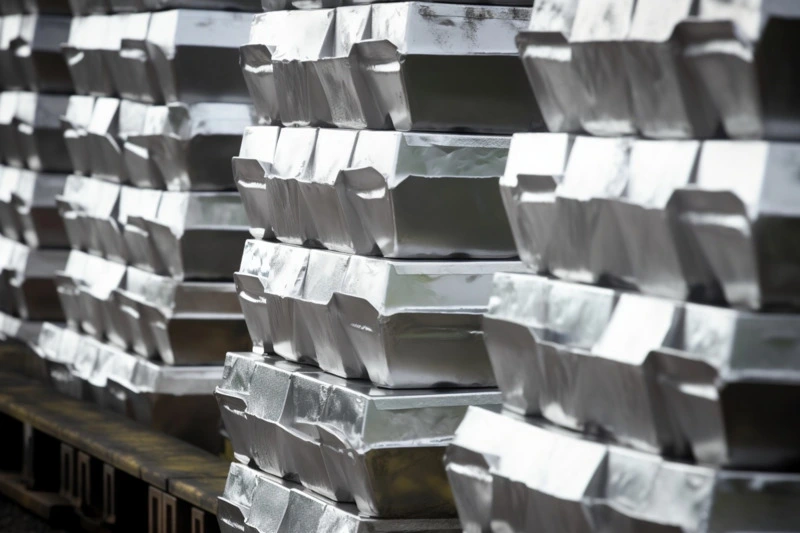
Shot capacity, platen size, and locking force limit die-cast part size. Larger parts need larger machines and costlier dies, while long flow paths make remote thin sections harder to fill.
Sand molds can accommodate much larger parts, but the process usually needs heavier walls. Uneven sections can create hot spots, shrinkage, warpage, and feeding problems. Because wall capability changes with alloy, flow length, projected area, local mass, and equipment, ask the supplier to review the CAD model instead of applying a generic minimum wall.
Tolerance, Repeatability, and Surface Finish
Die casting usually produces tighter as-cast dimensions and smoother surfaces. A rigid steel cavity supports repeatability, although die temperature, wear, distortion, and trimming still affect results.
Sand molds add variation through pattern condition, mold compaction, core placement, moisture, and shakeout. Sealing faces, bearing bores, precision datums, and close hole locations often need machining stock. Give as-cast and machined features separate tolerances so cosmetic areas do not receive needless machining.
Tooling Cost, Cycle Time, and Unit Cost
Die-casting tooling costs more because a steel die may need slides, cooling, ejection, gates, vents, and trim features. Once production stabilizes, short cycles can lower unit cost when volume is high enough to absorb the tooling investment.
Sand-casting tooling costs less to start, but every part needs a new mold, and cores add labor and variation. Ask suppliers to separate tooling, casting, heat treatment, machining, finishing, inspection, and packaging. This exposes cases where a low casting price produces a higher finished-part cost.
Which Casting Process Fits Your Aluminum Part?
Start with the hardest functional requirement. Thin walls and repeat production often favor die casting. Large envelopes, lower quantities, or specific heat-treatment needs often favor sand casting.
Die Casting for Higher-Volume Parts With Thin Walls
Die casting fits housings, covers, brackets, and frames that combine thin walls with ribs, bosses, openings, and repeatable external detail. A well-controlled steel die may also reduce machining on noncritical features.
Stable demand makes the tooling easier to justify. Check expected die life, cavity count, maintenance responsibility, change costs, and the volume tied to each unit price. Consider another route if the part exceeds available machine capacity, will change often, or needs properties the proposed alloy and process cannot support.
Sand Casting for Larger Parts and Lower Volumes
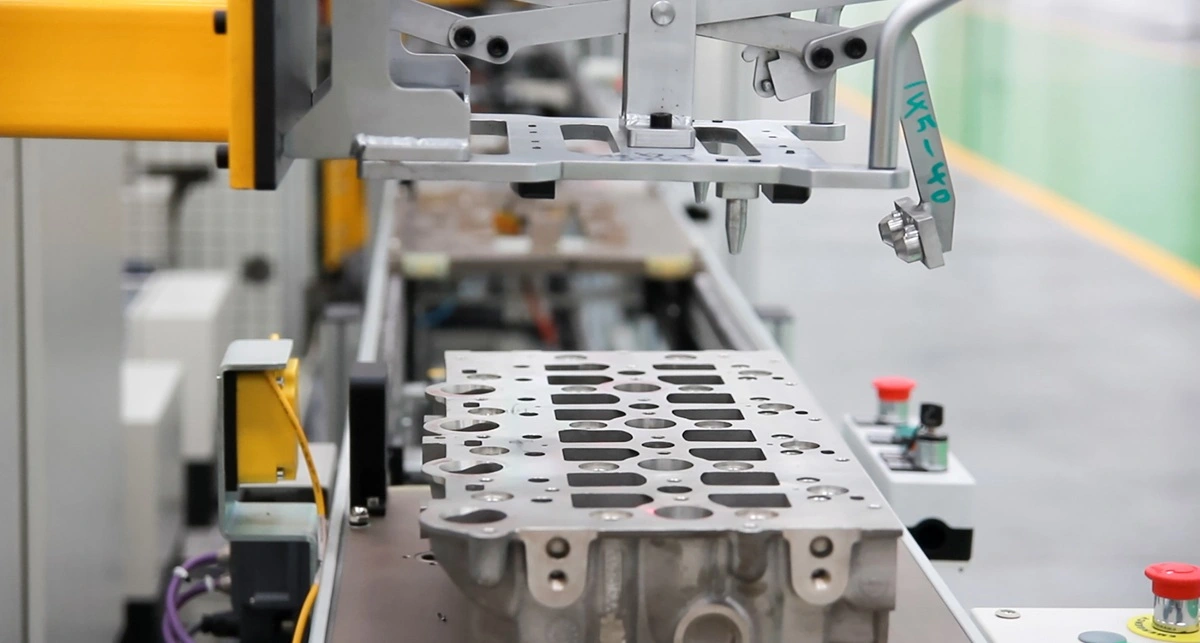
Sand casting fits large cast aluminum parts, including pump bodies, machine bases, and heavy-wall housings. Lower tooling cost also suits uncertain demand and designs that may change.
Budget for wider as-cast tolerances, rougher surfaces, more machining stock, and tighter control of core location and feeding. These costs can erase the tooling savings on a small part with extensive machining. The foundry should also confirm the alloy, temper, test method, and property basis.
How Should Aluminum Parts Be Designed for Each Casting Process?
Design around mold filling, casting release, and solidification. A geometry that works in sand may need major changes before a steel die can fill and eject it.
Draft Angles and Parting Lines
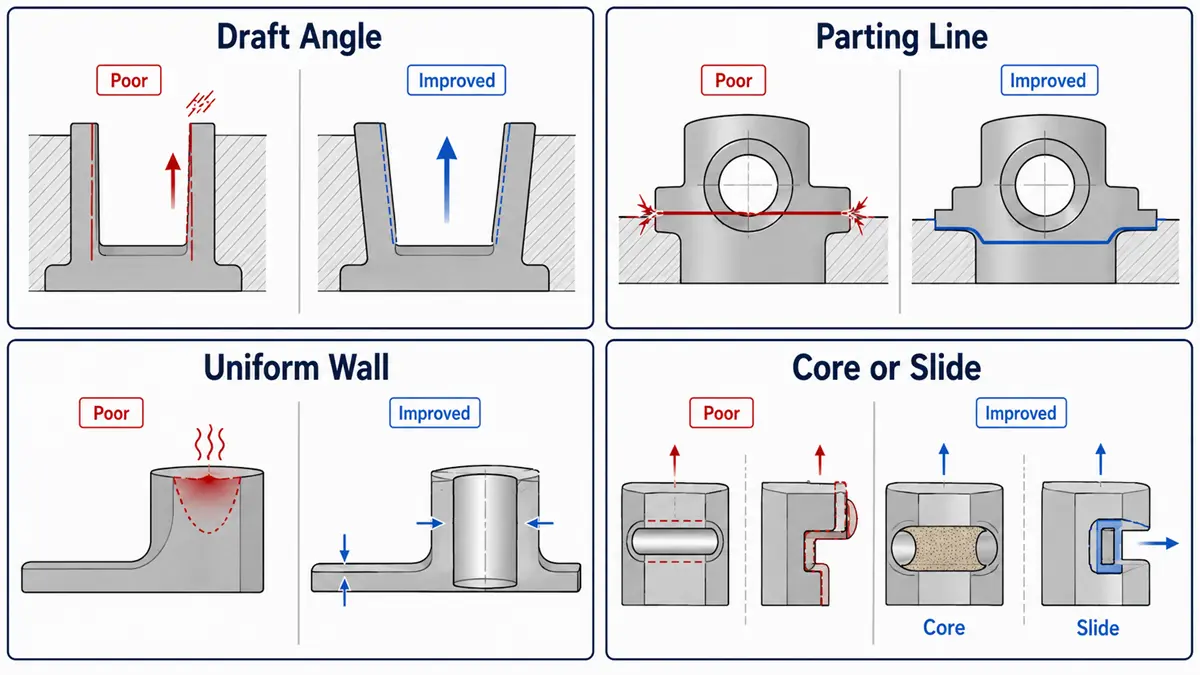
Both processes need draft on surfaces parallel to the draw direction. Draft helps a die casting eject without scuffing and lets a sand-casting pattern leave the mold without breaking cavity edges.
Keep the parting line away from sealing surfaces, cosmetic faces, and tight datums. Mark functional and cosmetic zones so the toolmaker can position gates, vents, ejector marks, and flash where they will not affect assembly or appearance.
Wall Thickness, Ribs, and Bosses
Keep wall thickness as uniform as the load path allows. Sudden changes cool unevenly and can move shrinkage or distortion into threaded bosses, sealing faces, and machined datums.
Use ribs to stiffen broad walls, and support bosses with smooth transitions. Review the causes of casting shrinkage before tooling because a heavy boss may expose porosity only after machining.
Cores, Undercuts, and Internal Passages
Sand cores form internal passages, but long or weak cores can shift or break. Core prints and supports must locate each core during pouring.
Die casting can use slides, lifters, loose pieces, or collapsible features for some undercuts. Each moving component adds cost, wear, and alignment risk. Compare a complex core or slide with a drilled, milled, or assembled passage based on access, finish, leak risk, and annual volume.
Machining Allowance for Critical Features
Add machining stock only where the finished feature needs it:
- Sealing faces and mounting datums
- Bearing seats and precision bores
- Threaded holes and critical mounting pads
Too little stock may leave low spots or cast surface. Too much adds machining time and may expose subsurface porosity. Before tooling approval, align casting and machining suppliers on datums, stock, clamping, and inspection. Show raw and finished dimensions separately on the drawing.
What Should Buyers Check Before Requesting a Casting Quote?
Give each supplier the same part definition, demand range, finishing scope, inspection plan, and tooling terms. Otherwise, the quotes may cover different work.
CAD Models, Drawings, and Alloy Specifications
Send a native 3D CAD file or STEP model with a controlled 2D drawing that identifies:
- Aluminum alloy and temper
- Critical dimensions, datums, and GD&T
- Machined surfaces and stock
- Cosmetic and surface-finish limits
- Pressure boundaries and porosity-sensitive zones
- Testing and documentation requirements
Resolve model and drawing conflicts before release. If any remain, state which file controls.
Order Quantity and Production Schedule
Provide prototype quantity, first order, annual demand range, and program life. One quantity cannot show where higher die cost crosses over with lower recurring cost.
Request realistic price breaks and keep tooling separate from piece price. Include sample timing, validation, production ramp, and design freeze. If demand is uncertain, compare a low-tooling route with a production-tool route and ask when the second option reaches payback.
Machining, Finishing, and Inspection Requirements
Define the delivered condition, including machining, deburring, blasting, coating, anodizing, painting, impregnation, heat treatment, and assembly. Each operation can affect dimensions, appearance, or porosity risk.
Match inspection to the failure mode. CMM inspection checks machined geometry. Radiography or computed tomography can reveal internal voids. Leak testing checks pressure integrity but does not locate each pore.
Rollyu Precision supports DFM review, secondary CNC machining, dimensional inspection, and material traceability for cast-part programs. List required FAI records, dimensional reports, Certificates of Conformance, and Material Test Reports in the RFQ.
Tooling Ownership and Supplier Capabilities
Confirm ownership of patterns, core boxes, dies, trim tools, fixtures, and gauges. Contract terms should cover storage, maintenance, repairs, engineering changes, tool-life reporting, and transfer rights.
Check the supplier against the part’s main risks. A thin housing needs fill and venting control. A large sand casting needs pattern, core, feeding, and heat-treatment control. For aluminum die casting parts, Rollyu supports mold design, high-pressure die casting, deburring, secondary CNC machining, and inspection. Rollyu lists aluminum and zinc die-casting alloys, but does not list sand casting as a core service.
FAQs
Can a Sand-Cast Prototype Validate a Future Die-Cast Part?
A sand-cast prototype can check basic geometry, assembly access, and some machining operations, but it cannot validate die-specific performance. Wall fill, draft, surface texture, tolerances, and porosity differ. Use die-casting simulation, tool trials, and production-intent samples for final validation.
When Is CNC Machining Better Than Die Casting or Sand Casting?
CNC machining often fits low quantities, frequent design changes, tight datum relationships, or parts that require wrought aluminum. It avoids casting tooling and some porosity concerns, although deep cavities and heavy material removal can raise unit cost.
How Should Buyers Compare Quotes When Annual Volume Is Uncertain?
Compare total cost per accepted finished part at low, base, and high annual volumes. Separate tooling from casting, machining, finishing, inspection, maintenance, and change charges. Ask each supplier to state the yield, cavity count, tool life, and volume assumptions behind its price.
How Does Heat Treatment Affect the Choice Between Die Casting and Sand Casting?
Sand casting may suit alloys and tempers that require high-temperature solution treatment. Trapped gas can blister conventional high-pressure die castings during heating. Some die-casting alloys and controlled processes support other heat-treatment routes, so confirm the alloy, porosity control, thermal cycle, and target properties before tooling.
Which Inspection Methods Can Detect Internal Porosity in Cast Aluminum Parts?
X-ray radiography and industrial computed tomography can reveal internal porosity. Computed tomography creates a three-dimensional view, while radiography produces a two-dimensional image. Leak testing identifies pressure loss from connected porosity but does not map every void. Visual inspection and CMM measurement cannot verify internal soundness.