

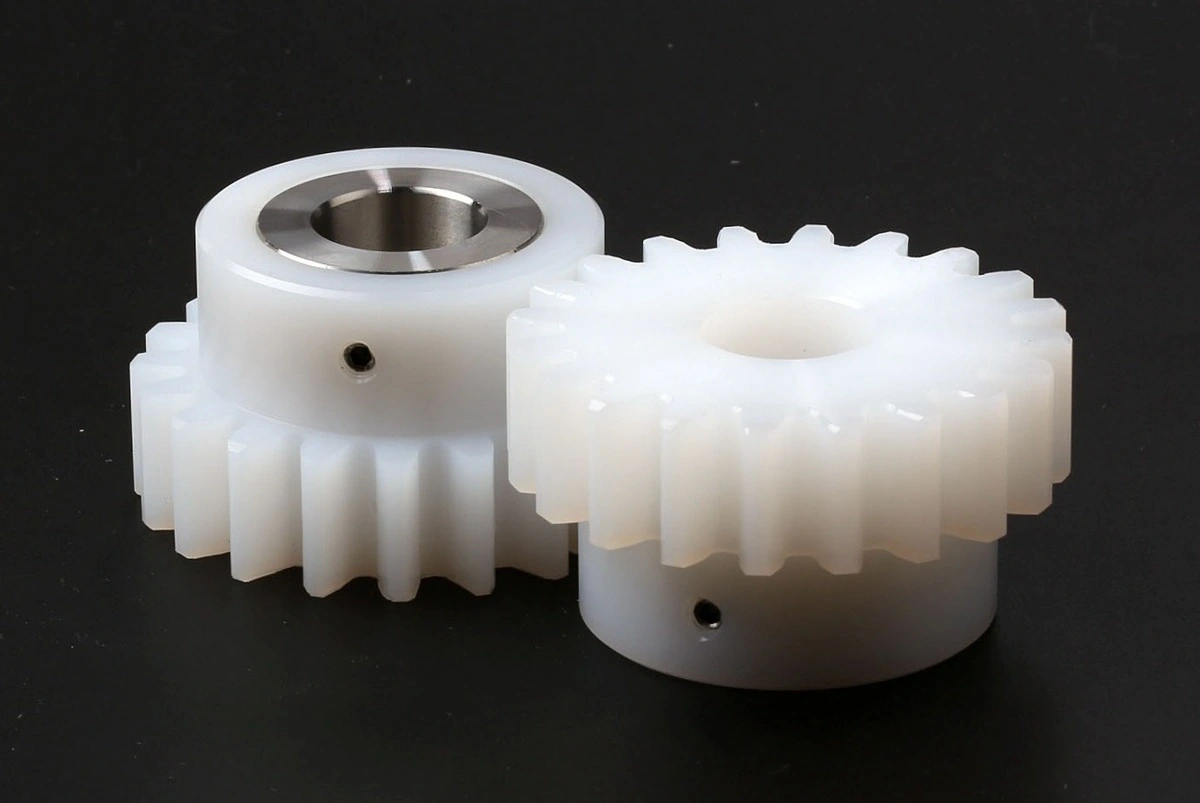
Nylon (polyamide, PA) is widely used for CNC-machined gears, bushings, rollers, wear pads, guides, insulators and other functional components because it combines low density, wear resistance, useful fatigue performance and relatively low friction. It is also easy to underestimate. Compared with metals, nylon has lower stiffness, lower thermal conductivity, much higher thermal expansion and a strong sensitivity to moisture. Those characteristics change how a machinist should clamp the stock, remove chips, select tools, apply coolant and define inspection conditions. The result is that a part can look excellent at the machine and still move enough to create a fit problem later if material condition and humidity are ignored.
| Quick answer for engineers and buyers: Unfilled PA6 and PA66 are generally machinable with very sharp HSS or carbide tools. Heat control and chip evacuation matter more than brute cutting power. Glass-filled nylon is significantly more abrasive and normally calls for carbide or diamond-based tooling. “Heat treatment” usually means stress-relief annealing or conditioning—not metal-style hardening—and should follow the stock supplier’s procedure for the exact grade. |
Is Nylon Easy to Machine? Understanding Nylon Machinability
Yes, nylon is generally considered a machinable engineering plastic, but good machinability does not mean that metal-cutting habits can be copied directly. Cutting forces are relatively low, yet the material can flex under clamping pressure and can retain heat at the tool–workpiece interface. Mitsubishi Chemical Group (MCG) notes that plastics lose heat more slowly than metals and recommends sharp tools, sufficient clearance, effective swarf removal and coolant where a process generates substantial heat. For polyamides, high enough feed and speed to move the chip away from the tool is often preferable to slow rubbing cuts that create heat.
What usually causes problems?
- Dull cutting edges or excessive rubbing, which raise local temperature and can smear or melt the surface.
- Long, continuous chips wrapping around the tool, chuck or part; air blast, vacuum extraction and open-flute geometry help control them.
- Over-clamping thin walls, tubes or soft sections, which can distort the part during cutting and spring back after release.
- One-sided heavy stock removal from flat plate, which can release residual stress and cause bow or warp.
- Ignoring moisture condition when defining close fits or inspecting dimensions.
How Hard Is Nylon for CNC Machining?
Hardness is useful for comparing specific grades, but it is not a direct machinability rating. A harder nylon can still machine cleanly if tool geometry, heat and chip control are appropriate. More importantly, hardness values must be compared only when the same test method and material condition are used. Supplier data illustrate the risk: Ensinger lists TECAMID 6 natural at Shore D 79 under DIN EN ISO 868 and TECAMID 66 natural at Shore D 82 under the same standard, while a U.S. PA66 datasheet reports a different Shore D value under ASTM D2240. These are grade- and method-specific values—not universal numbers for all PA6 or PA66.
| Example stock grade | Polyamide | Hardness | Test method | Use in this article |
| TECAMID 6 natural | PA6 | Shore D 79 | DIN EN ISO 868 | Reference example only |
| TECAMID 66 natural | PA66 | Shore D 82 | DIN EN ISO 868 | Reference example only |
Does Nylon Need Heat Treatment? Annealing vs Drying vs Conditioning
Nylon does not receive heat treatment in the metallurgical sense used for steels. It is not hardened or tempered to create a new metal microstructure. Three different operations are often mixed together in online content, so a technical page should separate them clearly:
- Drying removes absorbed moisture before a process where a controlled dry condition is required. Drying temperature and time depend on grade, stock history and supplier guidance; a generic oven recipe should not be presented as universal.
- Stress-relief annealing can be used between roughing and finishing when close tolerance, precision flatness or strongly asymmetrical stock removal makes distortion a concern.
- Conditioning brings the finished part to a defined moisture state before final dimensional acceptance when the service environment makes humidity-driven growth important.
MCG’s stock-shape guide recommends intermediate annealing for some extremely close-tolerance or precision-flatness parts: rough machine, anneal, then finish with a very light cut. For its PA stock, the published example procedure uses a slow ramp to 160°C, a hold of 10 minutes per millimetre of wall thickness and slow cooling; for its Ertalon 4.6 / 66 GF30 group it lists 170°C. These values are supplier-specific stock-shape guidance. They should not be copied onto a drawing for an unrelated nylon grade without confirmation from the actual material producer.
Recommended Cutting Speeds and Feeds for Nylon
The safest way to publish speeds and feeds is as supplier starting ranges, not as a shop-wide guarantee. The table below is adapted from MCG’s metric Machinist’s Toolkit for its Ertalon/Nylatron polyamide stock shapes. Actual settings must be validated for the exact grade, cutter diameter, edge geometry, machine rigidity, workholding, wall thickness, coolant method and surface-finish target.
| Operation | Material family | Cutting speed Vc | Feed | Typical tool | Technical note |
| Turning | Unfilled PA (Ertalon/Nylatron) | 200–500 m/min | 0.05–0.50 mm/rev | HSS or carbide | Keep tools sharp; manage continuous swarf. |
| Turning | PA66 GF30 reference group | 100–200 m/min | 0.05–0.30 mm/rev | Carbide or PCD/CVD | Glass fiber is abrasive; lower speed than unfilled PA. |
| Milling | Unfilled PA (Ertalon/Nylatron) | 200–500 m/min | ≤0.50 mm/tooth | HSS or carbide | Low tooth count, higher helix, good clearance. |
| Milling | PA66 GF30 reference group | 75–150 m/min | ≤0.30 mm/tooth | Carbide or PCD/CVD | Monitor tool wear and edge chipping. |
| Drilling | Unfilled PA (Ertalon/Nylatron) | 50–100 m/min | 0.10–0.30 mm/rev | HSS or carbide | Peck for chip/heat removal, especially deeper holes. |
| Drilling | PA66 GF30 reference group | 50–80 m/min | 0.10–0.30 mm/rev | Carbide or PCD/CVD | Step drilling/boring can reduce heat and cracking risk. |
Do not copy spindle RPM from another job. Convert cutting speed to spindle speed using n = (1000 × Vc) / (π × D), where n is rpm, Vc is cutting speed in m/min and D is tool or work diameter in mm. Then validate chip shape, surface temperature, finish and dimensional stability on the actual setup.
Best Tooling for CNC Machining Nylon
For unfilled PA6 and PA66, both HSS and carbide can work. HSS can provide a very keen edge; solid carbide adds stiffness and is generally attractive for repeat production. The important requirement is not simply “harder tooling,” but a clean, sharp cutting edge with adequate clearance so the flank does not rub the polymer. Ensinger similarly advises standard HSS for many plastics and recommends carbide, ceramic or diamond-tipped tools for reinforced plastics.
Milling nylon
- Use low tooth counts and open flute space so long chips can escape rather than recut.
- Higher helix and sharp positive geometry can reduce cutting force and tearing.
- For plate work, avoid removing a large volume from only one face where possible; balanced machining helps reduce warp.
- MCG recommends climb milling in its guide because the cutting action produces less heat and a better finish than the illustrated conventional-milling condition.
Turning nylon
- Support long, slender or tubular parts so jaw pressure does not ovalize or bend the stock.
- Provide clearance and a polished, sharp edge; continuous chips should be pulled away with air or suction rather than allowed to wrap around the chuck.
- For large cross-sections and tighter tolerance work, roughing followed by a stabilization period before finishing can improve repeatability.
Drilling nylon
- Heat is especially important when hole depth exceeds about two times diameter; peck drilling improves chip and heat removal.
- For larger holes, step drilling followed by boring is safer than forcing one large drill through thick stock.
- Allow the part to return to thermal equilibrium before final reaming, boring or acceptance of a critical bore size.
How to Prevent Nylon From Melting or Producing Fuzzy Edges
The most common mistake is treating nylon’s softness as a reason to slow the process until the tool rubs. Heat accumulation comes from friction, recutting chips and poor thermal conductivity. MCG advises air blast or vacuum extraction for polyamides, and notes that liquid coolant is generally unnecessary for many operations but can improve surface finish and tolerance control; drilling and parting are more heat-intensive exceptions. When liquid coolant is used, a compatible non-aromatic, water-soluble fluid is a conservative starting point for the stock families covered by its guide.
- Use a freshly sharpened tool before increasing spindle speed to solve a finish problem.
- Make chips thick enough to carry heat away instead of creating powder or smeared material.
- Keep chips out of pockets and bores; recutting is a direct route to heat, fuzz and dimensional error.
- Avoid long dwell at the bottom of a hole or at the end of a contour.
- Deburr by cutting the burr cleanly rather than aggressively sanding a critical edge and changing geometry.
Moisture Absorption, Dimensional Stability and Machining Tolerance
Nylon is hygroscopic. That means dimensional inspection is incomplete unless the drawing or quality plan defines the relevant material condition. A dry-as-machined part and the same part after equilibrium in a humid environment can differ. This is particularly important for bearing bores, press fits, shaft clearances, gear center distances, sealing interfaces and long thin sections.
For a B2B drawing review, define these four items before quoting:
- The exact nylon grade and stock form: PA6, PA66, cast nylon, extruded nylon, PA12, oil-filled, MoS2-filled, GF30, etc.
- The environment at final use: temperature, humidity, immersion, lubricant, cleaning chemical and duration.
- Whether dimensions apply dry-as-machined, after a specified conditioning state, or at a controlled inspection environment.
- Which dimensions are truly functional. Do not place metal-like tight tolerances on every plastic feature; reserve them for fits, datums and performance-critical geometry.
MCG publishes a supplier-specific “best tolerances” chart for its engineered solutions. For the PA/POM/F207 group, the illustrated values are roughly 0.03 mm at 10 mm size, 0.04 mm at 50 mm, 0.06 mm at 100 mm and 0.10 mm at 200 mm. Those numbers are useful as evidence that tolerance capability scales with feature size, but they are not universal acceptance limits and should not be advertised as a guaranteed capability for every nylon part.
Which Nylon Grade Is Best for CNC Machining?
| Grade / form | Machining behavior | Primary advantage | Main risk | Typical CNC use |
| PA6 / Nylon 6 | Generally easy to machine | Tough, economical, good wear behavior | Moisture-driven dimensional change | Wear pads, rollers, bushings, guides |
| PA66 / Nylon 6/6 | Good machinability; slightly stiffer stock | Higher stiffness/heat capability than PA6 in comparable grades | Still hygroscopic; grade-specific stress/conditioning | Gears, precision wear parts, electrical/mechanical parts |
| Cast nylon | Often favorable for large sections | Large stock sizes; often lower residual stress than some extrusions | Properties vary by cast grade/additives | Large rollers, sheaves, wear blocks, wheels |
| PA12 | Machinable but softer/flexible depending grade | Lower moisture uptake than PA6/PA66 | Lower stiffness in many unfilled grades | Fluid components, low-moisture precision parts |
| GF30 nylon | Moderate; abrasive | High stiffness, lower thermal expansion, improved dimensional stability | Tool wear, brittle edges, fiber exposure | Structural brackets, stiff insulators, loaded components |
Physical Part Examples: How We Would Review These Nylon Geometries
The photographs supplied for this article are useful for explaining manufacturability, but a photograph alone cannot verify resin grade, manufacturing route, tolerance or customer application. To avoid creating a false “case study,” the examples below are presented as drawing-review scenarios based on the visible geometry. No customer name, drawing number, dimensional result or production quantity is invented.
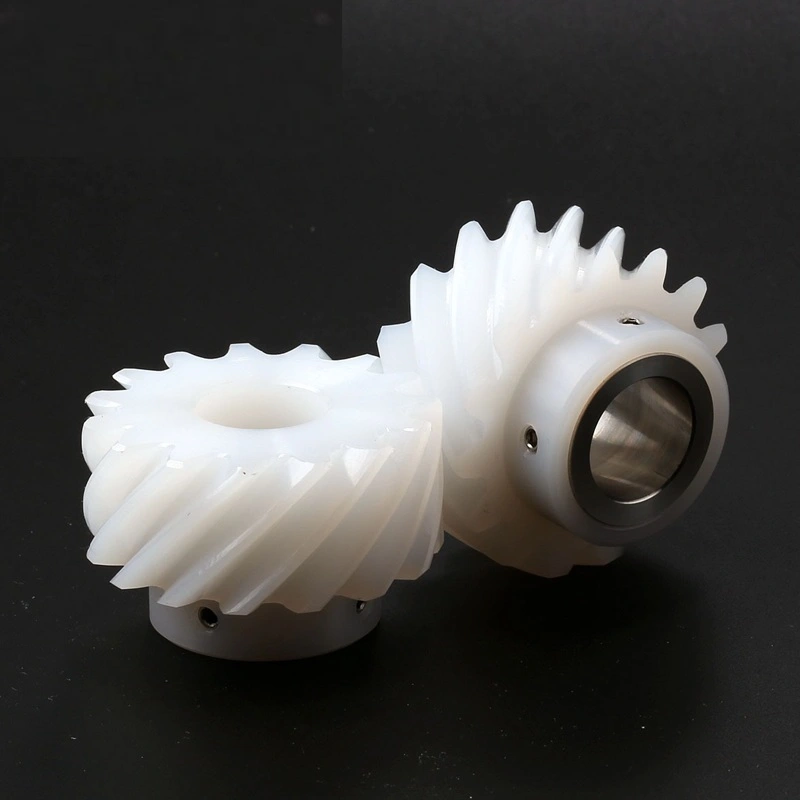
Example A — White nylon gear with insert
This geometry is a good example of why “machinable” does not automatically mean “easy to inspect.” Tooth profile, pitch diameter, bore location and the insert interface can interact. For low-volume CNC production, a practical control plan may combine standard dimensional tools for the bore and width with optical inspection or dedicated gauging for tooth form, depending on the drawing. Burr control at tooth edges matters because hand finishing can change profile if it is too aggressive.
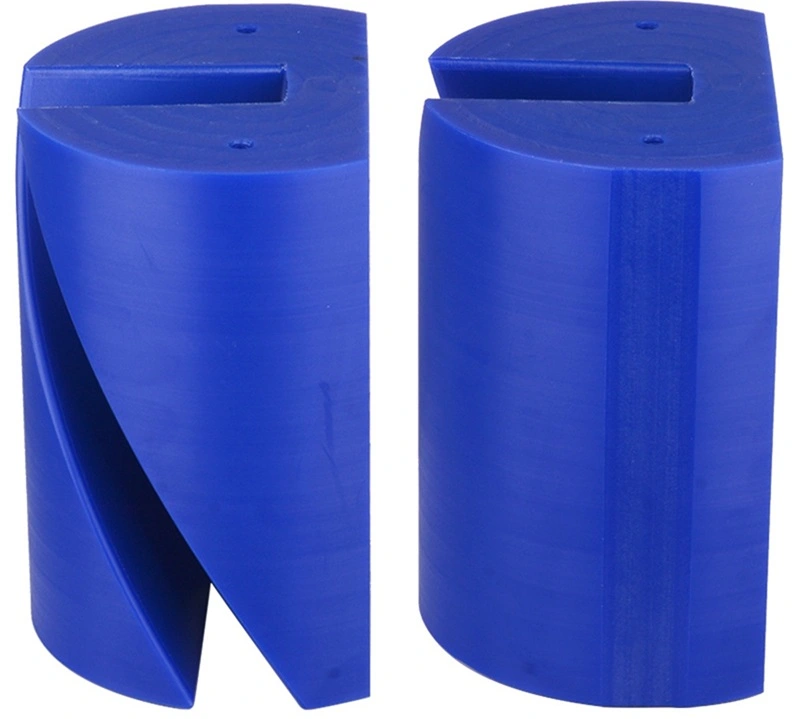
Example B— Slotted wear block / guide geometry
Deep slots and asymmetric material removal create a different problem from gears: stress release and part opening can dominate dimensional behavior. For a machined version of this type of geometry, the process plan should consider roughing both sides in a balanced sequence, leaving finish stock on functional faces, allowing thermal or stress stabilization if needed, and then completing the final slot width and datum surfaces. A wide, rigid jaw or contour fixture is preferable to point loading that can close the slot during inspection.
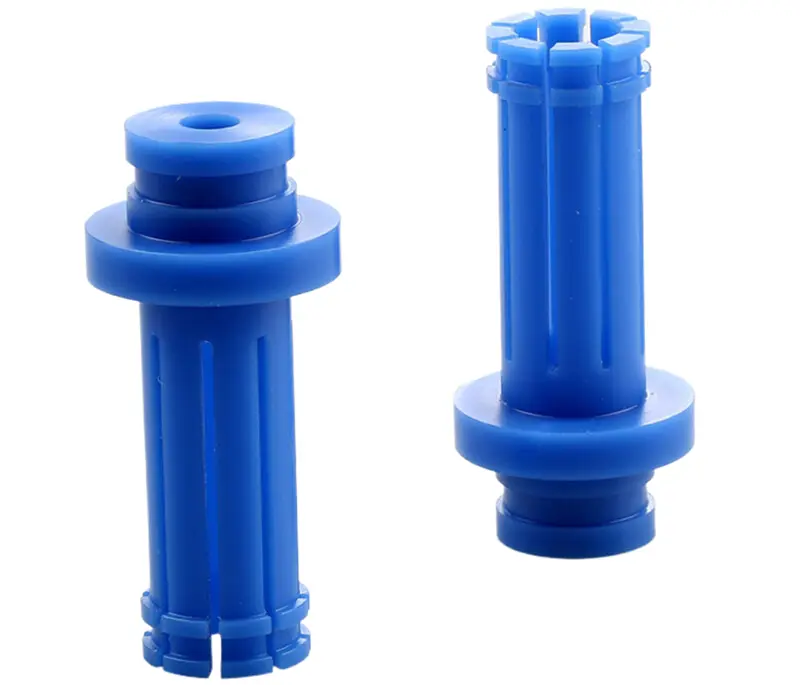
Example C — Thin ribbed and slotted tubular geometry
Thin ribs, castellations and long slits can be fragile during subtractive machining. If a drawing requires this geometry from machined stock, the review should check minimum wall thickness, cutter access, chip escape, clamping support and whether the economics favor molding or another manufacturing method at production volume. This is also a useful B2B conversion point: a responsible CNC supplier should recommend a different manufacturing route when the drawing and annual demand make machining inefficient.
Quality Control for CNC-Machined Nylon Parts
Quality control for nylon should control both geometry and material condition. A metal-style inspection plan that measures a warm, freshly cut part and ignores humidity can create false confidence. The correct plan starts at material receipt and continues through packaging.
| Stage | Control point | Why it matters | Typical record |
| Incoming material | Grade, supplier, lot/batch, stock form, visual condition | Different nylon grades and additives machine differently | Material certificate / receiving record |
| Pre-machining | Stock condition, moisture/conditioning requirement, visible bow/stress | Reduces unexplained movement during machining | Job traveler / process note |
| First article | Datums, critical dimensions, bore/shaft fits, tool marks, burrs | Confirms setup before quantity production | FAI / first-piece report |
| In-process | Tool wear, chip evacuation, temperature symptoms, fixture deformation | Prevents drift and smeared finish | IPQC checks / tool-life record |
| Final inspection | Defined temperature/conditioning state, critical dimensions, optical/CMM where appropriate | Makes results relevant to the drawing and service condition | Inspection report / CMM or optical report |
| Packaging | Clean, dry, protected from deformation; bagging condition defined if required | Avoids moisture or load changes before receipt | Packing record / lot traceability |
For flexible or thin nylon features, measurement force is another variable. Contact calipers are useful for many dimensions, but a part that can compress under the measuring force may require a low-force method, an optical system or a dedicated fixture. For tight fits, inspection should occur after the part has returned to the defined temperature and conditioning state. If a buyer requires CMM data, FAI, material traceability, RoHS/REACH declarations, food-contact documentation, flame rating or ESD performance, those requirements should be stated on the RFQ rather than assumed from the generic word “nylon.”
How to RFQ Nylon CNC Machining Services
A high-quality nylon RFQ gives the machine shop enough information to make material, process and inspection decisions before cutting stock. This improves quote accuracy and reduces technical back-and-forth after order placement.
- 2D drawing and 3D CAD model, including revision level.
- Exact material grade or approved equivalents, including filler or lubricant content.
- Quantity: prototype, pilot batch and expected annual volume.
- Critical-to-function tolerances and datum scheme rather than unnecessarily tight general tolerances.
- Service temperature, humidity/water exposure, chemical exposure and sliding/wear conditions.
- Required inspection condition: dry-as-machined or conditioned state, if dimensional stability is critical.
- Insert, thread, gear, surface-finish, cleanliness and packaging requirements.
- Quality documents required with shipment: material cert, FAI, dimensional report, CMM/optical report or lot traceability.
| RFQ CTA — Send the drawing, not just the material name: Need custom machined nylon parts? Send your 2D drawing, 3D CAD, nylon grade, quantity, critical tolerances and service environment. Rollyu Precision can review machinability, tooling strategy, tolerance risk, inspection condition and the most suitable manufacturing route before quotation. |
Frequently Asked Questions About Nylon CNC Machining
Can nylon be CNC machined?
Yes. PA6, PA66 and many modified nylon stock shapes can be milled, turned, drilled, bored and threaded. The key process differences from metals are heat management, chip evacuation, elastic deformation and moisture-driven dimensional change.
What is the best nylon for machining?
There is no single best grade. PA6 is a common general-purpose choice; PA66 is often selected when higher stiffness or thermal capability is needed; cast nylon is attractive for many large-section parts; PA12 is useful when low moisture uptake matters; GF30 is chosen for stiffness and dimensional stability but increases tool wear.
Is Nylon 6 or Nylon 66 easier to machine?
Both are machinable. The practical difference is often less about “ease” and more about stock condition, moisture, residual stress and the required tolerance. PA66 is generally stiffer and has a higher melting temperature than comparable PA6 grades, while PA6 is widely used for economical wear parts.
What cutting speed should be used for nylon?
Use the specific stock supplier’s data as the starting point. MCG publishes 200–500 m/min for turning and milling its unfilled Ertalon/Nylatron PA family, with feeds of 0.05–0.50 mm/rev for turning and up to 0.50 mm/tooth for milling. These are reference ranges, not universal settings.
What tooling is best for nylon CNC machining?
Very sharp HSS or carbide tooling can work well for unfilled nylon. Carbide is stiffer for production. Glass-filled or carbon-filled nylon is abrasive; carbide is preferred and PCD/CVD diamond tooling can be appropriate for longer runs or demanding finish/tool-life requirements.
Does nylon need heat treatment after machining?
Usually not in the metalworking sense. Selected close-tolerance parts may benefit from stress-relief annealing between roughing and finishing, but the cycle must follow the exact stock manufacturer’s guidance. Drying and humidity conditioning are separate operations.
How do you prevent nylon from melting while machining?
Keep the edge sharp, maintain clearance, avoid rubbing and dwell, evacuate chips quickly and use air or a compatible coolant when the operation generates significant heat. In drilling, pecking and staged holes are especially useful.
What tolerances can CNC-machined nylon hold?
Tolerance depends strongly on feature size, grade, wall thickness, workholding, residual stress, moisture state and inspection timing. Do not treat a single “±X mm” value as universal. Define the functional dimensions and let the supplier confirm achievable tolerances after drawing review.
Can glass-filled nylon be CNC machined?
Yes. It is stiffer and often more dimensionally stable than unfilled nylon, but glass fibers are abrasive and can expose a different surface texture. Use carbide or diamond-based tooling as appropriate, monitor wear and use reduced cutting-speed ranges recommended for the exact reinforced grade.
Does moisture affect machined nylon dimensions?
Yes. Nylon is hygroscopic. For close fits, specify whether dimensions are required in a dry-as-machined condition or after conditioning to a stated environment. The drawing and inspection plan should make that condition explicit.