
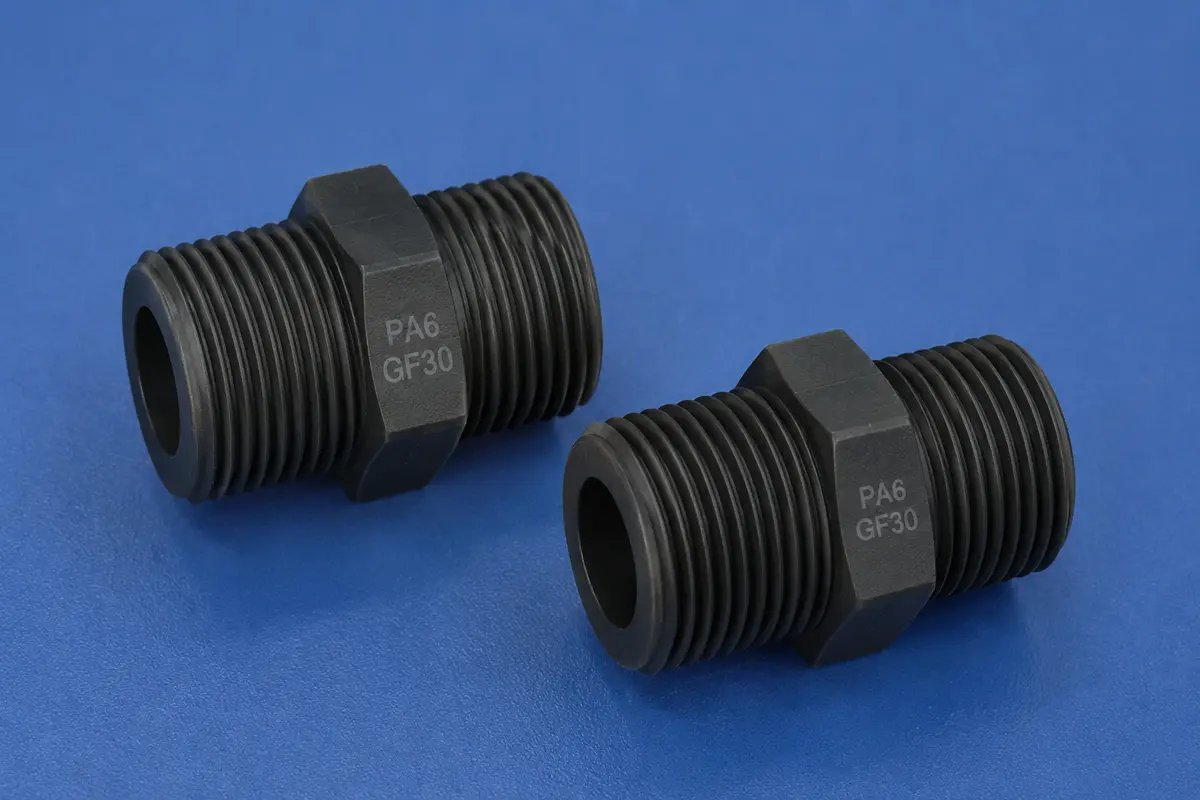
PA6 GF30 vs PA66 GF30: Quick Answer
PA6 GF30 and PA66 GF30 are both 30% glass-fiber-reinforced polyamides used for structural, wear-resistant, and dimensionally demanding parts. For CNC machining, both can produce accurate components from rod or plate, but the glass fibers increase tool wear compared with unfilled nylon. PA66 GF30 generally offers a higher melting point and can provide somewhat better thermal and moisture-related dimensional stability in comparable grades. PA6 GF30 can be a practical choice where cost, availability, toughness, and general mechanical performance are priorities.
The most important purchasing point is that “PA6 GF30” and “PA66 GF30” are material families, not a single guaranteed property set. Hardness, tensile strength, moisture absorption, heat-deflection behavior, and machinability vary with resin formulation, stock-shape manufacturing process, fiber orientation, color/additives, dimensions, and conditioning. A drawing should therefore specify an approved grade or a minimum property requirement rather than relying only on the generic material name.
What Are PA6 GF30 and PA66 GF30?
PA6 GF30 is polyamide 6 reinforced with approximately 30% glass fiber by weight. PA66 GF30 uses polyamide 66 as the matrix with the same nominal glass-fiber reinforcement level. The glass fibers increase stiffness, strength, creep resistance, wear resistance, and dimensional stability compared with unfilled PA6 or PA66, but they also make the material more abrasive to cutting tools and can reduce ductility.
Both materials are used in mechanical engineering, industrial equipment, automotive systems, electrical assemblies, sensor and actuator hardware, brackets, supports, gears, guides, housings, and other structural plastic components. However, an automotive molded connector marked “PA66-GF30” is not automatically equivalent to a machinable PA66 GF30 stock shape. Molded compounds may include heat stabilizers, flame retardants, impact modifiers, or other additives, and injection molding creates a different fiber orientation than extrusion or compression-molded stock.
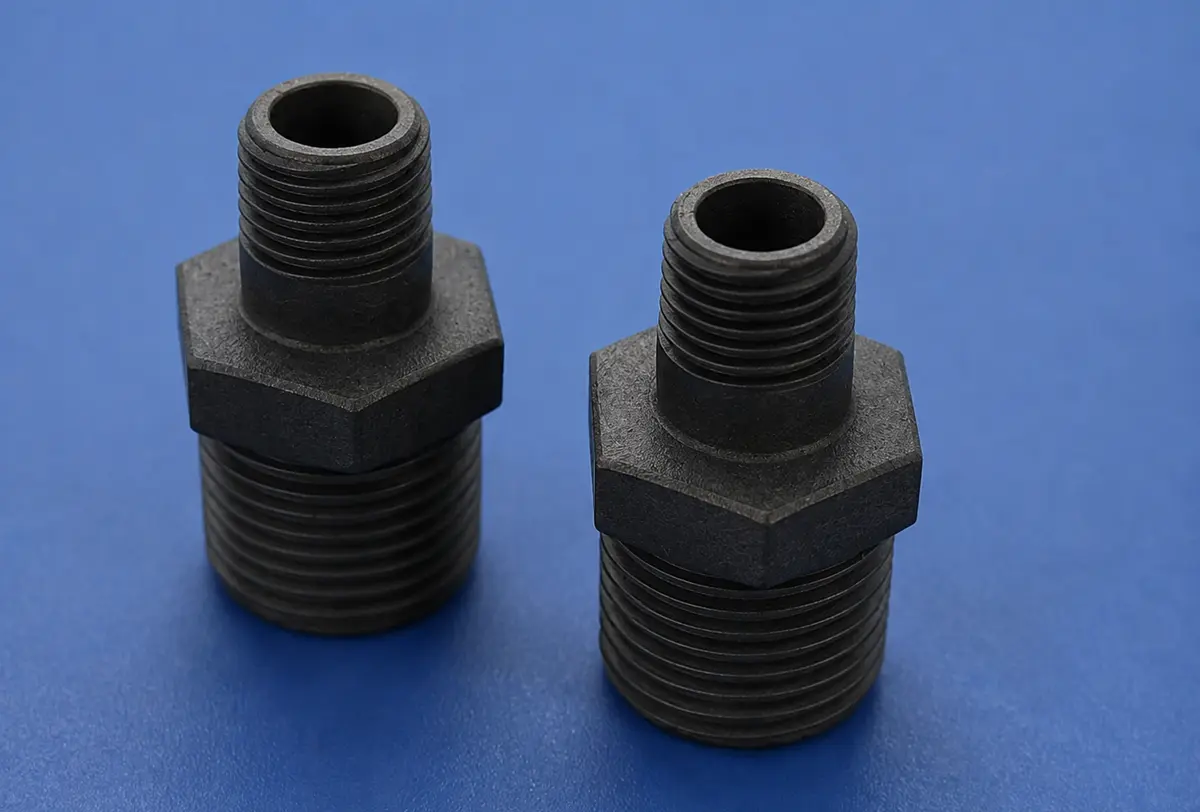
PA6 GF30 vs PA66 GF30 Machinability: Which Is Easier to CNC Machine?
Neither material should be treated like unfilled nylon. The 30% glass fiber content changes the cutting mechanism: the polymer matrix cuts relatively easily, while the fibers are abrasive and can accelerate edge wear. As a result, tool condition has a strong effect on size, edge quality, hole quality, and surface finish.
For prototypes and low-volume production, sharp carbide tooling is a common starting point. For repetitive production where tool life and consistent edge quality are important, PCD or other wear-resistant tooling may be justified after a process study. The correct choice depends on feature size, tolerance, batch size, machine rigidity, and the exact stock grade.
Tooling and Cutting Strategy
Use sharp cutting edges, positive cutting geometry, low runout, and sufficient chip clearance. Avoid rubbing or long dwell times because local heat can soften the polymer matrix even though the glass reinforcement increases overall stiffness. A worn tool may still cut the plastic, but it can increase cutting force, fiber pull-out, edge chipping, and dimensional drift.
There is no universal cutting-speed or feed-rate number that is professionally safe for every PA6 GF30 or PA66 GF30 part. Rod diameter, plate thickness, fiber orientation, tool diameter, flute count, depth of cut, coolant strategy, and required surface finish all matter. For production work, use the stock-shape supplier and toolmaker recommendations as the initial window, then validate the process on the actual grade and geometry.
Heat, Clamping, and Dimensional Stability
Glass-filled nylon still behaves as a thermoplastic. Excessive clamping pressure can distort thin walls or bores, and heat generated during machining can produce temporary dimensional changes. A robust route is to rough machine with balanced material removal, allow the component to return toward a stable temperature, then finish the critical datums and dimensions.
For tight-tolerance components, machining symmetrically from both sides can reduce distortion in plates. Soft jaws, collets, vacuum fixtures, or broad-area supports can distribute holding force. When a part has thin ribs, deep pockets, or large differences in wall thickness, the process should be proven with first-article inspection rather than assuming the stock will remain perfectly stable after heavy material removal.
Dry Machining, Air Blast, or Coolant?
Air blast is useful for chip evacuation and avoids adding moisture to a hygroscopic material. A compatible coolant can improve heat removal and tool life in some operations, but it may affect moisture condition and must be considered when final dimensions are critical. The supplier should define whether dimensions are verified immediately after machining, after a controlled stabilization period, or after conditioning to a specified temperature and humidity.
This point is especially important for PA6 and PA66 because moisture absorption changes dimensions and mechanical properties. If a drawing specifies very tight tolerances, the purchaser and machinist should agree on the inspection environment and the intended service condition.
Surface Finish and Edge Quality
PA6 GF30 and PA66 GF30 can be machined to clean functional surfaces, but glass fibers may remain visible at the surface. A glossy, cosmetic finish comparable with unfilled polymer should not be assumed. Fine features and sharp corners may also be more sensitive to chipping than unfilled nylon.
For sealing faces, bearing seats, precision bores, or optical/electronic hardware interfaces, define the functional surface requirement on the drawing: flatness, perpendicularity, bore size, surface roughness if truly needed, and allowable edge break. Do not rely on a vague requirement such as “smooth finish.”
PA6 GF30 vs PA66 GF30 Hardness: Is PA66 GF30 Harder?
The safest answer is: not always, and the test method matters.
Comparable stock-shape data show that the difference can be small. One Ensinger data set for machined extruded stock lists Shore D 84 for PA6 GF30 and Shore D 86 for PA66 GF30. Röchling data for Sustamid grades list Shore D 86 for both PA6 GF30 and PA66 GF30. Therefore, it is risky to publish a universal statement that PA66 GF30 is “much harder” than PA6 GF30.
Hardness values also cannot be compared directly when different test methods are used. A ball-indentation hardness value in MPa, a Shore D value, and a Rockwell hardness value are different measurements with different procedures and scales. If hardness is a design requirement, specify the exact material grade, test standard, conditioning state, and acceptance range.
For material selection, hardness is usually less informative than stiffness, creep resistance, temperature capability, moisture behavior, impact performance, and the actual load case.
PA6 GF30 vs PA66 GF30: Property Differences That Matter to Buyers
Both material families are stiff engineering plastics, but PA66 has a higher polymer melting temperature than PA6. In comparable extruded stock-shape examples, PA6 GF30 is around 218-220°C melting temperature, while PA66 GF30 is around 254-260°C. This does not mean a finished part can continuously operate at those temperatures. Continuous service temperature is much lower and must be taken from the exact supplier grade and application conditions.
Moisture is another important difference. Comparable supplier data may show lower short-term water uptake for a PA66 GF30 stock grade than for a PA6 GF30 grade, but both are hygroscopic. Moisture can reduce modulus while increasing toughness, and it can change dimensions. For precision components, “dry as machined” and “conditioned for service” should be treated as different dimensional states.
Strength is also grade-dependent. It is not professionally correct to assume that every PA66 GF30 grade is stronger than every PA6 GF30 grade. Different stock manufacturing routes and testing conditions can reverse the apparent ranking. Use an actual technical data sheet for design allowables, and use the generic comparison only for preliminary material screening.
Buyer-Oriented Comparison Table
| Selection factor | PA6 GF30 | PA66 GF30 | Procurement implication |
| Matrix | Polyamide 6 + ~30% GF | Polyamide 66 + ~30% GF | Not interchangeable without review |
| Machinability | Good, but abrasive to tools | Good, but abrasive to tools | Use sharp wear-resistant tooling |
| Hardness example | Shore D 84-86 in selected stock grades | Shore D 86 in selected stock grades | Difference may be small; compare same test method |
| Melting temperature example | ~218-220°C | ~254-260°C | PA66 matrix has higher melting temperature |
| Moisture behavior | Hygroscopic | Hygroscopic; can be lower in comparable grades | Define conditioning and inspection state |
| Strength/stiffness | High, grade dependent | High, grade dependent | Do not rank without exact TDS |
| Best screening use | General structural/wear parts, availability/cost driven | Higher-temperature or PA66-validated designs | Validate exact grade against service conditions |
Note: Values above are screening examples from comparable supplier stock-shape data, not guaranteed specifications. Exact properties depend on grade, stock form, dimensions, fiber orientation, conditioning and test method.
When Should You Choose PA6 GF30?
PA6 GF30 can be a strong candidate when the part needs high stiffness and wear resistance, but the thermal requirement does not justify moving to PA66 GF30 or another higher-temperature polymer. It is also attractive when machinable PA6 GF30 stock is readily available in the required size.
Typical CNC-machined applications may include structural brackets, equipment supports, wear guides, housings, insulators, fixtures, gear-related components, and industrial replacement parts. The final decision should consider moisture exposure, impact loading, temperature, chemical contact, tolerance, and required stock size.
When Should You Choose PA66 GF30?
PA66 GF30 is often considered when the design has higher temperature exposure, stronger dimensional-stability requirements under heat, or a preference for the PA66 matrix based on an existing validated design. It can be suitable for high-load structural parts, electrical or mechanical supports, precision housings, guides, and components near warm machinery.
However, “PA66 GF30” alone does not prove flame rating, food compliance, medical suitability, hydrolysis resistance, or automotive approval. These requirements belong to specific certified grades. If an application needs UL 94 V-0, food contact, medical documentation, low outgassing, or a special automotive specification, request the exact grade and supporting certificate before production.
CNC Machining Quality Control for PA6 GF30 and PA66 GF30
For B2B buyers, quality control is as important as nominal material selection because reinforced nylon is sensitive to material lot, stock form, moisture, temperature, tool wear, and fiber orientation.
Incoming Material Verification
The supplier should verify the purchase specification, polymer family, nominal GF content, color, stock form, size, and material lot. When required, retain the supplier CoC or material certificate. If the drawing names a trade grade, do not substitute a generic GF30 nylon without written approval.
Machining Process Control
Critical dimensions should be tied to stable datums and a defined operation sequence. For tight tolerances, use roughing and finishing stages rather than removing the full stock in a single aggressive operation. Track tool condition on repetitive work because glass fiber wear can gradually change edge quality and feature size.
Thin-wall parts should be inspected for clamping distortion. Deep bores and flat plates should be checked after the component has returned to a stable temperature. If the process uses coolant, the inspection timing and conditioning method should be documented for dimensions sensitive to moisture.
Final Inspection and First Article
Final inspection should match the drawing requirement and the feature. CMM, optical measurement, bore gauges, pin gauges, thread gauges, height measurement, and surface-roughness measurement may be appropriate depending on the part. First Article Inspection is valuable for a new geometry because it confirms that the material, fixture, toolpath, and inspection plan work together before repeat production.
A good inspection record should identify the part revision, material lot, quantity, inspection equipment, critical dimensions, nonconformances if any, and the agreed environmental or conditioning state for precision dimensions.
RFQ Checklist: What to Send for a Reliable Quote
To receive a useful quotation for PA6 GF30 or PA66 GF30 CNC parts, send the 2D drawing and 3D model together whenever possible. Include the exact material designation, approved brand/grade if mandatory, color, quantity, annual demand, and required lead time.
Also identify the critical tolerances and GD&T, thread specifications, surface/edge requirements, operating temperature, humidity or water exposure, chemical exposure, and whether dimensions must be controlled in a dry or conditioned state. State any documentation requirements such as material certificates, First Article Inspection, dimensional report, lot traceability, or special packaging.
If the grade is not fixed, tell the machining supplier the functional requirements rather than asking for a blind substitution. An engineering review can then compare PA6 GF30, PA66 GF30, unfilled nylon, POM, PBT, PPS, or another material without hiding the trade-offs.
Frequently Asked Questions
Is PA6 GF30 the same as PA66 GF30?
No. Both contain approximately 30% glass fiber, but PA6 uses polyamide 6 as the matrix and PA66 uses polyamide 66. Their thermal behavior, moisture response, stiffness, toughness, and grade availability differ.
Which is easier to machine, PA6 GF30 or PA66 GF30?
Both are machinable, and the difference is usually less important than the exact stock grade, geometry, tool condition, and tolerance. The glass fibers make both more abrasive than unfilled nylon. Sharp carbide tooling is a practical starting point, while longer production runs may justify more wear-resistant tooling.
Is PA66 GF30 harder than PA6 GF30?
Not universally. Some comparable data show PA66 GF30 slightly higher in Shore D hardness, while other supplier data show the same Shore D value. Always compare the same test method and conditioning state.
Does 30% glass fiber improve dimensional stability?
Yes, compared with the corresponding unfilled nylon, glass fiber generally increases stiffness and reduces dimensional movement. However, PA6 GF30 and PA66 GF30 still absorb moisture, so precision dimensions should be specified and inspected under an agreed conditioning state.
Can PA6 GF30 or PA66 GF30 hold tight CNC tolerances?
They can be machined accurately, but achievable tolerance depends on part size, wall thickness, material orientation, stock stability, temperature, moisture, fixture design, and feature geometry. A tolerance should be reviewed against the actual drawing rather than promised as a universal number.
Can PA66 GF30 be used for high-temperature parts?
It can provide higher thermal capability than PA6 GF30 in many comparable grades, but the melting point is not the continuous service temperature. Use the exact grade data sheet and validate the load, duration, environment, and safety factor.
Can I use a molded PA66 GF30 automotive part number as the material specification for CNC machining?
Usually not. A molded component marking may identify only the resin family and glass-fiber level, not the exact formulation. For CNC production, specify a machinable stock grade or define the required properties and approvals.
Do PA6 GF30 and PA66 GF30 require special quality inspection?
For critical B2B parts, yes. Material lot verification, first-article inspection, tool-wear control, environmental conditioning, and dimensional reporting can significantly reduce risk, especially for tight tolerances or repeat production.
CTA: Request a PA6 GF30 or PA66 GF30 Machining Review
Need a reliable material recommendation and CNC machining plan for a glass-filled nylon component? Send Rollyu Precision your PDF drawing and STEP file, along with quantity, application temperature, critical tolerances, and any material-certification or inspection requirements.
Our engineering review can help identify whether PA6 GF30, PA66 GF30, or an alternative engineering plastic is the better fit, then build the machining and inspection route around the actual geometry rather than a generic material assumption.
Request an RFQ with your drawing and application requirements.