
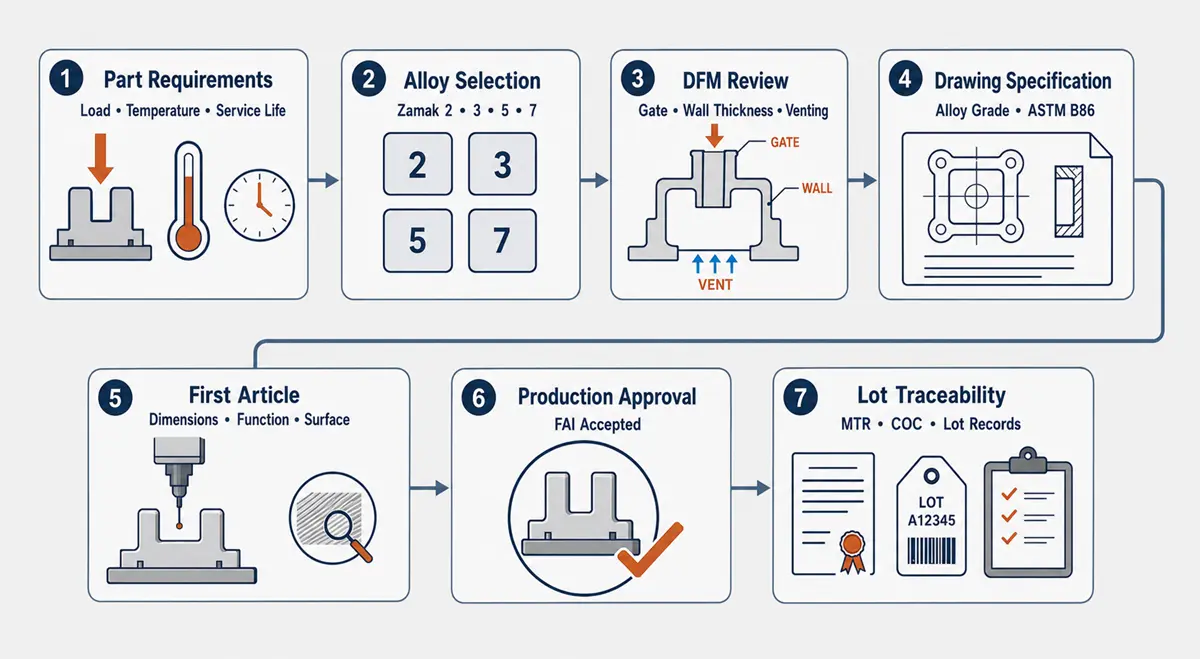
ASTM B86 treats Zamak 2, 3, 5, and 7 as separate zinc die casting alloys, so an OEM drawing should name the grade rather than state “zinc alloy.” Select the grade from load, temperature, service life, geometry, finishing, and assembly requirements.
This guide compares the four grades and shows what buyers should confirm before releasing the die design. The aim is to meet the part requirement without paying for an alloy property the design does not use.
How Do Zamak 2, 3, 5, and 7 Differ?
Zamak 3 is the general-purpose baseline. Zamak 5 adds strength and creep resistance. Zamak 2 provides the highest strength and hardness of the four, while Zamak 7 favors fluidity, ductility, and surface quality. Copper and magnesium drive most of these differences.
Chemical Composition and Alloying Differences
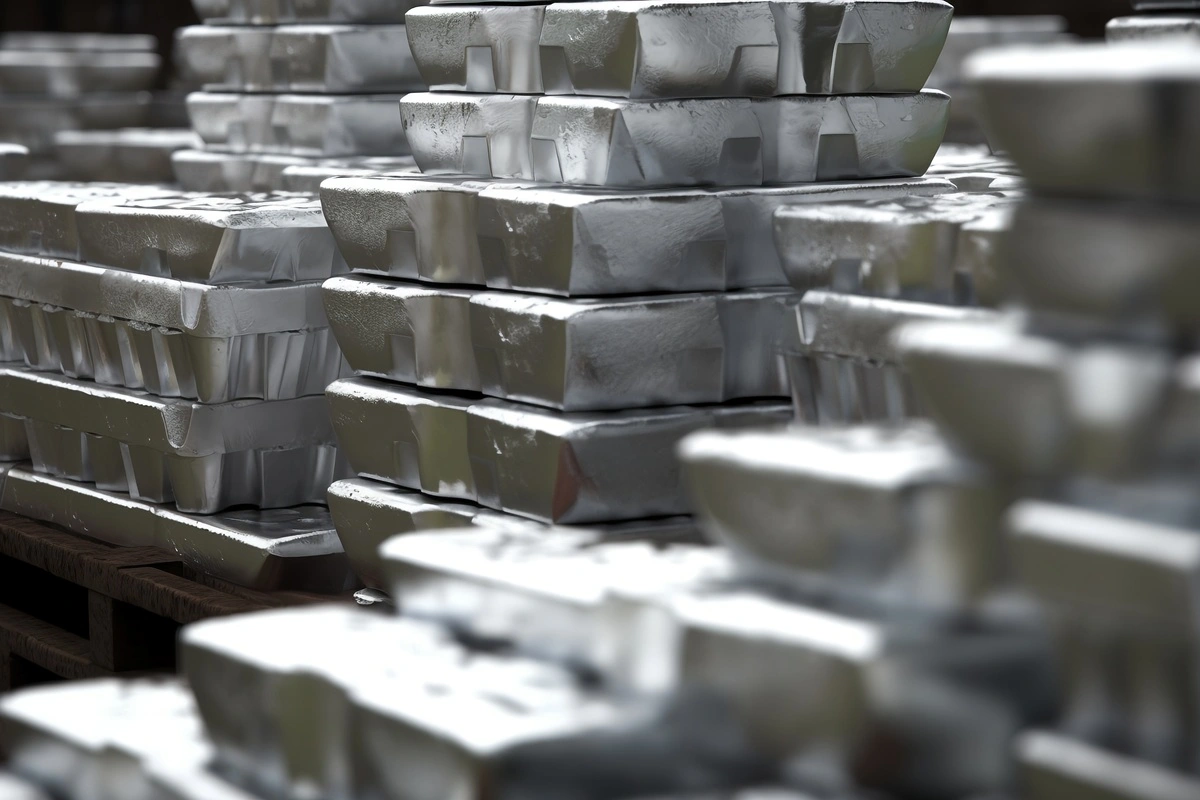
All four grades contain 3.7% to 4.3% aluminum under ASTM B86, plus magnesium and zinc as the balance. Zamak 5 and Zamak 2 add more copper. Zamak 7 uses less magnesium, tighter impurity limits, and a controlled nickel addition.
| Alloy | Aluminum | Magnesium | Copper | Nickel | Main effect |
|---|---|---|---|---|---|
| Zamak 3 | 3.7% to 4.3% | 0.02% to 0.06% | 0.10% max | Not specified | Balanced castability, ductility, and dimensional stability |
| Zamak 5 | 3.7% to 4.3% | 0.02% to 0.06% | 0.7% to 1.2% | Not specified | Higher strength, hardness, and creep resistance than Zamak 3 |
| Zamak 2 | 3.7% to 4.3% | 0.02% to 0.05% | 2.6% to 3.3% | Not specified | Highest strength and hardness of the four |
| Zamak 7 | 3.7% to 4.3% | 0.005% to 0.020% | 0.10% max | 0.005% to 0.020% | Better fluidity, ductility, and as-cast surface quality |
These ranges summarize ASTM B86-23 casting limits. ASTM B240 applies to ingot, so a purchase specification should identify whether it controls ingot, finished castings, or both.
Strength, Hardness, and Ductility
Zamak 2 leads the four grades in reference tensile strength and hardness. Zamak 7 has the lowest hardness and highest reference elongation. Zamak 5 is stronger than Zamak 3 but less ductile, which can affect crimping, swaging, bending, or riveting after casting.
| Alloy | Ultimate tensile strength | 0.2% yield strength | Brinell hardness | Elongation at rupture |
|---|---|---|---|---|
| Zamak 3 | 315 MPa | 276 MPa | 97 | 7.7% |
| Zamak 5 | 331 MPa | 295 MPa | 114 | 3.4% |
| Zamak 2 | 397 MPa | 360 MPa | 130 | 6.0% |
| Zamak 7 | 283 MPa | 221 MPa | 80 | 9.0% |
These International Zinc Association values describe pressure die cast test specimens near 20°C. Part geometry, porosity, cooling rate, aging, and test method can change production results. Use part-level testing for critical loads. A comparison with another material, such as zinc alloy and stainless steel, should also account for section thickness, stiffness, temperature, and the manufacturing route.
Creep Resistance and Dimensional Stability
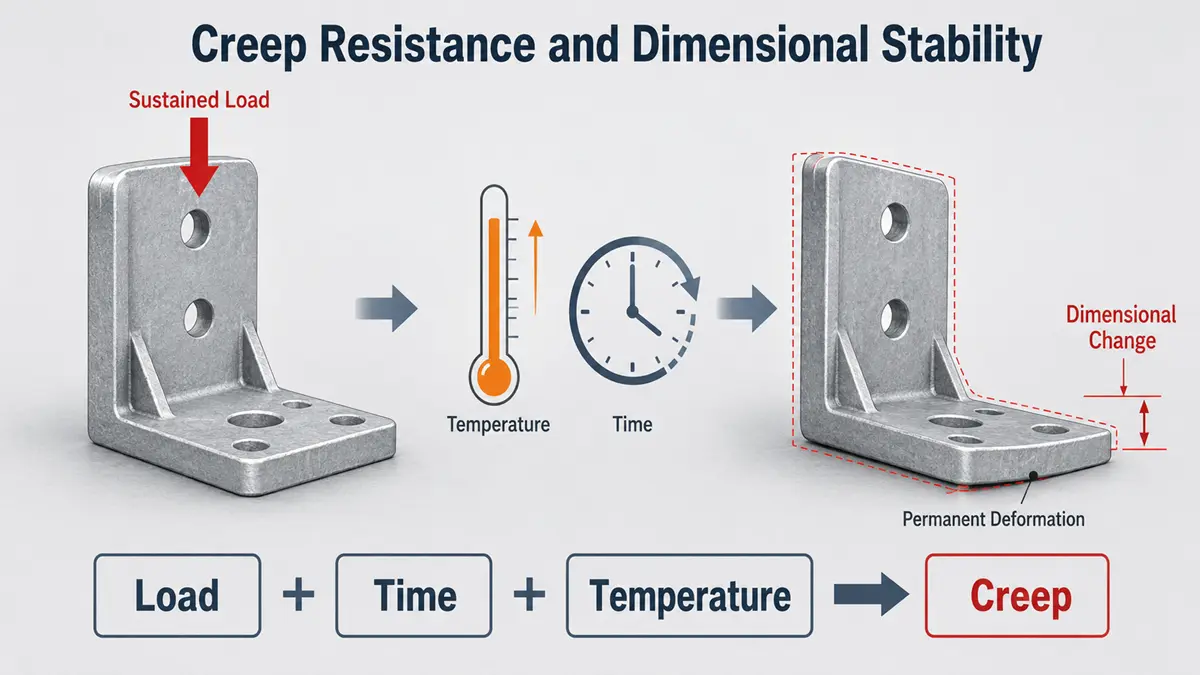
Zamak 2 offers stronger published creep performance than Zamak 3 and Zamak 5, while Zamak 5 improves on Zamak 3. Creep is time-dependent deformation under sustained stress, and higher temperatures accelerate it. Published selector data do not establish the same ranking for Zamak 7.
Zamak 3 is the safer baseline when long-term dimensional stability controls the design. Zamak 2 can grow slightly as it ages, and its impact performance may change. Check aging effects before using Zamak 2 for a precision fit or shock-loaded part.
Fluidity and As-Cast Surface Quality
Zamak 7 provides better fluidity and as-cast surface quality than the other conventional Zamak grades. Its lower magnesium content supports thin sections and fine features. Zamak 3 also fills well and accepts common plating and paint systems.
Alloy selection cannot correct weak die design. Gate location, venting, overflows, die temperature, metal temperature, and shot settings still control fill and visible defects.
What Should OEM Buyers Check Before Choosing a Zamak Alloy?
Choose the alloy from the full duty cycle. Define the load, temperature history, service life, geometry, finish, and assembly route during part and tool design.
Mechanical Load, Impact, and Wear
Match the alloy to the failure mode. Sliding contacts may need hardness and wear resistance. Crimped features need ductility. A bracket under constant clamp load needs creep data, while an impact-loaded housing needs part-level impact testing.
Zamak 2 suits wear and bearing duties, but aging may affect dimensions and impact behavior. Zamak 5 often supplies enough added strength with less aging concern. Zamak 3 can remain suitable when ribs, fillets, bosses, and wall sections carry the load efficiently.
Operating Temperature and Expected Service Life
Record normal temperature, short excursions, load duration, and target life. Zinc alloys lose strength and resist creep less effectively as temperature rises, so a brief warm cycle differs from years under load.
No single service-temperature limit covers every Zamak part. Compare the allowed strain under the actual time, temperature, and load combination. If the margin is low, compare Zamak 2, Zamak 5, a ZA alloy, and aluminum.
Wall Thickness, Feature Detail, and Surface Requirements
Use Zamak 7 when long flow paths, thin walls, fine lettering, or an appearance-critical as-cast surface drive the choice. Zamak 3 remains the practical default when the geometry fills reliably.
A DFM review should check wall transitions, heavy sections, draft, fillets, gates, vents, overflows, ejector marks, and trimming access. For demanding geometry, apply the same controls used in thin-wall zinc die casting. Define cosmetic surfaces, lighting, viewing distance, and defect limits before tool release, since bright plating can expose flow lines, pits, and polishing marks.
Machining, Forming, and Assembly Needs
All four grades machine well, but secondary operations can change the alloy choice. Zamak 3 is easier to form after aging than Zamak 2 or Zamak 5. Zamak 7 has higher reference elongation, although a specific forming process still needs production testing.
Mark machined seats, sealing faces, threads, and datums on the drawing. Cutting may expose subsurface porosity. Drawings should also state whether threads are cast, machined, or formed and whether dimensions apply before or after coating. Finish development for plated zinc die cast parts should precede final fit and gauge approval.
Which Zamak Alloy Fits Each OEM Part Requirement?
Start with Zamak 3, then change grades when a defined need supports the move. This table is a selection guide, not a substitute for design validation.
| OEM requirement | Starting alloy | Reason | Main caution |
|---|---|---|---|
| General housing, handle, bezel, or fitting | Zamak 3 | Balanced properties and dimensional stability | Limited creep or wear margin under sustained heavy load |
| Higher tensile load or creep resistance | Zamak 5 | Stronger and harder than Zamak 3 | Lower ductility |
| Wear surface, bearing duty, or high hardness | Zamak 2 | Highest strength and hardness of the four | Aging can change dimensions and impact behavior |
| Thin wall, fine detail, or critical appearance | Zamak 7 | Higher fluidity, ductility, and surface quality | Availability may affect sourcing and melt control |
Zamak 2 for Parts Requiring Wear Resistance
Choose Zamak 2 when hardness, wear, bearing behavior, or creep resistance controls the design. Its copper content raises strength and hardness but also increases aging-related change. Confirm lubrication, contact pressure, service life, long-term dimensions, and impact performance. The die caster should also keep Zamak 2 metal and returns separate from other grades.
Zamak 3 for General-Purpose OEM Parts
Choose Zamak 3 for general housings, knobs, handles, covers, brackets, and internal linkages unless a specific load, creep, wear, or fill requirement points elsewhere. Zamak 3 balances castability, ductility, finish response, availability, and long-term dimensional stability.
Zamak 5 for Parts Requiring Higher Strength
Choose Zamak 5 when Zamak 3 lacks strength or creep margin and Zamak 2 adds more hardness or aging risk than needed. Zamak 5 has lower ductility than Zamak 3, so validate crimping, swaging, staking, bending, or riveting at the actual delay after casting. Zinc alloy properties change as the casting ages.
Zamak 7 for Thin-Wall and Appearance-Critical Parts
Choose Zamak 7 when flow length, thin sections, fine detail, or as-cast appearance controls acceptance. Its lower magnesium level improves fluidity and ductility. Confirm local availability and separate melt controls before locking the grade, especially if the supplier normally runs Zamak 3 or Zamak 5.
How Should OEM Buyers Specify and Approve a Zamak Alloy?
Name the grade, standard, service conditions, critical features, finish, inspection plan, and traceability records. Agree on these items before tooling, since an alloy change can alter fill, dimensions, forming, and finish results.
Naming the Alloy Grade and Applicable Standard
For North American sourcing, ASTM B86 covers finished zinc alloy castings and ASTM B240 covers ingot used for remelting.
| Grade | ASTM designation | ASTM B86 casting UNS | ASTM B240 ingot UNS |
|---|---|---|---|
| Zamak 3 | AG40A | Z33525 | Z33524 |
| Zamak 5 | AC41A | Z35533 | Z35532 |
| Zamak 2 | AC43A | Z35545 | Z35544 |
| Zamak 7 | AG40B | Z33527 | Z33526 |
A drawing note can state: “Zamak 5, ASTM B86, alloy AC41A, UNS Z35533.” Add the standard revision when the quality system requires it. Do not use an ingot UNS number for the finished casting. For global programs, confirm composition and product form before treating an EN, ISO, or regional designation as equivalent.
Recording Service Conditions and Critical Requirements
Document the loads the casting will see in service and during assembly. State whether each load is sustained, cyclic, or caused by impact. Add the normal and peak temperatures, exposure time, expected service life, humidity, chemical exposure, and contact with other metals.
Identify critical dimensions and datums on the drawing, then state how much creep is acceptable and at what inspection temperature. Define coating thickness, masking, cosmetic defect limits, conductivity, shielding, wear, friction, and restricted-substance limits where they affect acceptance. Give each requirement a test method and pass/fail limit. Phrases such as “corrosion resistant” and “good appearance” are too vague for inspection.
Confirming Alloy Availability and DFM Before Tooling Release
Confirm alloy availability during quoting. A less common grade may require separate ingot handling, furnace scheduling, return-metal segregation, and chemistry checks.
The supplier should review alloy, part geometry, die layout, gates, runners, vents, cooling, trimming, machining, and finishing as one route. Rollyu Precision provides zinc die casting services with secondary CNC machining, finishing, and inspection. Project-specific alloy stock and process limits still require confirmation before tool release.
Approving First Articles, Material Records, and Lot Traceability
Approve first articles after production-intent casting, trimming, machining, forming, finishing, and assembly. The package should identify the drawing revision, alloy, material certificate or chemistry record, dimensional results, finish results, and functional tests.
For production, link each shipment to the melt record, casting lot, process revision, finish lot, inspection record, and nonconformance disposition. Rollyu Precision can support first article inspection, dimensional reports, Material Test Reports, Certificates of Conformance, and lot-level traceability when specified. The purchase order should state which records ship with each lot and how long the supplier retains them.
Frequently Asked Questions
When Should an OEM Choose a ZA Alloy Instead of Zamak?
Choose a ZA alloy when conventional Zamak cannot meet the required strength, hardness, creep resistance, or bearing performance. ZA-8 can run in hot-chamber equipment, while ZA-12 and ZA-27 generally use cold-chamber die casting or other foundry processes. Compare equipment, machining, sourcing, and part geometry before changing alloy families.
Can Recycled Zinc Be Used for OEM Zamak Die Cast Parts?
Yes. Clean, segregated process returns can be remelted if the finished chemistry meets the specified alloy limits. Mixed external scrap can introduce the wrong alloy, plating, oil, iron, lead, cadmium, or tin, so require chemistry control and lot traceability.
Can Zamak Die Cast Parts Be Anodized?
Specialized zinc anodizing processes exist, but aluminum Type II or Type III anodizing specifications do not apply directly to Zamak. Most OEM programs compare plating, passivation, powder coating, wet paint, or electropaint and qualify the finish on production-intent castings.
What Causes Zinc Pest in Zamak Parts?
Zinc pest is intergranular corrosion associated mainly with tin and lead above specification limits. ASTM zinc alloy standards also restrict cadmium. Heat and moisture can accelerate visible damage, so buyers should require chemistry records and prevent mixed scrap from entering the melt.
When Is Aluminum Die Casting a Better Choice Than Zamak?
Aluminum die casting is often a better fit when low mass, higher service temperature, or a larger structural casting outweighs zinc’s thin-wall fill and finishing advantages. Compare density, stiffness, sustained load, corrosion exposure, volume, tooling, machining, and finish. A material change also requires a new DFM review.