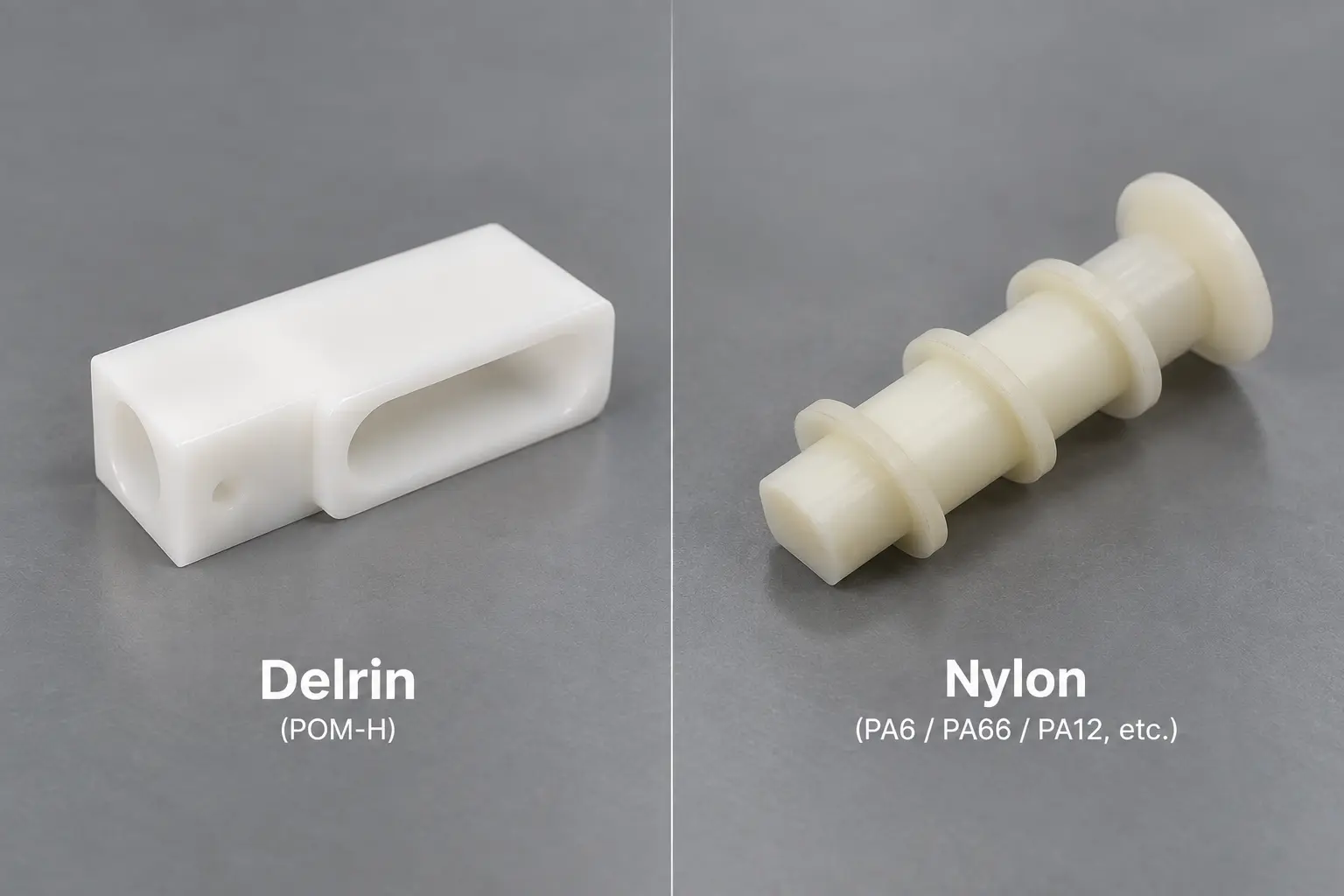
For a Delrin vs nylon decision, choose Delrin when humidity, close fits, low friction, and dimensional stability control the design. Choose a specified nylon grade when impact, vibration, or heavy wear matters more and the design can account for moisture-related change.
The material name alone is not enough. Delrin is a brand of acetal homopolymer, or POM-H. A Delrin machining guide explains family-level behavior, but the drawing still needs the exact grade. Nylon covers PA6, PA66, cast nylon, PA12, and filled or lubricated variants. This guide compares the conditions that affect CNC-machined gears, bushings, rollers, and sliding parts.
Delrin vs Nylon at a Glance
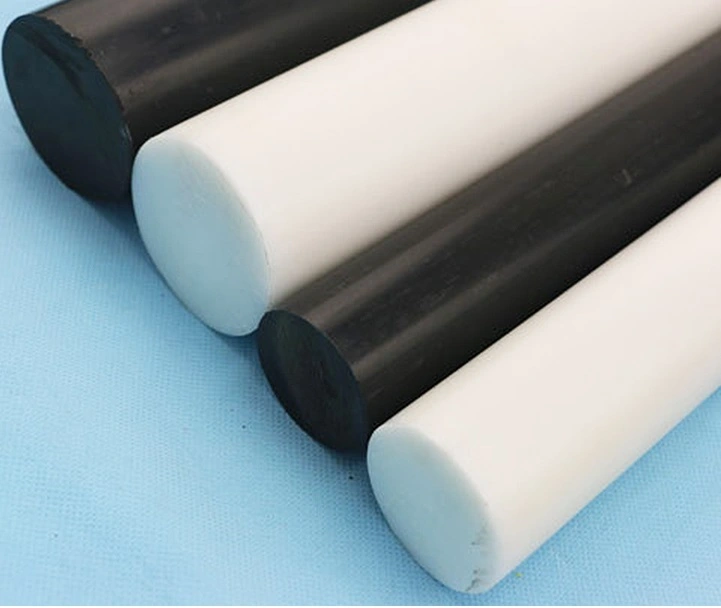
Delrin is usually the safer starting point for stable precision fits, while nylon is often the stronger candidate for shock, damping, and demanding wear conditions. The final choice still depends on the exact grade, moisture state, counterface, load, temperature, and inspection condition.
| Decision factor | Delrin tendency | Nylon tendency | What the engineer should confirm |
|---|---|---|---|
| Moisture and dimensions | Lower moisture uptake than common PA6 and PA66 grades | Moisture can change size and mechanical response | Service humidity, immersion, conditioning state, and fit allowance |
| Stiffness and geometry | Good stiffness and stable machined geometry | Dry grades can be stiff, but conditioning changes some properties | Supplier data in the expected service state |
| Shock and vibration | Grade-dependent toughness | Unfilled grades often provide good impact resistance and damping | Peak load, impact frequency, temperature, and notch geometry |
| Friction and wear | Good sliding behavior and low friction in documented dry-running pairs | Strong wear performance, with lubricated and filled grades available | Counterface, pressure, speed, lubrication, debris, and duty cycle |
| CNC machining | Good machinability and predictable finishing with sharp tools | Machinable, but long chips, elastic movement, and moisture need more control | Stock form, residual stress, wall thickness, workholding, and tool plan |
| Tolerance control | Lower moisture sensitivity supports repeatable inspection | Inspection result depends more strongly on temperature and moisture state | Acceptance condition and measurement timing |
| Total part cost | Material may cost more, but process control can be simpler | Stock may cost less in some grades, but conditioning and inspection can add cost | Current quote for the exact grade, geometry, quantity, and records |
How Moisture Changes Part Dimensions and Fits
Moisture is often the deciding factor when a bore, shaft, backlash, or sliding clearance must stay within a narrow range. Delrin absorbs less moisture than common unfilled PA6 and PA66 grades, while nylon is hygroscopic and can change dimensions as its moisture content changes.
Delrin in Humid or Wet Service
Delrin usually gives a Mechanical Engineer more dimensional margin when a machined part moves between dry and humid conditions. Official Delrin design guidance still treats temperature, moisture, and stress relief as dimensional variables, so a close-tolerance Delrin part is not immune to movement. Large section changes, asymmetric machining, and temperature shifts can still move a finished feature.
This lower moisture sensitivity often favors Delrin for bearing bores, press-fit interfaces, gear center distances, and sliding clearances. The drawing still needs an operating temperature and a defined inspection condition when a small dimensional change could affect assembly.
Nylon Conditioning and Dimensional Growth
Nylon needs a defined moisture condition because the same machined part can measure differently after conditioning or service exposure. Water also changes a nylon grade’s mechanical response, so dry-room data may not represent the installed part.
A nylon drawing should state whether critical dimensions apply dry as machined, after conditioning to a specified environment, or at another agreed state. Without that instruction, the machine shop and receiving inspector can measure different sizes and both measurements may reflect the material’s actual condition.
Stiffness, Toughness, and Impact Loads
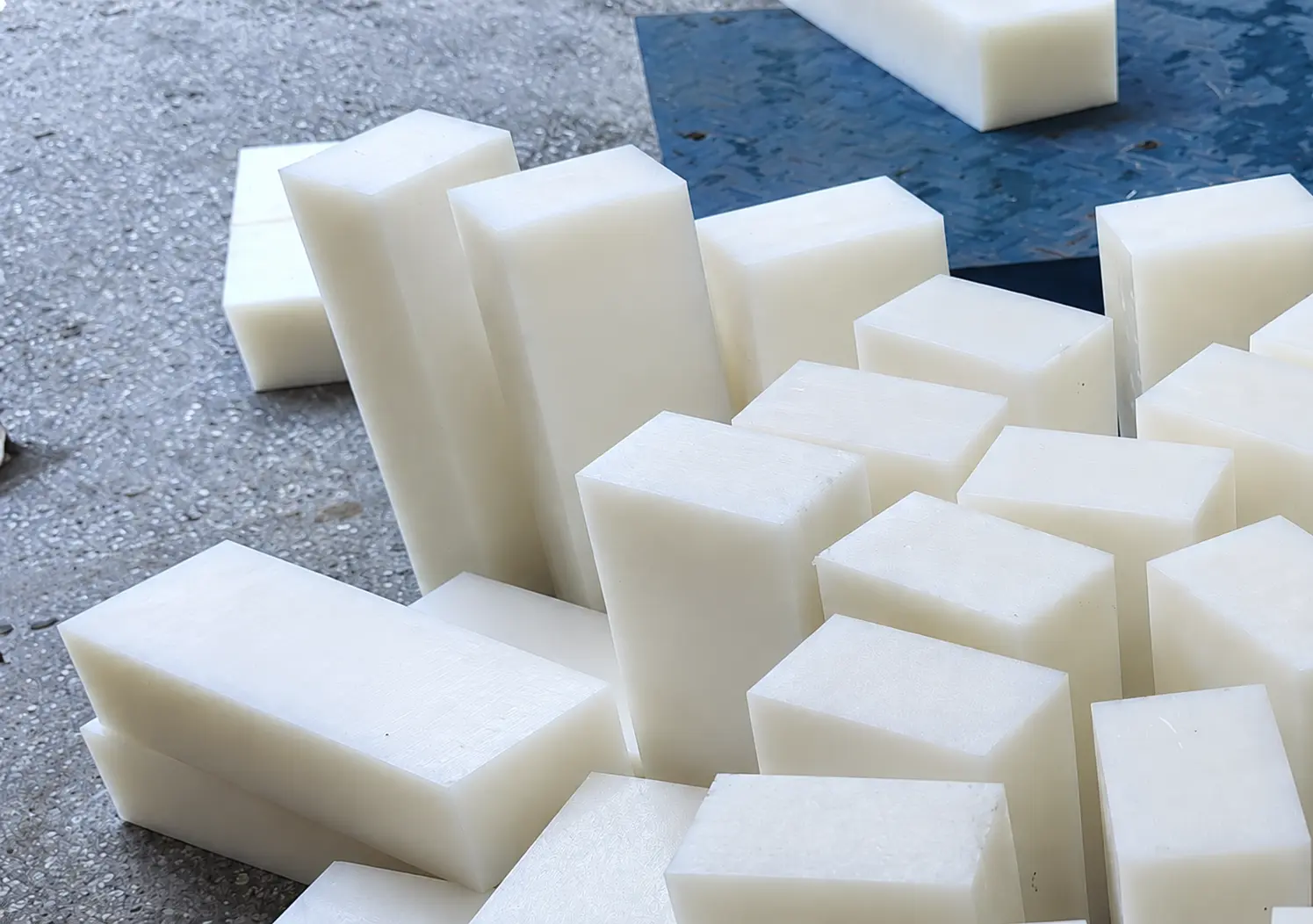
A single generic strength number cannot rank Delrin and nylon. Tensile strength, modulus, hardness, impact resistance, creep, and fatigue describe different failure modes, and the values change with grade, temperature, moisture, and test method.
Delrin for Stiffness and Stable Geometry
Delrin fits parts that need to resist elastic deflection while keeping tooth form, bore size, or guide geometry stable. That combination is useful in small gears, precision bushings, rollers, and linkages where a change in position can create noise, uneven contact, or binding.
Sharp corners and sustained load still need review. Grade-specific data for impact, creep, fatigue, and notch sensitivity matter more than the Delrin family name.
Nylon for Shock, Vibration, and Deflection
Unfilled nylon grades can provide useful toughness and damping for parts exposed to impact or vibration. Nylon can suit rollers, wear pads, guides, and loaded components when some deflection is acceptable and the design controls the moisture condition.
Filled grades change the tradeoff. Glass fiber can raise stiffness and reduce thermal movement, while lubricants can change sliding behavior. Fillers may also increase tool wear, alter surface finish, and make thin edges more brittle. The drawing should name the exact grade instead of calling out only “nylon.”
Friction and Wear in Moving Parts
Neither material wins every friction or wear test. Wear depends on the material pair, contact pressure, sliding speed, temperature, lubrication, surface finish, alignment, debris, and duty cycle.
Sliding Conditions That Favor Delrin
For light-to-moderate dry sliding, Delrin is a practical starting point when low friction, clean machining, and stable clearance all matter. Small gears, low-load bushings, guides, and rollers often benefit from that combination. Use a published coefficient of friction only when its test method, counterface, pressure, speed, and material grade match the design closely enough to support the decision.
Wear Conditions That Favor Nylon
A wear-focused nylon grade can be a better candidate for high impact, abrasive contact, or heavily loaded parts, especially when a purpose-made cast, oil-filled, or solid-lubricant grade is available. That advantage is not automatic. A nylon grade chosen for wear may add moisture sensitivity, machining difficulty, or dimensional change that a close fit cannot tolerate.
For a gear or bushing, compare the full tribological pair. A material that performs well against steel may behave differently against aluminum, another polymer, or a rough shaft. Prototype testing under the expected load, speed, lubricant, and humidity gives more useful evidence than a family-level property chart.
CNC Machining and Tolerance Control
Delrin is generally easier to machine to a repeatable finish, while nylon needs closer control of heat, chips, clamping, and material condition. Rollyu’s CNC machining capabilities include both acetal/Delrin and PA nylon stock families. Both plastics can move after cutting, so machining accuracy and in-service stability are separate questions.
Cutting Behavior and Chip Control
Sharp tools and open chip paths help both materials carry heat away from the cut. Delrin commonly produces a cleaner, more predictable cut. In nylon CNC machining, long chips can wrap around the tool, and the cut can smear or leave fuzzy edges when the tool rubs, dwells, or recuts trapped chips. The exact behavior changes with grade, filler, stock form, and cutter geometry.
Heat, Clamping, and Stock Stress
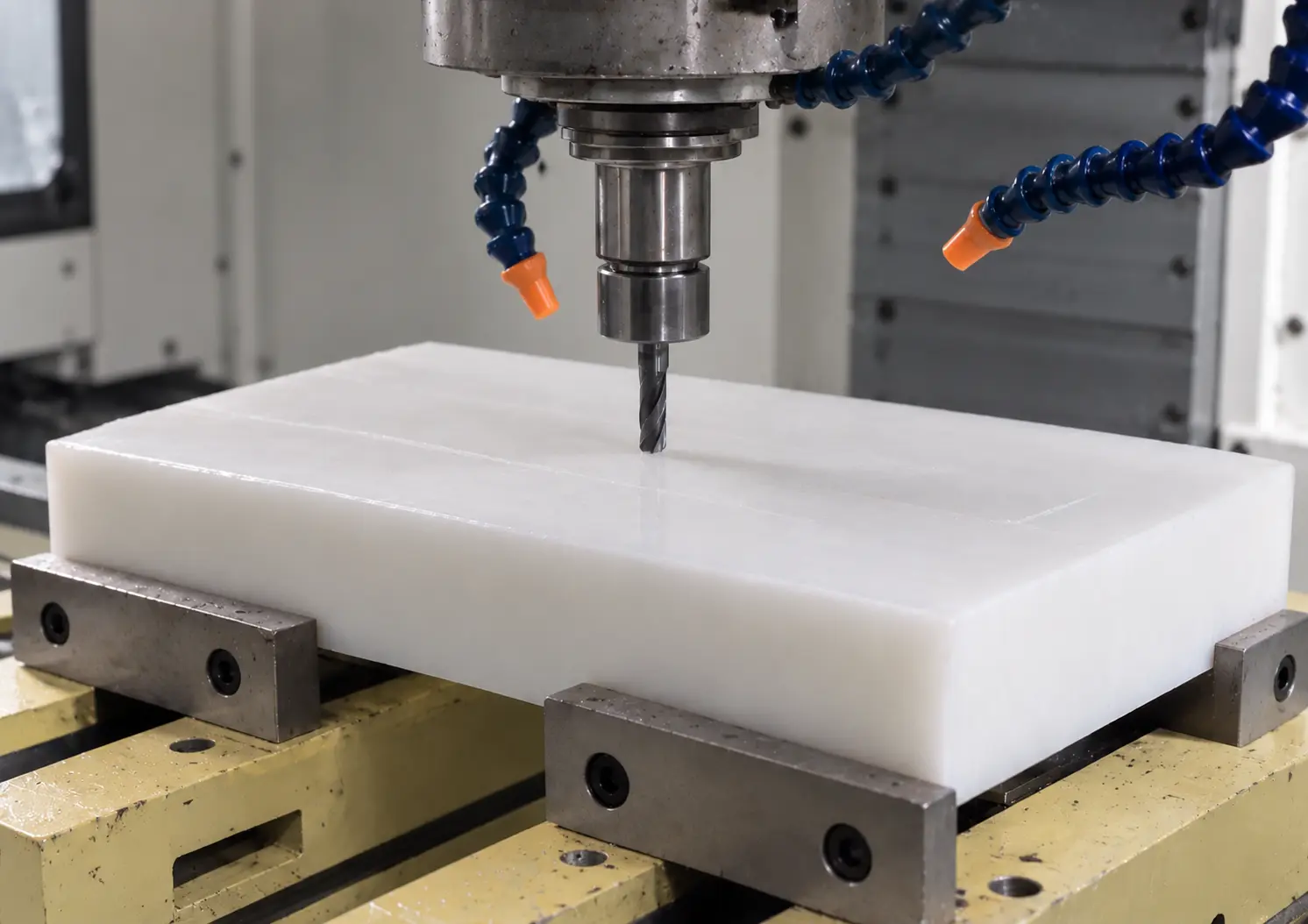
Plastic parts can measure incorrectly while warm or while compressed in a fixture. Thin walls, tubes, split features, and deep pockets need enough support to resist cutting force without fixture pressure squeezing them out of shape. Balanced roughing and a stabilization period before finishing can help when large or uneven stock removal releases internal stress.
The process plan should reserve a light finishing cut for functional bores, faces, and datums after the part has returned to a stable temperature. Extra operations add time, but they can reduce the risk of accepting a feature that moves after unclamping.
Inspection Condition and Measurement Timing
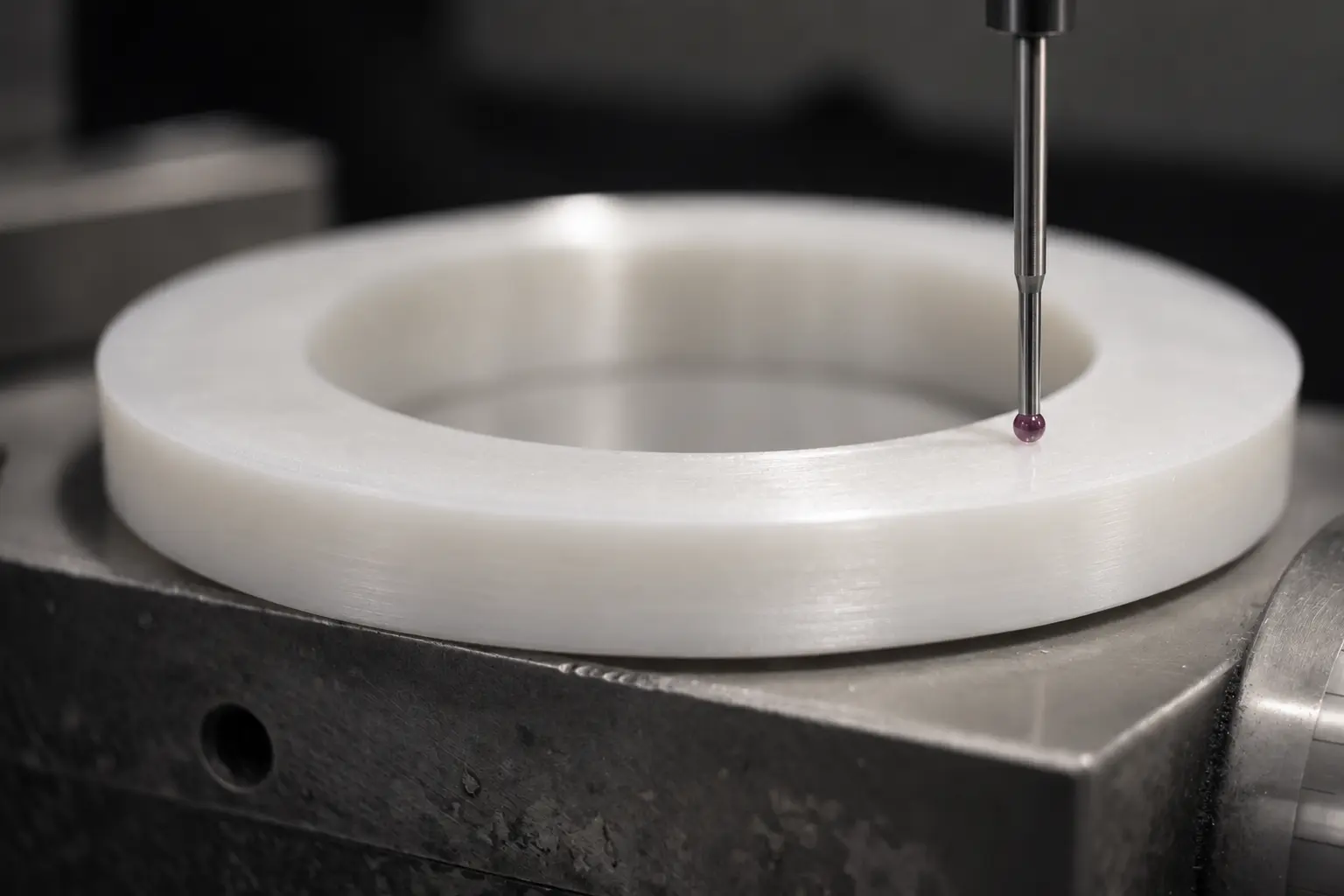
Inspection should reproduce the condition named on the drawing. A warm Delrin part and a cool Delrin part can measure differently. A dry nylon part and a conditioned nylon part can also measure differently. Measurement force matters for thin or flexible features because calipers or contact probes can deflect the surface.
For critical fits, the quality plan should identify the temperature or conditioning state, the dimensions to inspect, and the required method. A bore may suit a bore gauge or CMM, while a gear tooth profile may need optical inspection or dedicated gauging.
How Material, Machining, and Inspection Affect Cost
A lower stock price can still produce a higher part cost. The main CNC machining cost drivers include material yield, programming, setup, cycle time, tool life, stabilization, conditioning, deburring, inspection, scrap, and the cost of a fit that changes after installation.
Delrin may justify a higher material price when stable machining reduces finishing, reinspection, or assembly risk. Nylon may cost less for large wear parts or grades available in economical stock sizes, but a tight-tolerance nylon design can require roughing and finishing stages, controlled conditioning, longer inspection timing, or abrasion-resistant tooling for reinforced material.
Current material price is not a fixed property. Ask the machining supplier to quote the exact grade, stock form, quantity, inspection records, and acceptance condition. Compare the resulting part and control plan rather than a resin price per pound.
Which Material Fits Gears, Bushings, Rollers, and Sliding Parts?
Part type narrows the choice, but the service condition decides it. Use the table as a starting point, then confirm the exact grade with supplier data and a functional test when the consequence of wear or dimensional drift is high.
| Part and condition | Better starting point | Why | Main check before release |
|---|---|---|---|
| Precision gear in variable humidity | Delrin | Lower moisture sensitivity helps preserve tooth geometry and backlash | Tooth load, temperature, lubricant, noise, and life test |
| Gear with repeated shock loading | Nylon grade selected for impact | Toughness and damping may carry more weight than minimum dimensional change | Conditioned properties, tooth deflection, wear, and moisture allowance |
| Close-clearance bushing | Delrin | Stable bore and running clearance are easier to control | Shaft material, pressure-speed condition, temperature, and lubricant |
| Large wear bushing or wear pad | Cast or modified nylon may fit | Large stock and wear-focused grades can support heavy-duty contact | Moisture growth, abrasive debris, counterface, and inspection state |
| Roller with controlled diameter | Delrin when diameter stability controls | Lower moisture sensitivity supports a stable running diameter | Load, flat spots, temperature, and shaft fit |
| Impact-loaded roller or guide | Nylon grade selected for toughness | Damping and impact response may be more important | Deflection, creep, humidity, and wear test |
| Low-load dry sliding guide | Delrin | Low friction and clean machining support smooth motion | Counterface finish, alignment, and debris |
| Abrasive or heavily loaded slide | Wear-grade nylon may fit | Modified grades can improve wear performance | Grade data, tool wear, moisture, and field test |
What to Put on the Drawing or RFQ
A useful drawing or RFQ defines the material condition and functional risk before the machining supplier quotes the job. “Delrin” or “nylon” alone leaves too much room for incompatible grades, stock forms, and inspection assumptions.
Material Grade and Stock Condition
State the manufacturer and grade when the design depends on published properties. Include POM-H, PA6, PA66, cast nylon, PA12, glass-filled, oil-filled, or another modification as applicable. Name approved equivalents separately. Ask for the material certificate or lot record when traceability affects acceptance.
Service Loads, Environment, and Fits
Provide operating temperature, humidity, water or chemical exposure, impact or static load, motion, speed, lubricant, counterface, and expected duty cycle. Identify shafts, bores, gear meshes, press fits, and sliding clearances that control function. These conditions allow the supplier to review whether the material choice and nominal dimensions will still work after installation.
Critical Tolerances and Inspection Requirements
Mark critical dimensions, datums, fit conditions, surface requirements, measurement method, and the temperature or conditioning state for acceptance. Rollyu’s published CNC tolerance table lists ±0.05 mm for plastic linear dimensions, hole diameters, and shaft diameters as a standard reference. Geometry, feature size, wall thickness, grade, and environmental state still require drawing review before a supplier applies that value to a specific part.
Rollyu Precision supports acetal and nylon machining, DFM review, material verification, in-process checks, and final dimensional inspection. Sending the exact grade, 2D drawing, 3D model, quantity, critical fits, service environment, and required inspection records gives the machining team enough information to review tolerance risk before quotation.
Frequently Asked Questions
Can Glass-Filled Nylon Replace Delrin for Tight-Tolerance Parts?
Glass-filled nylon can improve stiffness and dimensional stability compared with an unfilled grade, but it does not automatically match Delrin in a humid service condition. The fiber percentage, fiber orientation, stock form, moisture uptake, feature geometry, and acceptance state still affect size. Glass fiber also increases tool wear and can change edge and surface quality.
Is Delrin or Nylon Better for Chemical Exposure?
Neither material family is better for every chemical environment. Chemical name, concentration, temperature, exposure time, stress, and exact grade can change the result. A Mechanical Engineer should compare the material producer’s compatibility data for the named grade and test the part when swelling, cracking, or loss of strength would affect safety or function.
Can Delrin and Nylon Run Against Each Other in Gears?
A mating gear pair can combine Delrin and nylon, and official engineering-polymer gear guidance reports favorable friction and wear in some Delrin-to-nylon combinations. That result does not cover every load or geometry. Confirm tooth stress, heat dissipation, duty cycle, alignment, lubricant, grade, and life-test conditions before releasing the design.
Which Material Is Better for Food-Contact or Medical Parts?
Food-contact or medical suitability is specific to the grade, application, and required documentation. Specify the applicable compliance, traceability, cleaning, sterilization, biocompatibility, and lot-document requirements for the finished component. Confirm that the selected stock grade and manufacturing process can supply those records before ordering.