

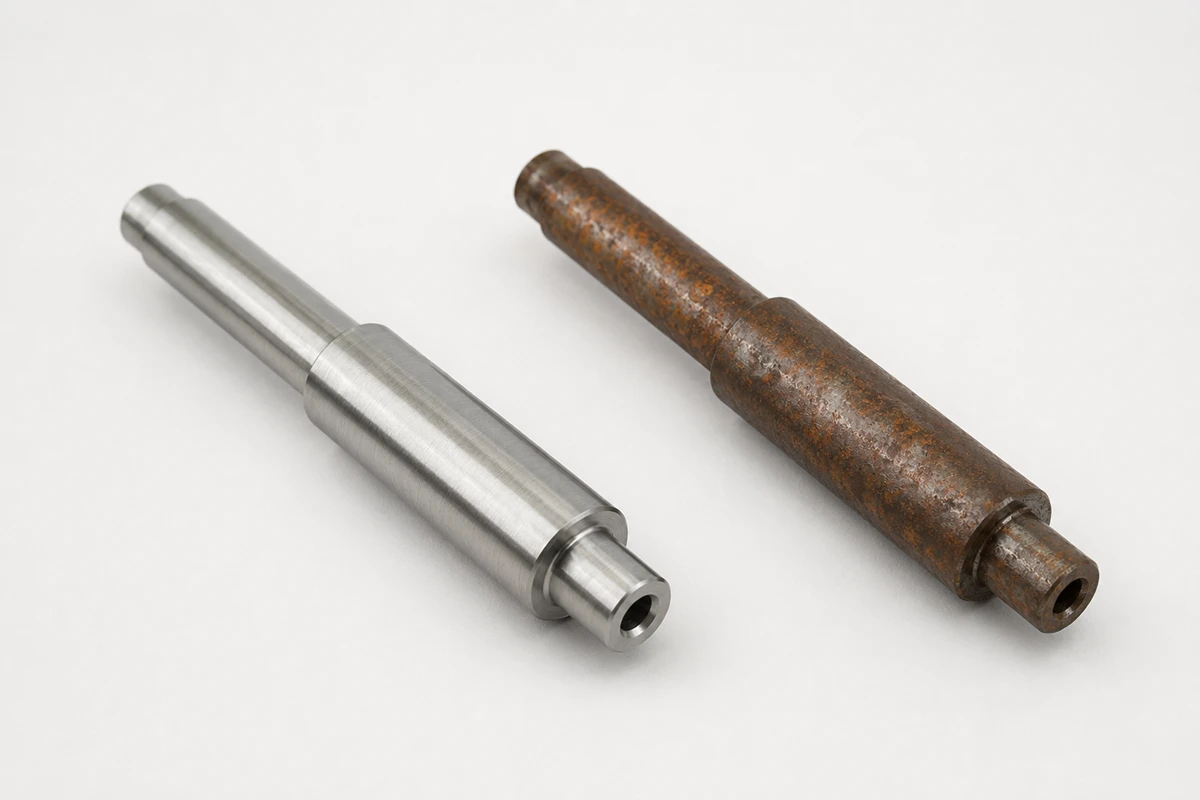
A precision-machined component can meet every dimensional requirement and still arrive unusable if corrosion starts between final inspection and receiving. For mechanical engineers and technical buyers of shafts, housings, manifolds, brackets, tooling components, medical hardware, motion-control parts, semiconductor hardware, and other precision components, “rust prevention” is not just a cosmetic issue. Corrosion can change fits, damage sealing surfaces, stain precision bores, contaminate assemblies, alter electrical contact surfaces, and create rework or rejection at incoming inspection.
The practical answer is not a single coating. A robust corrosion-control plan combines material behavior, surface preparation, permanent or temporary protection, inspection, and packaging. The plan also has to respect the drawing: a part that must be “free of oil, grease or debris” cannot simply be shipped under a heavy rust-preventive oil unless the customer has approved that condition.
| Direct answer for mechanical engineers and technical buyers For most machined parts, corrosion prevention starts with complete cleaning and drying. Then choose either (1) a permanent surface treatment such as passivation, anodizing, zinc, electroless nickel, black oxide/phosphate plus a seal, paint or powder coat, or (2) temporary protection such as a water-displacing rust preventive plus VCI / moisture-controlled packaging. The correct route depends on alloy, geometry, tolerance, cleanliness, service environment and shipping/storage time. |
Why Machined Parts Rust Even After CNC Machining
Freshly machined metal has newly exposed surfaces, and the manufacturing route can leave exactly the conditions corrosion needs: moisture, salts, reactive residues, fingerprints, trapped coolant, temperature cycling, and oxygen. Problems often start in the period between machining and the next operation, not after the part is in service.
Common corrosion triggers in a machine-shop supply chain
- Water-based coolant or wash solution left in blind holes, threads, cross-holes or capillary gaps.
- Machining-fluid residue, heat-treatment salts, blasting residue, chlorides or cleaning chemistry not fully removed before packaging.
- Fingerprints and sweat on bare steel or sensitive stainless surfaces when parts are handled without clean gloves.
- Packaging a part while it is still warm or damp, which can create condensation after the package is sealed.
- Ordinary plastic film that traps existing moisture but provides no active corrosion inhibition.
- Insufficient coverage of rust preventive oil on recesses, threads, deep bores or complex geometry.
- A damaged VCI bag, poorly sealed package, incorrect VCI selection, excessive package volume, or incompatibility with another coating or process residue.
- Mixed-metal contact and moisture that create galvanic corrosion risk, particularly when dissimilar metals are packed together.
- Long dwell time between operations or an export route with high humidity and repeated temperature changes.
The supplied anti-rust work instructions repeatedly emphasize immediate removal of chips, oil, sweat and dirt after machining; cleaning and protection during inter-operation storage; protection of precision surfaces; and controlled warehouse handling. They also highlight blind holes and complex geometry as areas where retained moisture can be missed. These are operational details that matter more than marketing claims about a single “best coating.”
A Practical 8-Step Rust-Prevention Process for Machined Parts
- Review the drawing and end-use constraints. Confirm alloy, heat treatment, surface finish, coating specification, critical tolerances, masking areas, electrical-contact requirements, cosmetic requirements, and whether oil/grease residue is allowed.
- Identify the corrosion exposure. Define in-process dwell time, warehouse duration, domestic or international shipment, sea-freight exposure, humidity/condensation risk, and the expected time before the customer opens the package.
- Clean the part completely. Remove cutting fluid, chips, abrasive residue, heat-treatment salts, fingerprints and prior process chemistry using a method compatible with the alloy and downstream finish.
- Dry the geometry—not just the visible faces. Blow out blind holes, threads, counterbores, cross-holes and internal cavities with clean, dry air where appropriate, or use another validated drying method. Never seal free water inside packaging.
- Apply the selected permanent or temporary protection. Control coverage, coating thickness and masking based on the drawing. For temporary oils, use the minimum effective and customer-approved residue level.
- Verify the result. Depending on the part, inspection may include visual condition, cleanliness wipe checks, coating thickness, adhesion, appearance, thread-gauge fit, dimensional reinspection, passivation verification, or customer-specified corrosion testing.
- Package as a corrosion-control system. Use VCI materials, dry barrier packaging, desiccant, cushioning and separation as appropriate. Keep the part from puncturing the bag and prevent movement that can rub off protective films.
- Record the lot and packaging condition. For higher-risk parts, capture finish specification, coating lot/certificate, packing date and inspection status so a mechanical engineer can trace the condition back to the manufacturing route.
Corrosion-Resistant Surface Treatments for Machined Components
A mechanical engieer should select a treatment by function—not by name recognition. Every finish changes some combination of appearance, thickness, friction, conductivity, hardness, cleanability and cost. The table below is a procurement-oriented screening guide, not a substitute for the drawing or governing specification.
| Method | Typical metals | What it does | Strengths | Key risks / limitations | Common references* |
| Rust preventive oil / water-displacing fluid | Carbon & alloy steel; some stainless; selected copper alloys | Temporary barrier and/or moisture displacement | Low cost; good for storage/shipping; easy to apply by dip/spray/brush | Residue may violate cleanliness requirements; incomplete coverage; compatibility and removal must be defined | Customer-approved product/process |
| VCI paper / film / bag | Ferrous and nonferrous metals when VCI chemistry is compatible | Creates a corrosion-inhibiting atmosphere inside a sealed package | Clean protection; reaches some recessed surfaces; useful for storage and export | Does not remove standing water; package must be clean, dry and reasonably sealed; select chemistry for the metal mix | Supplier system specification |
| Black oxide + oil/wax | Carbon and alloy steels | Conversion layer with a sealed topcoat | Minimal dimensional change; dark appearance; economical | Black oxide alone is not a high-corrosion barrier; sealing/topcoat matters | Drawing / approved process |
| Phosphate + oil / paint | Steel | Conversion coating used as a base for oil, paint or further protection | Useful adhesion base; can improve temporary corrosion performance | Porous coating normally needs a seal/topcoat; dimensional and appearance effects vary | Drawing / approved process |
| Zinc electroplating | Iron and steel | Sacrificial zinc coating | Strong corrosion protection for many industrial parts | Adds thickness; threads/fits need allowance; high-strength steel requires hydrogen-embrittlement controls and may be restricted | ASTM B633 or customer spec |
| Electroless nickel (EN) | Steel, stainless, aluminum and others with proper pretreatment | Uniform nickel-phosphorus barrier coating | Uniform on complex geometry; wear + corrosion options | Adds measurable thickness; phosphorus level and post-treatment affect performance; porosity/pretreatment matter | ASTM B733 |
| Passivation | Stainless steels | Removes free iron / exogenous contamination and promotes a clean passive surface | No intentional heavy coating buildup; useful after machining stainless | Not a substitute for selecting a corrosion-resistant grade; chemistry must suit the stainless grade and drawing | ASTM A967/A967M; ASTM A380/A380M |
| Anodizing Type II / Type III | Aluminum alloys | Electrochemically forms an oxide coating | Corrosion and/or wear protection; color options for Type II | Coating growth affects dimensions; sealing, masking, alloy and cosmetic variation matter | MIL-PRF-8625 or drawing |
| Chemical conversion / Chem Film | Aluminum alloys | Conversion coating on aluminum | Thin treatment; useful where conductivity and paint adhesion matter | Class, chemistry and electrical requirements must be specified; environmental restrictions may apply | MIL-DTL-5541 or drawing |
| Paint / powder coating | Steel and aluminum | Organic barrier coating | Broad color/corrosion options; good external protection | Thickness, edge coverage, masking, grounding/contact areas and cosmetic defects need control | Customer coating specification |
*Always use the customer’s latest drawing/specification and qualified process requirements. Standard revision and class/type selection must be confirmed at RFQ and order review.
How to Choose by Material
4140 and other carbon/alloy steels: assume the bare part can rust
4140 is a chromium-molybdenum alloy steel, but it is not stainless steel. Its chromium level is far below the level used to create the robust passive behavior associated with stainless grades, so bare machined 4140 should be treated as corrosion-sensitive. If the drawing calls for “no finish,” the corrosion plan usually shifts to cleanliness, temporary protection and packaging rather than a permanent coating.
For a precision shaft, the best choice may be a light water-displacing rust preventive if residue is allowed, followed by VCI or sealed moisture-controlled packaging. If a permanent coating is required, zinc, electroless nickel, black oxide + seal, phosphate + seal, paint/powder or another qualified system may be considered—but only after reviewing dimensional allowance, wear surfaces, fits, threads and material strength.
| High-strength steel warning Do not specify zinc electroplating on a high-strength 4140 part casually. Electroplating can introduce hydrogen-embrittlement risk, and ASTM B633 includes pre/post-treatment requirements and restrictions for very high-strength steels. Material hardness/strength, stress condition, process qualification and the governing drawing must be reviewed before plating. |
Stainless steel: machining contamination can still create corrosion
“Stainless” does not mean “cannot rust.” Machining can introduce free iron contamination, and some grades—especially free-machining or martensitic stainless steels—are less corrosion resistant than common 300-series grades. Cleaning and passivation may be appropriate when specified, but the process chemistry and acceptance method must match the grade and application. Heat tint, scale or heavy contamination may require descaling or pickling steps before passivation; passivation alone should not be sold as a cure-all.
Aluminum: anodizing and chemical conversion are functional choices, not interchangeable labels
Aluminum does not form red rust, but it can oxidize, pit or stain. Type II anodizing is widely used for corrosion protection and appearance, while Type III hard anodizing is selected where wear resistance is a major requirement. Chemical conversion coating is often chosen when a thin conductive surface or paint base is required. Because anodizing changes dimensions and can affect threads, bores and mating surfaces, coating allowance and masking should be resolved before machining is finalized.
Bronze, brass and copper alloys: manage tarnish, staining and compatibility
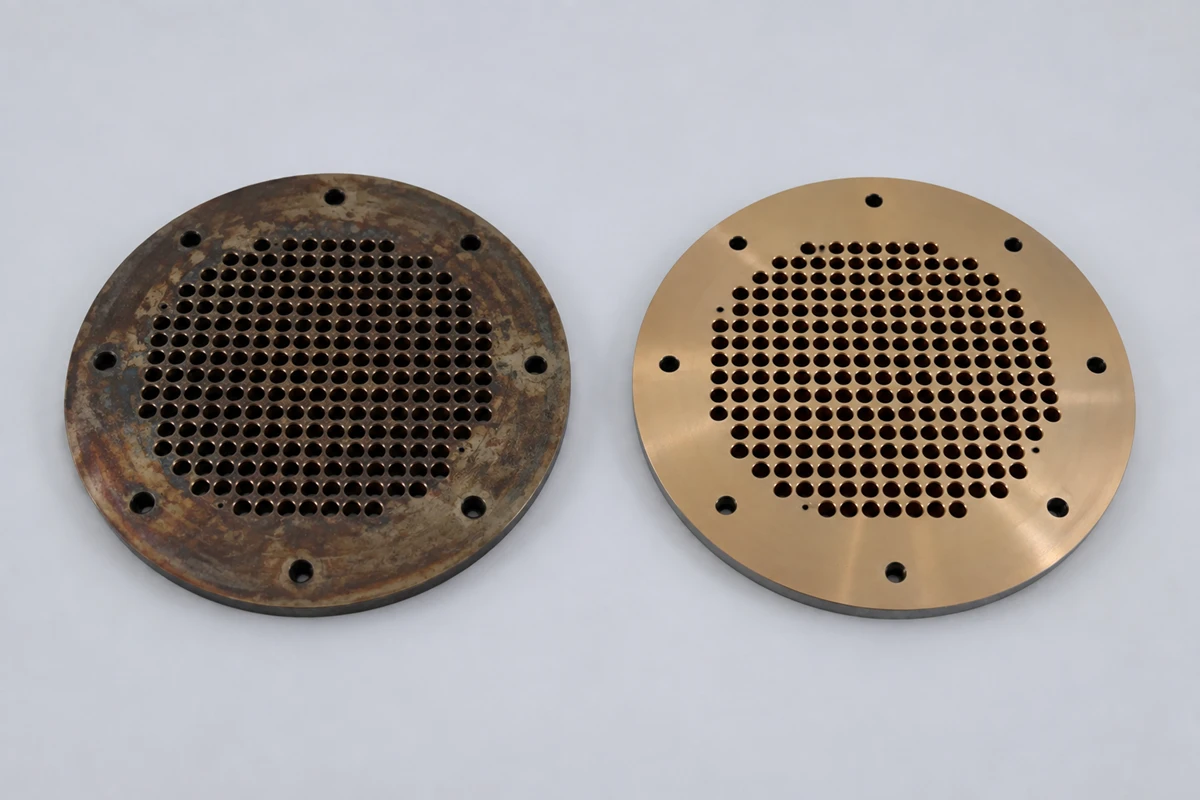
Copper alloys can develop tarnish or oxidation that looks unacceptable even when the part remains functional. Cosmetic expectations, contact surfaces, brazing/soldering, lubrication and electrical requirements determine whether the correct solution is controlled cleaning, a compatible temporary inhibitor, protective oil/wax, clear coating or specialized conversion treatment. VCI products should be selected for the actual alloy or mixed-metal package; not every ferrous-metal inhibitor is suitable for copper alloys.
Case-Based Lessons from Precision Machined Parts
Case 1: 4140 PH roller shaft with no permanent surface finish
In the supplied roller-shaft drawing, the material is 4140 PH, the surface treatment is listed as none, and the manufacturing note explicitly calls attention to rust prevention during packaging. That combination is exactly where a supplier’s process discipline becomes part of product quality: the drawing does not permit the supplier to “solve” corrosion by adding an arbitrary coating, but the bare steel still needs protection during storage and shipment.
A risk-controlled route is: final clean → complete dry-out of the bore, threads and shoulders → clean-glove handling → visual rust check → customer-compatible temporary protection → sealed VCI/moisture-control packaging → cushioning to prevent bag damage → documented packing date. If the customer requires the part to arrive oil-free, use a validated dry protection strategy rather than leaving a heavy oil film.
Case 2: AISI 416 tempered collimator tube—corrosion control vs. oil-free cleanliness
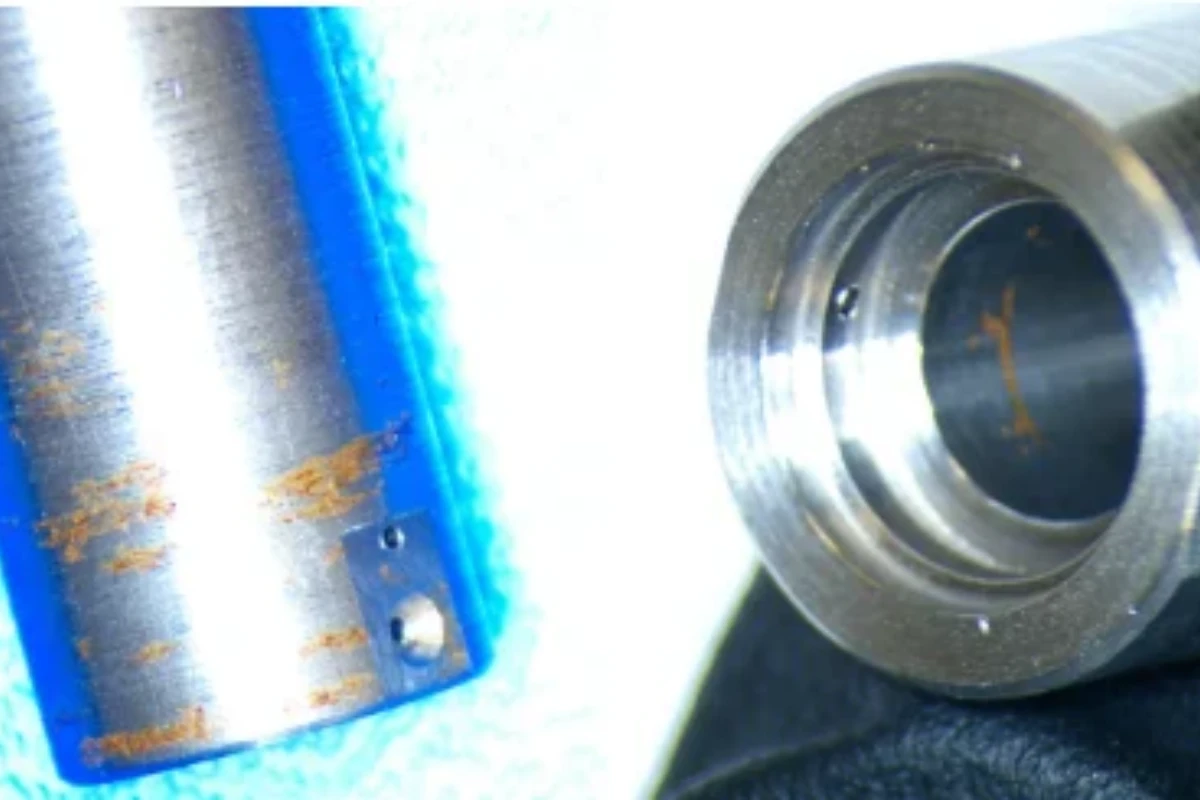
The supplied AISI 416 tempered collimator-tube drawing states that the part must be free of oil, grease or debris and that the supplier is responsible for cleaning. A separate supplied corrosion note reports localized oxidation and suggests that grease may have dried on the component for an extended period, with the recommendation to remove grease thoroughly before shipping. This is an important procurement lesson: “more oil” is not automatically safer if the drawing requires a clean, residue-free part.
For an oil-free stainless component with no permanent finish, corrosion prevention should be agreed during RFQ review. Depending on the customer’s requirement, options can include validated cleaning and drying, qualified passivation if specified/appropriate, clean-glove handling, VCI or dry barrier packaging compatible with stainless steel, desiccant/moisture control where justified, and short exposure time before sealing. The exact route should be documented rather than improvised after final inspection.
Case 3: Protecting bronze surfaces during storage and transport
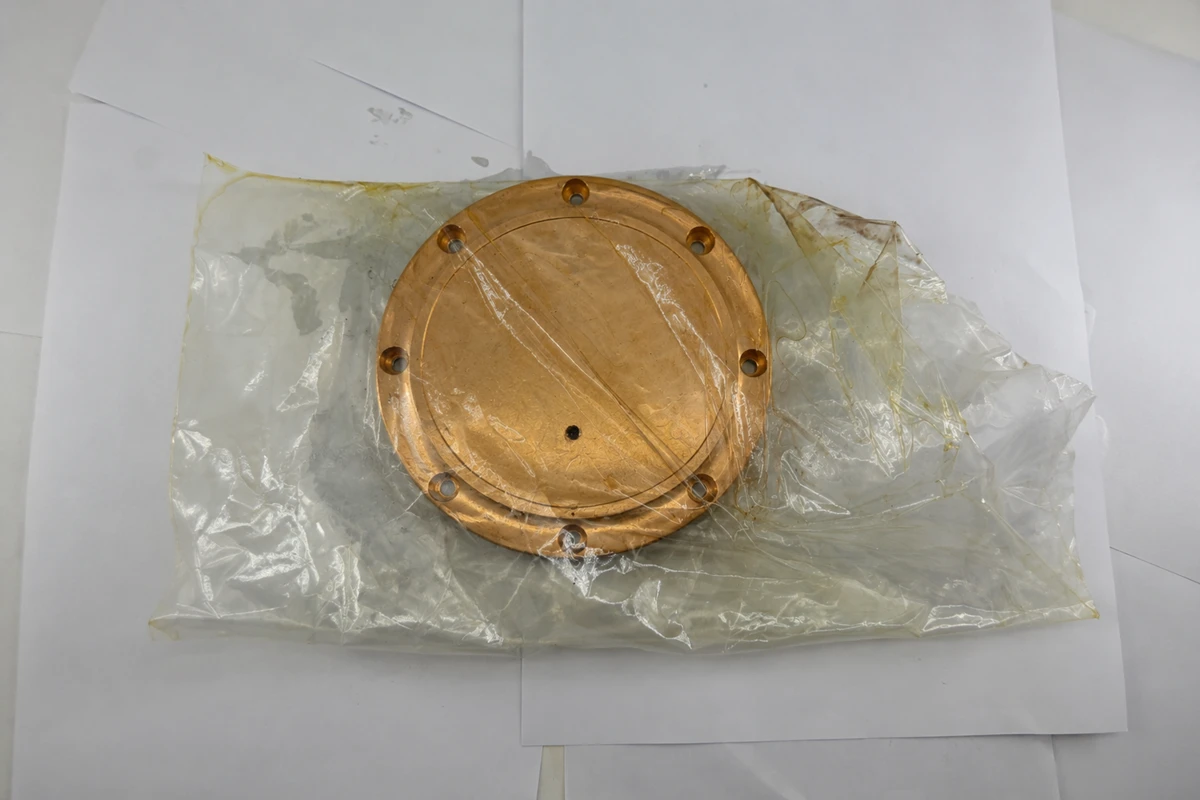
The supplied bronze images show the practical value of protecting a freshly machined surface from handling and the environment. A suitable packaging system must prevent direct contamination, reduce humidity exposure, keep the part from rubbing against other items, and avoid packaging materials that can react with copper alloys. When an oil or inhibitor is used, its compatibility with the alloy and the customer’s next operation must be confirmed.
Why Parts Still Rust After “Anti-Rust Treatment”
When corrosion appears after a supplier says the part was protected, the failure is usually in the system—not necessarily in the name of the product used. Investigate the route from final machining through cleaning, handling, storage and packaging.
| Failure mode | What may be happening | Corrective direction |
| Oil applied over contamination | Water, sweat, chloride, old coolant or cleaner remains under the film | Improve wash/rinse/dry validation; handle with clean gloves; audit bath cleanliness |
| Wet part sealed in VCI | VCI does not remove standing water; trapped moisture can drive flash rust | Package only clean, cool, visibly dry parts; add moisture control when justified |
| Blind holes corrode first | Water/coolant remains in recesses or protection never reaches them | Dedicated dry-out and coverage check for holes, threads, cavities |
| Part arrives rusted after sea freight | Long humid route, condensation cycles, damaged seal, untreated wood/cardboard exposure | Use route-specific sealed VCI/barrier system, desiccant as needed, cushioning and seal verification |
| Stainless develops rust spots | Free iron contamination, aggressive residue, unsuitable cleaning/passivation route | Separate stainless handling, clean thoroughly, use specified passivation and verification where applicable |
| Coated part corrodes at edges/threads | Thin coverage, damaged coating, masked area, poor pretreatment or porosity | Specify thickness/coverage and inspection at critical features; review pretreatment |
| Protection conflicts with customer process | Oil interferes with bonding, painting, optics, cleanroom, assembly or medical cleaning | Define residue/cleanliness requirement at RFQ; use removable or dry protection where required |
How to Inspect Corrosion Protection Before Shipment
The inspection method should match the risk and the specification. A simple visual inspection is not always enough, but a full laboratory corrosion test is not automatically required either. Useful controls include:
- Cleanliness check: lint-free white wipe or other validated method to detect visible residues, especially before passivation, coating or oil-free shipment.
- Coverage check: temporary film should be continuous where required, with no missed threads, bores, blind holes or machined faces.
- Coating thickness: verify plating/anodize/paint thickness when the drawing or process specification requires it.
- Dimensional re-check: confirm critical fits, threads, bores and sealing features after thickness-adding treatments; use functional gauges where appropriate.
- Surface condition: no visible red rust, pitting, active staining, blisters, peeling, damaged coating or packaging contamination at pack-out.
- Packaging inspection: verify bag integrity, seal, desiccant/VCI placement where used, cushioning, part separation, label/lot/date and dry condition before closure.
- Customer-specified corrosion test: use salt spray or other corrosion testing only to the specified method and acceptance criteria.
| Salt spray is not a service-life calculator ASTM B117 provides a controlled salt-fog environment for comparative corrosion information, but the standard itself cautions that stand-alone salt-spray results do not reliably predict natural-environment service life. Avoid marketing claims such as “X hours equals Y years” unless the customer’s validated specification explicitly supports that relationship. |
What Procurement Engineers Should Put on the RFQ
Many corrosion problems begin because “surface finish” is the only corrosion-related field on the RFQ. A more complete RFQ gives the supplier enough information to engineer the whole route.
- Material and heat-treatment condition (for example, 4140 PH, 416 tempered, 17-4PH H900, 6061-T6).
- Permanent finish specification, type/class, thickness range, color, sealing requirement and masked areas.
- Critical dimensions after finish, including threads, bores, bearing seats, sealing faces and electrical-contact areas.
- Cleanliness requirement: oil allowed, light removable film allowed, or oil/grease/debris prohibited.
- Expected storage duration and shipping mode: air, truck, containerized sea freight, long-term spares.
- Destination environment if unusually humid, coastal, cleanroom, outdoor or chemically aggressive.
- Packaging requirement: VCI compatibility, desiccant, barrier bag, individual separation, non-reactive packing material, vacuum/dry pack if specified.
- Required certificates and testing: coating certificate, passivation record, thickness report, salt-spray or other customer-defined validation.
How Rollyu Precision Can Build Corrosion Control into the Machining Route
For custom CNC machined parts, corrosion control is most reliable when it is reviewed together with DFM, tolerance and finishing—not after the parts are complete. A practical supplier workflow is to identify corrosion-sensitive materials and surfaces during quote review, flag conflicts such as “no finish + long export storage” or “oil-free + bare corrosion-sensitive steel,” and confirm the required protection before production.
For RFQs involving steel, stainless steel, aluminum, bronze or mixed-metal assemblies, Rollyu Precision can review the drawing and requested finish, identify dimensional or cleanliness risks, coordinate suitable finishing/packaging options, and define inspection points before shipment. The selected process should remain customer- and application-specific; the goal is not to apply the strongest possible coating, but to deliver the specified part in a condition that is dimensionally correct, clean, protected and ready for the customer’s next operation.
FAQ: Rust Prevention for CNC Machined Parts
What is the best rust prevention method for machined steel parts?
There is no universal best method. For short-term storage or shipping, a clean-and-dry part with a customer-compatible rust preventive plus VCI or barrier packaging is often effective. For long-term service, permanent coatings such as zinc, electroless nickel, black oxide + seal, phosphate + seal, paint/powder or another specified system may be required. Strength, dimensions, service environment and cleanliness determine the choice.
Does 4140 steel rust?
Yes. 4140 is an alloy steel, not stainless steel. Bare machined 4140 can rust when exposed to moisture, fingerprints, salts or condensation. If no permanent finish is allowed, temporary protection and controlled packaging become especially important.
Is black oxide enough to prevent rust?
Usually not by itself for demanding corrosion exposure. Black oxide is thin and dimensionally attractive, but corrosion performance depends heavily on the oil, wax or other seal used with it and the service environment.
Can stainless steel rust after machining?
Yes. Stainless steel can show rust or staining because of free iron contamination, aggressive residues, inappropriate cleaning, chloride exposure or the inherent corrosion resistance of the selected grade. Cleaning and qualified passivation may help when specified, but grade selection and environment still matter.
Should machined parts be coated with oil before export?
Only if the drawing and customer process allow oil residue. A light rust-preventive film can be effective for steel, but optics, bonding, painting, cleanroom, medical or oil-free assembly requirements may prohibit it. In those cases, validated dry protection such as VCI/barrier packaging may be preferable.
Does VCI packaging work if the part is wet?
VCI packaging is not a drying process. Parts should be clean and visibly dry before sealing. Free water, trapped coolant or condensation can cause corrosion before the protective atmosphere is fully established.
How do you protect blind holes and threaded bores from rust?
Treat them as high-risk moisture traps: clean them, remove retained coolant, dry them completely, ensure the selected inhibitor can reach them, and use sealed protection that does not allow new moisture in. If a coating is used, verify thread/bore dimensional allowance and masking.
Does salt-spray testing prove how many years a coating will last?
No. Salt spray is a controlled comparative test. It can be useful when a drawing specifies the method and acceptance criteria, but hours in salt fog should not be converted directly into field-service years without validated correlation data.
Which corrosion treatment changes dimensions the least?
Passivation of stainless steel and black oxide on steel generally do not add the same type of measurable deposited thickness as zinc, electroless nickel or heavy anodize, but every process must still be reviewed for the actual tolerance and surface requirement. Never assume “zero dimensional effect” on a critical feature.
Can bronze parts rust?
Bronze does not develop red iron rust, but it can tarnish, oxidize or develop corrosion products and staining. If appearance or contact performance is critical, specify cleaning, handling and compatible protection/packaging for the actual bronze alloy.
RFQ CTA: Define Corrosion Control Before the Parts Are Finished
| Send Rollyu Precision your RFQ Send the 3D CAD + 2D drawing + material/heat treatment + quantity + finish + critical tolerances + cleanliness requirement + destination/shipping method. We can review corrosion-risk points such as bare alloy steel, stainless cleaning/passivation, coating buildup on threads and fits, oil-free packaging, VCI compatibility, blind-hole moisture traps, and export storage before production starts. |
Recommended CTA button text: Request a Corrosion-Control & DFM Review