

ABS CNC machining is a practical way to manufacture functional plastic prototypes, fixtures, housings, covers, instrument panels, brackets, and low-volume end-use parts without investing in injection-molding tooling. ABS (acrylonitrile butadiene styrene) is relatively tough, rigid, low in density, and generally easy to cut. The machining challenge is not tool wear in the metalworking sense; it is heat control. A dull tool, poor chip evacuation, excessive rubbing, or heavy clamping can soften the surface, raise burrs, distort thin walls, or shift dimensions after the part is released from the fixture.
For engineers and buyers, the most useful questions are therefore straightforward: Is ABS easy to machine? How hard is it? What cutter geometry works best? What cutting speed and feed should be used? What surface finish can be expected? And what tolerance is realistic on a plastic part rather than on a metal part? This guide answers those questions first, then shows how the supplied real-part images translate into practical process planning, inspection, and RFQ requirements.
| Buyer / Engineer Question | Short Answer |
| Is ABS easy to machine? | Yes. ABS has good machinability, but sharp tools, low-friction cutting, chip evacuation, and heat control are essential. |
| How hard is ABS? | Hardness is grade-specific and test-scale-specific. Published ABS sheet/rod grades can differ materially; always use the exact supplier TDS rather than one universal number. |
| Best tooling? | Sharp carbide or HSS tooling designed for plastics; positive rake, polished cutting edges, generous chip space, usually 1–2 flutes for end milling. |
| Best cutting speed? | Use high cutting speed with a meaningful chip load—not rubbing. Convert RPM to surface speed from cutter diameter and validate on the actual grade and geometry. |
| Cooling? | Compressed air is often preferred. If liquid coolant is used, verify chemical compatibility with the exact ABS grade and downstream finishing process. |
| Typical tolerance? | A practical default for many ABS parts is about ±0.05 to ±0.10 mm, with tighter critical features possible after engineering review. Do not promise metal-like ±0.005 mm across a whole ABS part. |
| Surface finish? | Clean as-machined surfaces are achievable, but appearance depends on cutter sharpness, chip evacuation, toolpath, wall support, and heat. Cosmetic surfaces should be specified separately from dimensional surfaces. |
Is ABS Easy to Machine? Understanding ABS Machinability
Yes—ABS is generally considered a highly machinable thermoplastic. Its combination of stiffness and toughness allows clean milling, drilling, and turning when the tool cuts rather than rubs. ABS stock is commonly supplied as sheet, plate, rod, or other semi-finished shapes and can be machined on standard CNC equipment. For B2B production this makes ABS attractive for prototypes, test fixtures, electronics housings, diagnostic equipment covers, interior components, and low-volume custom parts where injection tooling would be uneconomical.
Good machinability does not mean ABS can be treated like aluminum. Plastics have much lower thermal conductivity and lower stiffness than metals. Heat stays near the cutting zone, and the workpiece can deflect under cutter or clamping force. The preferred strategy is therefore a sharp, positive-cutting tool, sufficient feed to form and eject chips, controlled engagement, low vibration, and enough support to prevent the part from moving or springing after unclamping.
| ENGINEERING NOTE — Ensinger’s general plastic-machining guidance recommends sharp tools, adequate chip space, high cutting speeds, medium feed rates, good workholding, and compressed air as an effective cooling method. These principles are more transferable than copying one universal RPM number. |
How Hard Is ABS Plastic—and Why Does Hardness Matter for CNC Machining?
ABS hardness varies by resin formulation, impact modification, flame-retardant package, sheet extrusion history, and the test scale used. This is an important professional-risk point: an article should not state that “ABS hardness is X” unless the grade and test method are identified. For example, published commercial ABS data sheets show different Rockwell values across product families. That variation is normal, not a contradiction.
For machining, hardness affects how the edge shears the polymer and how easily the surface can be dented by fixtures. A tougher or softer ABS grade may smear or raise a feathered burr if the edge is dull. A stiffer grade can hold small features more cleanly but may still distort if heat accumulates. The practical response is not to select a tool by hardness alone; use the material supplier’s TDS together with wall thickness, feature geometry, stock condition, and cosmetic requirements.
| Property | Published Example | Engineering Use |
| Rockwell hardness | Commercial ABS grades vary; e.g., sheet data can span roughly the low-80s to high-90s Rockwell R, while other machinable ABS products publish higher values. | Verify exact grade, scale, and ASTM method. Do not use a generic hardness value as an acceptance criterion. |
| Heat deflection / softening | Commercial ABS grades commonly have HDT values in the approximate 80–95°C range at higher test stress, depending on formulation. | Use HDT/Vicat and the supplier TDS for thermal design; ABS is amorphous, so a single “melting point” is a misleading design value. |
| Thermal expansion | ABS expands far more than metals. | Inspect at controlled temperature and avoid unnecessary heat input before final sizing. |
What Surface Finish Can CNC-Machined ABS Achieve?
Machined ABS can produce a clean, uniform surface that is suitable for functional parts and many cosmetic housings. The final appearance depends more on process discipline than on a simple material label. Sharp cutters reduce tearing. Correct chip load prevents rubbing. Good chip evacuation keeps hot chips from re-contacting the wall. Light, stable finishing passes reduce cutter-pressure marks, and rigid but non-damaging workholding prevents vibration.
A buyer should distinguish dimensional surfaces from cosmetic surfaces. An as-machined ABS surface can show tool paths or swirls even when dimensions are correct. If a visible customer-facing surface matters, call out the desired appearance separately—such as as-machined, mechanically polished, painted, or controlled matte texture—and identify surfaces that must remain free from coating. Avoid promising a numerical Ra value unless the drawing specifies the measurement direction, instrument method, and surface location.
| Finish | What to Expect | Risk / Design Note |
| As-machined | Natural/white/black ABS with visible but controlled cutter pattern. | Lowest cost. Tool marks are not necessarily dimensional defects. |
| Mechanical polishing | Reduces machining marks and can raise gloss. | Can round sharp edges or alter cosmetic geometry if overdone. |
| Light bead blasting | Can create a more uniform matte look. | May whiten the surface or soften very fine features; sample approval is recommended. |
| Painting / spray coating | Adds color, branding, or UV protection. | Mask mating features; include coating thickness in fit/tolerance stack. |
| Solvent / vapor smoothing | Can visually smooth some ABS surfaces. | Not a default precision-machining finish: solvent exposure can affect dimensions, stress cracking, safety, and downstream compliance. |
ABS Cutting Speed, Spindle Speed, Feed Rate, and Depth of Cut
There is no single correct cutting speed for ABS because RPM by itself is meaningless without cutter diameter, flute count, tool geometry, machine rigidity, engagement, and part thickness. A safer engineering method is to start from surface speed and chip load, then validate temperature, chip shape, burr formation, and dimensions on the actual stock.
| ENGINEERING NOTE — Use the relationships Vc = π × D × n / 1000 (m/min) and fz = F / (n × z), where D is cutter diameter in mm, n is spindle speed in rpm, F is feed in mm/min, and z is flute count. This makes a machining recommendation scalable instead of tying it to one arbitrary RPM. |
Milling ABS Plastic
For general ABS milling, a sharp single- or two-flute carbide end mill with polished flutes is a strong starting choice because the larger flute space clears plastic chips and reduces recutting. The supplied technical material includes broad milling windows around 4,000–10,000 rpm for roughing and 8,000–15,000 rpm for finishing. Those values should be treated as commissioning ranges, not universal specifications.
For a 6 mm, two-flute cutter, 8,000–15,000 rpm corresponds to roughly 151–283 m/min surface speed. A starting feed of about 300–900 mm/min corresponds to approximately 0.010–0.056 mm/tooth over that range. The correct point within the window is the one that produces clean chips without softening, chatter, or edge whitening. Thin walls, deep pockets, long-reach tools, and large radial engagement generally require lower cutting force and staged finishing.
Drilling ABS
Drilling is often more thermally sensitive than open milling because the tool is surrounded by insulating plastic and chips have less room to escape. Use a sharp drill, avoid excessive web thickness, and peck to evacuate chips on deeper holes. When drilling thin walls, control breakthrough so the drill does not grab and tear the exit. For deep or precision holes, allow the workpiece to return to room temperature before final measurement.
Turning ABS
Turning favors sharp, positive geometry, a small nose radius for low cutting force, and a sufficiently high cutting speed to form a clean continuous chip rather than a rubbed surface. A broad finishing edge can improve appearance on supported diameters. Slender plastic parts may require a steady rest or other support because workpiece rigidity—not spindle power—is often the limiting factor.
Cooling and Chip Evacuation
Compressed air is often the first choice for ABS because it cools the cutter and removes chips without introducing an unknown chemical. If a mist or liquid coolant is required, the shop should confirm compatibility with the exact ABS grade, paint or adhesive process, and cleanliness requirement. Avoid assuming that any metalworking coolant is automatically safe for ABS; stress, temperature, and solvent exposure can interact and cause cracking or surface damage.
| Operation | Preferred Tooling | Starting Logic | Watch For | Adjustment |
| Milling | Sharp carbide, 1–2 flutes, polished/large chip space | High cutting speed + medium feed; keep a real chip load | Melting, burrs, chip recutting | Increase chip evacuation; reduce engagement; verify feed is not too low |
| Finishing | Sharp carbide, short stick-out | Light stable finish pass after roughing stress is released | Witness marks, wall deflection | Reduce force; support the wall; use clean toolpath direction |
| Drilling | Sharp HSS/carbide drill; narrow web preferred | Size-dependent RPM; peck for deeper holes | Heat, exit tear, chip packing | Peck more often; air blast; controlled breakthrough |
| Turning | Sharp positive tool; small nose radius | High cutting speed, controlled feed | Deflection, stringy chips, heat | Support slender work; improve chip control |
Best Tooling for ABS CNC Machining
Carbide vs. HSS
Both HSS and carbide can machine ABS. HSS can be economical and can hold a very sharp edge; carbide offers better wear resistance and rigidity for production, small tools, or longer run time. The more important variable is edge quality. A polished, sharp edge designed for non-ferrous or plastic cutting is usually preferable to a heavily honed edge developed for hard steel.
Flute Count and Cutter Geometry
Single- and two-flute cutters are often effective because they create generous chip space. Positive rake and a sharp wedge angle reduce cutting force and heat. Excessive flute count can trap chips, especially in slots and deep pockets. For face finishing, a fly cutter or suitable single-edge strategy can produce a uniform appearance when the setup is rigid and the surface is adequately supported.
Workholding for Plastic Parts
Fixture pressure should be only as high as needed to resist cutting force. Soft jaws, broad contact areas, vacuum tables, sacrificial plates, and custom nests can reduce denting and distortion. Thin sheet can require distributed support; thin-wall housings can require internal support. A part that measures correctly while clamped but moves after release is not a controlled process.
Common ABS Machining Problems and How to Prevent Them
| Problem | Likely Cause | Process Response |
| Melting or smeared edges | Heat from rubbing, dull tools, chip recutting, excessive engagement | Sharpen/replace tool; increase chip evacuation; maintain chip load; reduce engagement; use air cooling. |
| Feathered burrs | Dull edge, unsupported exit, too little chip thickness | Use sharp positive tooling; support breakthrough edges; adjust feed rather than only raising RPM. |
| Warping after unclamping | Residual stock stress, asymmetric material removal, heat, high clamping pressure | Rough symmetrically where possible; allow stabilization; finish in a second setup; reduce clamp force. |
| Chatter on thin walls | Low workpiece stiffness, long tool stick-out, heavy radial engagement | Improve support, shorten tool, reduce radial engagement, use consistent toolpath. |
| Poor hole accuracy | Chip packing, drill heat, grab at breakthrough | Peck drill; use air; control breakthrough; ream/finish only after thermal stabilization where required. |
| Cosmetic scratches | Hot chips dragged across surface, hard jaws, handling | Protect cosmetic faces, improve chip flow, use soft clean fixtures and controlled packaging. |
Real-Part Engineering Analysis from the Supplied ABS Images
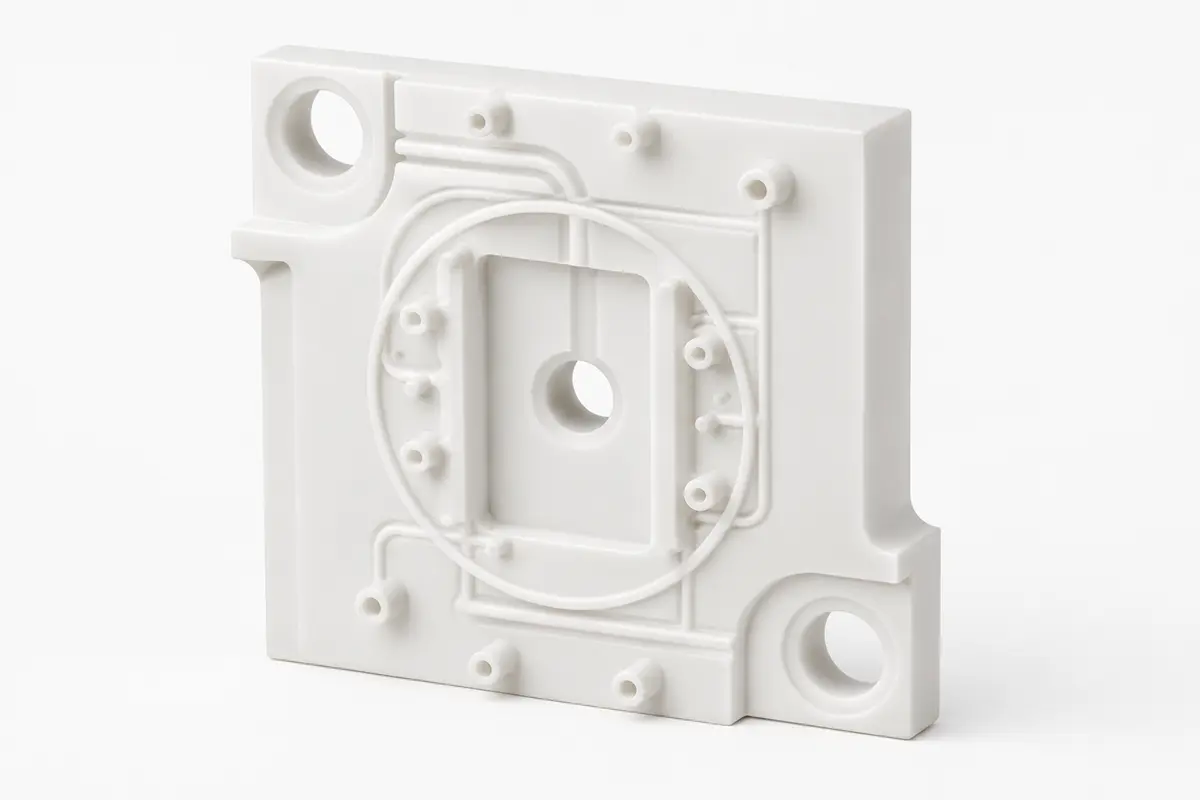
White ABS Housing / Interface Plate
This part combines large through-holes, multiple small bosses, a circular raised/recessed path, a central pocket, and thin channel-like features on one face. The machining risk is feature interaction: a heavy roughing pass can release stress and move the plate before the small bosses and channels are finished. A more robust sequence is to establish stable datums, rough the large pocket and major bores, leave controlled finishing stock, allow the part to relax if required, then finish datum-critical holes and fine surface features in a stable setup.
Quality control should prioritize hole position relative to the functional datums, pocket depth, boss height, plate flatness after release from the fixture, and visual condition of the fine channels. If the part is an enclosure or interface plate, mating-fit verification with a gauge or reference component may be more valuable than measuring every cosmetic line on a CMM.
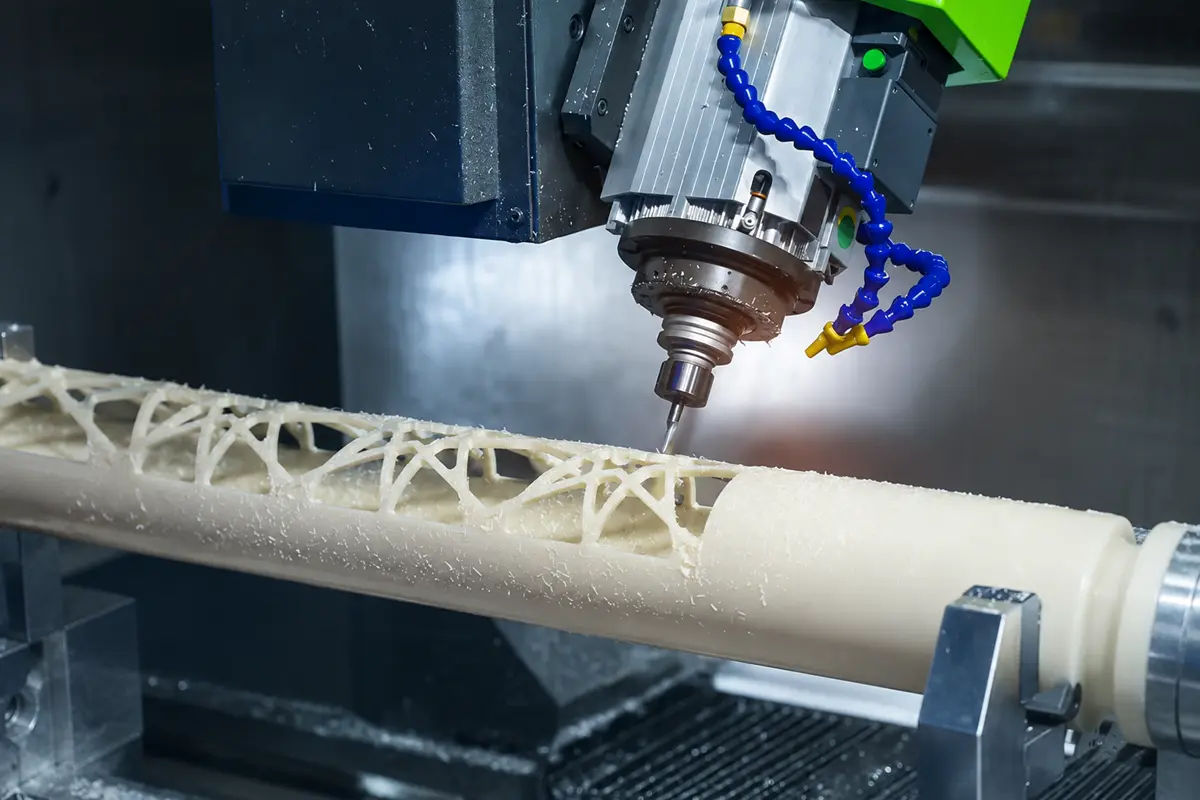
In-Process Machining of a Thin-Feature ABS Workpiece
The in-process image is a useful illustration of why ABS parameters must be tuned around heat and support. The open geometry leaves slender ribs and reduced cross-sections that can vibrate as material is removed. Chips should leave the cut quickly; if they remain in the pocket, they can be recut, warmed, and dragged across the new surface. The cutter should stay sharp, step engagement should be controlled, and the remaining structure should be supported until the last practical stage of machining.
For a part like this, a programmer should avoid treating the final thin ribs as if they were bulk material. Roughing can leave temporary support stock; finishing can proceed in short, low-force segments; and the inspection plan should include wall/rib geometry after the part has returned to room temperature. This is also a good case for air blast rather than assuming a liquid coolant is required.
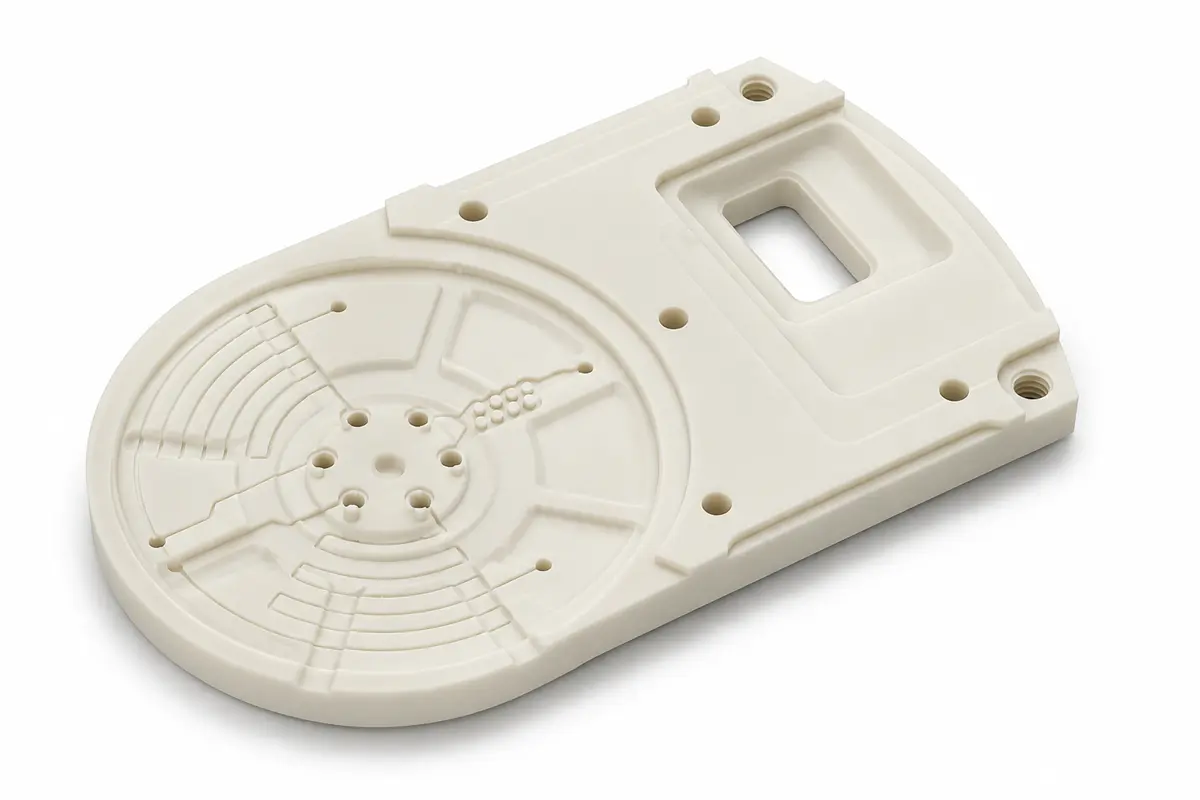
Ivory ABS Panel with Large Recesses and Threaded Features
The third supplied part shows a broad plate with a large circular recessed region, a rectangular pocket, several drilled holes, and threaded features near the perimeter. Large-area pocketing can change flatness because stock stress is released asymmetrically. A controlled plan would balance stock removal where possible, use broad low-pressure support, and reserve a finishing pass for critical faces after the main pocketing operation.
Threads in ABS deserve special attention. Internal threads can deform if tap geometry, pilot size, or clamp pressure is poorly chosen. For assemblies that will be repeatedly serviced or highly loaded, threaded inserts may be more robust than relying only on plastic threads. The RFQ should state whether threads are one-time assembly features, service threads, or load-bearing interfaces so the manufacturing method can be reviewed before machining begins.
Quality Control for CNC-Machined ABS Parts
A strong ABS machining supplier should control more than the toolpath. Plastic dimensions are influenced by stock condition, temperature, fixture force, measurement force, and elapsed time after machining. For tight-fit components, the inspection method and conditioning are part of the process plan.
| Control Point | Recommended Practice |
| Material verification | Confirm resin/stock grade, color, supplier documentation, and any FR/medical/food-contact declaration required by the drawing. |
| Incoming stock check | Review thickness, flatness, surface condition, and obvious warp before programming critical datums. |
| First Article Inspection | Measure critical datums, bores, pocket depths, hole locations, thread features, and assembly interfaces before releasing production. |
| In-process control | Check heat-sensitive or distortion-sensitive dimensions between major operations, not only after the final pass. |
| Final dimensional inspection | Use calipers/micrometers, height gauges, optical measurement, CMM, or custom gauges according to feature type and required uncertainty. |
| Surface / cosmetic inspection | Separate cosmetic acceptance from dimensional acceptance; define scratch, burr, tool-mark, and color expectations. |
| Thread verification | Use appropriate thread gauges where applicable and verify insert installation if inserts are specified. |
| Packaging | Protect white/natural ABS from dirt, rubbing, and metal chips; isolate cosmetic faces and prevent part-to-part abrasion. |
What Tolerance Is Realistic for ABS CNC Machining?
Tolerance must be tied to geometry. A practical general drawing tolerance around ±0.05 to ±0.10 mm is more defensible for many ABS parts than a blanket ±0.005 mm claim. Tighter tolerances can be achievable on selected short, well-supported features with stable stock, temperature control, suitable inspection, and a reviewed process. Large flat plates, thin walls, long spans, and features separated by multiple setups should not inherit the same tolerance automatically.
Design Guidelines for Better ABS Machining Results
- Use consistent internal radii where possible so one cutter can machine multiple features and reduce tool changes.
- Avoid unnecessarily deep narrow pockets that trap hot chips and require long-reach tooling.
- Give thin walls enough support and consider temporary support stock if the geometry becomes flexible during roughing.
- Specify cosmetic faces separately from critical datum and sealing/mating surfaces.
- Avoid over-tolerancing nonfunctional dimensions; reserve tight tolerances for assembly, optical, sealing, or alignment interfaces that truly need them.
- For frequently serviced threads, consider metal inserts rather than relying on repeated engagement in ABS.
- If painting or coating is required, identify masked surfaces and account for coating build on mating features.
- For outdoor use, evaluate UV-stabilized ABS, protective coating, or ASA rather than assuming standard ABS is weather-stable.
ABS vs. Other Plastics for CNC Machining
| Material | Why Choose It | Where ABS May Be Better | When to Choose the Alternative |
| Polycarbonate (PC) | Higher heat capability and exceptional impact resistance. | Often easier/cost-effective for general housings and prototypes. | Higher temperature, higher impact demand, or transparency. |
| POM / Acetal / Delrin | Excellent dimensional stability, low friction, crisp machining. | ABS is often lower cost and easier to paint/finish cosmetically. | Precision sliding parts, gears, bushings, low-friction mechanisms. |
| Nylon (PA) | Good wear and fatigue resistance. | ABS generally absorbs less moisture and can hold cosmetic dimensions more predictably. | Wear parts, fatigue-loaded components, some chemically exposed applications. |
| ASA | Better weather and UV resistance. | ABS is widely available and cost-effective for indoor parts. | Outdoor housings and exposed components. |
| PEEK | High temperature, chemical resistance, premium mechanical performance. | ABS is far more economical for moderate-duty prototypes/housings. | High-temperature, vacuum, chemical, aerospace, semiconductor, or demanding medical applications. |
When Should You CNC Machine ABS Instead of Injection Molding or 3D Printing?
CNC machining is usually the strongest choice when the customer needs engineering-grade stock, accurate interfaces, clean drilled or milled features, low-to-medium volume, or rapid design revision without mold investment. Injection molding becomes more attractive when geometry is frozen and the annual quantity justifies tooling. FDM 3D printing can be faster for very early shape validation, but layer structure, surface finish, hole quality, and anisotropy differ from machined stock.
| Process | Best Fit | Main Advantage | Main Trade-off |
| CNC machining | Functional prototypes, fixtures, low-volume end-use parts | No mold; strong dimensional control; true stock material | Material removal, machining time, geometry access limits |
| Injection molding | High-volume production | Low part cost at scale; molded textures/features | Tooling cost, lead time, change cost |
| FDM 3D printing | Early prototypes, complex low-load shapes | Fast iteration, no subtractive access limits | Layer lines, anisotropy, lower precision on many interfaces |
What B2B Buyers Should Send in an ABS Machining RFQ
A quote is more reliable when the supplier receives enough information to review thermal, dimensional, cosmetic, and regulatory risk before pricing. The fastest RFQs usually include both the 3D model and the controlled 2D drawing.
- 3D CAD file (STEP preferred) and current 2D drawing/revision.
- ABS grade or performance requirement: standard, high-impact, heat-resistant, flame-retardant, ESD/antistatic, or other specified grade.
- Color and stock preference: natural/ivory, white, black, or supplier-approved equivalent.
- Critical-to-function dimensions, datum scheme, GD&T, and mating interfaces.
- Thread specification and whether threaded inserts are required.
- Cosmetic surface class, paint/coating/marking requirement, and surfaces that must remain uncoated.
- Operating temperature, chemical exposure, UV/outdoor exposure, cleaning agents, and assembly loads.
- Any regulatory/documentation requirement such as a specific UL 94 rating, food-contact declaration, or medical-device material documentation.
- Prototype quantity and expected production quantity so the process can be optimized for the real business case.
- Inspection deliverables: standard inspection, FAI, CMM report, material certificate, CoC, or custom control plan.
Why Source CNC-Machined ABS Parts from Rollyu Precision?
For precision plastic projects, the value of a machining partner is engineering review rather than simply loading a CAD file into a CNC machine. Rollyu Precision can support CNC milling and turning, multi-axis machining, inspection, surface finishing, and prototype-to-production coordination for custom components. For ABS specifically, the engineering focus should remain on grade verification, low-force workholding, heat and chip control, datum strategy, critical-feature inspection, and cosmetic protection.
The recommended commercial position is not “we can hold ±0.005 mm on every ABS part.” A more credible message is: send the drawing, identify the critical features, and Rollyu will review the material, geometry, tolerances, workholding, finishing, and inspection plan before confirming manufacturability. That approach gives engineers a realistic answer and reduces avoidable RFQ-to-production risk.
Frequently Asked Questions About ABS CNC Machining
Is ABS plastic easy to CNC machine?
Yes. ABS is generally easy to mill, turn, and drill, especially with sharp tooling and good chip clearance. The main risks are heat, burrs, workpiece deflection, and distortion—not heavy tool wear.
What is the best cutting tool for ABS?
A sharp carbide or HSS tool with positive cutting geometry and generous chip space works well. One- or two-flute carbide end mills are common for milling because they evacuate chips efficiently.
What cutting speed should I use for ABS?
Use a high cutting speed with an adequate chip load and validate it on the exact cutter diameter and ABS grade. Do not copy one RPM value across different cutter sizes. Calculate surface speed and feed per tooth, then adjust based on chip shape, temperature, burrs, and dimensions.
Can ABS melt during CNC machining?
ABS can soften or smear if the cutting zone overheats. Dull tools, rubbing, chip recutting, heavy engagement, or poor cooling are common causes. Sharp tools and air blast usually improve the process.
What hardness is ABS?
There is no single universal ABS hardness. Published grades vary and may use different Rockwell scales. Use the exact resin or stock-shape technical data sheet when hardness is important to design or acceptance.
What tolerance can CNC-machined ABS hold?
Many parts are sensibly specified around ±0.05 to ±0.10 mm for general dimensions. Selected features can be tighter after engineering review, but blanket metal-like tolerances increase cost and distortion risk.
Can ABS be polished after CNC machining?
Yes. Mechanical polishing, painting, and some controlled texturing processes are possible. Any post-process must be reviewed for dimensional effect and chemical compatibility.
Can ABS be used for medical parts?
ABS is often used for housings and non-implant device components, but “medical-grade” or biocompatible status is grade- and application-specific. Compliance must be verified from the material supplier and the device requirements.
Is ABS food safe?
Do not assume generic ABS is food-contact compliant. Food-contact suitability depends on the exact grade, additives, colorants, intended use, temperature, cleaning environment, and supplier regulatory declaration.
Is ABS good for outdoor parts?
Standard ABS has limited UV/weathering resistance. Outdoor applications should evaluate UV-stabilized grades, coating, ASA, or another material based on exposure requirements.
Should ABS be pre-dried before CNC machining?
Not automatically. Pre-drying is critical in many melt-processing operations, but CNC machining of stock shapes is different. Review stock storage, moisture condition, grade, surface requirements, and dimensional sensitivity rather than applying an injection-molding drying rule by default.
Can you laser cut ABS?
Laser cutting may be technically possible in some setups, but fumes, edge quality, thermal damage, and equipment/safety requirements must be evaluated. For precision mechanical components, CNC routing or milling is usually easier to control.
RFQ CTA — Get an Engineering Review for Your ABS CNC Machined Parts
| Need ABS prototypes, housings, fixtures, panels, or low-volume precision plastic parts?
Send Rollyu Precision your STEP file, 2D drawing, material/grade requirement, quantity, critical tolerances, surface-finish requirement, and inspection needs. Our engineering review can identify heat, distortion, workholding, thread, cosmetic, and tolerance risks before production and provide a manufacturable quotation. RFQ: www.rollyu.com | Recommended files: STEP + PDF drawing |
Pre-Publication Professional Risk Checklist
| Risky Claim | Safer Technical Wording |
| Do not call ABS a material with one fixed melting point. | Use grade-specific HDT, Vicat, service-temperature and processing data. |
| Do not publish ±0.005 mm as a universal ABS CNC tolerance. | State geometry-dependent tolerances and require review for tight features. |
| Do not call generic ABS “medical-grade,” “biocompatible,” “FDA compliant,” or “food safe.” | Tie claims to a named grade, supplier declaration, standard, and intended use. |
| Do not state a universal Rockwell hardness without a scale and grade. | Reference the exact TDS and ASTM method. |
| Do not claim ABS is fully recyclable in every market. | Say ABS is technically recyclable, while actual recovery depends on grade, contamination, collection and local infrastructure. |
| Do not recommend solvent smoothing as a routine precision finish. | Flag dimensional, stress-cracking, EHS and compliance effects. |
| Do not assume pre-drying is always required before CNC machining. | Treat drying as a grade/storage/process-specific decision. |
| Do not assume any coolant is compatible. | Prefer air where practical or validate coolant/cleaner compatibility with the exact grade. |
| Do not claim standard ABS has strong outdoor weatherability. | Use UV-stabilized ABS/ASA/coating where the application requires it. |
| Do not invent results for the supplied images. | Use them as anonymized geometry/process examples unless actual drawings, measured tolerances, quantities and QC records are supplied. |