

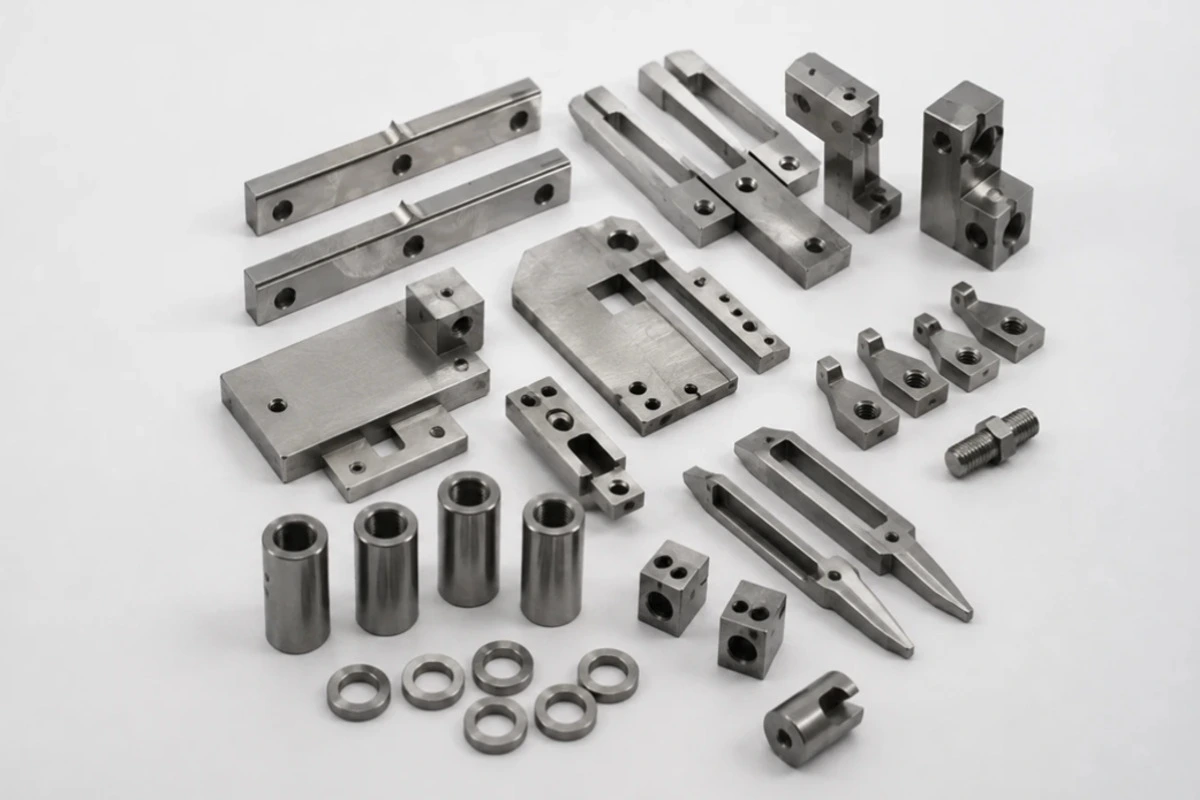
416 stainless steel is a free-machining martensitic stainless steel designed for precision components that require efficient turning, milling, drilling, threading and other extensive machining operations. Its sulfur addition improves chip breaking and reduces cutting resistance, while its martensitic structure allows the material to be hardened and tempered when higher strength or wear resistance is required.
Rollyu Precision manufactures custom 416 stainless steel CNC machined parts for medical equipment, dental mechanisms, photonics, quantum instruments, robotic laser projection, optomechanical systems, motion-control assemblies and precision industrial equipment. Representative components include jaws, jaw holders, gripper holders, couplings, spacers, shafts, instrument brackets, goniometer-related arms, collimator tubes and small mechanical mechanisms.
This guide is written for design engineers, mechanical engineers, supply chain management, sourcing managers and procurement teams who need to decide whether 416 is the correct material, understand how heat treatment changes the machining plan, identify risks such as burrs or distortion, and prepare an RFQ that can be quoted accurately.
What Is 416 Stainless Steel?
416 stainless steel, also designated UNS S41600, is a martensitic stainless steel developed specifically for improved machinability. The corresponding European designation is EN/DIN 1.4005, commonly written X12CrS13, and the JIS designation is SUS 416. These designations are useful for global sourcing, but the drawing, purchase specification and material certificate should always govern the final acceptance requirement.
| Standard / system | Designation |
| AISI / ASTM | 416 |
| UNS | S41600 |
| EN / DIN | 1.4005 |
| European grade name | X12CrS13 |
| JIS | SUS 416 |
The defining feature of 416 stainless steel is its controlled sulfur content. Sulfur promotes manganese sulfide inclusions that help chips break rather than form long, difficult strings. That is why 416 is attractive for components containing many threads, drilled holes, cross holes, slots, grooves, precision bores, turned diameters, shoulders, counterbores and repeated small milled features.
For repeat production, improved chip control can translate into shorter machining cycles, more stable tool engagement, more predictable tool life, fewer chip-related interruptions and a lower manufacturing cost per finished component. The benefit is especially noticeable when the geometry requires repeated drilling, tapping, boring or turning operations.
Why Choose 416 Stainless Steel for CNC Machined Parts?
Excellent Machinability
Machinability is the primary reason engineers specify 416 stainless steel. Compared with common austenitic stainless steels such as 304 and 316, 416 generally cuts more freely and produces shorter, more manageable chips. This can reduce cutting forces and make it easier to maintain stable machining conditions on small, feature-dense components.
- Reduced machining cycle time
- Better chip evacuation
- Lower cutting-tool wear in suitable conditions
- More stable threading and tapping
- Efficient drilling and boring
- Consistent machined surface quality
- Lower machining cost on repeat production
- Better suitability for automated or high-repetition turning
This benefit is particularly relevant for precision turned parts, threaded components, small shafts, couplings, bushings, pins, jaws, spacers, holders and complex small mechanical components where a large percentage of the material must be removed by cutting.
Heat-Treatable for Higher Hardness and Wear Resistance
Unlike 304 and 316 stainless steel, 416 is martensitic and can be hardened and tempered. This creates a useful manufacturing combination: the component can be machined efficiently in a more machinable condition, then heat treated when the final application requires greater hardness, strength or wear resistance.
| Typical process sequence Rough CNC machining → heat treatment / tempering → dimensional stabilization as required → finish machining or grinding → deburring / cleaning → dimensional inspection → hardness verification when specified. |
For tight-tolerance parts, heat treatment must be considered during process planning because hardening can change dimensions and increase subsequent cutting difficulty. Critical bores, mating surfaces, threads, sliding features, locating diameters and bearing interfaces may need finish machining after heat treatment. The drawing should clearly identify which dimensions apply to the finished, heat-treated part.
416 Stainless Steel Properties for CNC Design
| Property | 416 stainless steel | Engineering impact |
| Material family | Martensitic stainless steel | Heat-treatable; magnetic |
| Machinability | Excellent for stainless steel | Supports complex and repeat machining |
| Magnetism | Magnetic | Important for sensors and magnetic-sensitive assemblies |
| Heat treatment | Available | Hardness and strength can be adjusted |
| Corrosion resistance | Moderate | Best for controlled / mild environments |
| Weldability | Poor | Not preferred for welded assemblies |
| Thread machinability | Excellent | Useful for feature-dense threaded components |
| Chip control | Generally favorable | Supports automated/repeat machining |
| Common feedstock | Round bar, hex bar, flat bar and other machinable stock | Efficient for turned and milled parts |
A useful sourcing decision is not simply “Is 416 stainless steel strong?” The more relevant question is whether 416 provides the correct balance of machinability, final hardness, corrosion resistance, dimensional repeatability and total production cost for the specific component and service environment.
Chemical Composition of AISI 416 / UNS S41600
Typical chemistry depends on the governing standard and material supplier. The material certificate should be checked against the drawing and purchase specification for critical programs. A practical reference range is shown below; it is not a substitute for the applicable standard or mill certificate.
| Element | Typical role / reference | |
| Chromium | Approximately 12–14%; provides the stainless character and moderate corrosion resistance | |
| Carbon | Supports martensitic hardening and final mechanical properties | |
| Sulfur | Intentionally elevated, commonly around 0.15–0.35%, to improve chip breaking and machinability | |
| Manganese | Supports sulfur control through manganese sulfide formation | |
| Silicon | Deoxidation / steelmaking control | |
| Iron | Balance | |
The main difference between 416 and conventional martensitic stainless steels is its sulfur addition. Sulfur improves chip breaking and machining productivity, but it also reduces corrosion resistance, weldability and, depending on condition, toughness. This is why 416 is a targeted machining alloy rather than a universal stainless-steel choice. |
||
CNC Machining 416 Stainless Steel
Although 416 is one of the easier stainless steels to machine, precision production still depends on tooling geometry, workholding rigidity, material condition, heat-treatment sequence, coolant delivery, chip evacuation and inspection planning. Treating it like an ordinary carbon steel can still lead to dimensional drift, rubbing, chatter, poor burr control or inconsistent surface finish.
CNC Turning
416 is particularly suitable for CNC turning when parts contain precision outside diameters, internal diameters, shoulders, grooves, threads, small bores, concentric features and stepped shaft geometry. Typical turned components include shafts, pins, bushings, sleeves, threaded inserts, couplings, cylindrical housings and precision fasteners.
Its chip-breaking behavior is useful in repetitive turning because short, controlled chips reduce the risk of chip wrapping around the workpiece or tool. For deep bores and internal threading, coolant direction and chip evacuation remain important because recutting chips can mark the bore and affect final size.
CNC Milling
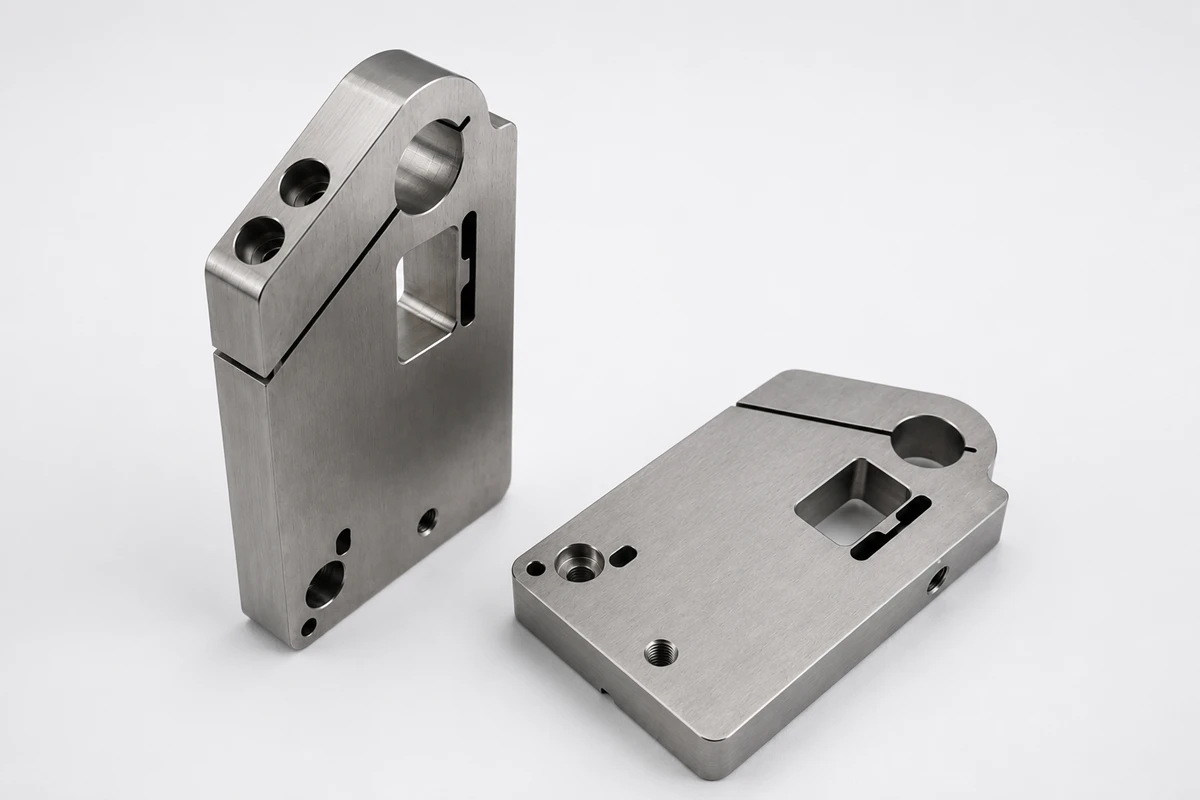
CNC milling is used for 416 components such as jaws, holders, mounting blocks, brackets, goniometer arms, instrument components, clamps, precision plates, slotted mechanisms and compact structural parts. Sharp carbide tooling, rigid workholding and a cutting strategy that avoids rubbing help maintain surface finish and dimensional stability.
For thin arms or fork-like features, the machining sequence matters as much as the cutting parameters. Removing too much stock from one side before the opposite side is balanced can release residual stress and move a flexible feature. Staged roughing and finishing, controlled clamping force, and post-unclamping verification are often more effective than simply slowing the machine down.
Drilling, Tapping and Threading
Many engineering buyers select 416 because their parts contain a high density of holes and threads. The alloy is well suited to small threaded holes, cross holes, tapped features, countersinks, counterbores, precision threaded interfaces and repeated drilling operations. Feature accessibility and chip evacuation must still be reviewed, especially for blind holes, deep threads and intersecting holes.
For components with many holes, threads and repeated machined features, 416 can offer a meaningful manufacturing advantage over harder-to-machine stainless grades. This is one of the strongest reasons to evaluate 416 when the service environment does not require 304/316-level corrosion resistance. |
Common Challenges When Machining 416 Stainless Steel
Machining Hardened 416
Annealed 416 is relatively easy to machine. After hardening and tempering, however, tool wear increases, achievable feeds and speeds may need to be reduced, finishing becomes more demanding, and dimensional control becomes more sensitive to heat and tool condition. When final hardness is required, a common approach is to rough machine before heat treatment and reserve critical sizing, grinding or fine finishing for after hardening.
- Leave calculated stock on critical surfaces when heat treatment follows rough machining.
- Identify finished-after-heat-treatment dimensions directly on the drawing.
- Use sharp, appropriate carbide tooling and avoid rubbing on hardened surfaces.
- Verify hardness separately from dimensional inspection.
- Re-establish critical datums after heat treatment when distortion could influence setup repeatability.
Thin Walls, Flexible Arms and Narrow Jaws
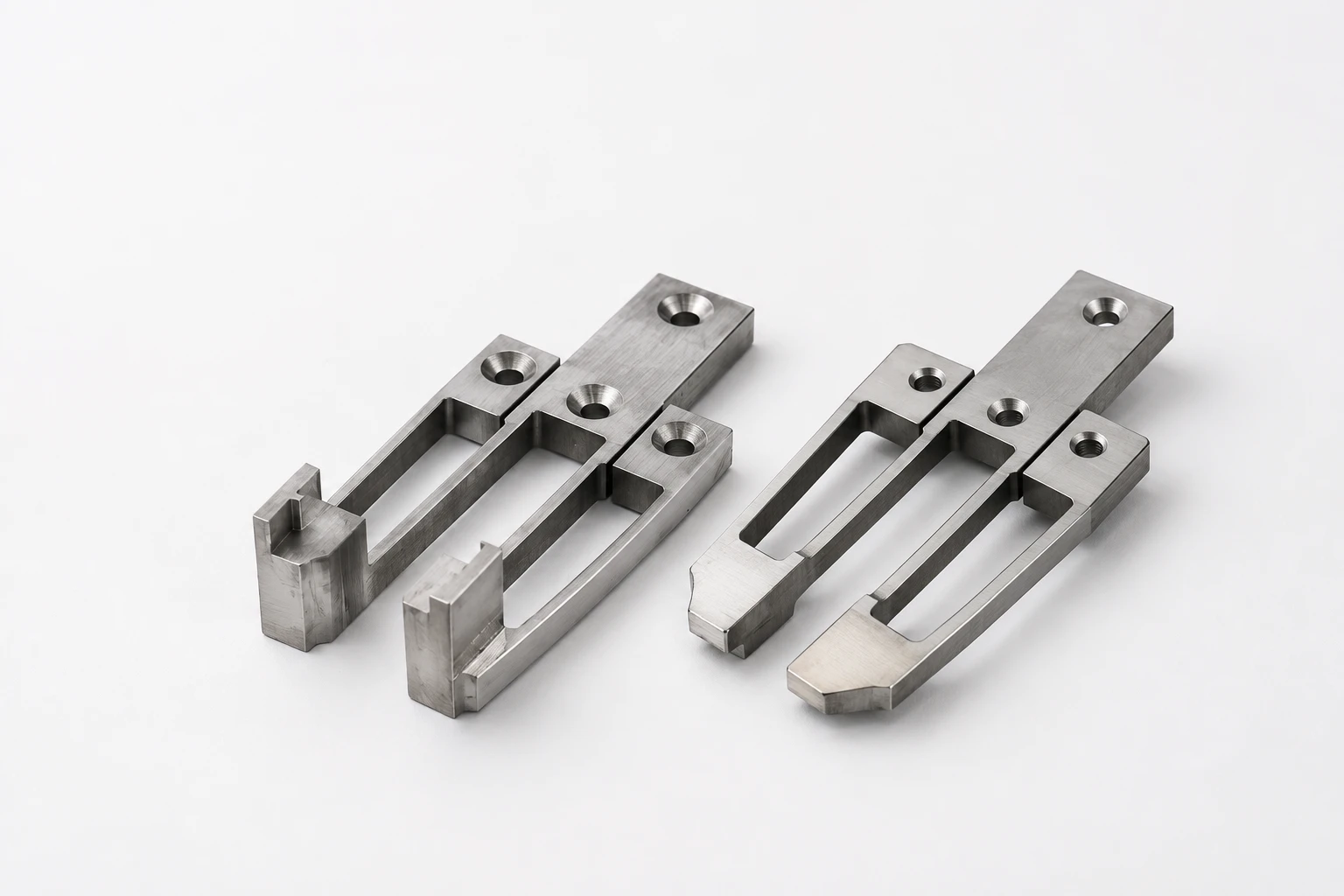
Several Rollyu 416 components use long slots, thin arms, narrow jaws, gripping features or locally reduced wall thickness. These geometries can deflect during cutting or clamping. A part may measure correctly while still clamped and move after the fixture is released, so process validation should include inspection in the free state when function depends on jaw spacing or spring-like geometry.
- Use low-stress fixturing and support the part close to the cutting zone.
- Balance material removal across opposing features.
- Use staged roughing and semi-finishing before the final pass.
- Control clamping force so thin arms are not preloaded during inspection.
- Inspect critical gap, symmetry and feature location after unclamping.
Burr Control at Cross Holes, Slots and Threads
Small precision mechanisms often contain intersecting holes, slots, threads and pockets. These intersections are common locations for residual burrs. For medical equipment, optical mechanisms and compact motion assemblies, a dimensionally correct part can still fail assembly if a burr interferes with mating, movement or thread engagement.
Rollyu therefore treats deburring as a functional manufacturing step rather than a cosmetic afterthought. Edge condition, cross-hole burrs, tapped-hole entry, slot intersections and internal chips should be addressed before final inspection and packaging. Some supplied 416 project requirements explicitly call for cleaned and deburred parts, which is representative of the assembly-focused quality requirement for these components.
Heat Treatment of 416 Stainless Steel CNC Parts
Heat treatment should be defined before RFQ whenever hardness is a functional requirement. The selected condition affects raw material procurement, cutting parameters, process sequence, distortion risk, finishing allowance, inspection methods and lead time.
| Condition / route | When it makes sense |
| Annealed / machinable condition | Best when machining productivity and low tool load are the priorities and final hardness is not critical. |
| Hardened and tempered | Used when greater strength, contact durability or wear resistance is required. |
| Rough machined → heat treated → finish machined | Useful when final dimensions must be controlled after hardening. |
| Heat treated → precision ground / finish cut | Useful for selected bores, fits, sliding surfaces or critical location features that require high final accuracy. |
Rollyu project records include multiple parts specified as AISI 416 tempered. One medical-oriented part record specifies SS 416 hard temper HRC 38–43, illustrating why hardness, machining sequence and final inspection must be treated as an integrated process rather than separate purchasing steps.
Surface Finishing for 416 Stainless Steel Machined Parts
Depending on the application, post-machining operations may include controlled deburring, cleaning, passivation when specified, polishing, precision grinding, heat treatment and hardness verification. Surface finishing should be selected for function: thread lead-in, mating friction, cleanliness, appearance, corrosion support and assembly performance.
Passivation can help remove free-iron contamination introduced during machining, but it does not change the fundamental corrosion-resistance limitation of 416. A smooth, clean surface may perform better than a rough, contaminated one in mild environments, yet no finishing process should be used to justify 416 in a chloride-rich or strongly corrosive application that really requires a more corrosion-resistant alloy.
416 Stainless Steel vs 304 Stainless Steel for CNC Machining
| Factor | 416 stainless steel | 304 stainless steel |
| Machinability | Excellent for stainless steel | Moderate; more prone to work hardening and stringy chips |
| Chip control | Generally better | More difficult |
| Heat treatable for hardening | Yes | No conventional martensitic hardening |
| Corrosion resistance | Moderate | Better general corrosion resistance |
| Magnetic | Yes | Generally non-magnetic in annealed condition |
| Welding | Poor | Much better |
| Best fit | Precision, machining-intensive components | General corrosion-resistant components and welded assemblies |
Choose 416 when machining efficiency, thread quality, drilled/milled feature density and the option of hardening are more important than maximum corrosion resistance. Choose 304 stainless steel when general corrosion resistance, frequent cleaning, welding or a more aggressive service environment is the higher priority.
416 Stainless Steel vs 316 Stainless Steel
| Requirement | 416 | 316 / 316L | |
| CNC machinability | Excellent | More demanding | |
| Corrosion resistance | Moderate | High | |
| Chloride resistance | Limited | Much better | |
| Heat-treatable hardening | Yes | No conventional martensitic hardening | |
| Thread-heavy machined parts | Excellent manufacturing fit when environment allows | Possible but typically more machining-intensive | |
| Marine / chemical exposure | Not preferred | Often preferred | |
Use 416 when machining productivity, thread quality and heat-treatable hardness are more important than maximum corrosion resistance. Use 316/316L when chloride resistance, chemical exposure, washdown or high corrosion resistance is the primary design requirement. |
|||
416 Stainless Steel vs 440C
416 and 440C are both heat-treatable stainless steels, but they solve different engineering problems. 416 is primarily chosen for machining efficiency and controllable mechanical properties. 440C is chosen when very high hardness and wear resistance dominate the requirement, but it is significantly more difficult to machine, especially after hardening.
For a precision jaw, threaded holder, adjustment component, coupling, machined bracket or compact instrument part, 416 may offer a better total manufacturing cost when the operating environment is suitable. For bearing elements, very high-wear contacts or applications that require hardness near the upper range of martensitic stainless steels, 440C may be more appropriate.
416 Stainless Steel CNC Machined Parts for Medical and Dental Equipment
416 stainless steel can be suitable for selected precision mechanical components in medical and dental equipment when machinability, dimensional stability, wear resistance and repeatable mechanical movement are more important than maximum corrosion resistance. It should not be selected automatically for fluid-contact, sterilization-heavy or chloride-rich environments; the actual cleaning regime and exposure conditions must be reviewed.
Representative Rollyu 416 project descriptions include Gonio Arm, Diode Nest, Diode Jig, Diode Holder, Jaw, Motor Coupling and Z Min Stopper. Many of these parts were specified in tempered condition. Potential component families include precision jaws, diode holders, adjustment mechanisms, motor couplings, stops, fixtures, instrument brackets and alignment components.
| Medical quality positioning For medical-equipment projects, Rollyu Precision supports precision machining under an ISO 13485:2016 quality management system. This quality-system positioning should be paired with drawing-specific inspection requirements rather than presented as a substitute for component validation. |
416 Stainless Steel Parts for Photonics and Optomechanical Systems
416 is relevant for selected optomechanical assemblies where a component requires accurate positioning, fine threaded features, compact stiffness, small precision bores, repeatable clamping, magnetic material behavior or hardened contact surfaces. Representative components may include gripper holders, collimator-related components, alignment blocks, mounting elements, precision jaws and adjustment mechanisms.
Rollyu project records include a 416 collimator tube for robotic laser projection / optomechanical systems and 416 gripper-holder-type components for photonics. For optical systems, mechanical surface quality and burr control are often more important than decorative appearance because a raised edge, chip or distorted slot can affect alignment, preload or motion.
416 Stainless Steel CNC Parts for Quantum and Scientific Instruments
Precision scientific and quantum instruments often contain small mechanical components that require repeatable adjustment, fine positioning, thread quality, wear resistance, dimensional consistency and compact geometry. In controlled laboratory environments, 416 can be a practical option when these mechanical requirements are more important than maximum corrosion resistance.
Representative Rollyu 416 project descriptions include Micrometer Tip, Finger, Filter Holder and Ring Spacer, recorded in tempered condition. These part types illustrate a useful material-selection pattern: when an instrument needs small mechanical contact or positioning elements with clean machining and repeatable geometry, 416 can provide a strong manufacturability advantage if magnetic behavior and corrosion exposure are compatible with the design.
Typical 416 Stainless Steel CNC Machined Parts
Leveraging the exceptional machinability and high strength of AISI 416 stainless steel, we deliver custom CNC machined components tailored for precision and durability. These parts are ideal for high-performance industrial equipment and compact instrument mechanisms. Our representative capabilities in 416 stainless steel machining include the following components:
- Precision jaws and jaw holders
- Gripper holders
- Motor couplings
- Micrometer tips
- Filter holders
- Ring spacers
- Precision brackets and instrument blocks
- Cylindrical sleeves and bushings
- Threaded components
- Alignment components
- Shafts and pins
- Collimator-related components
- Stops and contact elements
- Small mechanical mechanisms
Drawing-Based Rollyu Project Evidence
The following examples are based on the supplied production drawings and part photos. They are presented as manufacturing evidence for the kinds of features Rollyu has handled; they are not universal tolerance claims for every 416 component. Final capability must always be reviewed against the specific geometry, size, material condition, heat treatment, quantity and inspection plan.
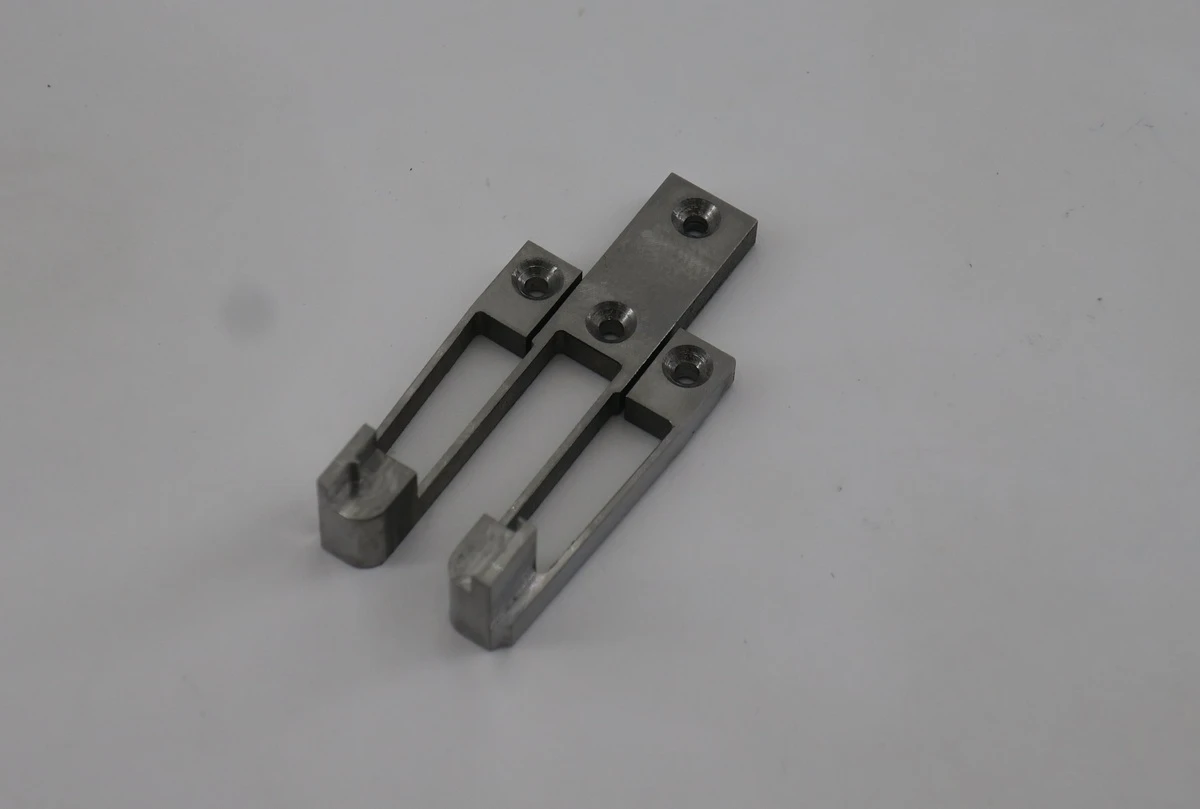
Case Example 1 — Tempered 416 Precision Jaws
Drawings 22222 and 33333 identify jaw components in AISI 416 tempered condition with no separate surface finish. The title blocks call for burr and edge removal, 1.6 µm / 63 µin roughness notation, decimal tolerances down to X.XXX ±0.015 mm, and flatness guidance of 0.002 mm per mm unless otherwise specified. The geometry includes long narrow arms, thin local sections, through holes and countersinks, making workholding and distortion control more important than the material’s nominal machinability alone.
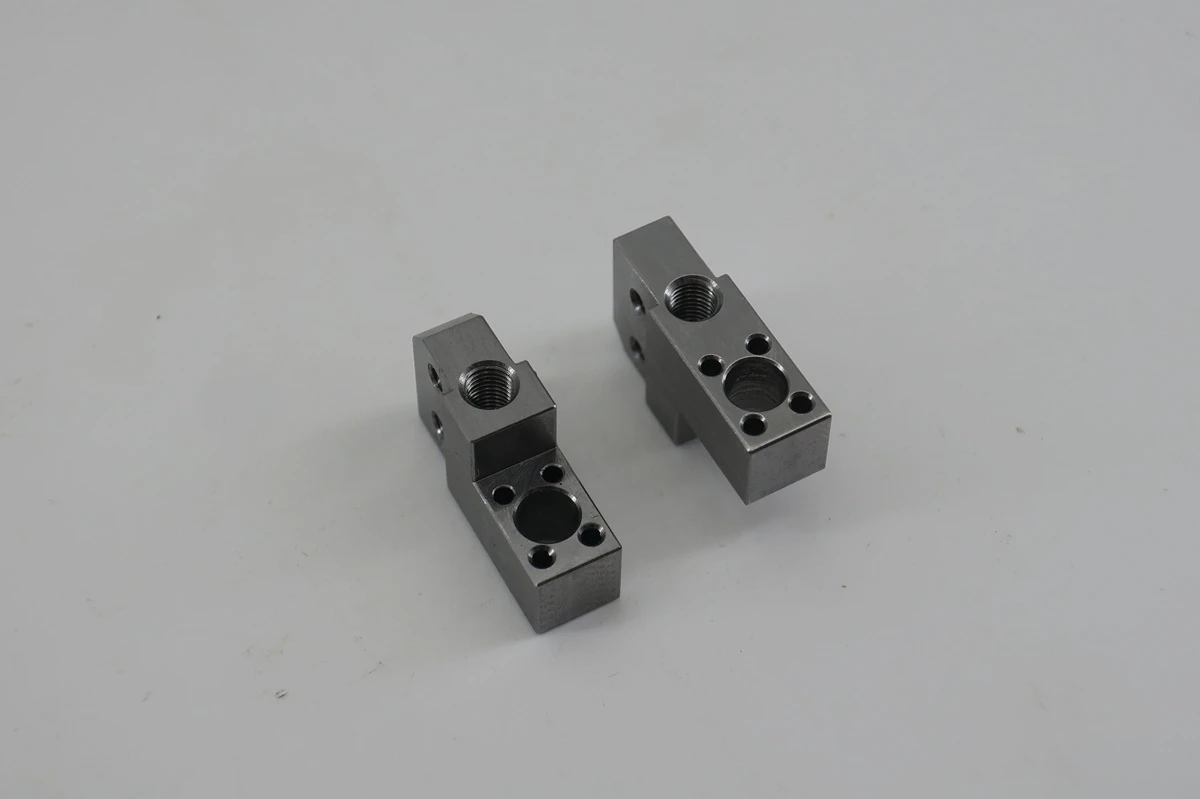
Case Example 2 — 416 Jaw Holder with Fine Threads and GD&T
Drawing 11111 identifies a JAW HOLDER in AISI 416 tempered condition. The component combines larger bores, M4×0.5 fine threading, M2×0.4 threaded features, through holes and geometric controls including a 0.02 mm position callout. This is a good example of why 416 can be attractive for compact, hole-dense, thread-dense parts: the material supports efficient cutting, but datum strategy, hole location, thread quality and deburring still determine whether the part assembles correctly.
Case Example 3 — Tempered 416 Gonio Arm
Drawing 66666 identifies a 72 mm-long GONIO ARM in AISI 416 tempered condition. The drawing combines threaded holes, through holes, tight diameter ranges, datum references and multiple 0.02 mm geometric controls. This type of part is a useful illustration of mixed manufacturing priorities: machining efficiency matters, but so do flatness, feature location, datum repeatability and final measurement after the part is released from the fixture.
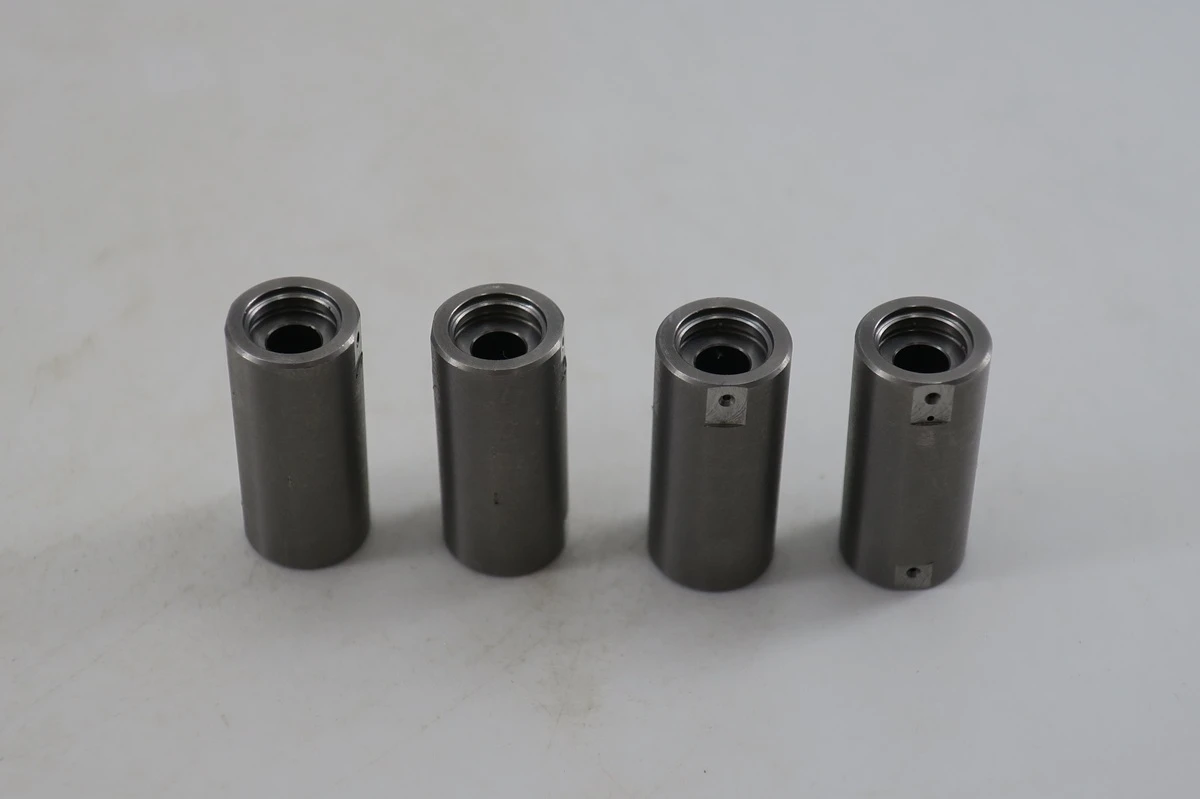
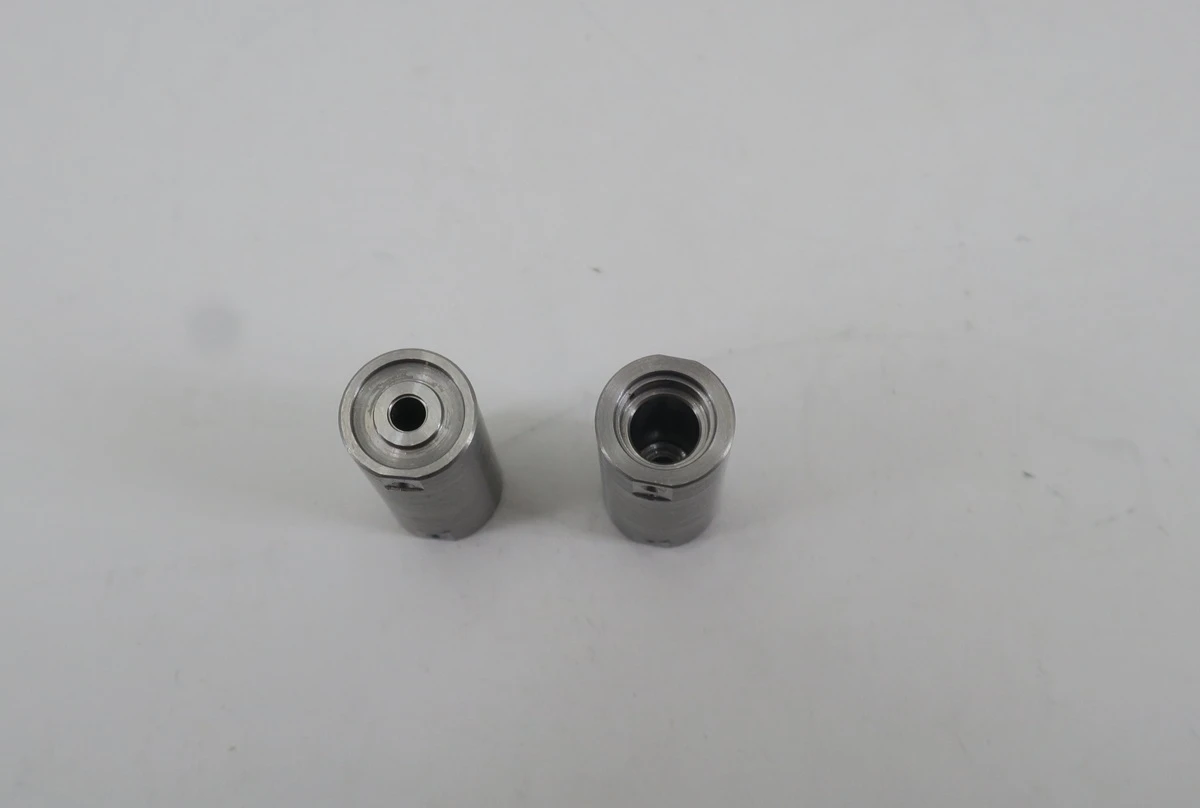
Case Example 4 — Precision 416 Collimator Tube
Drawing 88888 identifies a COLLIMATOR TUBE in AISI 416 tempered condition with a stepped internal bore, small cross holes, countersunk features on both sides and geometric controls at the 0.01–0.02 mm level. The drawing also uses the 1.6 µm / 63 µin roughness notation. This geometry emphasizes concentricity, internal feature control, bore finish, burr removal at intersecting holes and reliable inspection of the finished part.
How Rollyu Precision Machines 416 Stainless Steel Parts
Engineering Review Before Quotation
Before production, the engineering review should establish material designation, delivery condition, required hardness, heat-treatment sequence, critical tolerances, GD&T, thread specifications, surface finish, burr-sensitive features, inspection requirements and production quantity. This reduces the risk of quoting a part as if all features were machined in the annealed condition when the drawing actually requires final sizing after hardening.
- AISI 416 / UNS S41600 / 1.4005 requirement
- Raw material condition and certificate requirements
- Required hardness or temper condition
- Heat-treatment sequence and post-heat-treatment machining allowance
- Critical tolerances and GD&T
- Thread class, fine-thread requirements and gauges
- Surface finish / Ra requirements
- Burr-sensitive cross holes, slots and thread entries
- First Article / inspection report requirements
- Prototype quantity and repeat-production forecast
Precision CNC Milling and Turning
Depending on geometry, Rollyu can combine CNC milling, CNC turning, multi-axis machining, drilling, tapping, boring, grinding and EDM where required. This is useful when a project includes both prismatic and turned 416 components, or when a single complex part combines milled datum faces with precision bored or threaded features.
Heat Treatment and Post-Heat-Treatment Finishing
When hardened 416 is required, the process plan should identify which surfaces can be finished before heat treatment and which must be sized afterward. Fits, precision holes, sliding surfaces, contact surfaces, threads and thin flexible features deserve special attention. A practical drawing note should make it clear whether the stated dimension applies before or after heat treatment.
Deburring and Cleaning
For precision assemblies, Rollyu controls sharp edges, cross-hole burrs, thread burrs, slot edges, internal chips and residual contamination. Parts can be cleaned and deburred according to drawing requirements before inspection and packing. For small optical, medical and scientific mechanisms, this step can be as important as the nominal dimensional tolerance because a microscopic burr can alter motion, preload or seating.
Inspection and Quality Control
Inspection should be matched to the functional feature, not simply performed with one universal instrument. CMM is appropriate for datums, feature location and complex geometry; pin and thread gauges are efficient for functional holes and threads; micrometers and bore gauges are useful for size; optical inspection supports edge and small-feature review; surface roughness measurement verifies Ra where specified; and hardness testing confirms the heat-treatment result.
- CMM / coordinate inspection for datum-related geometry
- Optical inspection for small edges, slots and visual burr review
- Micrometers and bore measurement for critical size
- Pin gauges for hole acceptance
- Thread gauges for internal and external threads
- Surface roughness inspection when Ra is specified
- Hardness testing for tempered / hardened 416
- Material certificate and traceability review when required
Design-for-Manufacturing Guidance for 416 Parts
Good component design lets an engineer capture the machining advantage of 416 without creating unnecessary cost. The material can machine quickly, but poor access, excessively deep narrow pockets, unsupported thin sections or over-specified surface finish can erase that advantage.
- Apply tight tolerances only to surfaces that control fit, motion, sealing, alignment or load transfer.
- Use clear datums and relate hole-location GD&T to functional assembly references.
- Provide reasonable internal corner radii rather than forcing unnecessarily small tools into deep pockets.
- Give internal threads adequate runout and tool-clearance space where geometry permits.
- Review intersecting holes and slots for burr-removal access.
- Avoid extremely thin unsupported walls unless the mechanical function requires them.
- For heat-treated components, define final-condition dimensions and leave finishing allowance where needed.
- For sliding or optical-mechanical interfaces, specify surface roughness only where it affects function.
- Identify cosmetic surfaces separately from functional machined surfaces so unnecessary polishing is avoided.
How to Reduce Cost When Sourcing 416 Stainless Steel CNC Parts
The lowest raw-material price does not necessarily produce the lowest finished-part cost. For 416 components, total cost is influenced by material condition, machining time, tooling, heat treatment, tolerance, surface finish, inspection, quantity and the number of setups. The economic advantage of 416 usually comes from reducing machine hours and tool consumption, so sourcing decisions should compare the finished, inspected component cost rather than alloy price alone.
- Apply tight tolerances only to functional dimensions.
- Clearly identify datum structures and critical-to-function features.
- Define which dimensions apply after heat treatment.
- Avoid unnecessarily deep, narrow pockets or inaccessible features.
- Use realistic surface-finish requirements.
- Define burr and edge requirements explicitly.
- Specify hardness only where functionally required.
- Consolidate similar components or family quantities when practical.
- Provide annual volume as well as prototype or first-order quantity.
- Ask the supplier to identify high-cost tolerances during DFM rather than after production starts.
What Information Should Be Included in a 416 Stainless Steel RFQ?
A complete RFQ reduces ambiguity and helps suppliers quote the same requirement. For 416 parts, include not only the nominal grade but also the condition and final hardness because those decisions can materially change tooling, process sequence and inspection.
3D CAD file — STEP / STP
2D drawing — PDF
Material — AISI 416 / UNS S41600 / EN 1.4005 as applicable
Material condition / delivery condition
Required hardness or temper
Heat-treatment requirement
Critical dimensions and GD&T
Surface finish / Ra
Deburring and edge condition
Passivation or other finishing requirement
Quantity
Prototype quantity and production forecast
Inspection report / First Article requirement
Material certificate / traceability requirement
Packaging / cleanliness requirement where relevant
When Should You Not Use 416 Stainless Steel?
416 is not a universal replacement for 304, 316 or other stainless steels. A professional material recommendation should state the boundary conditions clearly. 416 may not be the best choice when continuous saltwater exposure is expected, chloride corrosion is critical, strong acids are present, extensive welding is required, very high impact toughness is required, or maximum general corrosion resistance is more important than machining productivity.
In these cases, 304, 316/316L, 17-4PH, 440C or another application-specific stainless steel should be reviewed. The correct choice depends on environment, load, wear, joining method, heat treatment, magnetic behavior, cleaning regime and total manufacturing cost.
Why Source 416 Stainless Steel CNC Machined Parts from Rollyu Precision?
Rollyu Precision supports custom 416 stainless steel components from prototype development through repeat production. Our experience includes tempered 416 components for dental equipment, medical mechanisms, photonics, quantum instrumentation, robotic laser projection and optomechanical systems — not only conventional shafts and fasteners.
Manufacturing support can include CNC milling, turning, multi-axis machining, EDM, grinding, deburring, cleaning, coordinated heat treatment and dimensional inspection. For projects that contain a wider BOM, Rollyu can also support stainless steel, aluminum, titanium, brass and engineering-plastic components through one project-management interface.
| Precision Machining Complex holes, slots, threads, pockets, thin features and precision interfaces. |
Heat-Treatment Planning Machining sequence planned around final hardness and dimensional requirements. |
| Quality Control CMM, gauges, surface-finish inspection and hardness verification as specified. |
Prototype to Production Engineering samples, low-volume builds and repeat-production support. |
| Medical Quality System ISO 13485:2016 quality-management positioning for medical-equipment machining projects. |
Engineering Communication DFM review focused on drawings, critical features, inspection expectations and manufacturability risk. |
FAQ — 416 Stainless Steel CNC Machining
Is 416 stainless steel easy to machine?
Yes. 416 is one of the most machinable stainless-steel grades. Its sulfur addition improves chip breaking and reduces cutting resistance, making it especially suitable for CNC turning, drilling, threading and repetitive machining operations.
What is 416 stainless steel used for?
416 is commonly used for precision shafts, pins, bushings, fasteners, valve components, couplings, jaws, holders, spacers and other highly machined mechanical components. It can also be used for selected medical-equipment, photonics, quantum-instrument and optomechanical parts when the service environment is compatible.
Is 416 stainless steel magnetic?
Yes. 416 is a martensitic stainless steel and is magnetic. This should be considered for sensors, magnetic instrumentation and assemblies that are sensitive to magnetic materials.
Can 416 stainless steel be hardened?
Yes. 416 can be hardened and tempered to increase strength and wear resistance. For tight-tolerance components, machining allowance and final finishing should be planned around the heat-treatment process.
What is 1.4005 stainless steel?
1.4005, also known as X12CrS13, is the European designation corresponding to AISI 416 / UNS S41600 free-machining martensitic stainless steel.
What is the difference between 416 and 304 stainless steel?
416 provides much better machinability and can be hardened by heat treatment, while 304 provides better general corrosion resistance and weldability. Choose 416 for machining-intensive components in controlled environments and 304 where corrosion resistance or welding is the higher priority.
What is the difference between 416 and 316 stainless steel?
416 is easier and often less costly to machine. 316/316L provides substantially better corrosion resistance, particularly in chloride-containing environments. For marine, chemical, high-purity washdown or strongly corrosive applications, 316/316L is generally the safer starting point.
Can 416 stainless steel be welded?
416 has poor weldability compared with austenitic stainless steels because of its sulfur content and martensitic structure. If welding is a major part of the design, another stainless grade should usually be evaluated.
Can 416 stainless steel be passivated?
Passivation may be specified to remove free-iron contamination from machining, but it does not change the fundamental corrosion-resistance limitations of 416. The service environment must still be evaluated.
Can Rollyu machine hardened 416 stainless steel?
Yes, subject to part-specific engineering review. The process should be planned around specified hardness, geometry and tolerances. Rough machining may be completed before heat treatment, followed by precision finishing, grinding or other final operations where required.
What tolerances can be achieved on 416 stainless steel CNC parts?
Achievable tolerance depends on part size, geometry, feature type, material condition, heat treatment, setup strategy and inspection method. Critical dimensions should be identified on the drawing so the manufacturing and inspection process can be designed accordingly. It is better to quote the actual drawing than to apply one blanket tolerance claim to every 416 part.
How should thin 416 jaws or flexure-like parts be machined?
Use low-stress workholding, balanced material removal, staged roughing and finishing, controlled clamping force, and verification after the part is unclamped. The goal is to prevent the fixture from masking distortion during inspection.
What should I send for a 416 stainless steel machining quote?
Send your 3D CAD file, 2D drawing, material specification, material condition, hardness or heat-treatment requirement, surface finish, quantity, GD&T, inspection requirements and any traceability or cleaning requirements.
When should I choose a different stainless steel?
Choose another grade when the application requires significantly better chloride resistance, extensive welding, higher corrosion resistance, different magnetic behavior, or much higher hardness / wear resistance than 416 can provide for the required service environment.
Request a Quote for 416 Stainless Steel CNC Machined Parts
| Need custom 416 stainless steel CNC machined parts? Send Rollyu Precision your 3D CAD model and 2D drawing for an engineering review. Whether your project requires a precision jaw, holder, coupling, spacer, shaft, threaded component, optomechanical part or heat-treated 416 component, our engineering team can review material condition, machining sequence, tolerances, heat treatment and inspection requirements before quotation. |
REQUEST A 416 STAINLESS STEEL CNC QUOTE
| Send STEP/STP + PDF Drawings for Engineering Review |
Website: www.rollyu.com