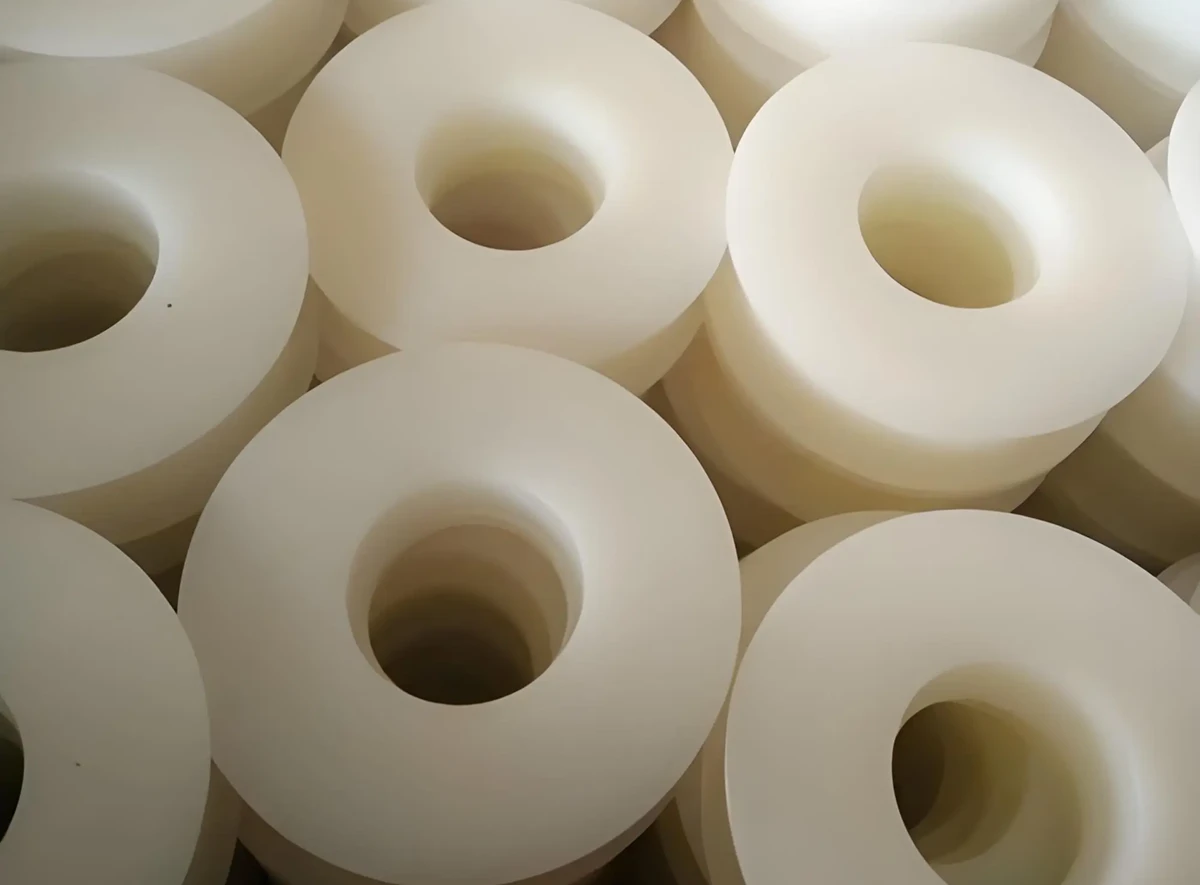
UHMW-PE can be CNC milled, turned, drilled and routed successfully, but it does not behave like aluminum, steel or even a stiffer engineering plastic such as acetal. The main machining risks are elastic deflection, heat-related dimensional change, long stringy chips, burr or “fuzz” formation and post-machining movement. A reliable process therefore depends on sharp cutting edges, adequate chip load, open flute geometry, effective chip evacuation, balanced workholding and inspection after the part has returned to a stable temperature.
For a buyer searching for machining UHMW, the real question is not simply whether the material can be cut. It is whether the selected UHMW grade, stock form and part geometry can be machined to the functional dimensions the assembly actually needs. That is especially important for wear strips, conveyor guides, bushings, automation components, ESD parts and large machined plates.
What Is UHMW-PE?
UHMW stands for ultra-high molecular weight polyethylene, commonly written as UHMW-PE or UHMWPE. It belongs to the polyethylene family but uses extremely long molecular chains that give the material a distinctive combination of abrasion resistance, impact toughness, low friction and chemical resistance. Those properties are why UHMW is widely selected for sliding and wear applications where metal-to-part friction, noise or repeated impact would shorten the life of many conventional plastics.
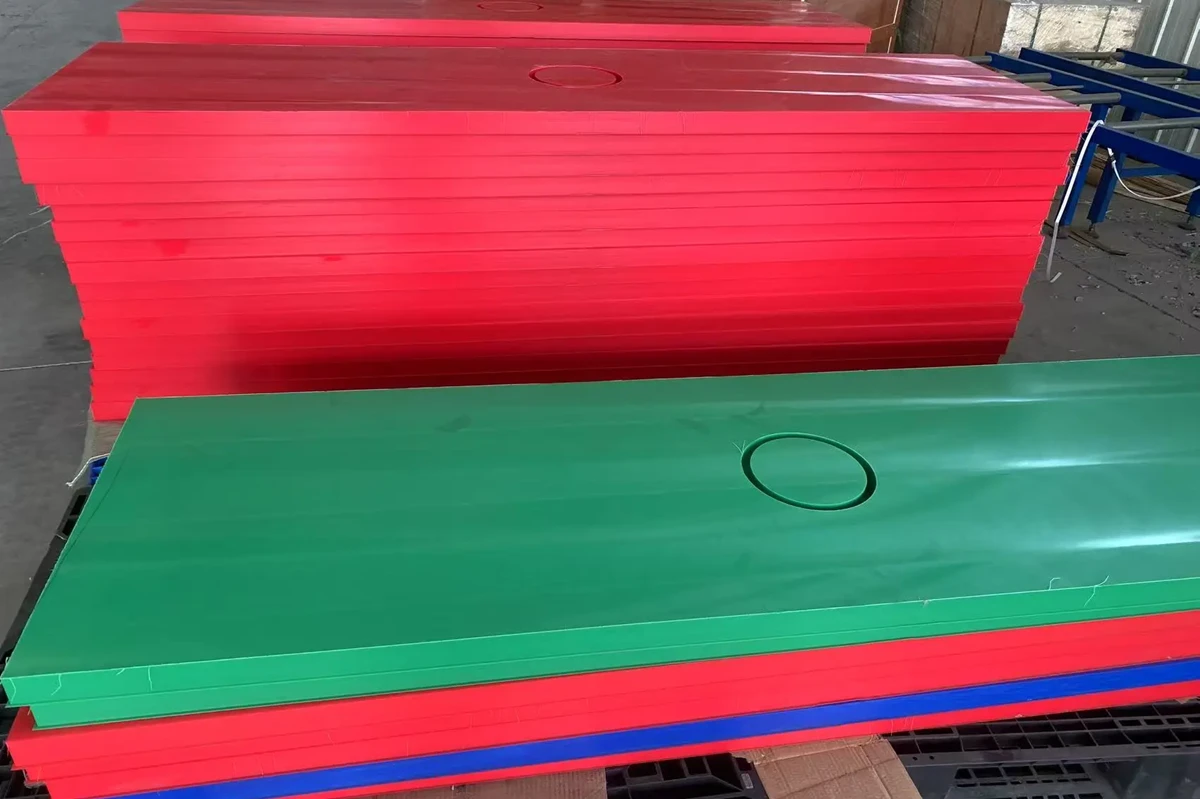
Standard natural UHMW is typically white, while black, green, red, blue and other colors can be supplied depending on grade and manufacturer. Color alone does not identify the exact resin formulation. ESD, conductive, UV-stabilized, food-contact, glass-filled, oil-filled and specialty high-temperature grades may look similar but can have very different electrical, regulatory and machining requirements.
Why Is UHMW Challenging to Machine?
Elastic “Push-Away” and Springback
UHMW is relatively soft and elastic. Under cutting or clamping pressure, the material can deflect away from the tool and then recover after the cutter passes. This can create inconsistent diameters, local high spots and apparent dimension changes after a part is released from the fixture. The effect is most noticeable on thin sections, unsupported walls, long strips and bores close to an edge.
Heat, Thermal Expansion and Smearing
UHMW is sensitive to frictional heat. A dull edge, excessive rubbing, poor chip evacuation or dwell can soften the surface and create a smeared or glossy finish. The dimensional problem is just as important as the cosmetic problem: a part measured while warm can change as it returns to room temperature. For critical dimensions, machining and inspection conditions should be defined rather than assuming the value seen immediately at the machine is the final value.
Long, Stringy Chips
Instead of producing short brittle chips, UHMW often generates continuous ribbons. Those chips can wrap around drills, end mills, the spindle or the workpiece. Re-cutting them increases heat and can damage the finish. Large chip gullets, compressed air or another validated evacuation method are therefore central to UHMW CNC machining.
Burrs and Edge Fuzzing
UHMW can stretch before it shears. If the tool is dull or the cutting geometry is not suitable for plastics, the edge may look “hairy” rather than cleanly cut. The best fix is usually at the cutting stage: improve sharpness, chip load, support and tool geometry. Aggressive sanding is often counterproductive because friction can smear the surface.
Recommended Cutting Tools for Machining UHMW
Tool sharpness matters more than simply choosing the hardest tool material. Fresh HSS can provide a very sharp edge for manual or short-run work, while polished uncoated carbide is often preferred for CNC production because it holds an edge longer. The cutter should slice the polymer with minimal rubbing.
- Single-flute or O-flute cutters: useful for routing, deep slots and operations where maximum chip clearance is the priority.
- Two-flute carbide end mills: a practical choice for general CNC milling when the flute space remains large enough to evacuate UHMW ribbons.
- Three- and four-flute tools: use cautiously in deep slots or pockets because reduced chip space can promote chip packing and heat.
- Drills: use sharp, high-chip-clearance geometry intended for plastics or other soft, ductile materials; deep holes require frequent chip clearing.
- Turning tools: use a keen cutting edge, positive rake and enough clearance to avoid rubbing against the material after elastic recovery.
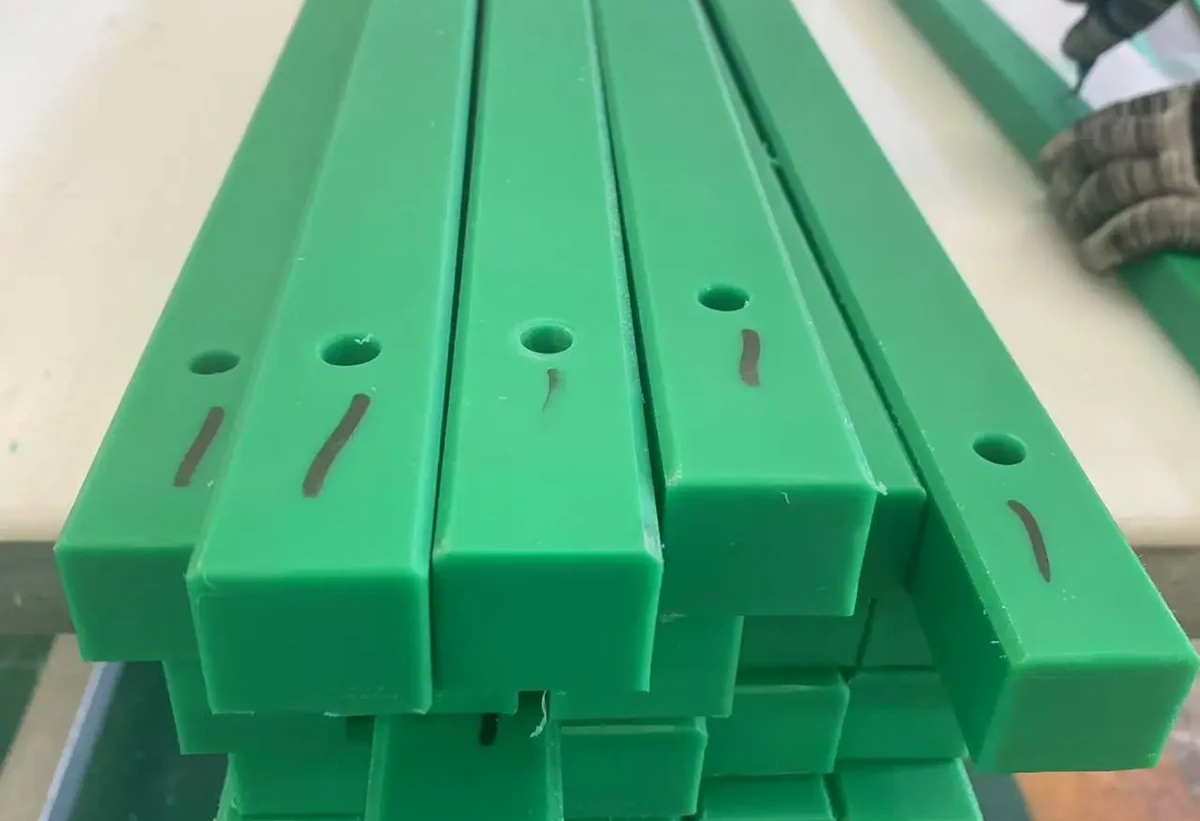
UHMW Speeds and Feeds: Use Starting Windows, Not Universal Numbers
Published UHMW machining data varies because tool diameter, machine rigidity, stock form, grade, coolant strategy and feature geometry strongly affect the result. The supplied machining guide includes the reference ranges below. They should be treated as starting windows for process development—not guaranteed production settings.
| Operation | Typical Tool Direction | Reference Surface Speed | Feed / Chip-Load Direction | Primary Risk |
| Milling | Sharp single- or two-flute carbide / O-flute where appropriate | Approx. 600–900 SFM in the supplied guide | Maintain enough chip load to cut rather than rub; supplied examples include 0.005–0.015 in/tooth for larger cutters | Heat, chip re-cutting, fuzzing |
| Turning | Sharp HSS or carbide with positive rake | Approx. 400–700 SFM in the supplied guide | Positive feed; avoid very light rubbing passes | Springback, heat, diameter drift |
| Drilling | Sharp plastic / high-chip-clearance drill | Approx. 100–200 SFM in the supplied guide | Peck as needed and fully evacuate stringy chips | Chip wrapping, hole distortion, heat |
| Routing / Sheet Cutting | O-flute or open-flute carbide | Set RPM from tool diameter and validated chip load | High enough feed to produce clean chips rather than dust | Re-welding chips, edge smear |
A useful rule is to stop thinking of “high RPM” or “low RPM” in isolation. The real failure mode is rubbing: the spindle is rotating, but the cutter is not taking a clean chip. If the part becomes hot, the surface turns unusually glossy, or chips become wispy and re-weld to the workpiece, the combination of speed, feed, edge condition and chip evacuation needs adjustment.
Milling UHMW: Workholding and Toolpath Strategy
Use Broad, Even Clamping
UHMW can conform to an uneven fixture. Narrow clamps or excessive jaw pressure may machine the part while it is distorted, only for the geometry to spring back after release. Wide soft jaws, flat support plates, vacuum fixtures or distributed clamping are often better for large sheets and strips. The fixture should resist movement without crushing the material.
Balance Material Removal on Large Parts
Large extruded or compression-molded stock can contain residual stress. Removing a large amount from one face while leaving the opposite face untouched may allow the blank to bow. For a plate with tight flatness or parallelism requirements, consider balanced roughing, resting the part, then finishing the critical faces after it has stabilized.
Climb Milling Is Often Preferred on Rigid CNC Machines
On a rigid CNC with controlled backlash, climb milling often gives UHMW a cleaner shearing action and reduces rubbing at entry. It should not be treated as an unconditional rule for every manual machine: if machine backlash makes climb milling unsafe or unstable, the machining method must be selected accordingly.
Avoid “Whisker” Finishing Passes
A finishing cut that is too light may compress and rub the polymer instead of shearing it. Leave enough material for a continuous final cut, use a sharp tool and keep the cutter moving. For pockets and deep slots, ramp or helical entry is generally preferable to forcing a tool into the material while chips have nowhere to escape.
Drilling, Boring and Threading UHMW
Drilling UHMW is less about raw cutting force and more about chip control and elastic recovery. In deep holes, stringy chips can pack the flutes and raise the temperature. Use an appropriate peck cycle or full retraction when necessary, clear chips before they wrap around the drill, and allow the feature to return to a stable temperature before final acceptance.
For locating bores, press fits or bearing interfaces, drilling alone may not be the most predictable finishing method. A drilled feature can be left for boring or reaming after the surrounding material has been rough-machined. The final method depends on the tolerance, diameter, wall thickness and how the part will be loaded in service.
Threads can be cut in UHMW for light-duty applications, but the material can creep under clamp load. Coarse threads usually provide more shear area than fine threads. If the joint will be assembled repeatedly or must carry meaningful load, a mechanically retained threaded insert or through-bolt design is normally more robust. Insert type must be validated for the actual UHMW grade—do not assume a generic heat-set insert process is appropriate.
Moisture, Temperature and Dimensional Stability
Unlike nylon, UHMW has very low moisture absorption, so humidity is usually not the dominant source of dimensional movement. Temperature, elastic recovery and creep are more important. This distinction matters for both SEO accuracy and engineering decisions: a buyer searching “UHMW moisture absorption” should not leave with the impression that UHMW behaves like a hygroscopic polyamide.
For tight dimensions, allow the workpiece to reach a stable shop or inspection temperature before final measurement. If the part is large, thin, heavily pocketed or machined asymmetrically, consider a rough-machine / stabilize / finish-machine sequence. The drawing should identify the functional dimensions instead of applying unnecessarily tight tolerances to every feature.
Does UHMW Need Post-Curing or Annealing?
Conventional UHMW machining does not require “post-curing” in the way some thermoset or high-performance polymer systems do. UHMW is a thermoplastic. For difficult flatness or tight-tolerance jobs, some suppliers and machine shops may use stress-relief or thermal conditioning procedures, but the cycle should come from the stock-shape manufacturer or a validated internal process. Publishing one universal annealing temperature/time recipe for all UHMW grades is a technical risk and should be avoided.
UHMW vs HDPE: Which Is Better for CNC Machined Parts?
The keyword “UHMW vs HDPE” has substantially more search demand than most machining-specific terms in the supplied keyword set, so the comparison deserves its own decision-focused section. Both materials are polyethylene, but they are selected for different priorities.
| Factor | UHMW-PE | HDPE | Engineering Implication |
| Wear / sliding performance | Excellent; frequently selected for wear strips, chain guides and sliding surfaces | Good, but typically below UHMW for severe abrasion/sliding duty | Choose UHMW when service life and low friction dominate |
| Impact toughness | Very high | High | UHMW is favored for repeated impact and abuse |
| Machinability | Good with the correct technique, but elastic and prone to stringy chips/smear | Generally easier and more predictable to machine | HDPE is often easier when dimensional precision and cycle simplicity matter more than extreme wear |
| Dimensional stability | More challenging because of elasticity, thermal movement and creep | Still temperature-sensitive, but typically easier to control | Avoid metal-like tolerance assumptions for either material |
| Welding / fabrication | Possible, but process is grade- and joint-dependent | Commonly welded and fabricated | HDPE may be preferable for large fabricated tanks/structures |
| Typical CNC use | Wear strips, guide rails, bushings, rollers, pads, impact components | Panels, guards, tanks, general fabricated components | Use the service condition—not only material price—to select the polymer |
ESD, Antistatic and Conductive UHMW: Verification Matters
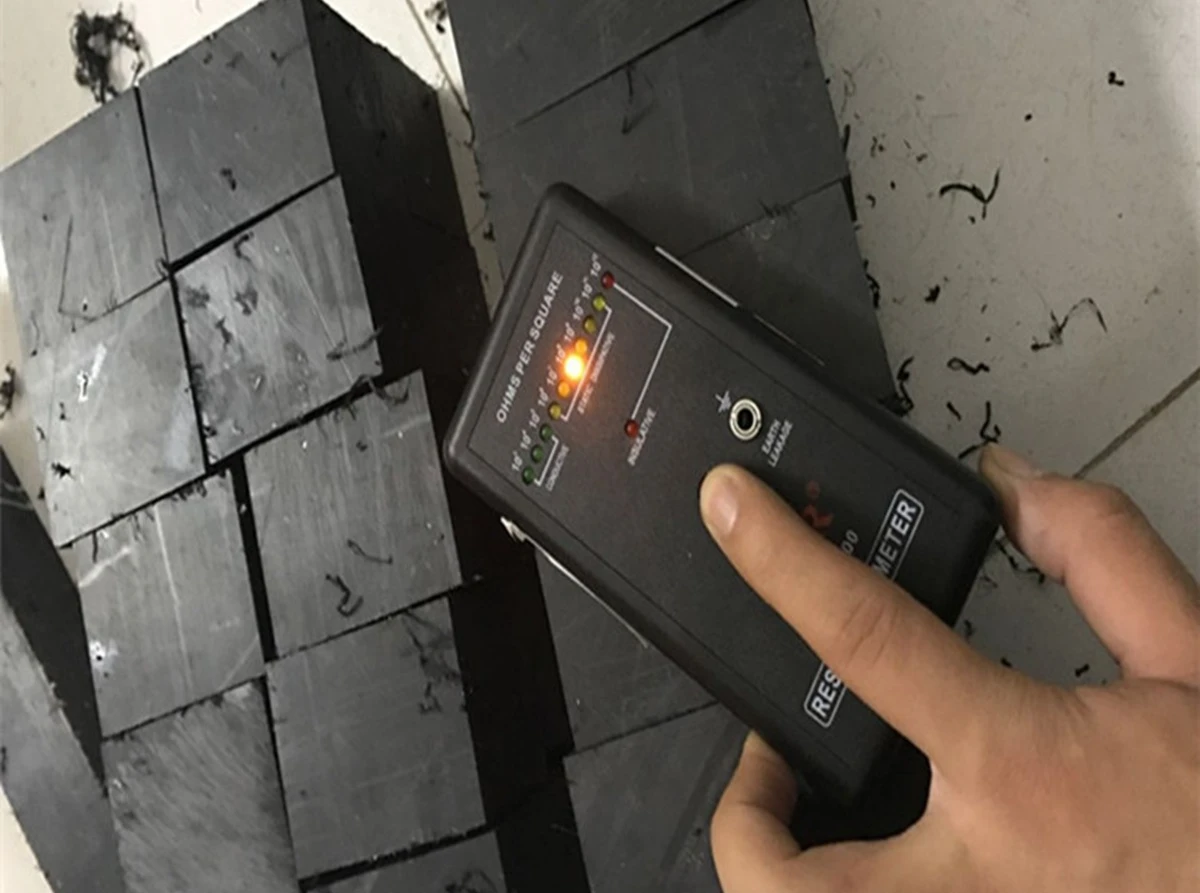
Standard UHMW is electrically insulating. Specialty antistatic, electrostatic-dissipative (ESD) and conductive UHMW grades use additives or fillers to change the electrical behavior. These grades are useful around sensitive electronics, robotic handling, packaging and conveyor systems where charge buildup can attract dust or interfere with equipment.
If the drawing specifies an electrical resistance requirement, the material designation and acceptance range should be defined before machining. Surface resistivity testing can then be used as part of incoming or final verification. A black part is not automatically “ESD UHMW”: color is only visual evidence, while the material certificate and resistance test define the requirement.
UHMW Applications: Where Machined Parts Make Sense
UHMW is strongest when the part is expected to slide, absorb impact, resist abrasion or operate without corrosion. Common CNC-machined components include wear strips, chain guides, rollers, bushings, pads, guide rails, liners, wheels, spacers and custom automation fixtures. The keyword data supports this application cluster: UHMW conveyor components, chain guides and wear strips all show clear commercial search intent.
Automation and handling systems are particularly well suited because low friction can reduce sliding resistance while UHMW absorbs noise and repeated contact. In food or pharmaceutical equipment, UHMW can also be attractive because food-contact-compliant grades are available. Compliance is grade-specific, however; do not describe every UHMW sheet or colored recycled grade as “FDA compliant” without the supplier documentation required for the project.
Quality Control for CNC Machined UHMW Parts
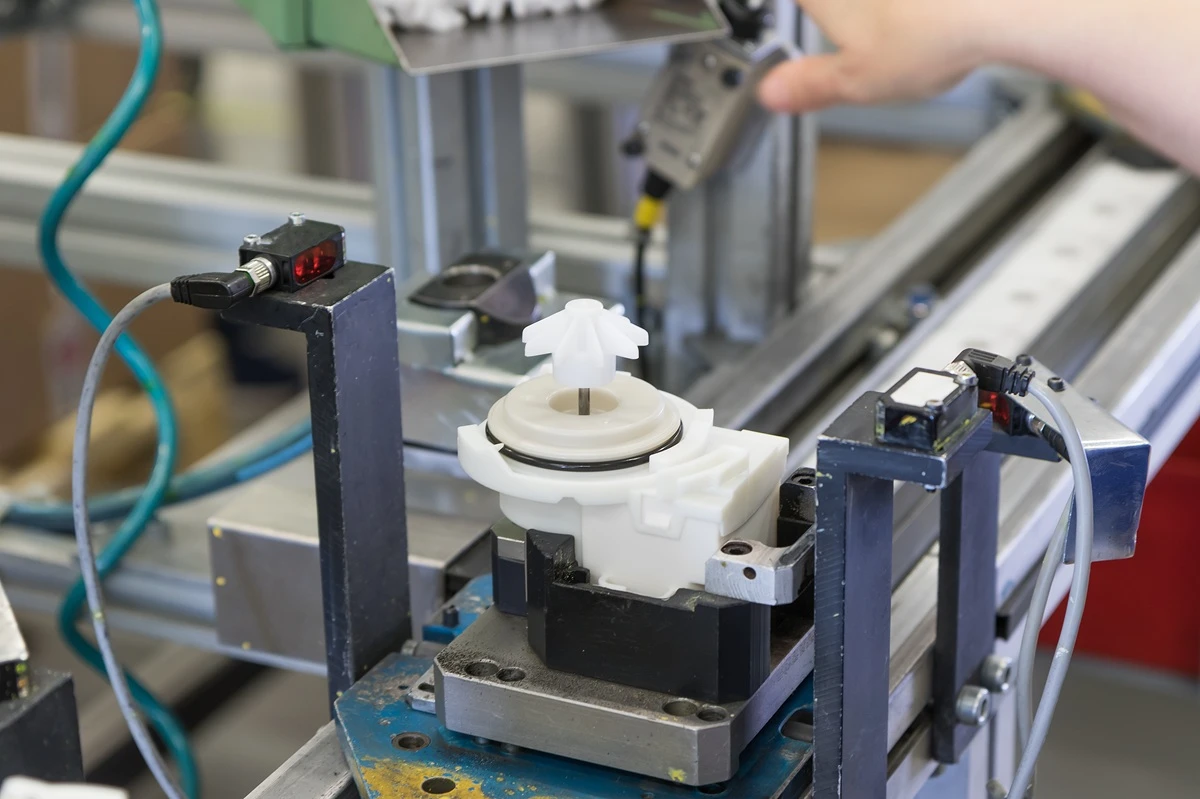
Inspection should reflect the way UHMW actually behaves. Measuring every feature immediately after cutting can create false confidence if the component is still warm or held under fixture stress. A practical quality plan can include:
- Material certificate and grade verification, especially for ESD, food-contact, UV-stabilized or filled UHMW.
- Critical-dimension inspection after the part has stabilized at an agreed temperature.
- Flatness and parallelism checks after releasing the part from the fixture.
- Bore and hole verification for locating features, shafts, pins and bearing interfaces.
- Thread or insert functional inspection when the joint carries load or will be repeatedly assembled.
- Visual inspection for melted edges, re-welded chips, fuzzing, gouges and excessive clamp marks.
- Surface-resistivity verification when ESD or conductive performance is a drawing requirement.
DFM Checklist Before Sending a UHMW Machining RFQ
A better RFQ gives the machine shop enough information to separate functional dimensions from dimensions that can safely use normal polymer tolerances. Before requesting a quote, provide:
- Exact UHMW grade, color and approved stock-shape supplier if controlled.
- 2D drawing plus STEP or other 3D model.
- Critical dimensions, datums and GD&T rather than blanket tight tolerances.
- Operating temperature range and whether the component slides, impacts, carries static load or sees chemicals.
- Food-contact, ESD, UV, flame or regulatory requirements, including the certificate required.
- Fit-critical holes, press fits, bearings, pins and mating parts.
- Thread load and expected number of assembly cycles.
- Surface finish and edge requirements, especially where material contacts product or a moving belt.
- Prototype and production quantities.
- Inspection report, FAI, CMM or functional gauge requirements.
Why Rollyu Precision for Custom UHMW Machined Parts?
For UHMW, a useful machining supplier should do more than select a CNC program from a metal part and replace the material name. The process review should consider stock condition, fixturing pressure, tool sharpness, chip evacuation, temperature, feature sequence and the inspection condition of the final part.
Rollyu Precision can review custom UHMW components from 2D drawings and 3D models for CNC milling, turning, drilling, routing and related assembly requirements. The most valuable starting point is a drawing-specific DFM review: identify the dimensions that matter in service, then choose a machining and inspection plan that is realistic for the polymer.
FAQ: Machining UHMW
Can UHMW be CNC machined?
Yes. UHMW can be milled, turned, drilled and routed on conventional CNC equipment. The main process controls are sharp tooling, chip evacuation, heat control, stable workholding and realistic tolerances.
What is the best cutting tool for UHMW?
Sharp HSS or polished uncoated carbide can both work. Single-flute or O-flute cutters are useful where maximum chip clearance is needed; sharp two-flute carbide is also common for general milling. Tool geometry and chip evacuation matter as much as tool material.
What spindle speed should I use for UHMW?
There is no universal RPM because RPM depends on cutter diameter. Use an appropriate surface-speed window and enough chip load to create a clean chip rather than rubbing. The supplied guide uses roughly 600–900 SFM as a milling reference for carbide, but the actual program must be validated on the specific setup.
Why does UHMW melt or smear during machining?
Usually because the cutting edge is rubbing rather than shearing. Common causes are a dull tool, insufficient feed, dwell, trapped chips or an unsuitable flute geometry. Correct the cutting action and chip evacuation instead of trying to polish the melted surface afterward.
What tolerance can be held when machining UHMW?
There is no responsible universal number. Geometry, feature size, stock form, temperature, fixture pressure and post-machining relaxation all matter. Many UHMW parts use looser tolerances than metal or acetal; tighter dimensions should be reviewed feature by feature.
Does UHMW absorb moisture?
Very little compared with nylon. Moisture is usually not the primary source of dimensional drift in UHMW; temperature, elastic recovery and creep are more important.
Does UHMW need post-curing?
Normally no. UHMW is a thermoplastic and conventional CNC machining does not require a post-cure. A stress-relief or conditioning process may be used for selected tight-tolerance jobs, but the cycle should come from the stock supplier or a validated shop process.
UHMW vs HDPE: which is easier to machine?
HDPE is generally easier to machine and fabricate. UHMW is usually selected when superior wear resistance, sliding performance and impact toughness justify the additional machining control.
Can threads be tapped directly into UHMW?
Yes for light-duty use, especially with coarse threads. For repeated assembly or higher loads, consider a validated threaded insert or through-bolt because UHMW can creep under clamp load.
Is black UHMW always antistatic or conductive?
No. Standard black UHMW, ESD UHMW and conductive UHMW are different material grades. Confirm the material certificate and, where required, verify surface resistance against the drawing specification.
Is UHMW food safe?
Food-contact-compliant UHMW grades are available, but compliance is material- and supplier-specific. Do not assume every colored, recycled, filled or antistatic grade meets the same food-contact regulation.
What information should I send for a UHMW machining quote?
Send the 2D drawing, STEP model, exact grade, quantity, critical tolerances, operating environment, regulatory requirements and inspection needs. This allows the shop to review manufacturability before promising tolerance or lead time.
| Need Custom UHMW CNC Machined Parts? Send Rollyu Precision your STEP file + PDF drawing + exact UHMW grade + quantity. We can review wear strips, conveyor guides, bushings, rollers, automation components, ESD UHMW parts and other custom UHMW-PE components for manufacturability, material risk and inspection requirements. |