
| Quick answer: ABS (acrylonitrile butadiene styrene) is a tough, rigid, impact-resistant amorphous thermoplastic used for housings, fixtures, covers, brackets, prototypes, electronics, automotive parts, and many other manufactured components. Because ABS is a family of grades, exact heat, impact, flame, safety, and machining properties must be verified from the selected supplier grade. |
What Is ABS Plastic Material?
ABS is an amorphous thermoplastic commonly supplied as pellets for molding and as sheet, plate, rod, or block for fabrication and CNC machining. Because it is amorphous, a single universal “ABS melting point” is not the best engineering value for design or machining; ABS softens over a range, and grade-specific thermal data are more meaningful.
ABS is popular because it combines stiffness, impact toughness, low density, good appearance, electrical insulation, and manufacturability at moderate cost. It can be injection molded, extruded, thermoformed, 3D printed in suitable grades, bonded, painted, plated in selected grades, and machined from stock. The supplied technical material also highlights moisture, heat, internal stress, chemical exposure, and UV as variables that can change performance. In B2B specifications, those qualifications matter because not all ABS grades are interchangeable.
What Does ABS Stand For and What Is ABS Plastic Made Of?
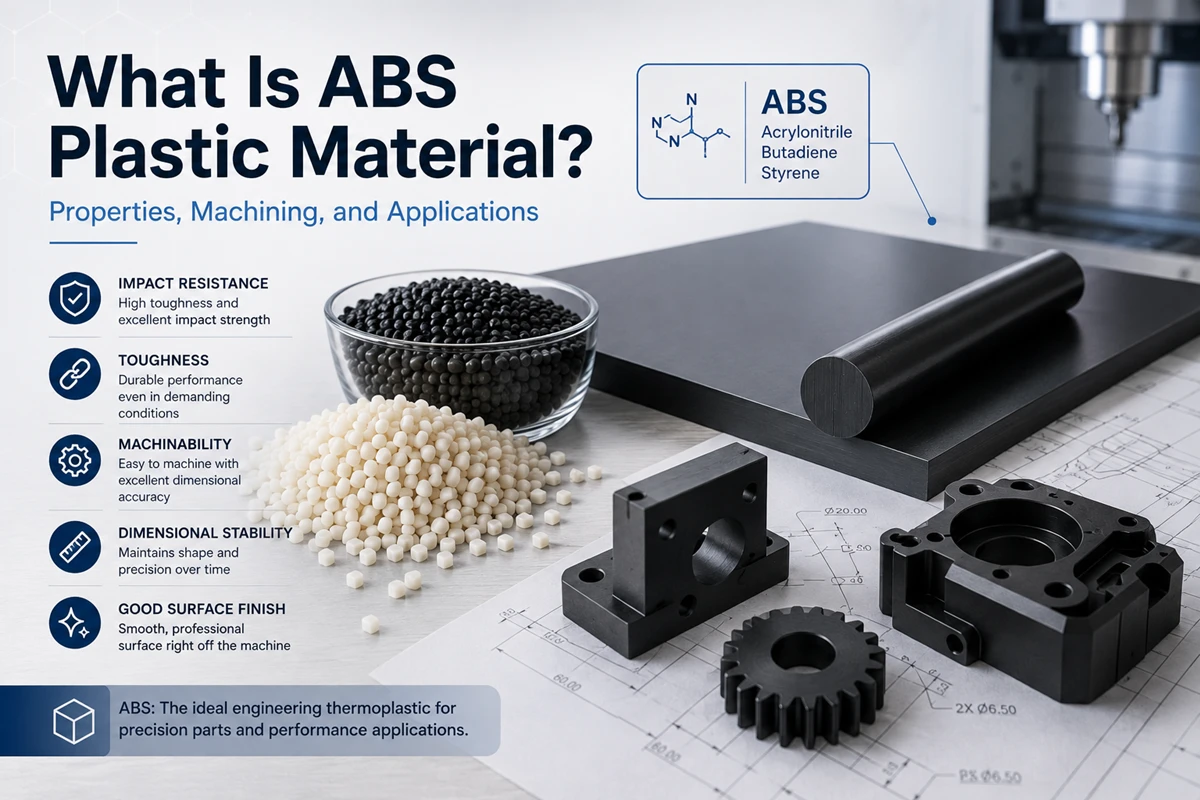
ABS stands for Acrylonitrile Butadiene Styrene. Industrial ABS is built from a styrene-acrylonitrile thermoplastic phase combined with a rubbery butadiene-containing phase. Manufacturers can change composition, molecular architecture, additives, colorants, fillers, flame-retardant packages, and processing technology to create different property profiles.
Acrylonitrile generally improves chemical resistance, surface hardness, and thermal performance. Butadiene increases toughness and impact resistance, especially at lower temperatures. Styrene contributes stiffness, processability, surface gloss, and ease of coloring. The interaction among these components is more important than any single component by itself.
This is why a high-impact ABS, a high-heat ABS, a flame-retardant ABS, an electroplating grade, and an ABS containing recycled content may behave differently even though all are sold under the same generic material name. When purchasing machined ABS parts, specify the manufacturer and grade when the application is sensitive to heat, flame behavior, chemical exposure, color, cosmetic finish, or regulatory compliance.
ABS Material Properties: What Engineers Should Know
Typical engineering values
Typical general-purpose ABS has a density around 1.03-1.08 g/cm³. Tensile strength for common unfilled grades is often in the approximate 35-50 MPa range, while modulus values are commonly around 1.8-2.6 GPa. These are broad engineering ranges, not purchasing specifications; modified grades, conditioning, temperature, test method, and processing history can change the values
| Property | Typical General-Purpose Range* | Design / Machining Relevance |
| Density | Approx. 1.03-1.08 g/cm³ | Low mass; useful for housings, fixtures, and prototypes. |
| Tensile strength | Approx. 35-50 MPa | Grade- and test-dependent; not a universal allowable stress. |
| Modulus | Approx. 1.8-2.6 GPa | Lower stiffness than metals; clamping and thin-wall deflection matter. |
| HDT / Vicat behavior | Often around 80-110°C, grade/test dependent | More useful than a generic ‘melting point’ for thermal design. |
| Thermal expansion | Much higher than metals; supplier value required | Inspection temperature and part size affect dimensional results. |
Thermal, chemical, UV, and stress limitations
ABS is valued for impact resistance, machinability, and attractive surface quality. Its limitations are equally important. Thermal expansion is much higher than that of metals, standard grades are not ideal for long-term UV exposure, and chemical resistance is selective. Ketones, certain esters, chlorinated solvents, and other aggressive chemicals may attack or stress-crack some grades, so actual service-fluid compatibility should be verified.
Internal stress can also affect precision parts. Stress may come from stock production, uneven material removal, aggressive clamping, or cutting heat. Thin walls and broad flat surfaces are more likely to move after unclamping. Balanced stock removal, staged machining, stable datums, and final finishing after rough material removal can reduce this risk.
Does ABS Plastic Have a Melting Point?
A common search query is “ABS melting point,” but the most technically useful answer is that ABS is an amorphous thermoplastic and does not have one sharp crystalline melting point that applies to every grade. Engineers should instead review values such as glass-transition behavior, Vicat softening temperature, heat-deflection temperature, and the supplier’s recommended processing range.
Commercial ABS grades often have heat-deflection and Vicat values in roughly the 80-110°C region, depending on grade and test condition, while specialized high-heat grades can differ. These values are not interchangeable with maximum continuous-use temperature, and they should not be used as direct CNC cutting-temperature limits.
For CNC machining, the practical rule is simpler: prevent the cutting zone from becoming hot enough to soften the polymer. A tool that rubs instead of cuts can smear the surface, weld chips back onto the edge, round corners, enlarge holes, create burrs, and allow the finished part to change size as it returns to room temperature. Sharp tools, adequate chip evacuation, sensible chip load, intermittent passes on heat-sensitive features, and dimensional inspection at a controlled temperature are more useful than publishing one “maximum machining temperature.”
Is ABS Plastic Strong?
ABS is strong enough for many housings, instrument components, covers, knobs, brackets, test fixtures, guards, and functional prototypes, but “strong” must be tied to the load case. ABS combines moderate tensile and flexural strength with good impact toughness. It can outperform brittle commodity plastics in impact-loaded applications, but it is not a substitute for metal when high stiffness, thread strength, creep resistance, temperature capability, or structural load capacity dominates the design.
A designer should check static load, impact, cyclic loading, creep duration, temperature, chemical exposure, wall thickness, fastener loads, and safety factors. For repeated screw assembly, a metal insert or a redesigned boss may be more reliable than repeatedly loading a cut plastic thread. For a precision bearing or sliding application, POM/Delrin or another wear-focused polymer may be a better choice. Material selection should follow the function rather than the popularity of the material name.
Is ABS Plastic Safe, Toxic, Food Safe, or BPA Free?
Is ABS plastic safe or toxic?
These questions attract high search volume and carry high compliance risk, so the answer must be grade-specific.
Finished ABS articles are widely used in industrial and consumer products, but not every ABS grade is automatically “non-toxic,” “food safe,” or suitable for medical use. Additives, pigments, flame-retardant packages, recycled content, residual substances, processing history, and intended contact conditions all matter. Hazards associated with the individual monomers also should not be presented as identical to the hazard profile of a finished ABS article.
Is ABS plastic food safe?
Food contact must be evaluated against the exact resin, additives, color, food type, temperature, contact duration, and applicable regulation. The U.S. FDA food-contact inventory includes ABS-related substances but directs users to the relevant regulation and intended-use limitations. Therefore, do not publish “ABS is food safe” without documentation for the selected grade and application.
Is ABS plastic BPA free?
ABS chemistry is not based on bisphenol A in the same way conventional polycarbonate chemistry is, but buyers requiring a BPA-free declaration should still obtain a supplier statement for the exact grade, especially when color concentrates, modifiers, or recycled content are involved.
Is ABS flame retardant?
Flammability is also grade- and thickness-specific. A UL 94 rating belongs to a tested formulation under defined conditions. Never describe generic ABS as “V-0” unless the exact recognized grade and thickness support that claim.
Is ABS Plastic Recyclable or Sustainable?
ABS is a thermoplastic, so technically it can be remelted and reprocessed. In practice, recyclability depends on collection, sorting, contamination, color, additives, flame-retardant chemistry, local recycling infrastructure, and the quality requirements of the next application. A technically recyclable resin does not guarantee that a finished part will be accepted by a local recycling stream.
Recycled-content ABS can be appropriate for many non-critical products, but property variation may be greater than with tightly controlled virgin resin. For precision machined parts, ask whether the stock is virgin, recycled-content, reprocessed, or a certified compound. If dimensional stability, impact performance, color, regulatory documentation, or repeatability is important, material traceability and lot consistency should be part of the RFQ.
ABS is generally not biodegradable under normal disposal conditions. Sustainability decisions should therefore consider more than a single label: service life, part mass, scrap rate, ability to repair or reuse the component, recycled content, end-of-life pathway, and whether another material can meet the same function with lower total impact.
How Is ABS Plastic Manufactured?
ABS resin is produced industrially by combining a styrene-acrylonitrile thermoplastic matrix with a butadiene-based rubber phase. Producers may use different polymerization and grafting routes, including mass or emulsion-based processes, to tune impact behavior, gloss, flow, heat resistance, and other characteristics. The finished resin is typically pelletized for injection molding or extrusion.
Extrusion can then produce ABS sheet, plate, rod, or profile stock. Injection molding is efficient for high-volume parts after tooling is justified. CNC machining starts from solid stock and removes material to create the geometry, which avoids mold tooling and makes engineering changes faster. This is why machining is attractive for prototypes, bridge production, fixtures, test components, and low-volume precision parts.
How to Cut and CNC Machine ABS Plastic
ABS is generally machinable, but a stable process depends on heat control, chip evacuation, workholding, and stress management.
Tool geometry and cutting strategy
Use sharp cutting edges. Polished carbide tools with positive geometry are commonly preferred for engineering plastics because they cut cleanly instead of plowing the material. Fewer flutes can improve chip space. Exact tooling depends on the operation and geometry.
Avoid rubbing. Excessive spindle speed combined with very low feed can generate heat, soften the polymer, weld chips to the edge, smear surfaces, and produce burrs. Speeds and feeds should therefore be developed from tool diameter, grade, machine rigidity, wall thickness, depth of cut, and finish requirement rather than copied from a universal table.
Chip evacuation and cooling
Remove chips efficiently. Clean air blast or extraction can keep chips away from the cutter. Liquid coolant is not automatically necessary; if coolant or cleaner is used, verify compatibility with the exact ABS grade because some fluids may cause cosmetic damage or stress cracking.
Workholding, finishing, and deburring
Clamp gently and support the part. Soft jaws, broad contact areas, vacuum fixtures, sacrificial support, and staged workholding can reduce deformation. Thin walls or broad plates may benefit from leaving support material during roughing and finishing critical surfaces later.
For tight flatness, hole position, or parallelism, remove material in balanced stages, allow the part to stabilize, and finish from controlled datums. Deep drilled holes need chip evacuation to prevent heat buildup. Deburr mechanically and conservatively; aggressive solvent smoothing can change dimensions or create stress-cracking risk.
Inspection after thermal stabilization
Finally, inspect after thermal stabilization. ABS expands much more with temperature than metal, so measuring a warm part immediately after machining can give a misleading result.
How Tight Can CNC Machined ABS Tolerances Be?
There is no responsible single tolerance that applies to every ABS feature. Achievable tolerance depends on stock form and grade, part size, wall thickness, geometry, material removal ratio, temperature, fixturing, measurement method, and whether the drawing controls free-state or restrained geometry.
A small, well-supported hole can hold a different tolerance from a 400 mm flat plate or a thin-wall housing. This is why procurement drawings should identify only functionally critical dimensions as tight tolerances and leave non-critical features at a realistic general tolerance. Over-tolerancing plastic increases setup time, inspection cost, scrap risk, and lead time without improving function.
For RFQs, the best practice is to provide the 2D drawing with GD&T, the 3D CAD model, the exact ABS grade or approved equivalent, inspection temperature if critical, mating-part information where relevant, and the functional reason for the most important dimensions. A capable machining supplier can then propose a process and measurement plan instead of making a blanket tolerance promise.
ABS Plastic vs Other Engineering Plastics
ABS is often compared with polycarbonate, PVC, POM/Delrin, nylon, ASA, and PC/ABS.
Polycarbonate generally offers higher impact and heat capability, while ABS is often more economical and easier to machine. POM/Delrin is frequently preferred for low-friction and wear components, while ABS offers good appearance and impact behavior. Nylon can provide strong wear, fatigue, and toughness performance, but ABS usually absorbs less moisture and can be easier to control dimensionally.
For long-term outdoor exposure, ASA is often preferred over standard ABS because of improved UV/weather resistance. PC/ABS provides a different balance of heat resistance, impact performance, and processing. PVC may be attractive for certain chemical, piping, or construction uses, but its design profile differs from ABS.
Choose by service temperature, impact, stiffness, creep, wear, chemical exposure, UV, flammability, electrical needs, appearance, regulatory status, machining, and cost—not by one property alone.
| Material | Why Choose It Over ABS | Why ABS May Be Better | Decision Driver |
| Polycarbonate (PC) | Higher heat; very high impact; transparent grades | Often lower cost; easier machining/finishing | Impact + heat + transparency |
| POM / Delrin | Low friction; wear; mechanism stability | Appearance, bonding/painting, general housings | Sliding/wear vs housing |
| Nylon | Wear, fatigue, toughness | Usually lower moisture uptake | Wear + moisture |
| ASA | Better outdoor UV/weatherability | Cost; common indoor applications | Outdoor exposure |
| PC/ABS | Different heat/impact balance | Simpler ABS may be sufficient | Heat/impact target |
| PVC | Certain chemical/piping advantages | Impact/appearance in many housings | Environment + codes |
Common ABS Plastic Uses and B2B Applications
ABS is used in automotive interiors, electronic and electrical housings, instrument covers, appliance parts, protective enclosures, office equipment, fixtures, handles, knobs, brackets, bezels, and consumer products. For CNC machining, the strongest B2B use cases are low- to medium-volume parts where tooling is not yet justified or the design is still changing.
Industrial and scientific applications can include non-load-critical housings, sensor mounts, electronics covers, test fixtures, operator-interface parts, cable-management components, internal brackets, and development prototypes. Machining is useful when these parts need accurate mounting faces, pockets, bores, counterbores, inserts, or mating interfaces.
ABS should not be selected automatically for vacuum, high-temperature, aggressive-chemical, cleanroom, sterilization, food-contact, or safety-critical service. Those applications require a grade-specific review and may justify another polymer.
CNC Machining vs Injection Molding vs 3D Printing for ABS Parts
Choose CNC machining when you need functional parts from solid stock, relatively fast design changes, accurate machined interfaces, low tooling commitment, and low-to-medium quantities. It is especially useful for prototype housings, fixtures, jigs, engineering validation parts, and bridge production before a mold is released.
Choose injection molding when the design is stable, annual volume justifies the mold investment, and molded geometry such as ribs, snaps, bosses, textures, and integrated features creates a strong unit-cost advantage. Molded-part behavior can differ from machined-stock behavior because flow orientation, weld lines, shrinkage, gate location, and molded-in stress affect the final part.
Choose 3D printing when speed of iteration and complex geometry matter more than matching machined or molded stock behavior. FDM ABS can be useful for design evaluation, but layer orientation, porosity, surface finish, and printed thermal history mean it should not automatically be treated as mechanically identical to a CNC-machined ABS part.
Rollyu Precision ABS Machining Application Example
| Case claim boundary: The available project context confirms ABS use for diagnostic-device housings, sensor mounts, internal components, and test fixtures, but does not provide a releasable customer name, drawing number, quantity, numerical tolerance, or inspection result. Those values are intentionally not invented. |
Rollyu Precision’s prior ABS prototyping scope includes diagnostic-device housings, sensor mounts, internal components, and test fixtures used for design validation and functional testing. That is a credible application area for machined ABS because development teams often need physical parts before production tooling is frozen.
For this type of work, the manufacturing focus is not simply “cut the plastic to size.” The process should start with material-grade review and stock inspection, followed by a datum plan that protects the functional interfaces. Roughing removes most material without overheating the workpiece; thin walls and broad faces are supported to limit movement. Critical holes, mating surfaces, and assembly features are finished after the part has stabilized. Burrs are removed without aggressive solvent treatment, and dimensions are checked after the part returns to a controlled temperature.
The supplied source material does not include a customer name, drawing number, production quantity, numerical tolerance, or verified inspection result for a specific ABS project. Those details are therefore intentionally not invented here. If this section is later expanded into a formal customer case study, use a released drawing or project record to add the actual grade, quantity, critical tolerance, inspection method, problem encountered, corrective action, and measured outcome.
Quality Control for CNC Machined ABS Parts
Quality control should match part geometry and function. A robust plan can include incoming material verification, first-article inspection, in-process checks, final dimensional inspection, visual inspection, and traceable documentation when required.
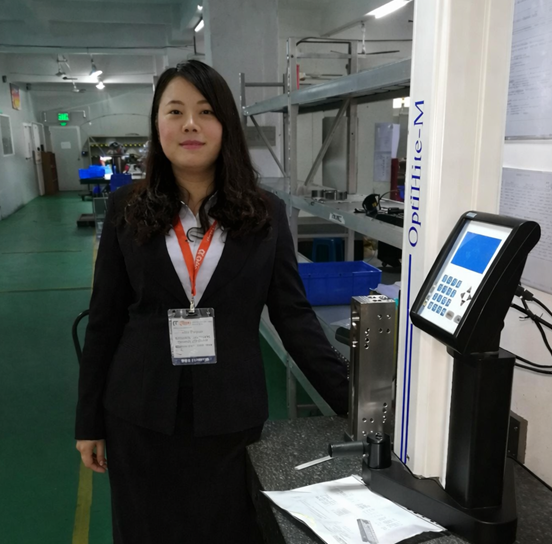
CMM inspection can work for rigid, well-supported geometry, but probing force, fixture restraint, and temperature can affect plastic measurements. Optical measurement, height gauges, calipers, bore gauges, pins, or custom fixtures may be better for some features. The measurement method should match the tolerance and functional condition.
Cosmetic inspection should cover edge quality, cutter marks, burrs, scratches, clamping deformation, and specified surfaces. For regulated or safety-related products, the supplier’s quality system does not by itself make the resin compliant; material certificates and regulatory evidence must relate to the exact material and intended use.
How to Specify ABS Parts for an RFQ
A good ABS RFQ reduces quoting assumptions and protects both buyer and supplier. Send the STEP or STP model, a controlled PDF drawing, quantity by release, target annual volume if known, exact resin grade or approved alternatives, stock form preference, color, cosmetic surfaces, critical dimensions and GD&T, thread or insert requirements, surface finishing, assembly requirements, and inspection documentation.
Also identify any non-obvious application requirements: food contact, flame rating, electrical behavior, UV exposure, cleaning chemicals, sterilization, vacuum, temperature range, repeated screw assembly, or contact with oils and solvents. If the material is not finalized, ask the supplier for manufacturability feedback, but keep final material approval with the product design authority.
This information allows a CNC supplier to evaluate whether ABS is appropriate, whether stress-relief or staged machining is useful, how to fixture the part, what inspection method is realistic, and whether another plastic such as POM, PC, ASA, nylon, PEEK, or PEI would reduce technical risk.
Conclusion
ABS is a versatile engineering thermoplastic because it balances toughness, stiffness, appearance, processability, and cost. It can be CNC machined effectively when heat, chips, clamping, internal stress, and inspection temperature are controlled.
The key purchasing lesson is to treat ABS as a family of grades. Do not rely on a universal melting point, safety claim, flame rating, or machining tolerance. Select the exact grade for the operating environment, review supplier data, and define critical requirements on the drawing.
For low-volume precision ABS parts, a drawing-led CNC machining review can identify tolerance, workholding, stock, inspection, and material risks before production.
Frequently Asked Questions About ABS Plastic
What is ABS plastic?
ABS is acrylonitrile butadiene styrene, an amorphous engineering thermoplastic valued for its balance of stiffness, impact toughness, appearance, electrical insulation, and manufacturability. Properties vary by grade, so supplier data should be used for final engineering decisions.
What does ABS stand for in plastics?
ABS stands for Acrylonitrile Butadiene Styrene. These three components contribute different parts of the performance profile: acrylonitrile supports heat and chemical resistance, butadiene adds toughness, and styrene contributes stiffness, surface quality, and processability.
What is ABS plastic made of?
ABS contains a styrene-acrylonitrile thermoplastic phase combined with a butadiene-based rubber phase. Exact composition, modifiers, fillers, pigments, flame-retardant systems, and recycled content vary by manufacturer and grade.
What is the melting point of ABS plastic?
ABS does not have one sharp crystalline melting point because it is amorphous. For design, use the exact grade’s glass-transition behavior, Vicat softening temperature, heat-deflection temperature, and recommended processing data instead of a single generic “melting point.”
Is ABS plastic strong and durable?
ABS offers good impact resistance and moderate stiffness for housings, fixtures, covers, brackets, prototypes, and many functional parts. It is not automatically suitable for high structural loads, high temperature, long-term creep, aggressive chemicals, or repeated high-force threads.
Is ABS plastic food safe?
Not universally. Food-contact suitability depends on the exact resin grade, additives, color, processing, food type, temperature, contact time, and applicable regulation. Request compliance documentation for the intended use rather than assuming all ABS is food safe.
Is ABS plastic BPA free?
ABS polymer chemistry is not based on bisphenol A in the same way conventional polycarbonate is, but a BPA-free requirement should still be supported by a supplier declaration for the exact compound, especially when additives, color concentrates, or recycled content are present.
Is ABS plastic recyclable?
ABS is a thermoplastic and can technically be reprocessed, but real-world recyclability depends on sorting, contamination, additives, color, local collection infrastructure, and the requirements of the next application. “Recyclable” should not be treated as a universal end-of-life guarantee.
Is ABS plastic biodegradable?
ABS is generally not considered biodegradable under normal disposal conditions. Sustainability should be evaluated using service life, mass, scrap rate, repairability, recycled content, reuse potential, and available end-of-life pathways.
How do you cut ABS plastic sheet?
For industrial fabrication, support the sheet, use a sharp fine-tooth saw or appropriate router/CNC tool, evacuate chips, and avoid rubbing that can overheat and melt the edge. The best method depends on sheet thickness, edge quality, tolerance, and production quantity.
Can ABS plastic be painted?
Many ABS grades accept paint well, but surface cleanliness, mold-release residue, primer selection, paint chemistry, and adhesion testing matter. For production parts, validate the full finishing system on the exact ABS grade and color.
How do you glue ABS plastic?
ABS can be bonded with compatible adhesives or solvent-based systems, but there is no universal adhesive for every grade and load case. Validate the adhesive against the exact material, joint design, chemical environment, temperature, and required strength; uncontrolled solvents can cause stress cracking.
When should I choose CNC machining for ABS instead of injection molding?
Choose CNC machining for prototypes, low-volume parts, bridge production, changing designs, and accurate machined interfaces without mold tooling. Injection molding becomes attractive when the design is stable and production volume justifies tooling. The two routes can produce different stress and dimensional behavior.
RFQ CTA: Get a Manufacturability Review for CNC Machined ABS Parts
| Planning an ABS prototype, housing, fixture, bracket, cover, or low-volume production part? Send Rollyu Precision your STEP/STP model, controlled PDF drawing, ABS grade or supplier data sheet, quantity, critical tolerances/GD&T, cosmetic surfaces, inserts or threads, and any food-contact, flame, UV, chemical, or temperature requirements. The engineering review can identify machining, fixturing, tolerance, inspection, and material risks before production. Final material and regulatory approval should remain with the customer’s design authority. |
Recommended RFQ Information
- 3D CAD model: STEP / STP preferred
- Controlled 2D drawing with GD&T and revision
- Exact ABS manufacturer + grade, or approved equivalent rule
- Quantity per release and estimated annual volume
- Critical dimensions, mating conditions, and inspection expectations
- Color, appearance, edge quality, and cosmetic surfaces
- Threads, inserts, adhesive interfaces, and assembly loads
- Operating temperature, UV, chemicals, cleaning agents, or oils
- Regulatory requirements: food contact, UL 94, RoHS/REACH, medical, or customer-specific declarations
- Required material certificates, FAI, dimensional report, or traceability documents
Technical References and Editorial Verification Notes
This article was developed from the user-supplied ABS technical material and keyword dataset, with risk-sensitive points cross-checked against current primary or authoritative sources. These references are for editorial verification and may be retained or removed from the public web version.
| Reference | Why It Was Used |
| SABIC — CYCOLAC™ Resin (ABS) | ABS family description, amorphous structure, grade tailoring, and grade-specific regulatory documentation. |
| INEOS Styrolution — Novodur® technical data | Examples of grade-specific Vicat, heat-deflection temperature, and thermal expansion values. |
| U.S. FDA — Inventory of Food Contact Substances | Supports grade/intended-use qualification instead of a universal ‘food safe’ statement. |
| UL Solutions — UL 94 plastics flammability resources | Supports grade-, thickness-, and test-condition-specific flammability claims. |
| User-supplied document — What is ABS Plastic Material | Source basis for composition, properties, processing, applications, machining, UV, chemical, moisture, heat, and internal-stress considerations. |
| User-supplied workbook — ABS Plastic keywords | Search-intent basis for definition, melting point, properties, safety, recyclability, strength, and fabrication questions. |
Pre-Publication Risk Checklist
- Confirm any numerical material property against the exact ABS supplier grade before using it as a guaranteed value.
- Do not convert generic ABS data into a maximum continuous-use temperature.
- Do not state that all ABS is food safe, non-toxic, BPA free, medical grade, or UL 94 V-0.
- Do not publish a specific tolerance as a universal ABS machining capability; bind tolerance to drawing, feature, size, stock, and inspection condition.
- Do not publish exact feeds/speeds as universal values unless validated for the tool, machine, grade, and geometry.
- Do not claim solvent/coolant compatibility without grade-specific validation.
- For a formal ‘real customer case study,’ add only released project facts from an actual drawing, job traveler, inspection report, or customer-approved case record.