| Short answer: Do not select a cleaning method from color alone. First identify the alloy, oxidation severity and functional surfaces. Light tarnish may need controlled cleaning; active corrosion or pitting requires engineering review. After treatment, protect the surface with an application-compatible finish and dry packaging. For UHV, optical and semiconductor applications, cleanliness, outgassing and residue limits take priority over a bright appearance. |
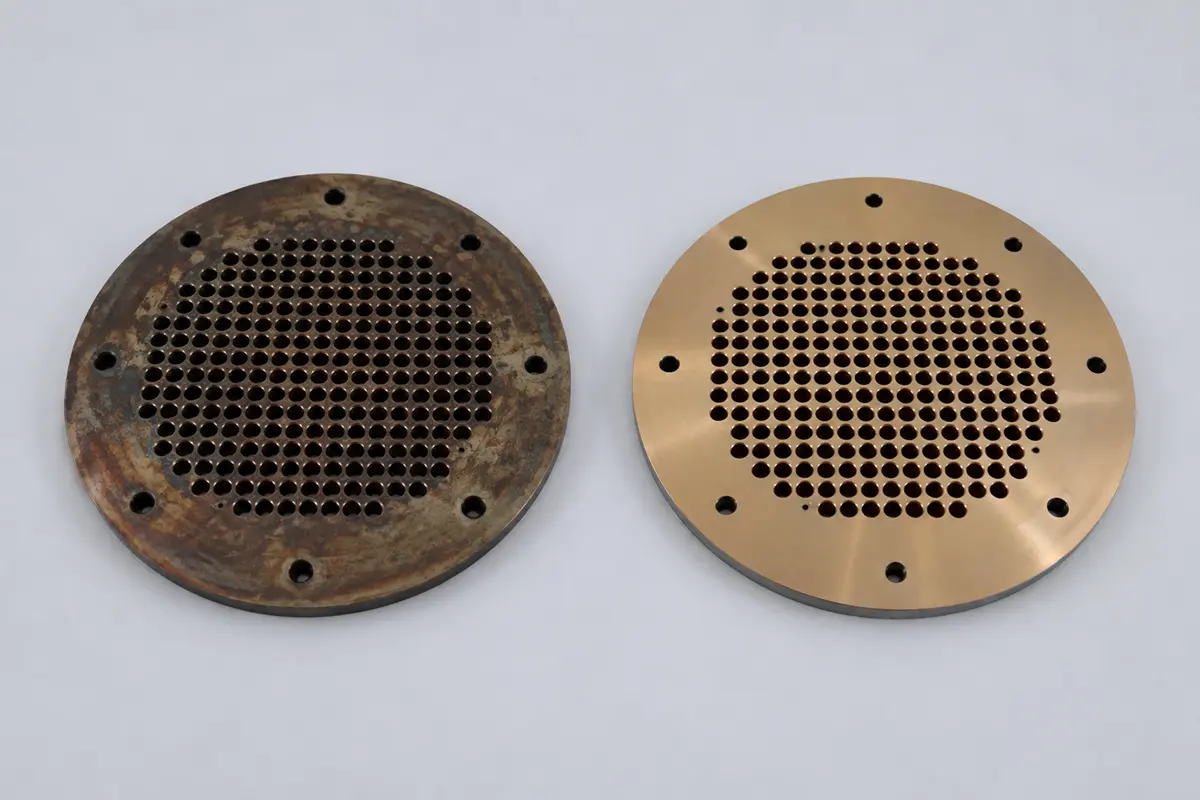
Brass, bronze and copper are widely selected for electrical conductivity, thermal transfer, low friction, wear resistance, machinability and stable mechanical interfaces. Yet the same parts may darken, stain or develop green corrosion during machining, cleaning, storage or international shipping.
For an industrial manufacturers, oxidation is not only a cosmetic complaint. It can affect electrical contacts, optical alignment hardware, bearing interfaces, vacuum cleanliness, soldering or brazing, sealing surfaces and incoming inspection. The correct response is therefore a controlled engineering process—not aggressive polishing after the problem appears.
Why Do Brass, Bronze and Copper Parts Oxidize?
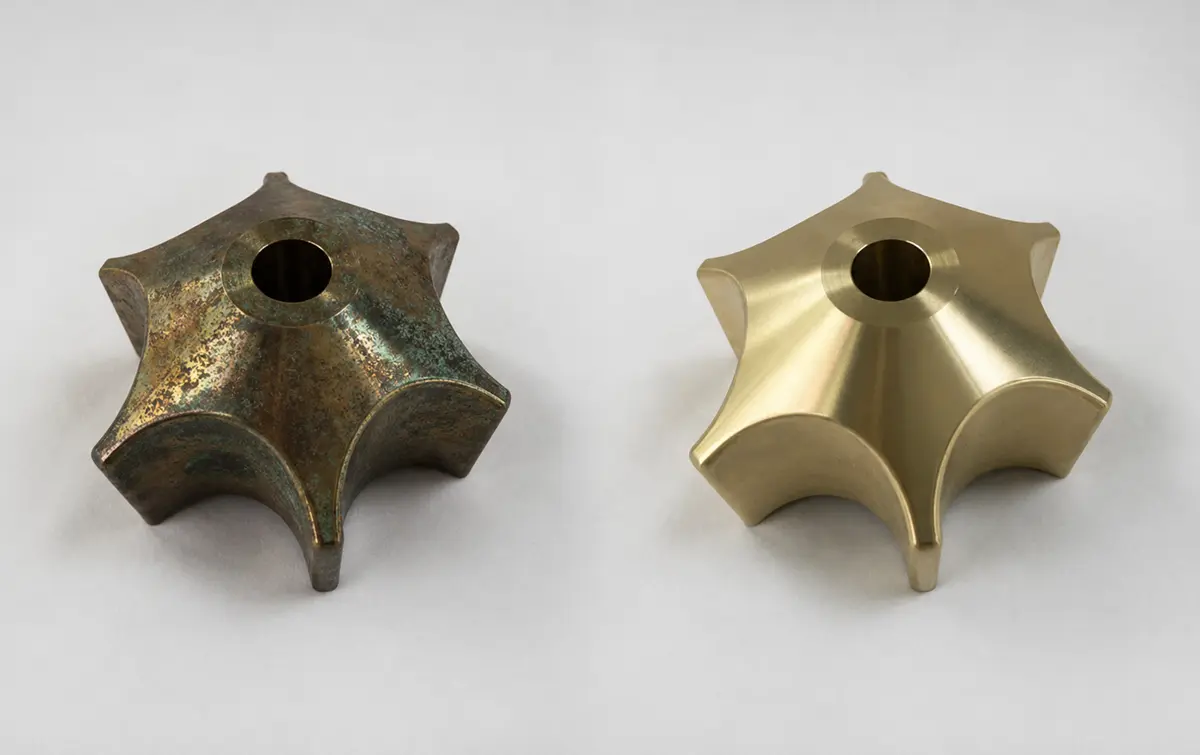
Copper-bearing alloys react with oxygen, moisture and environmental contaminants. Pure copper commonly forms reddish or dark oxides. Brass can tarnish and, in aggressive environments, may experience selective zinc attack. Bronze behavior depends strongly on alloy chemistry; phosphor bronze, bearing bronze and aluminum bronze should not be treated as interchangeable materials.
The most common causes
- Humidity or condensation during storage and transport
- Sulfur-containing paper, foam, rubber, adhesives or polluted air
- Fingerprints, salts and shop-floor handling residues
- Residual cutting fluid, polishing compound or cleaning chemistry
- Incomplete drying in blind holes, threads, grooves or dense hole patterns
- High temperature, repeated thermal cycling or process-gas exposure
- Contact with dissimilar metals in the presence of an electrolyte
- Packaging that traps moisture or emits corrosive volatile compounds
Oxidation, Tarnish or Active Corrosion?
| Observed condition | Likely concern | Recommended action |
| Uniform dulling or slight darkening | Often cosmetic, but unacceptable on visible or contact surfaces | Clean under a validated method; compare with the agreed appearance standard. |
| Brown or black film | More developed oxide or process residue | Identify residue and alloy; use controlled chemical or mechanical cleaning. |
| Green or blue-green deposits | Moisture- and contaminant-driven corrosion products | Quarantine, inspect for pitting, then decide whether controlled rework is possible. |
| Localized spots around holes or threads | Trapped chemistry or incomplete drying | Clean internal features, dry thoroughly and verify no residue remains. |
| Pitting, erosion or dimensional loss | Base material damage rather than simple discoloration | Measure critical features; remake the part if function or tolerance is compromised. |
| Recurring tarnish after cleaning | Root cause remains in handling, rinse, drying or packaging | Correct the process; repeated polishing is not a sustainable solution. |
| Important: A bright surface is not proof that the part is acceptable. A restored part must still meet dimensional, surface-finish, conductivity, cleanliness, coating-adhesion and functional requirements. |
How Oxidation Affects Precision CNC Parts
Electrical and thermal interfaces
Oxide and contamination on a current-carrying contact can increase contact resistance. On heat-transfer interfaces, nonuniform films and residues can interfere with controlled mating conditions. Contact pressure, oxide thickness and assembly design all matter, so the drawing should identify critical electrical and thermal interfaces rather than applying a general “bright finish” note.
Fits, threads, seals and bearing surfaces
Aggressive polishing may round edges, enlarge holes, change thread form, disturb flatness or alter a bearing surface. A cleaning process that looks successful can still make a precision part unusable. Critical features should be masked when appropriate and inspected after rework.
Vacuum and cleanliness performance
For UHV and high-vacuum hardware, organic oils, waxes, clear lacquers and some anti-tarnish films can become contamination or outgassing risks. A treatment used successfully for warehouse protection is not automatically vacuum compatible. Cleaning chemistry, rinse quality, bake requirements and packaging materials should be approved for the actual vacuum system.
Optical, quantum and semiconductor assemblies
Residues, particles and unstable films may contaminate optics, interfere with bonding or soldering, or fail customer cleanliness specifications. Cosmetic color may matter less than nonvolatile residue, particle control and traceable processing. These projects need application-specific acceptance criteria.
A Controlled Process for Removing Oxidation
Step 1 — Review the alloy, drawing and service environment
Confirm whether the part is pure copper, free-machining brass, naval brass, phosphor bronze, bearing bronze or another copper alloy. Then mark electrical contacts, sealing lands, optical interfaces, threaded features, bearing surfaces and visible Class A surfaces. The acceptable method depends on both material and function.
Step 2 — Determine whether the condition is recoverable
Use visual inspection under consistent lighting and magnification as needed. Check for staining, loose corrosion products, pitting, edge attack and deposits in recessed features. Measure critical dimensions before any method that may remove material. If corrosion has penetrated the base metal, replacement can be safer and more economical than repeated rework.
Step 3 — Select the least aggressive effective method
| Method | Best fit | Key risk to control |
| Controlled aqueous cleaning | Oil, fingerprints and soluble residue before oxide removal | Water quality, chemistry compatibility and complete drying |
| Mild chemical deoxidizing / bright dipping | Uniform oxide or tarnish on compatible alloys | Etch rate, immersion time, dimensional loss and color variation |
| Localized hand polishing | Accessible cosmetic areas with low dimensional sensitivity | Scratches, rounded edges, directional finish mismatch and embedded abrasive |
| Controlled mechanical finishing | Heavier surface film on robust features | Material removal, flatness, burrs and altered surface roughness |
| Electropolishing or specialized chemical polishing | Selected copper alloys and finish requirements | Alloy response, current distribution and subsequent protection |
| Strip and re-plate / re-finish | Failed plated or coated surface | Base-metal attack, thickness buildup and fit changes |
Step 4 — Rinse, neutralize and dry completely
Chemical residues left in pores, blind holes, threads and dense perforation patterns can restart corrosion. Use a documented rinse and drying sequence suitable for the cleanliness class. Where required, verify water-break-free surfaces, rinse quality, dryness or nonvolatile residue.
Step 5 — Inspect after treatment
- Visual appearance against an approved sample or defined color/finish limit
- Critical dimensions, flatness, threads, fits and sealing surfaces
- Surface roughness where polishing or material removal occurred
- Electrical continuity or contact resistance when specified
- Cleanliness, particles or nonvolatile residue for sensitive assemblies
- Coating or plating thickness and adhesion when a protective finish is applied
How to Prevent Oxidation After CNC Machining
Prevention is usually more reliable and less expensive than restoring discolored parts. Rollyu Precision plans oxidation control together with material selection, machining, deburring, cleaning, inspection and packaging.
Control machining and cleaning residues
Select compatible cutting fluids and remove them promptly after machining. Avoid cross-contamination from carbon steel tools, dirty baskets, polishing compounds and incompatible shop materials. Control time between final cleaning and packaging.
Use clean handling and complete drying
Operators should use clean gloves for finished functional or cosmetic surfaces. Dry blind holes, small bores, threads, capillary gaps and perforated plates. Condensation control matters during both production and shipment.
Match the protective treatment to the function
| Protection option | Advantages | Where caution is required |
| Copper-alloy passivation / anti-tarnish film | Thin protection with little dimensional change when properly controlled | Confirm chemistry, conductivity, solderability, vacuum compatibility and customer restrictions. |
| Nickel, silver, gold or other engineered plating | Can improve corrosion behavior, contact performance or wear for a defined application | Specify underplate, thickness, masked areas, adhesion, porosity and dimensional allowance. |
| Clear organic coating | Strong barrier and preserved appearance for suitable external parts | Usually unsuitable for electrical contacts, soldering areas and unqualified vacuum or clean-process surfaces. |
| Protective oil or wax | Economical temporary protection for general industrial storage | Requires removal; may contaminate optics, vacuum systems, bonding, coating or assembly processes. |
| VCI-compatible packaging | Useful for transport and storage without coating every surface | Verify compatibility with copper alloys and downstream cleanliness requirements. |
| Dry barrier packaging with desiccant | Clean, practical protection for export shipments | Control humidity indicator, bag integrity, desiccant quantity and packaging duration. |
Define packaging as an engineering requirement
For long international shipments, specify clean individual wrapping, barrier bag type, desiccant, humidity indicator, surface separation and maximum storage period. Keep copper alloys away from sulfur-emitting paper, foam, rubber and adhesives. Packaging should not abrade the finish or trap residual moisture.
Industry-Specific Recommendations
| Industry | Critical concern | Recommended purchasing language |
| Photonics | Particles, fingerprints, stray-light surfaces, optical contamination and alignment stability | Identify optical-adjacent surfaces, cosmetic class, cleaning level, packaging and prohibited residues. |
| UHV / vacuum motion | Outgassing, trapped chemistry, virtual leaks and bake compatibility | Require vacuum-compatible cleaning and packaging; prohibit unapproved oil, wax, lacquer and conversion films. |
| Motion control | Bearing or sliding surfaces, fits, encoders, electrical grounding and appearance consistency | Define critical fits, Ra, contact areas, masked features and post-treatment dimensional inspection. |
| Quantum instruments | Magnetic/material restrictions, optical cleanliness, cryogenic or vacuum service | State alloy, magnetic restrictions, service temperature, vacuum class, cleanliness and traceability. |
| Semiconductor equipment | Particles, ionic contamination, process compatibility and repeatable supply quality | Specify clean handling, NVR/particle needs, plating system, packaging class and lot documentation. |
Rollyu Precision’s Oxidation-Control Solution
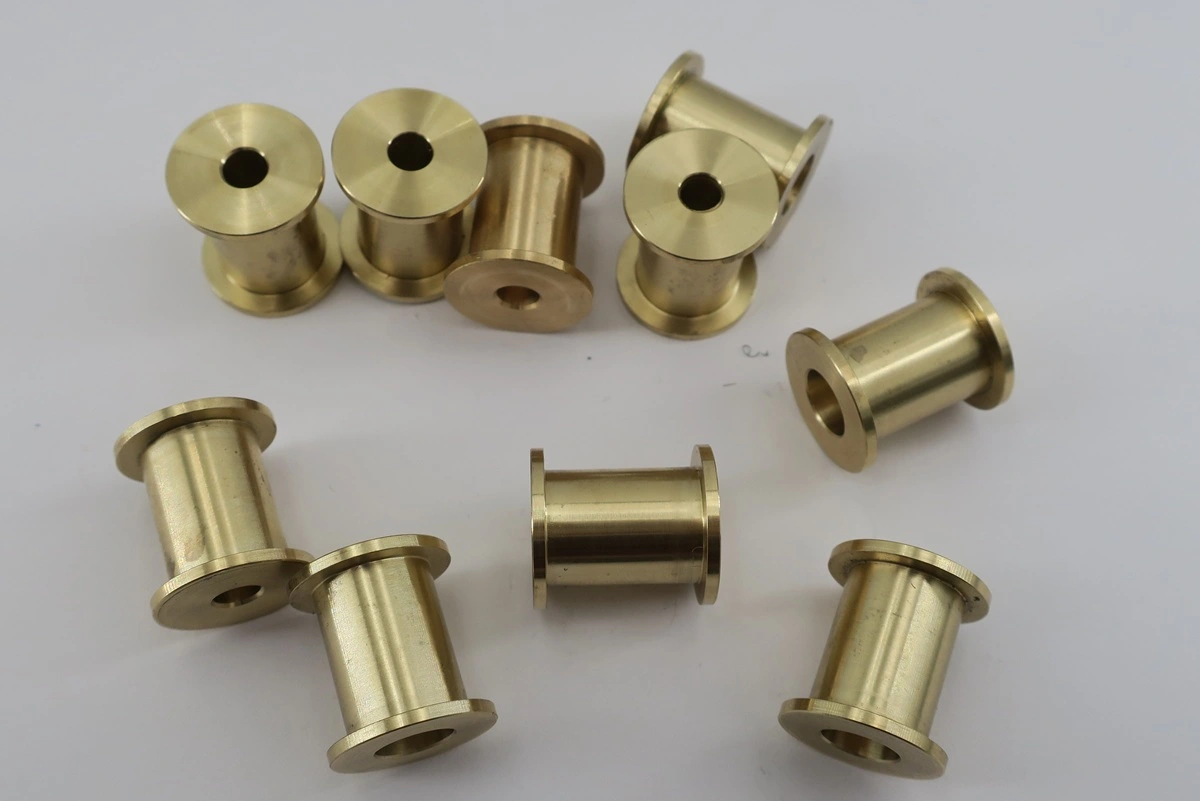
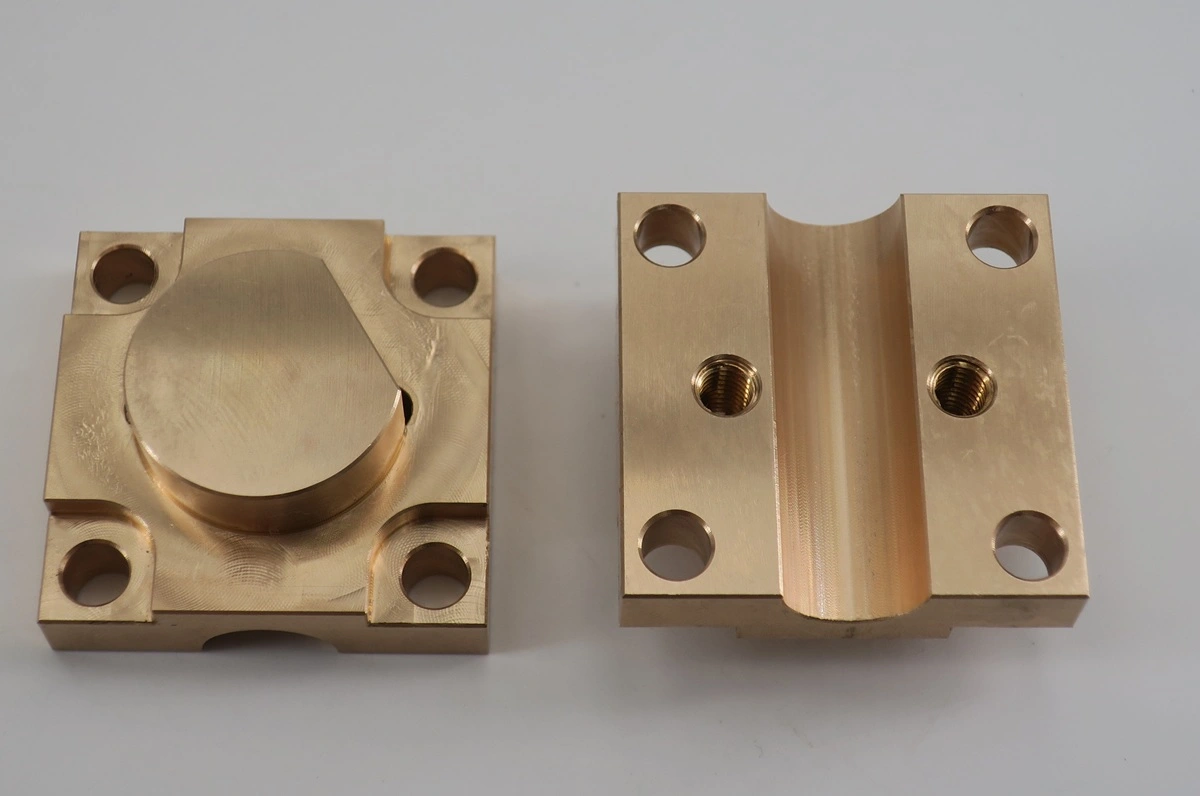
Rollyu Precision supports custom brass, bronze and copper CNC machined parts from prototype through repeat production. Our role is not limited to removing visible discoloration. We help engineering and sourcing teams define a practical process that protects function, tolerance and delivery acceptance.
Engineering review before quotation
- Review material grade and certification requirements
- Identify functional, cosmetic and no-coating surfaces
- Evaluate geometry that can trap fluid or complicate drying
- Confirm surface finish, plating, passivation and masking notes
- Align cleaning, inspection and packaging with the operating environment
Controlled manufacturing and finishing
- CNC milling, turning and precision secondary operations for copper alloys
- Deburring with attention to sealing lands, threads and micro-features
- Coordinated cleaning, polishing, passivation or plating through defined process routes
- Protection of critical dimensions through masking and thickness allowance
- Process records and supplier coordination through one point of contact
Inspection and shipment protection
- Visual inspection against approved criteria or a limit sample
- CMM, optical inspection and gauges for critical geometry as applicable
- Post-finish verification of dimensions, threads and mating features
- Clean handling, controlled drying and application-appropriate packaging
- Lot identification and inspection documentation when requested
| Buyer benefit: Fewer incoming-inspection disputes, lower rework risk, more consistent appearance and better protection of critical electrical, vacuum, optical and mechanical functions. |
What to Put on Your Drawing or RFQ
To receive a useful quotation—not just a price—include the following information:
- 2D drawing and 3D model, with revision level
- Exact copper, brass or bronze alloy and material condition
- Annual volume, lot size and prototype quantity
- Critical dimensions, GD&T, threads and surface-roughness requirements
- Electrical contacts, sealing lands, bearing surfaces, optical-adjacent areas and visible surfaces
- Allowed and prohibited cleaning chemicals, films, oils or coatings
- Plating or passivation specification, thickness, masking and appearance requirements
- Vacuum level, bake temperature, cleanroom or process-compatibility requirements
- Packaging duration, shipment route, storage conditions and shelf-life expectation
- Required inspection report, material certificate, coating certificate or traceability
| Recommended drawing note: “Finished copper-alloy surfaces shall be clean, dry and free from visible corrosion products, fingerprints and processing residue. No oil, wax, lacquer or anti-tarnish film is permitted on identified functional surfaces unless approved in writing. Protect for shipment using the specified clean barrier packaging.” |
Frequently Asked Questions
Does oxidation mean a brass, bronze or copper part must be scrapped?
No. Uniform light tarnish may be recoverable, but active corrosion, pitting or dimensional loss requires engineering review. Critical contacts, seals, threads and fits must be inspected before and after rework.
What is the safest way to remove oxidation from precision copper-alloy parts?
Use the least aggressive validated method that removes the oxide without changing dimensions, roughness or function. The correct choice depends on alloy, geometry, severity, surface requirements and cleanliness class.
Can polishing change CNC part tolerances?
Yes. Abrasive polishing can remove material, round edges, alter flatness and change the texture of sealing or bearing surfaces. Critical features should be protected and re-inspected.
Is passivation always the best way to prevent copper oxidation?
No. Passivation can be effective for many industrial parts, but chemistry and residue must be compatible with electrical, soldering, optical, semiconductor and vacuum requirements. Application approval comes first.
Can clear lacquer or rust-preventive oil be used on UHV parts?
Not by default. Organic coatings, oils and waxes can create outgassing or contamination. Use only materials and processes specifically approved for the vacuum system and bake conditions.
How can oxidation be prevented during overseas shipping?
Clean and fully dry the parts, use clean individual separation, compatible barrier packaging and correctly sized desiccant, and control humidity and storage duration. Avoid sulfur-emitting packaging materials.
Will oxidation reduce electrical conductivity?
Bulk conductivity may remain largely unchanged, but oxide on a contact interface can increase contact resistance. Mark electrical contact surfaces and specify their finish and acceptance criteria.
Which brass or bronze alloy is best for my equipment?
The choice depends on machinability, strength, wear, electrical or thermal behavior, corrosion environment, magnetic restrictions and compliance requirements. Rollyu can review the application with the drawing before quotation.
Can Rollyu supply prototypes and production quantities?
Yes. Rollyu Precision supports prototypes, low-volume builds and repeat production of custom copper-alloy parts, with machining, finishing coordination, inspection and shipment protection.
What files should I send for a quotation?
Send STEP or another 3D model, a controlled 2D drawing, material and finish specifications, quantity, application environment, inspection requirements and packaging expectations.
Request a Quote for Precision Copper-Alloy Parts
| CTA — Send Your Project: Need custom brass, bronze or copper components for photonics, UHV, motion control, quantum instruments or semiconductor equipment? Send Rollyu Precision your 2D drawings, 3D files, alloy, quantity, surface requirements and operating environment. Our engineering team will review manufacturability, oxidation risk, finishing, inspection and packaging before quotation. |