
According to Mordor Intelligence, the global laser marking market was estimated at $3.91 billion in 2024. Regulations like the US FDA’s UDI requirements and the EU MDR now require permanent, traceable markings on surgical tools and implantables, making ink and labels no longer viable.
This guide covers how laser marking works, which laser type fits your material, and where it’s used across industries. Use it to source the right service for your parts.
What Is Laser Marking and How Does It Work?
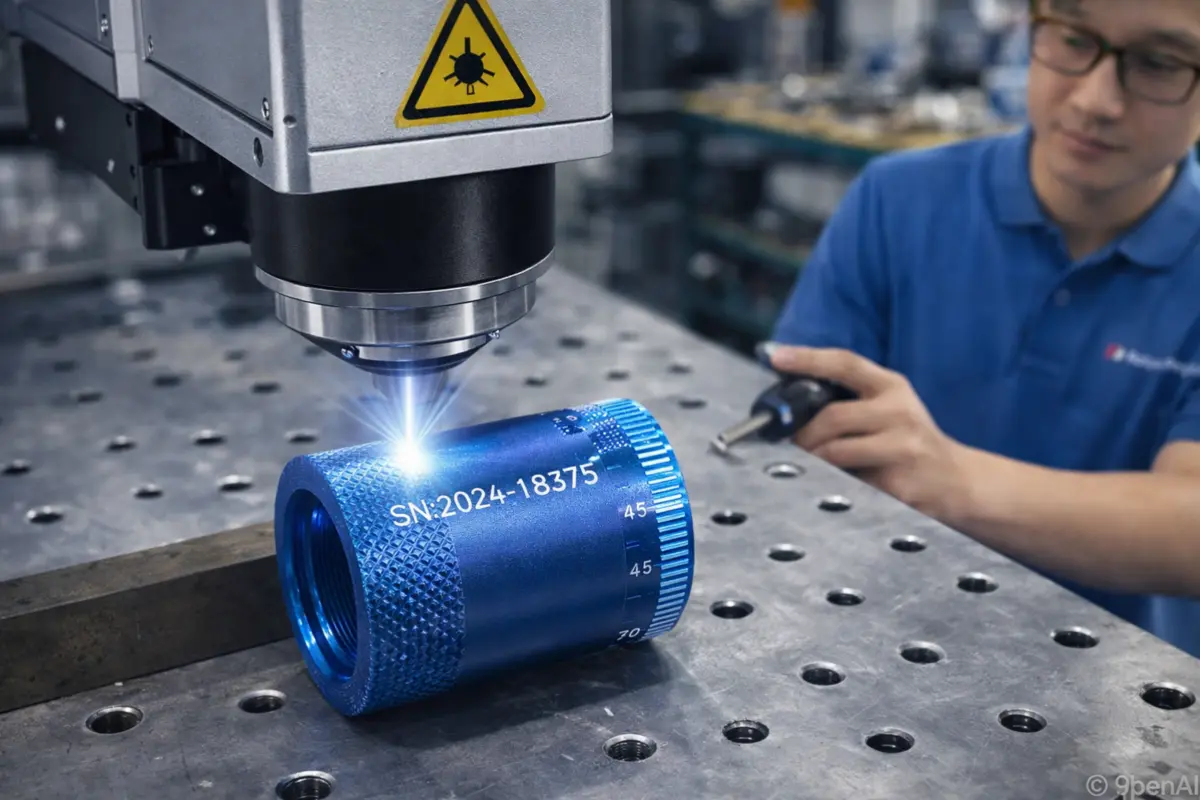
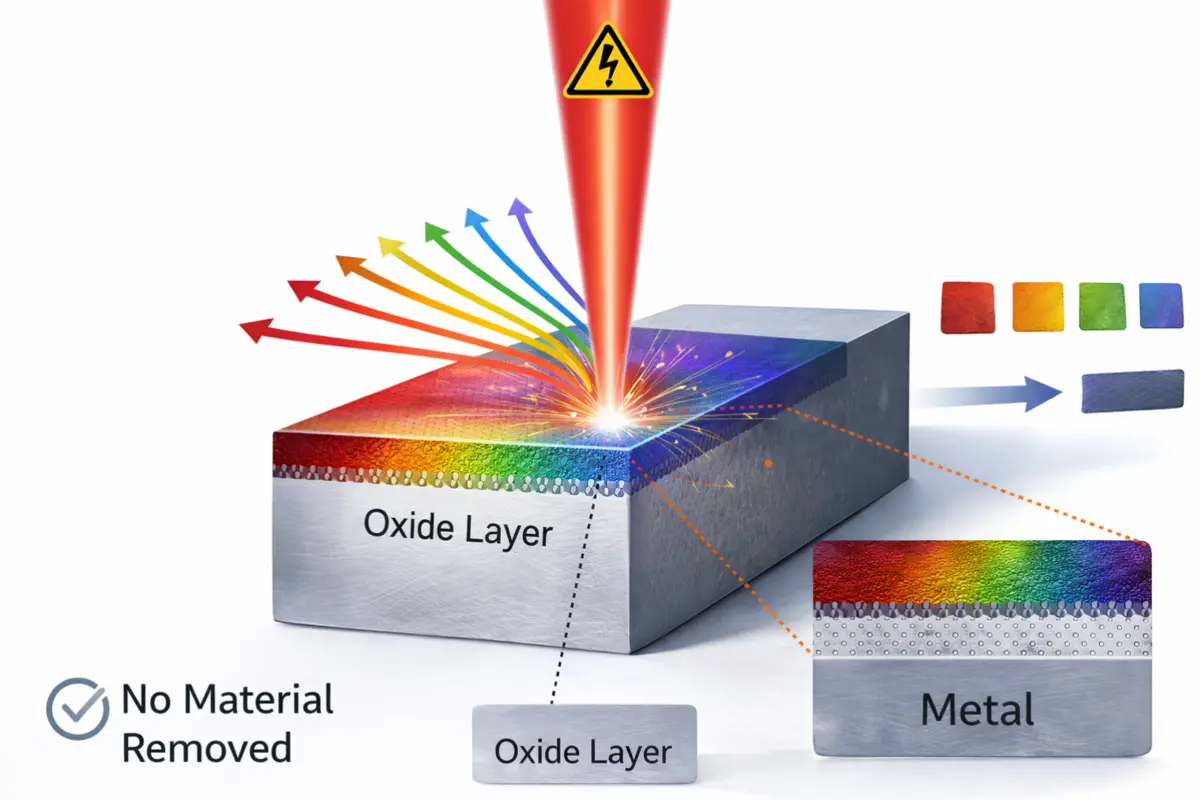
Laser marking uses a focused laser beam to permanently change a material’s surface appearance without removing any base material. The laser heats a precise spot, triggering a localized reaction such as annealing, oxidation, or foaming, producing a high-contrast, readable mark.
A controller converts your design file into a scan path, and the laser head traces it at speeds up to several meters per second. Each pulse lands with calibrated energy, placing text, barcodes, or Data Matrix codes accurate to ±0.01 mm.
Why Choose Laser Marking Over Inkjet and Dot Peen?
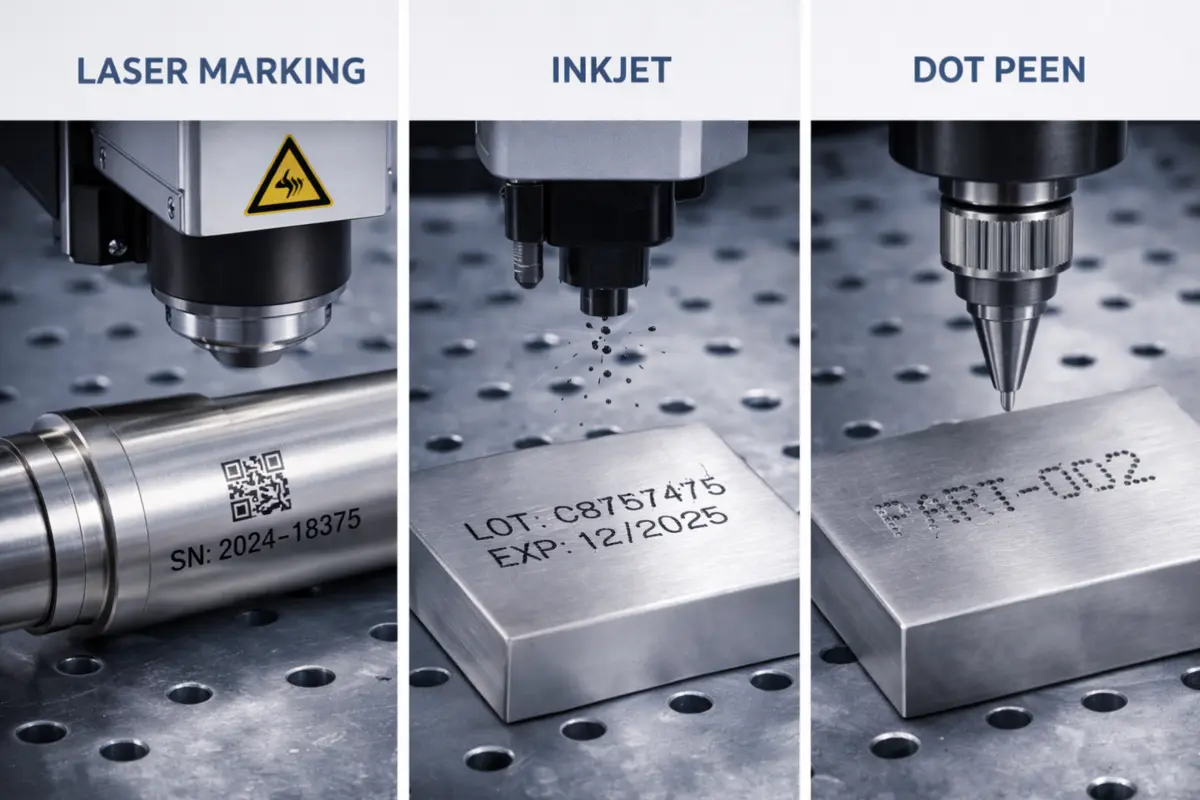
Laser marking outperforms both on three points that matter most in regulated manufacturing.
High Precision
Laser marking holds positional accuracy to ±0.01 mm, covering miniature components where character height drops below 0.5 mm. In contrast, Inkjet spreads across the surface, blurring fine details at that scale. Dot peen is limited by pin diameter, so sub-millimeter features are difficult to achieve.
Non-Contact Processing
The laser beam never touches the part, keeping surface hardness, coating integrity, and dimensions exactly as machined. Dot peen drives a pin into each point, risking micro-cracks on hardened steel or thin-wall sections. Inkjet leaves a wet film that needs curing time and struggles to adhere to oily or uneven surfaces.
Permanent Traceability
Laser marks are integrated into the surface itself, staying readable through sterilization cycles, chemical baths, and years of wear. Inkjet ink fades under UV exposure and solvent cleaning. Dot peen marks collect debris and corrode in harsh environments. Consequently, causing barcode scan failures during compliance checks.
Quick Comparison Table
Here’s how the three methods stack up across the specs that matter in precision manufacturing.
|
Feature |
Laser Marking | Inkjet |
Dot Peen |
|
Positional accuracy |
±0.01 mm | Low | Medium |
|
Contact with part |
None | None |
Yes |
| Min. character height | 0.5 mm | Limited by droplet size |
Limited by pin diameter |
|
Mark durability |
Permanent | Fades over time | Degrades in harsh environments |
| Hard metal compatibility | Yes | No |
Limited |
|
Maintenance |
Low | High (ink, nozzle) | Medium (pin replacement) |
| UDI / MDR compliance | Yes | No |
Partial |
Laser marking provides permanent, non-contact precision and full regulatory compliance, easily outperforming the limitations of inkjet and dot peen.
What Are the Different Types of Laser Marking?
Different materials and applications call for different laser types. Here’s how each one works and where it fits.
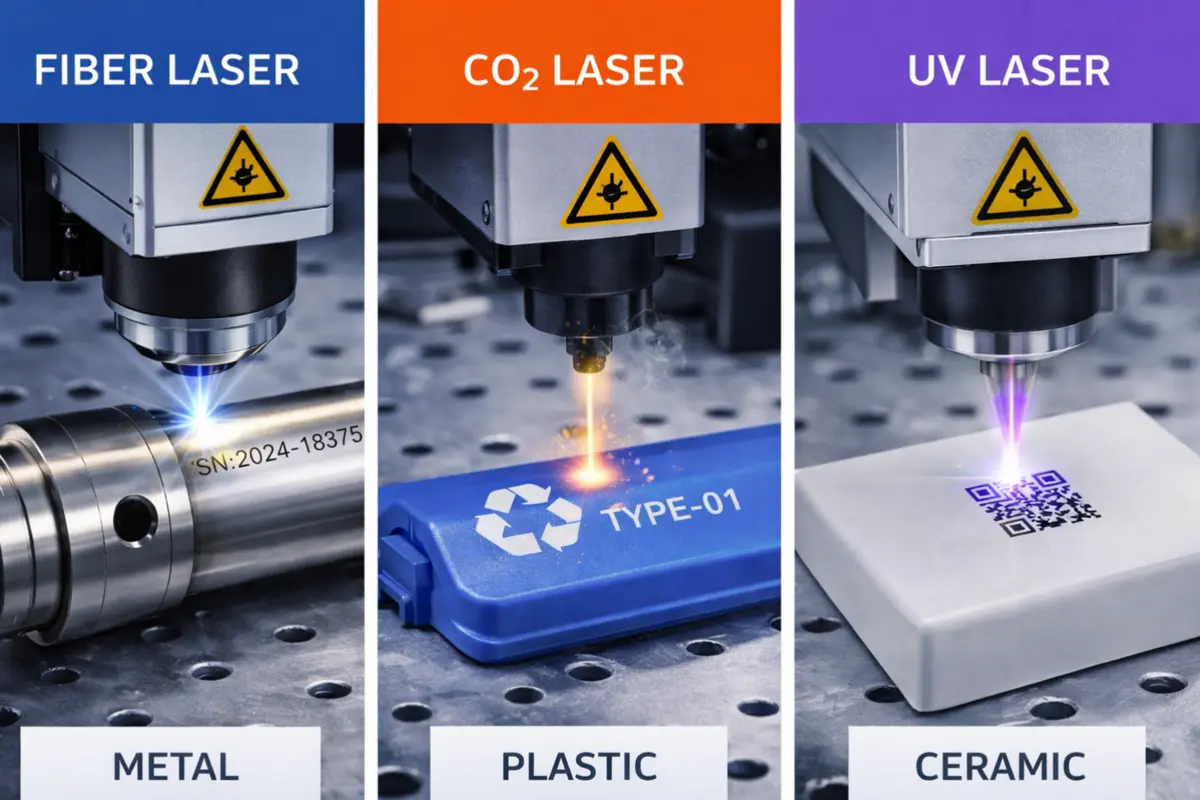
Fiber Lasers for High-Speed Metal Marking
Fiber lasers operate at 1,064 nm, a wavelength metals absorb efficiently. They mark stainless steel, aluminum, titanium, and hardened alloys at speeds ranging from 7,000 to 12,000 mm/s, with no consumables and minimal maintenance.
UV Lasers for Sensitive Medical Components
UV lasers operate at 355 nm, producing short, low-heat pulses that prevent surface discoloration, micro-cracking, and heat-affected zones on temperature-sensitive materials like PEEK, polycarbonate, and thin-wall medical tubing.
CO2 Lasers for Non-Metallic Materials
CO2 lasers operate at 10,600 nm, a wavelength that non-metallic materials absorb well. They mark wood, glass, ceramics, acrylic, and most industrial plastics. CO2 lasers are generally not suitable for bare metals without a coating or pre-treatment.
MOPA Lasers for Advanced Color Marking
MOPA lasers operate at 1,064 nm but allow independent control of pulse width and frequency, producing different oxidation depths on stainless steel and titanium that appear as distinct colors: black, gray, gold, and blue. Standard fiber lasers lack this pulse flexibility, limiting output to monochrome marks.
What Materials Can Be Laser Marked?
Laser marking works across a broad range of materials. The right laser type depends on how well the material absorbs the wavelength.
Industrial Metals and Alloys
Fiber lasers mark most metals directly, including stainless steel (304, 316L), aluminum 6061 and 7075, titanium (Grade 5), brass, copper, and hardened tool steel. Titanium produces color marks through oxidation, while stainless steel gives high-contrast black or gray marks through annealing.
Medical and Engineering Plastics
UV lasers are the standard choice for plastics, producing clean marks without melting or discoloring the surface. Compatible materials include PEEK, polycarbonate, ABS, Delrin, PTFE, and Ultem. Fiber lasers can mark certain plastics but risk heat damage on thin-wall or transparent parts.
Anodized Aluminum and Coatings
Anodized aluminum delivers sharp, high-contrast laser marks. The laser precisely removes the protective oxide layer created during the anodizing process, exposing bare metal beneath while the protective oxide layer around each mark stays intact, keeping corrosion resistance unchanged.
Precision Ceramics and Glass
Ceramics and glass are compatible with laser marking, covering materials like alumina, zirconia, and borosilicate glass. CO2 lasers handle most of these through focused heat. For fragile glass components where cracking is a concern, UV lasers are a better fit, keeping heat input low enough to prevent micro-fractures.
What Are the Common Applications of Laser Marking?
Laser marking is the default traceability solution across industries where permanent identification is a regulatory or operational requirement.
Semiconductor and Electronic Components
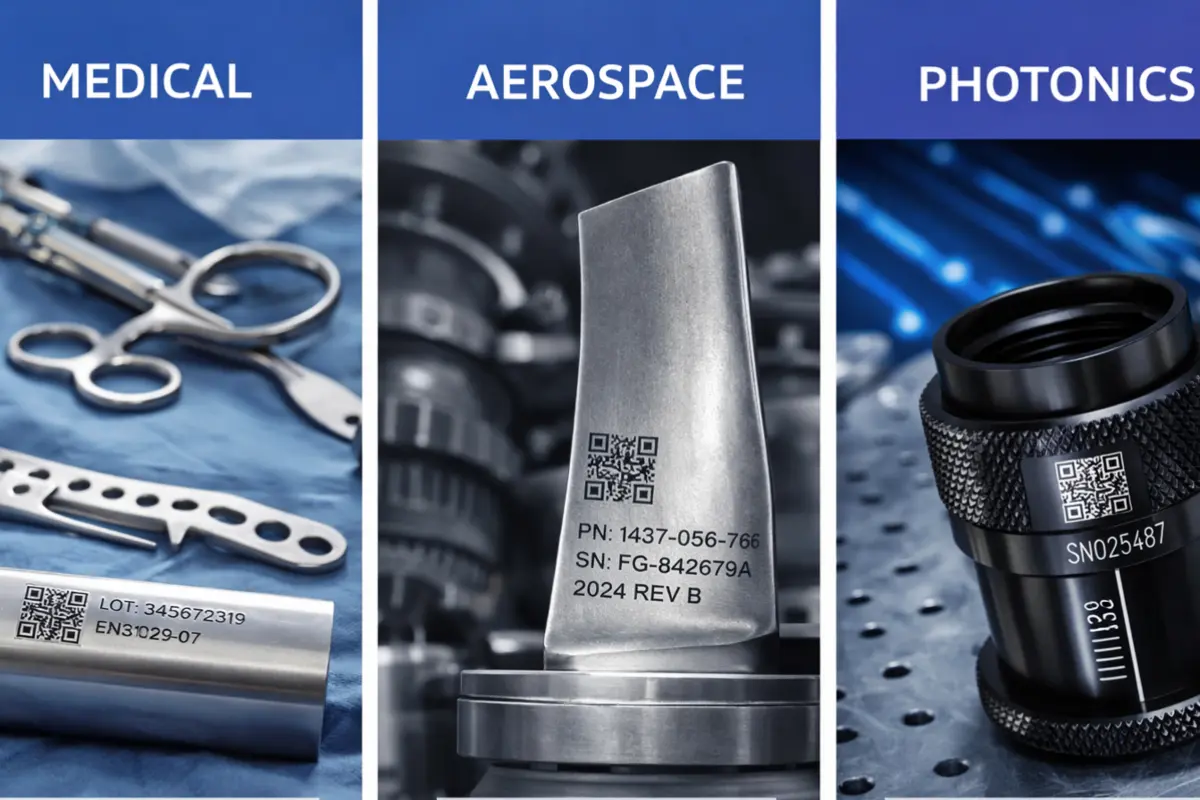
Laser marking places serial numbers, lot codes, and 2D Data Matrix codes on wafer cassettes, PCB boards, IC chips, and connectors. Mark areas go as small as 2 mm², with no thermal damage to adjacent circuitry. For semiconductor CNC machining parts, laser marking is a standard step in the finishing workflow.
Medical Devices and Surgical Instruments
Laser marking is the go-to solution for FDA UDI and EU MDR compliance, placing permanent, machine-readable codes on stainless steel instruments, titanium implants, and PEEK housings without affecting biocompatibility or surface finish.
Aerospace and Automotive Parts
Laser marking keeps part numbers, revision codes, and traceability marks readable through heat, vibration, and chemical exposure across decades of service life. Titanium fasteners, aluminum housings, and hardened steel brackets hold their marks where labels and inkjet fail.
Robotics and Industrial Automation
Laser marking puts permanent serial numbers and QR codes on joint housings, actuator mounts, sensor brackets, and end-effectors, giving manufacturers full traceability from the production line through field maintenance.
How to Choose a Reliable Laser Marking Service Provider?
Three factors separate a capable laser marking partner from one that creates compliance headaches down the line.
Essential Quality Certifications and Compliance
A qualified provider holds both ISO 9001:2015 and ISO 13485:2016, running documented, traceable processes on every job. Full material certs, First Article Inspection reports, and Certificate of Conformance should be available on request. RoHS and REACH compliance should be standard, not an add-on.
Rollyu Precision holds both certifications, with laser marking integrated into its standard manufacturing workflow.
Comprehensive In-House Processing Capabilities
A full-service provider covers CNC-machined components, laser marking, and finishing under one roof, cutting handoff errors and keeping lead times tight. Look for 3-axis, 4-axis, and 5-axis machining alongside laser marking.
Advanced Quality Control and Inspection Systems
A reliable provider runs CMMs, optical comparators, and surface roughness testers to verify laser mark legibility and dimensional accuracy. For production runs, Statistical Process Control tracks trends and flags deviations before final inspection.
FAQ
What is the Difference Between Laser Marking and Laser Engraving?
Laser marking changes the surface appearance without removing material. Laser engraving cuts a physical cavity into the surface by removing material. Marking is preferred when dimensional tolerance and surface integrity matter.
Is Laser Marking Better Than Pad Printing?
Yes, especially for regulated industries. Because laser marks are permanent, they survive chemical exposure and UV. Conversely, pad printing ink degrades under the same conditions.
Can Laser Marking Be Done in Color?
Yes, but only on specific metals. MOPA lasers control oxidation depth through pulse adjustments, producing black, gray, gold, and blue marks.
Conclusion
Laser marking produces permanent, high-precision identification that holds up across sterilization, chemical exposure, and decades of mechanical wear. Fiber, UV, CO2, and MOPA lasers each cover different materials and applications. Together, they make laser marking the standard traceability solution across semiconductors, medical devices, aerospace, and robotics.
Rollyu Precision offers ISO 9001:2015 and ISO 13485:2016 certified laser marking as part of a full-service CNC machining workflow, covering metals, plastics, ceramics, and coated components.