
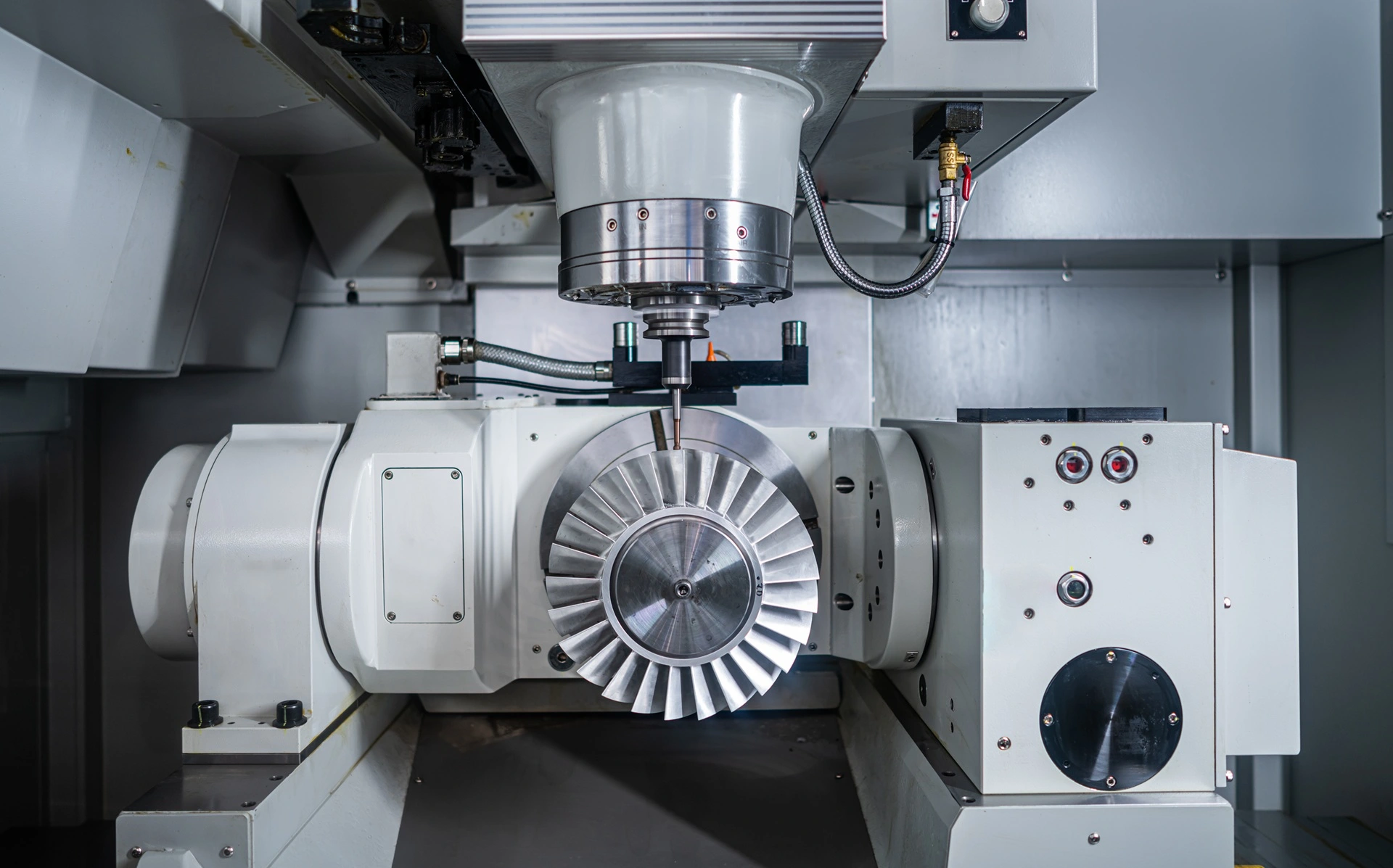

Aerospace CNC machining is a special local manufacturing process, which is important in the creation of safe, dependable, and efficient aircraft and spacecraft.
It is a field of industry that combines the most advanced Computer Numerical Control (CNC) with the maximum in precision to produce parts that need to work in the most extreme conditions in a flawless fashion.
Aerospace CNC machining is not just a plus point for the industry leaders but a necessity. This handbook will give you a complete picture of what you should know about CNC aerospace machining and its basics, as well as the process of identifying the right manufacturing aerospace machine shop.
What is Aerospace CNC Machining
Aerospace CNC machining is the highest level of accurate production and the foundation of contemporary aviation and space exploration.
It is a specialized industry that incorporates highly advanced technology with zero tolerance for quality to generate components that should work perfectly even under the harshest circumstances.
Meaning of Aerospace CNC Machining
Aerospace CNC machining is a precision-oriented subtractive manufacturing process that involves the transformation of solid materials into aircraft, spacecraft, and satellite critical components through computer-controlled equipment.
Controlled by canned software, it is made to create very complex components with remarkable precision, where the absolute reliability is vital.
All the elements have to correspond to high-quality standards because even small mistakes result in significant setbacks, so ruthless precision has been the central characteristic of this professional area.
Benefits of CNC Machining in Aerospace
CNC machining is important to the aerospace industry since it provides a unique set of benefits that is essential in flight-worthy components.
Unmatched Precision and Tight Tolerances: CNC machines have tolerances as narrow as ±0.0001 inches (2.54 micrometers), which is by far out of reach of conventional machining. Such a micron-level precision cannot be compromised by such components as jet engine turbines and landing gear, where a flawless fit and perfect operation are a matter of safety.
Higher strength-to-weight Ratio: Performance and fuel efficiency are the most important in aerospace. CNC machining can enable engineers to produce high complexity, lightweight geometries that are strong and durable, and to directly optimize the weight of an aircraft geometry without making it structurally unsound.
Material Versatility: The process is able to work with the high-strength, temperature-resistant aerospace materials, including titanium alloys, nickel-based superalloys, and advanced engineering plastics. This is as it permits the appropriate material to be applied to every distinct use.
High Consistency and Efficiency: CNC machines have very high repeatability when the program has been verified; this is because the machine can make the same parts in large production runs. This automation saves the human factor, decreases the amount of material waste, and makes the process much faster than the traditional one.
Why the Aerospace Industry Relies on CNC Machining
Just like high-precision medical devices and automotive components, the aerospace industry relies on CNC machining for unmatched accuracy and consistency. Precision aerospace CNC machining parts manufacturers delivering precision CNC components with unmatched accuracy for aviation and space applications.
Unparalleled Accuracy in Extreme Conditions: CNC machining is required in the aerospace sector since it is the only way to meet the sector’s non-compromising safety and performance requirements. The modern aircraft and spacecraft are made of millions of CNC machining aerospace parts that need to work flawlessly under the most extreme conditions, both in significant changes of pressure to extreme temperatures, as well as -65°F to well over 2000°F.
The Prerequisite to Complex Component Manufacturing:
Aerospace machining companies play a critical role in producing complex, mission-critical components for aircraft, spacecraft, and satellites.
CNC machining aerospace remains the only manufacturing method capable of consistently delivering parts with intricate geometries, unique aerospace-grade materials, and micron-level precision required to perform in extreme environments.
From high-temperature jet engine turbines to lightweight satellite frames, only advanced CNC capabilities can meet these stringent demands, ensuring safety, reliability, and compliance with aerospace industry standards.
Driving Infusion Across the Aerospace Sector: This technology brings about innovation in the aerospace industry, not only in production but also enables engineers to quickly develop and test new designs. After all, whether it is commercial jets or deep-space probes, CNC machining gives the manufacturing base upon which the modern aerospace industry is built.
How CNC Machining Is Used in Aerospace Manufacturing
The flexibility of CNC machining has seen its use in almost every aircraft system. It is extremely important in the manufacture of high-stakes parts where no failure is possible.
Engine Parts: This application is one of the most difficult ones. CNC machining for aerospace is applied to produce such vital components as turbine blades, compressor discs, and combustion chambers. These parts have to be resistant to high temperatures and rotational velocity and be precise on the micron level in order to make the engines run efficiently and safely.
Structural and Airframe Parts: The airframe is a structure made of machined parts that are part of its strength and aerodynamics. CNC machines are involved in the production of wing structures, fuselage sections, brackets, and landing gear components. These sections are commonly made of aluminum or titanium alloys in order to get the ideal ratio between low weight and great strength.
Aerospace Electronics and Avionics: The business employs special CNC operations, e.g., micro-milling and electrical discharge machining (EDM) of sensor cases, circuit board cases, and avionics cooling units. The components are used to shield delicate electronics against electromagnetic radiation and control heat dissipation in vital flight controls
Space and Satellite Components: The space requirements are still more extreme. Satellite structural frames, thruster nozzles, and communication antenna arrays are made in CNC machining. There are companies such as Rollyu, which possess certain specialization in this field and provide various services to the space and satellite industry, which you can also read on their special page.
Space machining refers to the ultra-precise manufacturing of critical components used in spacecraft, satellites, launch vehicles, and deep-space probes. These parts must operate flawlessly in the most extreme environments—vacuum, radiation, thermal extremes from -250°F to +2500°F, and micrometeoroid exposure.
Modern space machining combines multi-axis CNC technology, electric discharge machining, and high-speed micro-milling to deliver components with tolerances down to ±0.0001″. This precision is essential for mission-critical structures such as:
- Satellite Structural Frames– Lightweight aerospace-grade materials, optimized for rigidity in orbital deployment.
- Thruster Nozzles and Propulsion Systems– Machined from high-temperature alloys like Inconel for chemical and electric propulsion.
- Communication Antenna Arrays– Complex geometries for signal accuracy, cut from titanium or carbon composite mounts.
- Optical and Sensor Housings– Micro-machined to protect sensitive instruments from vibration and thermal distortion.
Satellite Machining Services involve the precision manufacturing of critical satellite components, from lightweight structural frames to high-performance thruster nozzles and antenna assemblies. Using advanced multi-axis CNC machining, electrical discharge machining (EDM), and micro-milling techniques, these services ensure micron-level accuracy and consistent quality for parts designed to operate in extreme space environments.
Machining specialists work with aerospace-grade materials such as titanium alloys, Inconel superalloys, lightweight aluminum, and carbon fiber composites, meeting strict standards like AS9100 and ITAR to guarantee reliability under the harsh thermal, vacuum, and radiation conditions of orbit.
Whether for communications, Earth observation, or deep-space exploration, satellite machining services provide the high-tolerance solutions required to keep missions on track.
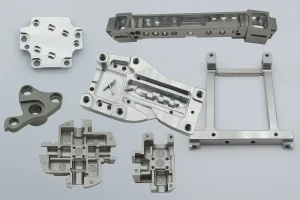
Table: Key CNC Machining Applications in Aerospace
| Application Area | Example Components | Typical CNC Processes Used |
| Jet Engine Manufacturing | Blades of turbines, compressor discs, chambers of combustion. | 5-axis milling, CNC turning, grinding |
| Aircraft Structures | Wing, fuselage, landing gear. | Precision turning, Multi-axis CNC milling. |
| Flight Control Systems | Manifolds, actuator components, valve bodies | High-precision turning, milling |
| Space & Satellite | Frames, nozzles, thrusters, arrays of antennas. | 5-axis machining, high-speed micro-milling |
Common Materials Used in CNC Machining Aerospace Parts
Material selection is a very important decision in aerospace design and has a direct effect on the performance, weight, and safety of the final product.
Aerospace Aluminum
Lightweight aluminum for aerospace applications offers the perfect balance between high strength, corrosion resistance, and low density, making it ideal for aircraft and spacecraft structures.
Alloys such as Aluminum 2024, 6061, and advanced aluminum-lithium formulations provide superior fatigue resistance and high stiffness-to-weight ratios, ensuring optimal fuel efficiency and payload capacity.
Precision machining and heat treatment allow these materials to meet tight aerospace tolerances while withstanding harsh operational environments, including extreme temperatures and vibration.
Used in wing panels, fuselage structures, satellite frames, and launch vehicle components, lightweight aerospace aluminum significantly reduces mass without compromising safety or performance.
Titanium Alloys
Titanium alloys, such as Ti-6Al-4V (Grade 5), are being used in the aerospace industry due to their excellent strength-to-weight ratio and high level of corrosion resistance.
They are approximately 40 percent lighter than steel of the same strength, making them a good option in parts of structures of critical importance, such as landing gear, engine components, and airframe components of airplanes such as the Boeing B787 and Airbus A380.
However, this is a difficult machining of titanium since its low thermal conductivity may cause the concentration of heat at the cutting tool and thus rapid tool wear.
Nickel Alloys
Nickel-based superalloys (e.g., Inconel 718, Waspaloy) are also used in the hottest parts of the jet engines. They do not lose mechanical integrity even above 2000 degrees Fahrenheit (1093 degrees Celsius), which is important in such elements as turbines, exhaust systems, and combustion chambers.
Such superalloys are rather tough, work-hardened, and difficult to produce because of the specialized tooling and very slow cutting speeds that are required.
Stainless Steel
Stainless steel is of high strength, high corrosion resistance, and economical. It has the largest application in fuel tanks, engine parts, and exhaust parts, where the temperature is up to 1150°C. It is weldable and has enough durability to be used in a variety of non-critical and structural aerospace projects.
Factors to Consider When Looking for an Aerospace CNC Machining Partner
Selecting the appropriate manufacturing partner is one of the most important aspects of the success of any aerospace project. These are the most important aspects to consider.
Certifications and Compliance Standards
AS9100 and ISO Certifications
The first step in evaluating any aerospace supplier is verifying their quality management certifications.
- AS9100D: The global aerospace industry standard that incorporates ISO 9001 but adds additional requirements for risk management, configuration control, and product traceability.
- ISO 9001:2015: Demonstrates that the company has a strong quality management foundation—essential even for non-AS9100 suppliers working in aerospace prototypes or secondary assemblies.
- ISO 13485:2016: Though medical-focused, this certification signals rigorous documentation and process control, valuable when working with aerospace systems requiring traceability and validation.
Tip: A machining partner with both ISO 9001 and ISO 13485 (like Rollyu Precision) already operates under strict control systems compatible with aerospace expectations, even before AS9100 certification.
Engineering Collaboration and DFM Expertise
Design for Manufacturability (DFM) Support
Top aerospace machining partners don’t just build parts—they improve them. DFM feedback helps engineers optimize wall thicknesses, corner radii, and tolerance stack-ups before machining begins.
This collaboration reduces rework and cost while accelerating time-to-flight.
CAD/CAM Integration
Advanced CAM software (e.g., Mastercam, HyperMill, Siemens NX) integrated with the customer’s CAD data enables faster programming, fewer translation errors, and improved accuracy.
Look for partners who can accept STEP, IGES, and native SolidWorks/NX files directly into their CNC workflow.
Complex Geometries and Tight Tolerances
This demands highly multi-axis CNC machining centers (3, 4, and 5 axis) to develop complex geometries, irregular contours, and undercuts.
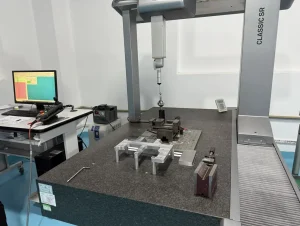
Moreover, they should always maintain extraordinarily narrow tolerance, which can be in the order of thousandths of an inch and checked with sophisticated inspection tools such as Coordinate Measuring Machines (CMMs). Find a supplier that has complex components such as those required for space satellite applications.
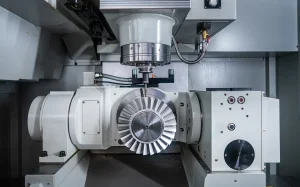
Quality Control and Inspection Systems
100 % Inspection Culture
Every aerospace component should undergo in-process, intermediate, and final inspections.
Modern facilities deploy:
- CMM (Coordinate Measuring Machines)with Zeiss or Mitutoyo sensors.
- Optical comparators and vision systemsfor small geometries.
- Surface roughness and hardness testersto verify finishing and material conditions.
First Article Inspection (FAI) and PPAP
FAI reports, built under AS9102 standards, verify that the first production part fully matches drawing requirements.
For long-term or high-volume aerospace projects, the supplier should support PPAP (Production Part Approval Process) documentation.
Traceability and Documentation
Traceability is the backbone of aerospace quality assurance. Every part should have:
Unique part identification (laser marking or serial number).
Material certificates (MTRs) and heat-lot records.
Process traveler sheets recording every machining and inspection step.
Surface Treatment and Finishing Capabilities
Aerospace aluminum parts are rarely used “as-machined.” Verify whether your supplier can provide or manage finishing operations under aerospace standards.
| Process | Purpose | Common Standards |
| Anodizing (Type II / III) | Corrosion & wear resistance | MIL-A-8625 F |
| Chromate Conversion (Alodine) | Conductive corrosion protection | MIL-DTL-5541 |
| Passivation / Electropolish | Clean stainless & enhance fatigue life | ASTM A967 |
| Bead Blast / Micro-Finish | Uniform appearance & low Ra | Internal spec |
| Laser Engraving | Permanent traceability marking | ISO 14145 |
A partner with in-house or certified finishing partners shortens lead times and ensures surface integrity remains consistent across assemblies.
Reasonable Lead Time
The other important competitive advantage in aerospace is speed. A survey conducted in 2025 established that more than 54 percent of the professionals within the industry have put speed as a priority in manufacturing.
Collaborate with a machine shop that has consistent deadlines, one that has effective technologies such as 5-axis machining. The high-technology method can save 40-60 percent on the setup time because intricate components are made during a single process. This speed is provided by the ideal partner without any compromise on quality.
Regulatory Compliance and Certification Requirements
This is non-negotiable. Aerospace must have a machining partner that is AS9100 certified. It is the international standard of quality management system, especially in the aerospace industry, that introduces strict demands in the risk management, traceability, and control of processes.
This is a necessary certification that will be held by providers who provide the full range of CNC machining services to the aerospace industry.
Conclusion
The practice of aerospace CNC machining is one of the foundations of contemporary aviation and space exploration, as it allows the elements that be of the utmost quality regarding the level of precision, safety, and performance.
Everything that is related to the critical benefits and the common materials, to the abilities of choosing a qualified manufacturing partner, in order to be a successful participant in the challenging sphere of CNC machining for aerospace, one should be informed about all the aspects of the processes.
With the ways of technology, such as the trend of AI-based automation and hybrid production, the limits of the possibilities of CNC aerospace machining can only expand to further the limits of the possibilities in the skies and beyond.