Discover the core differences between Invar and Stainless Steel. Learn why engineers choose Invar for thermal stability and Stainless Steel for corrosion resistance in CNC machining.
Invar vs. Stainless Steel: What You Need to Know
In the world of precision CNC machining, Invar (specifically Invar 36) and Stainless Steel (like 304/316) may both look like shiny, silver metals, but their design purposes, physical properties, and machining logic are worlds apart.
If we had to summarize their core difference in a single sentence:
Invar
Engineered purely for “Dimensional Stability” (extreme resistance to thermal expansion, but it will rust).
Stainless Steel
Engineered purely for “Corrosion Resistance” (extreme resistance to rust, but it expands and contracts significantly with heat).
As a precision CNC manufacturing partner like Rollyu Precision, here is the core comparison you need to understand when evaluating these materials for your next project.
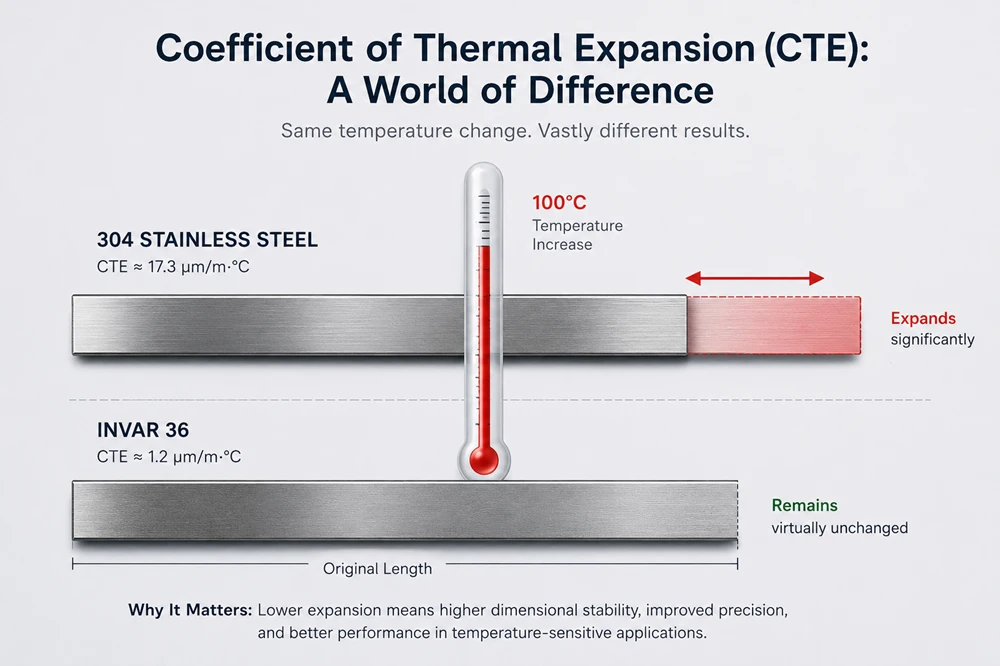
Coefficient of Thermal Expansion (CTE): A World of Differenc
This is the absolute deciding factor when engineers must choose between these two materials.
Stainless Steel (High Expansion)
Standard stainless steel is actually quite poor at dimensional stability. Austenitic stainless steel has a relatively high CTE (around 16.0 to 17.0 x 10⁻⁶ /°C), which is even higher than standard carbon steel. A slight temperature increase will cause noticeable thermal expansion and warping.
Invar 36 (Near Zero Expansion)
Invar’s expansion coefficient is only about 1/15th that of stainless steel (approx. 1.2 x 10⁻⁶ /°C). In ultra precision equipment (such as 5 axis air bearing stages, lasers, and optical mounts), standard stainless steel will deform by tens of microns when temperatures change, causing catastrophic system failure. Invar, however, experiences virtually zero microscopic deformation.
Corrosion Resistance: Invar’s Absolute Weakness
While Invar wins on thermal stability, Stainless Steel dominates in durability against the elements.
Stainless Steel 304/316
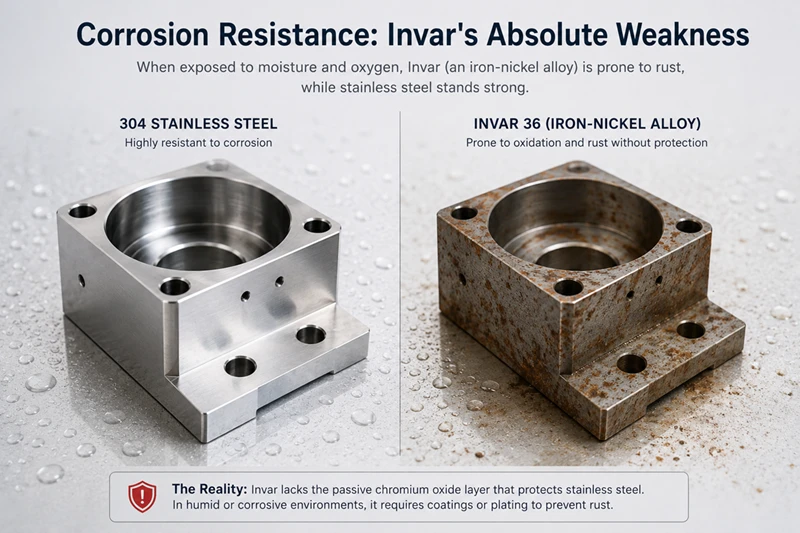
Stainless steel contains a high amount of Chromium (Cr) (over 10.5%). This forms a dense chromium oxide “passive layer” on the surface, giving the metal exceptional, built in rust and corrosion resistance.
Invar 36
Its main composition is roughly 36% Nickel and 64% Iron, completely lacking Chromium. Therefore, Invar will rust! In humid environments, or even if touched by sweaty bare hands, the surface of an Invar part will quickly oxidize.
Machining Tip
After machining, Invar parts must be immediately coated with anti rust oil and properly packaged. For long term use, customers typically require post process surface treatments, such as nickel or gold plating, to protect Invar from corrosion.
Machinability Comparison (A CNC Perspective)
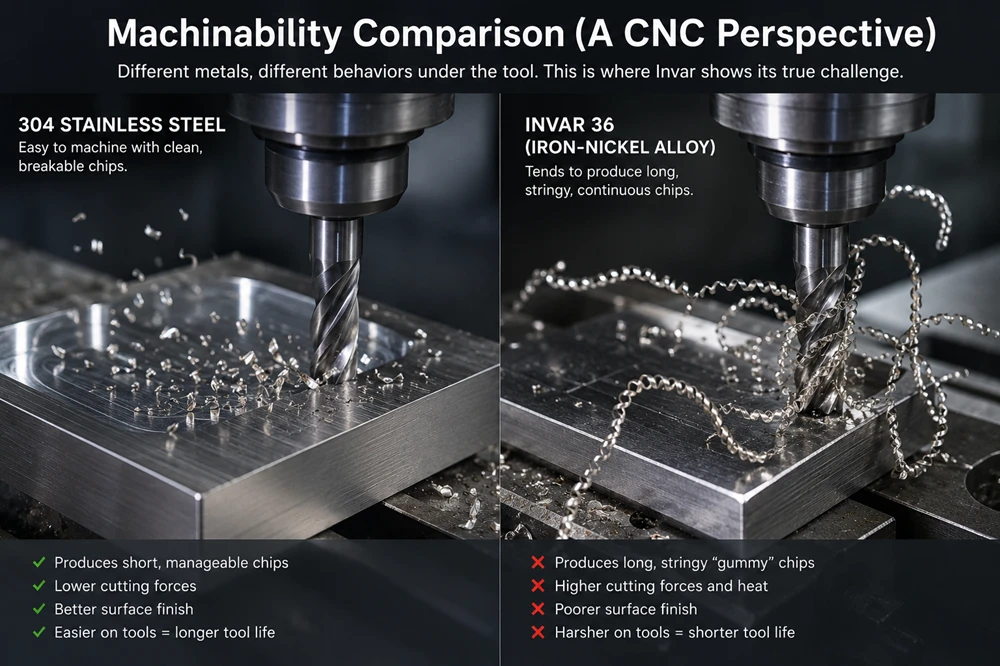
For CNC milling machines and lathes, both materials feature an austenitic structure that classifies them as “difficult to machine.” However, their specific pain points are very different.
Machining Stainless Steel
Stainless steel is known for its high toughness and severe work hardening. However, because it is so universally common, tooling manufacturers have developed highly mature, specialized cutting tools and well documented machining parameters. An experienced machine shop can handle it with ease.
Machining Invar
The machining difficulty of Invar is significantly higher than standard stainless steel due to three major factors:
Extremely “Gummy”
It is softer and gummier than 304 SS. The chips behave like chewing gum, refusing to break cleanly. They easily form a Built Up Edge (BUE) on the cutting tool, which leads to poor surface finishes.
Severe Work Hardening
Although the base material is relatively soft, cutting friction causes the surface to harden rapidly, quickly wearing out and destroying cutting tools.
Internal Stress Control
Because Invar is used exclusively for ultra high precision components, a strict Stress Relieving Annealing process must be added after rough machining. Without this thermal treatment, residual stresses will cause the material to undergo microscopic warping during finish machining or long term storage.
Cost and Pricing
When budgeting for your project, the difference between these two metals is substantial.
Material Cost
The raw material cost of Invar is typically 5 to 10 times higher than standard 304/316 stainless steel (and is heavily influenced by fluctuating global nickel prices).
Machining Cost
Due to slower cutting speeds, rapid tool wear, and the mandatory inclusion of multiple heat treatments, CNC machining quotes for Invar are generally 50% to 100% higher than a stainless steel part of the exact same geometry.
Summary Comparison Table
While both are iron based alloys, Invar 36 and stainless steel serve completely different purposes.
Invar 36
offers unmatched dimensional stability with near zero thermal expansion, perfect for high precision applications.
Stainless Steel
Stainless steel provides exceptional corrosion resistance but expands significantly under heat, making it ideal for general manufacturing.
| Feature / Dimension | Invar 36 | Stainless Steel (304 / 316) |
| Core Value Proposition | Ultra low thermal expansion, ultimate dimensional stability. | Excellent rust and corrosion resistance. |
| Thermal Expansion (CTE) | ~1.2 x 10⁻⁶ /°C (Extremely low) | ~16.0 x 10⁻⁶ /°C (Relatively high) |
| Will it rust? | Yes (Usually requires surface plating) | No (Inherent anti-rust properties) |
| Primary Composition | 36% Nickel (Ni) + 64% Iron (Fe) | Iron + 18% Chromium (Cr) + 8-10% Nickel (Ni) |
| Typical Applications | Optical instruments, aerospace structures, metrology, OLED masks. | Medical devices, food processing, fluid piping, structural parts. |
| Machinability Difficulty | ⭐⭐⭐⭐⭐ (Extremely Hard: Gummy, work hardens, stress sensitive) | ⭐⭐⭐ (Medium: Mature processes and specialized tooling available) |
| Overall Cost | Very Expensive | Highly Cost Effective |
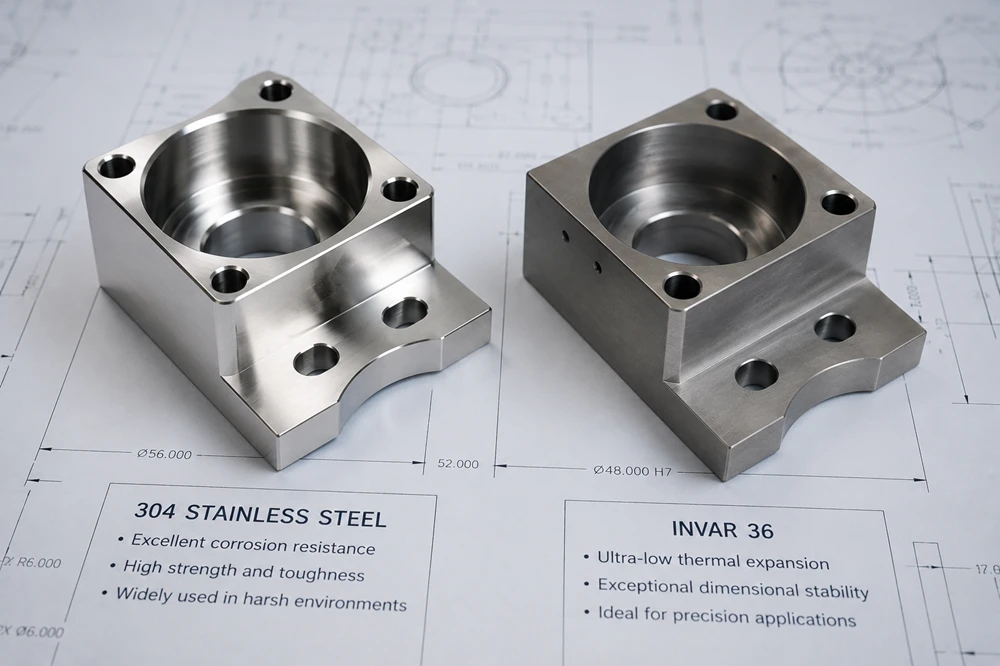
Expert Engineering Advice from Rollyu Precision
At Rollyu Precision, we frequently review engineering drawings that specify Invar for standard structural components simply because it sounds like a premium aerospace material. However, if your part does not require strict thermal stability, using Invar is often an expensive case of over engineering that complicates manufacturing.
The Hidden Costs of Unnecessary Invar
Specifying Invar unnecessarily will drastically increase both your raw material expenses and CNC machining costs. Furthermore, because it lacks chromium, your expensive structural component will be highly susceptible to rust, requiring additional protective surface treatments for long term use.
Why Stainless Steel is Often the Better Choice
If thermal expansion is not a critical factor for your assembly, our engineers highly recommend switching to 304 or 316 stainless steel. This simple material change will save you a significant amount of money while providing vastly superior built in corrosion resistance.
Frequently Asked Questions About Invar
Can I upgrade my parts from Stainless Steel to Invar for better quality
Not necessarily. Unless your specific application requires absolute dimensional stability under fluctuating temperatures (like laser optics or aerospace sensors), switching to Invar is not an “upgrade.” It will drastically increase your manufacturing costs and make the part susceptible to rust, whereas stainless steel would naturally resist corrosion.
Does Invar rust like regular iron
Yes. Because Invar is composed of 64% iron and lacks the protective Chromium found in stainless steel, it is highly vulnerable to oxidation. If left exposed to humid air or touched by bare hands, it will quickly develop rust. For permanent applications, Invar usually requires protective plating (such as nickel, silver, or gold).
Why is machining Invar so much more expensive than Stainless Steel
Machining Invar is more expensive due to extended machining times and tooling costs. Invar is “gummier” than stainless steel and work hardens rapidly, meaning CNC machines must run at slower speeds to prevent tool breakage. Additionally, Invar parts require specialized, time consuming heat treatments (stress relief annealing) between machining phases to guarantee they maintain their ultra low thermal expansion properties.
Conclusion
Choosing between Invar and Stainless Steel ultimately depends on whether your project demands absolute thermal stability or superior corrosion resistance. Both metals require expert handling. Whether you need the zero expansion precision of Invar or the rugged durability of stainless steel, Rollyu Precision provides the advanced CNC machining expertise to deliver flawless components for your critical applications.