Discover what Invar and Invar 36 are. Learn about their unique low thermal expansion properties and explore why Invar machinability poses extreme challenges for CNC manufacturing.
What is Invar
Understanding Invar 36 and Its Machinability Challenges
Invar is a well known nickel iron alloy. Its name is derived from the word “invariable,” which perfectly encapsulates its core physical characteristic: within a certain temperature range, its dimensions remain almost entirely unchanged.
Simply put, it is a metal that “neither expands with heat nor contracts with cold.”
What is Invar The Basics of the Nickel Iron Alloy
If you have ever tried to open a stuck metal jar lid by running it under hot water, you have witnessed thermal expansion in action. Almost all metals expand when they get hot and contract when they get cold.
But what if you are building a satellite, a high powered laser, or a precision motion control system, where even a microscopic shift in size could cause a catastrophic failure? That is where Invar comes in.
Here is a breakdown of what Invar is, how it works, and why it is so important to modern engineering.
What Exactly is Invar 36
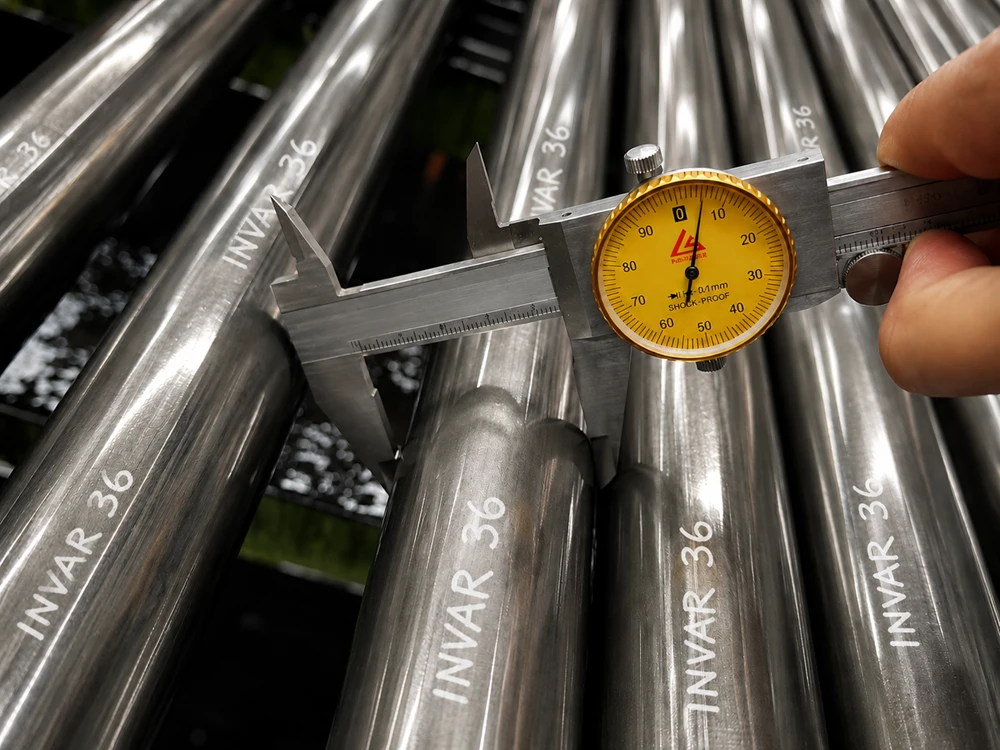
Invar 36, also known as 4J36 or Vacodil 36, is a specialized iron nickel alloy renowned for its ultra low coefficient of thermal expansion (CTE). To maintain its core properties, strict control of its carbon and manganese content is crucial. Furthermore, cold working can be used to further lower its CTE, while heat treatment within a specific temperature range ensures this expansion rate remains completely stable.
The Properties of Invar 36
Invar 36 is a unique nickel iron alloy composed of 36% nickel and 64% iron. Its most remarkable property is a near zero coefficient of thermal expansion. From cryogenic temperatures up to 200°C, it maintains exceptional dimensional stability, making it the ultimate material for high precision engineering applications.
Chemical Composition:
- Nickel (Ni): 35.0% to 37.0%
- Iron (Fe): Balance (Remainder)
- Trace Impurities: Contains small amounts of Carbon (C) ≤0.05%, Manganese (Mn), Silicon (Si) ≤0.3%, Phosphorus (P) ≤0.02%, and Sulfur (S) ≤0.02%.
Chemical Composition of Invar 36
| Element | Symbol | Percentage (%) | Notes |
| Nickel | Ni | 35.0% – 37.0% | The key element for the Invar Effect. |
| Iron | Fe | Balance (Remainder) | The primary base metal (approx. 64%). |
| Carbon | C | ≤ 0.05% | Trace impurity; strictly controlled. |
| Silicon | Si | ≤ 0.3% | Trace impurity. |
| Manganese | Mn | Trace Amount | Strict control is crucial for CTE stability. |
| Phosphorus | P | ≤ 0.02% | Trace impurity. |
| Sulfur | S | ≤ 0.02% | Trace impurity. |
How Does the “Invar Effect” Work
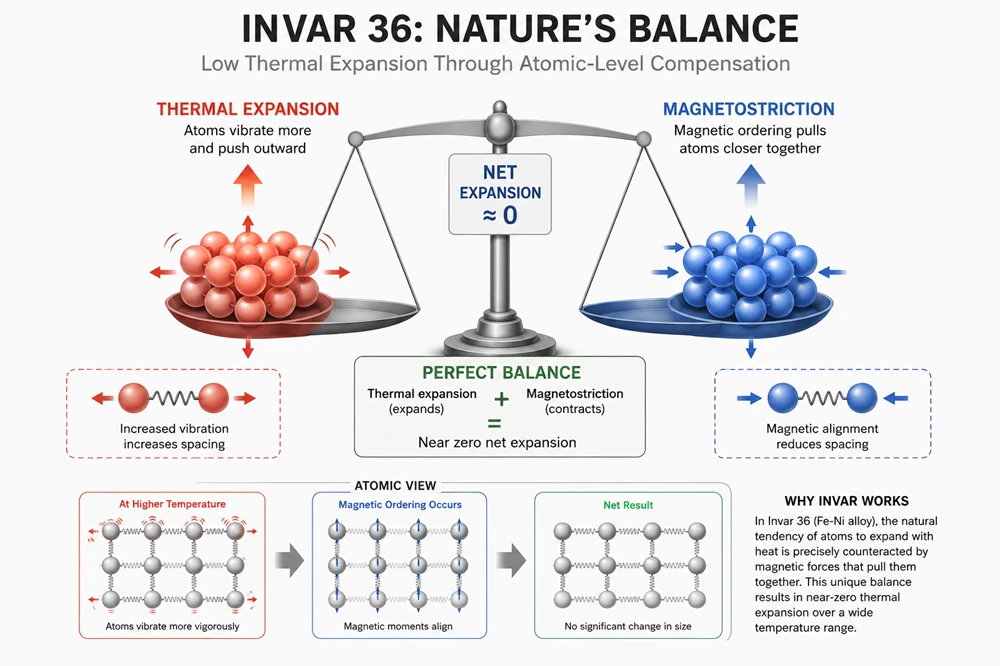
While most metals naturally expand when heated and contract when cooled, Invar completely defies these fundamental thermodynamic rules. This incredible dimensional stability is not magic, but rather the precise result of a fascinating internal struggle between heat and magnetism. Let’s explore the underlying atomic science behind this unique anomaly known as the Invar Effect.
Why Doesn’t It Expand Like Normal Steel or Iron
The true secret to this remarkable dimensional stability lies in a complex quantum physics phenomenon known as the Invar Effect, where the unique magnetic interactions between the nickel and iron atoms at a subatomic level perfectly counteract the natural tendency of the metal lattice to expand when exposed to heat.
The Role of Magnetostriction
As Invar heats up, the natural thermal expansion of the atoms moving further apart is perfectly counteracted by a magnetic property called magnetostriction.
A Perfect Cancellation
As the metal gets warmer, it loses some of its magnetic properties, which causes the atomic lattice to shrink. The expansion from the heat and the shrinking from the magnetic loss cancel each other out, resulting in a metal that stays exactly the same size.
Common Applications of Invar
Because of its dimensional stability, Invar is the go to material for industries where precision is non negotiable:
Aerospace & Satellites
Spacecraft experience drastic temperature swings as they move in and out of the sun’s direct rays. Invar is used for structural frames and optical mounts to ensure telescopes and sensors do not warp in orbit.
Liquefied Natural Gas (LNG) Tanks
LNG must be transported at super cooled cryogenic temperatures (-162°C / -260°F). The inner membranes of massive LNG carrier ships are often made of Invar so they do not shrink and crack under extreme cold.
Precision Instruments
It is used in surveying tapes, laser housings, seismographic tools, and scientific measuring devices.
High Precision Linear and Rotary Encoders
Encoders are the “eyes” of a motion control system; they read a scale to tell the computer exactly where a moving part is positioned.
Nanopositioning and Piezoelectric Stages
In fields like microscopy, photonics, and cell biology, motion control systems use piezoelectric actuators to move samples by mere nanometers.
Composite Manufacturing
When aerospace companies cure massive carbon fiber airplane parts in hot ovens, they use Invar molds. Because the mold doesn’t expand, the carbon fiber part comes out perfectly shaped.
Robotic End Effectors in Extreme Environments
In specialized robotics, the “hand” or tool at the end of the robotic arm (the end effector) must maintain a precise grip or calibration.
Common Industrial Applications of Invar 36
| Industry / Sector | Specific Application | Why Invar is Required |
| Aerospace & Space | Satellite structural frames, optical mounts | Prevents warping of telescopes/sensors during drastic temperature swings in orbit. |
| Energy & Shipping | Liquefied Natural Gas (LNG) carrier tanks | Prevents inner membranes from shrinking and cracking at cryogenic temperatures (-162°C). |
| Metrology & Optics | Surveying tapes, laser housings, seismographs | Ensures measuring devices maintain absolute accuracy regardless of environmental heat. |
| Motion Control | Linear/rotary encoders, piezoelectric stages | Allows nanopositioning systems to move samples by mere nanometers without thermal distortion. |
| Advanced Manufacturing | Composite curing molds | Ensures large carbon-fiber aerospace parts cure in hot ovens without the mold expanding. |
| Robotics | End-effectors in extreme environments | Maintains a precise grip and calibration when operating in fluctuating temperatures. |
Other Types of Invar
While Invar 36 is the standard, metallurgists have created variations for specific needs.
Super Invar
By adding a small amount of Cobalt (usually 5%), the thermal expansion rate drops to almost absolute zero at room temperature, making it even more stable than standard Invar.
Kovar
Another related nickel iron alloy designed to have the exact same expansion rate as borosilicate glass, allowing metal and glass to be sealed together in lightbulbs and vacuum tubes without shattering.
Invar is the unsung hero of modern precision. Whether it is safely transporting freezing liquid gas across the ocean or keeping a space telescope focused on distant galaxies, this unique nickel iron alloy proves that sometimes, the best thing a metal can do is absolutely nothing at all.
Invar 36 vs. Other Precision Alloys
| Alloy Type | Key Characteristic | Primary Use Case |
| Invar 36 (Standard) | Near-zero thermal expansion from cryogenic to 200°C. Highly magnetic. | Aerospace, LNG tanks, high-precision tooling and instruments. |
| Super Invar | Adds ~5% Cobalt. Thermal expansion drops to almost absolute zero at room temp. | Ultra-precise optical instruments where even standard Invar fluctuates too much. |
| Kovar | Thermal expansion rate is engineered to perfectly match borosilicate glass. | Vacuum tubes, lightbulbs, and glass-to-metal hermetic seals. |
| Stainless Steel (304/316) | Excellent corrosion resistance (contains Chromium), but expands significantly with heat. | General manufacturing, medical, and food-grade applications where thermal expansion is not a critical issue. |
Invar Machinability: Why is Invar So Difficult to Machine
While Invar is celebrated for its incredible physical stability, working with this unique nickel iron alloy is notoriously difficult. Although it successfully eliminates the problem of thermal expansion, manufacturers face three significant engineering challenges during production and application. Overcoming these specific pain points requires specialized machining expertise, rigorous post processing, and extremely careful handling to ensure the final parts maintain absolute precision.
Poor Machinability
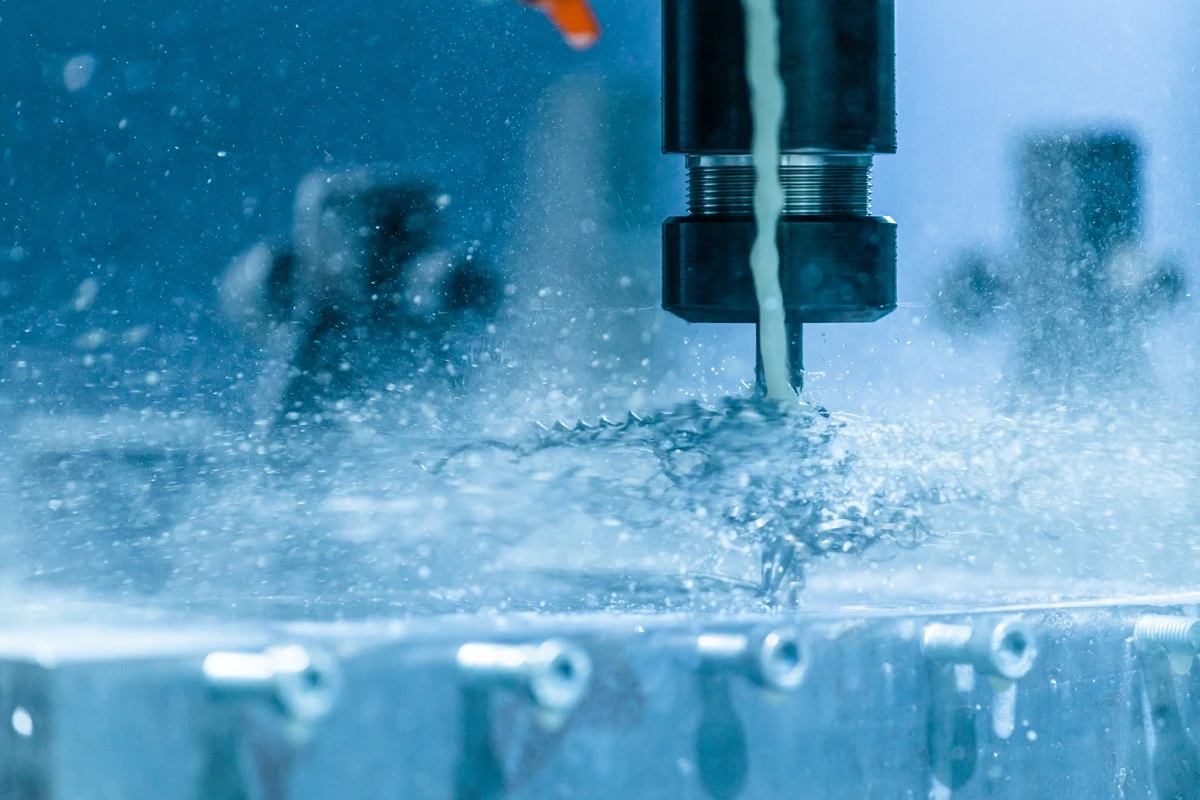
Invar is extremely difficult to machine because the material is highly gummy. It produces long, continuous chips that stick to cutting tools. Furthermore, it is highly prone to rapid surface work hardening during machining, which causes excessive and costly wear on your cutting tools.
Corrosion Susceptibility
Unlike stainless steel, Invar contains no chromium, offering poor rust resistance. If exposed to humid air or touched by bare hands, the surface quickly oxidizes and rusts. Consequently, finished components usually require protective surface plating, like nickel or gold, to prevent environmental corrosion.
Internal Stress Sensitivity
Invar is highly sensitive to internal stresses. After machining, components must undergo a rigorous stress annealing process. Without this critical thermal treatment, residual machining stresses will inevitably cause microscopic dimensional warping, completely destroying the material’s signature high precision stability over time.
Overcoming Invar Machining Challenges with Rollyu Precision
| Invar Machining Challenge | The Engineering Problem | The Rollyu Precision Solution |
| 1. Poor Machinability (Gummy) | Produces long, stringy chips and causes rapid work-hardening, leading to severe tool wear. | We utilize optimized cutting speeds, custom coolant strategies, and specialized carbide tooling to prevent work hardening. |
| 2. Corrosion Susceptibility | Lacks chromium; highly prone to oxidation and rust if exposed to humidity or bare hands. | We offer expert handling and advanced anti-corrosion surface treatments (like nickel or gold plating) for long-term protection. |
| 3. Internal Stress Sensitivity | Residual machining stress causes microscopic warping, destroying precision over time. | We employ rigorous stress-relieving thermal treatments (annealing) to completely eliminate internal stress and guarantee dimensional stability. |
Why Choose Rollyu Precision for Your Invar Projects
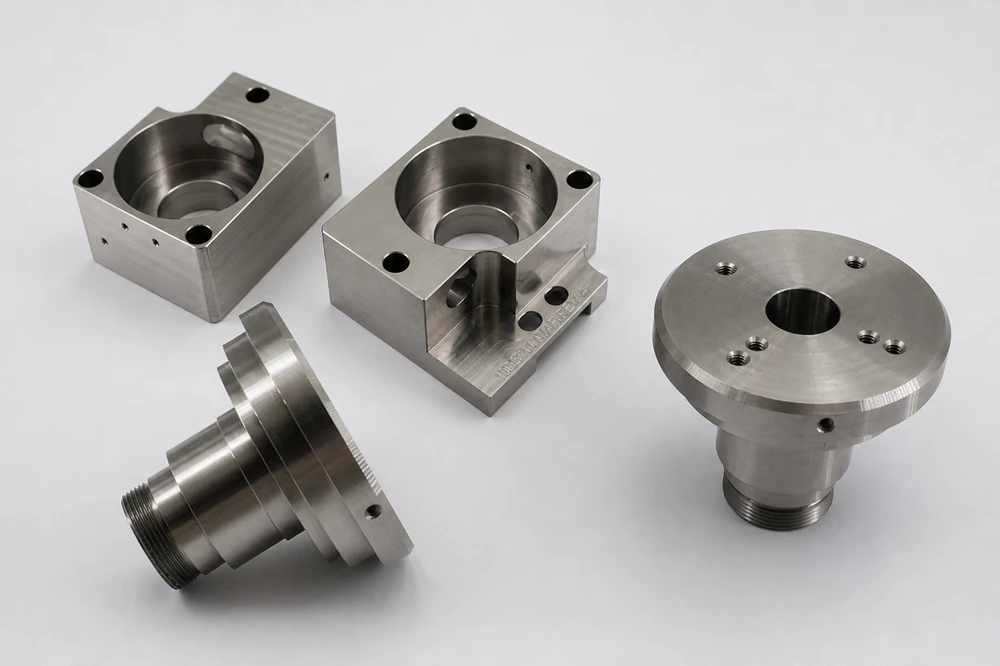
Machining Invar requires highly specialized knowledge and advanced technology to overcome its notoriously gummy nature and strict stress relieving requirements. At Rollyu Precision, we combine years of manufacturing expertise with cutting edge equipment to deliver flawless Invar components. We understand the unique engineering challenges of this material, ensuring your high precision parts are manufactured perfectly without ever compromising dimensional stability.
Proven Experience with Specialized Alloys
Rollyu Precision has years of hands on experience machining highly sensitive materials like Invar 36. Our skilled engineering team knows exactly how to optimize cutting speeds, tool selection, and critical heat treatment processes to prevent work hardening and eliminate internal stresses.
Advanced Multi Axis CNC Machining
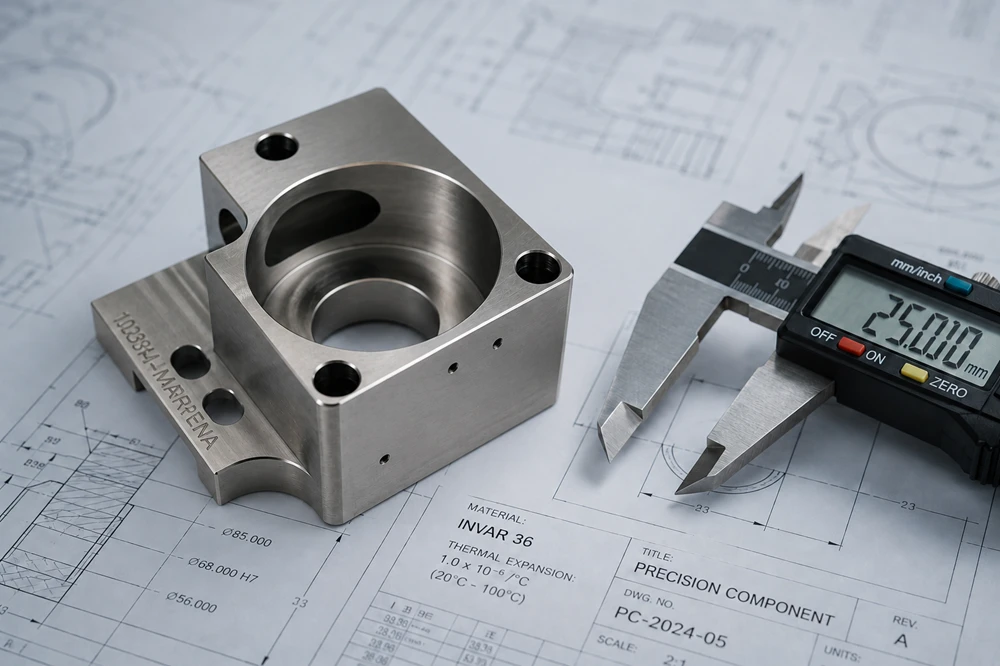
We utilize state of the art 4 axis and 5 axis CNC machining centers to tackle the most complex Invar geometries. This advanced technology allows us to achieve incredibly tight tolerances and ultra smooth surface finishes, reducing setup times and ensuring absolute repeatability for your components.
Mastering Difficult to Machine Materials
Invar is notoriously gummy and prone to rapid tool wear, but we have perfected the machining formulas to conquer it. From custom coolant strategies to advanced anti corrosion surface treatments, we successfully turn this difficult alloy into high precision, ready to use engineered parts.
Frequently Asked Questions About Invar
What is the difference between Invar and Invar 36?
There is essentially no difference in common industrial terminology. Invar is the general trademarked name for the alloy family, while “Invar 36” specifies the exact grade containing 36% Nickel and 64% Iron. When engineers ask “what is invar,” they are almost always referring to Invar 36.
Is Invar magnetic
Yes, Invar 36 is highly magnetic at room temperature. However, it loses its magnetic properties when heated above its Curie temperature (around 280°C or 535°F).
How does Invar machinability compare to Stainless Steel
Invar machinability is generally considered more difficult than standard 304 or 316 stainless steel. While both can work harden, Invar is “gummier” and produces stringier chips, requiring sharper, specialized carbide tooling and highly optimized cutting speeds to prevent tool failure.
Does Invar rust?
Yes. Unlike stainless steel, Invar does not contain Chromium. Because it is largely made of Iron (64%), it is susceptible to corrosion and rust in humid or corrosive environments. It often requires plating or protective coatings for long term use.
Conclusion
Invar 36 is an irreplaceable material for applications demanding absolute dimensional stability. However, its poor machinability and sensitivity to internal stress require a highly skilled manufacturing partner. Trust Rollyu Precision’s advanced multi axis CNC technology and proven metallurgical expertise to seamlessly transform this challenging alloy into flawless, high precision components for your critical projects.