

Selecting the right alloy is a critical balance of performance, feasibility, and cost. According to failure analysis data from ASM International, a significant percentage of industrial failures stem not from simple overload or design errors, but from improper material selection. This data highlights that mechanical failure is often a procurement failure before it ever becomes a structural one.
For manufacturers, this implies that “saving” money on generic specs is a trap that leads to expensive downtime. This guide acts as your decision-making framework, breaking down critical mechanical properties from Yield Strength to Machinability, to help you interpret standard data sheets and choose the most commercially viable alloy for your CNC projects.
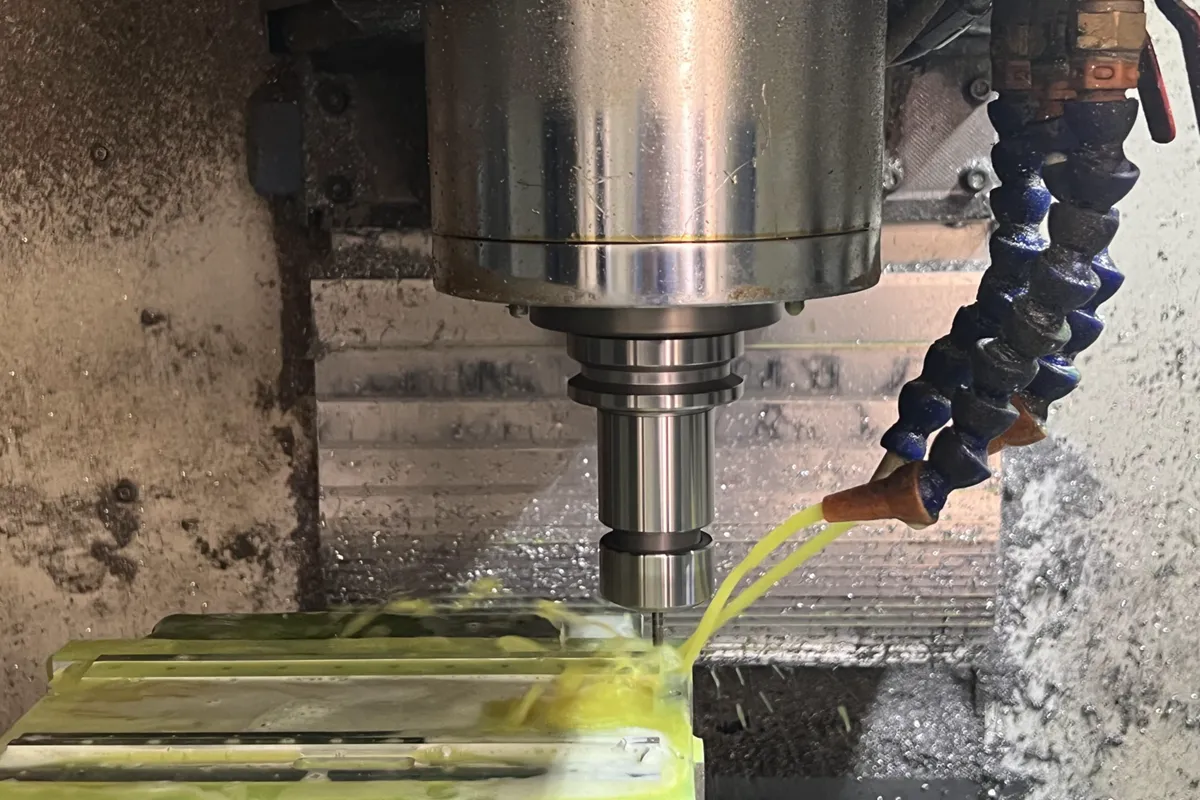
Common Properties of Metal Materials
When evaluating alloy specifications, “strength” is an umbrella term that is often misused. A material might be incredibly resistant to compression but fail catastrophically under tension. To select the viable candidate for your application, you must interpret how the metal behaves under specific force vectors.
Tensile Strength
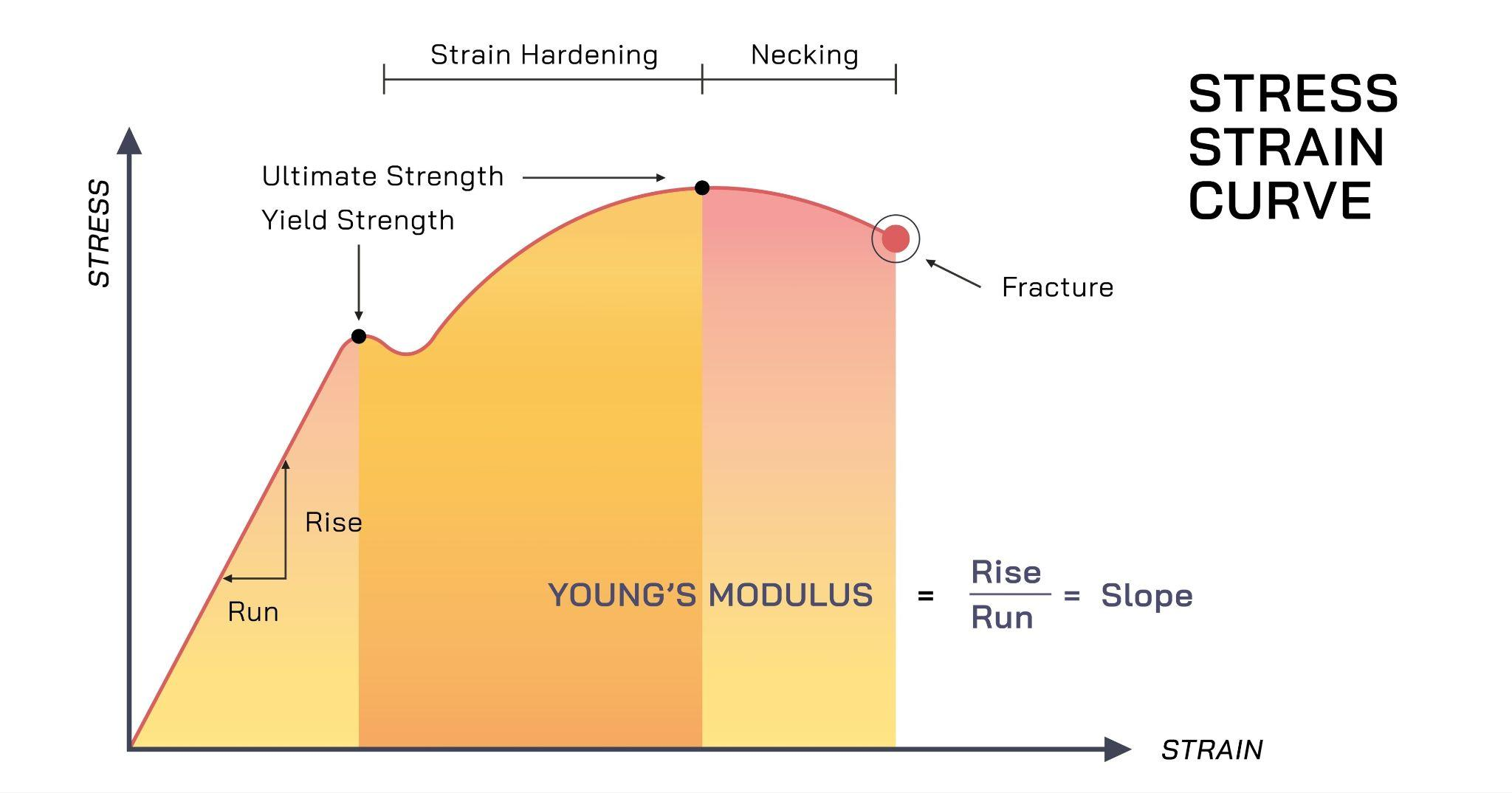
Often the headline figure on data sheets, Ultimate Tensile Strength (UTS) measures the maximum stress a material can withstand while being pulled before it fractures. While UTS is the most common specification referenced during procurement, it represents the point of total failure—the snap.
In practice, if a component is stressed near its tensile limit, it has likely already undergone significant necking or elongation, rendering it functionally useless. Therefore, UTS indicates the absolute ceiling of performance, not the operational safe zone.
Yield Strength
This is the most critical metric for structural engineers. Yield Strength marks the point where a material transitions from elastic deformation (bouncing back) to plastic deformation (staying bent).
Once a load passes the yield point, the part is permanently damaged. For 99% of CNC machined parts, you are designing to stay below the Yield Strength, not the Tensile Strength. If your part yields, the assembly creates tolerance stack-up issues or simply fails to function.
Impact Strength
Static load capacity does not guarantee performance under sudden stress. Impact strength measures a metal’s “toughness”—its ability to absorb energy from a rapid blow (shock loading) without fracturing.
There is often an inverse relationship: harder materials with high tensile strength tend to be brittle, shattering like glass under impact. Conversely, tougher materials act as shock absorbers. This metric is non-negotiable for components in mining, excavation, or firearms. Note that temperature plays a huge role; many carbon steels lose impact strength significantly in sub-zero environments.
Compressive Strength
Compressive strength is the capacity to withstand being squeezed or crushed. While ductile metals like aluminum and mild steel typically exhibit compressive strengths similar to their tensile limits, this metric is the defining factor for brittle materials like cast iron or high-hardness alloys.
In applications involving heavy machinery bases, support columns, or bearings, the primary threat is not stretching, but buckling. For these load-bearing scenarios, a high compressive rating is essential to prevent the material from collapsing under the assembly’s own mass or operational load.
Metal Strength Chart
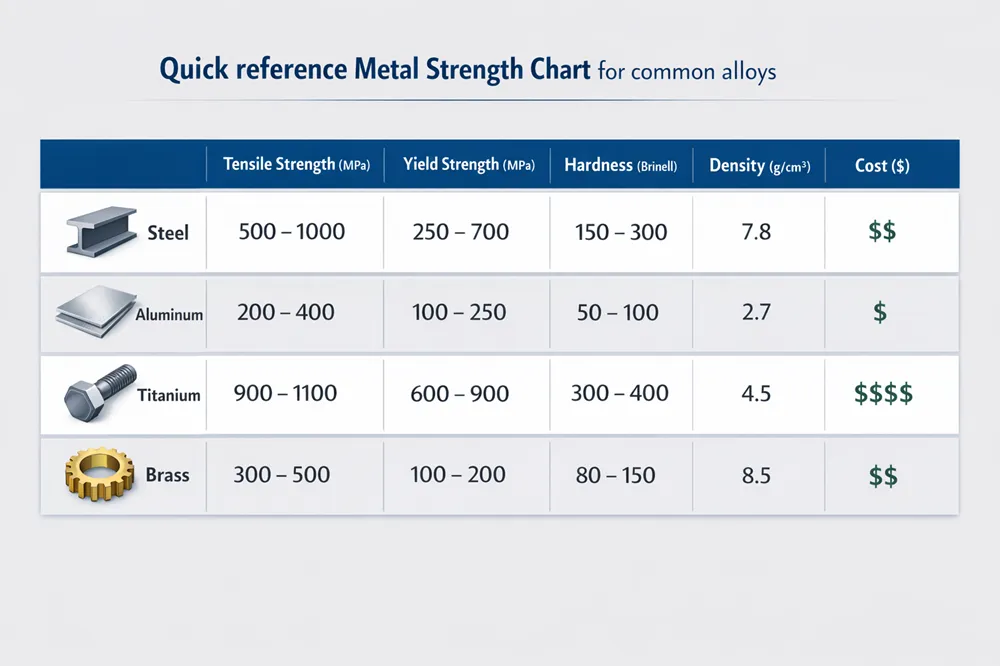
When browsing material catalogs, you will encounter thousands of ASTM and ISO standards. However, for most commercial CNC projects, the choice boils down to four primary categories: Steel, Aluminum, Titanium, and Brass.
The following chart provides a baseline comparison:
| Material Family | Alloy Grade (Ref) | Tensile Strength (MPa) | Yield Strength (MPa) | Hardness (Brinell) | Density (g/cm³) | Cost Index |
| Stainless Steel | 304 | 505 – 700 | 215 | 123 | 8.00 | Medium |
| Carbon Steel | 1045 | 565 – 585 | 310 | 163 | 7.87 | Low |
| Aluminum | 6061-T6 | 310 | 276 | 95 | 2.70 | Low-Med |
| Titanium | Ti-6Al-4V | 950 | 880 | 334 | 4.43 | High |
| Brass | C360 | 340 – 400 | 180 – 300 | 100 | 8.49 | Medium |
These are average values for standard tempers. Specific heat treatments can drastically alter these numbers.
Steel vs. Aluminum: Strength-to-Weight Ratio
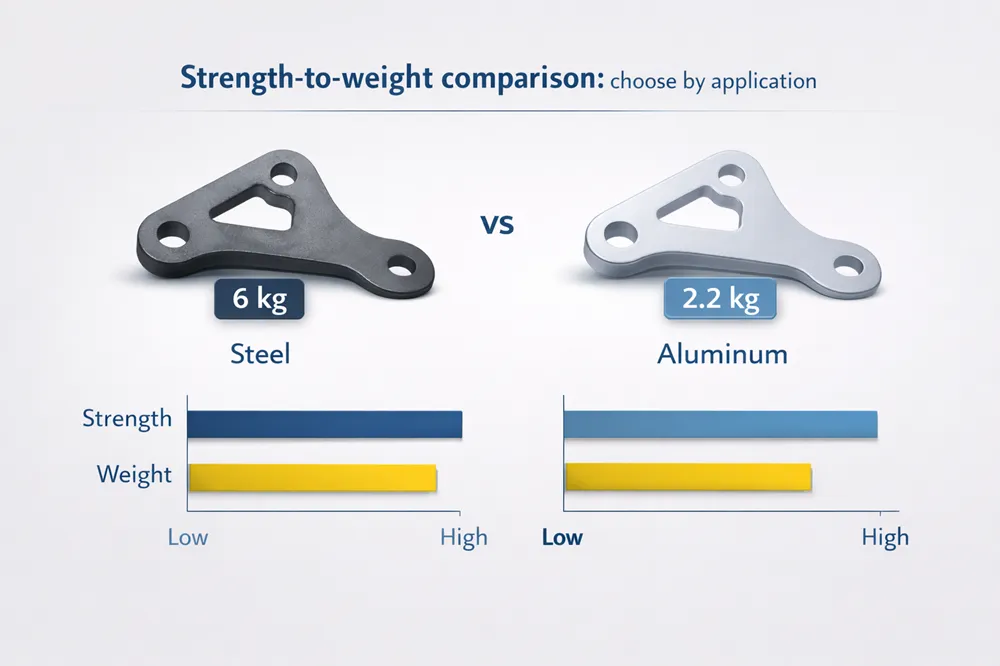
Here is the trap many junior engineers fall into: they pick steel simply because the “Tensile Strength” number is higher. On paper, steel wins. In the field, gravity often makes steel a liability.
Raw strength means nothing if the component is too heavy to function efficiently. This is where Specific Strength (Strength-to-Weight Ratio) dictates the design.
- The Steel Reality: It’s cheap, rigid, and tough. But at 7.8 g/cm³, it’s heavy. If you are building a bridge or a stationary machine base, weight is actually your friend (vibration dampening).
- The Aluminum Advantage: Aluminum 6061-T6 has roughly half the raw strength of steel, but it’s one-third the weight. Pound for pound, aluminum is actually “stronger.”
If the part moves (EV chassis, robot arms, drones), steel is likely overkill and overweight—use Aluminum. If the part stays put and holds a building up, stick with Steel.
The Strongest Metals for Heavy-Duty Applications
When you need serious performance, we’re talking high-pressure environments or cyclic fatigue—standard “mild steel” won’t cut it. You generally have two premium paths, and your budget will decide which one you take.
Titanium (Ti-6Al-4V): The “Aerospace” Route Titanium is the darling of the engineering world for a reason. It gives you the strength of heat-treated steel at nearly half the weight, plus it’s virtually immune to corrosion. The catch? It is painfully expensive. Not just to buy, but to machine. You only specify Titanium if the application absolutely demands it—like jet engine fans, medical implants, or high-end racing components. If you use it for a simple bracket, you’re just burning money.
High-Strength Steels: The “Industrial” Route For parts that abuse the ground—mining drills, automotive axles, hydraulic shafts—you don’t need light weight; you need toughness. AISI 4140 is the workhorse here. It’s significantly cheaper than titanium and can be heat-treated to massive yield strengths. It doesn’t snap; it takes a beating. If your part is going deep underground or inside a heavy engine, forget the fancy exotic alloys and stick to high-grade steel.
Best Alloys for CNC Machining and Fabrication
You can design the strongest part in the world, but if the machine shop can’t cut it efficiently, you don’t have a product, you have a production bottleneck. Machinability is the hidden cost driver.
- Brass (C360): We call it “free-machining” for a reason. It cuts like butter, extends tool life, and allows for incredibly fast cycle times. If you need thousands of small fittings or spacers, Brass is often the cheapest final part, even if the raw material cost is higher than steel.
- Aluminum 6061-T6: The default for 80% of CNC parts. It machines fast, dissipates heat well, and creates manageable chips.
- High-Wear Alloys: 304 Stainless and Titanium. 304 likes to “gum up” and work-harden if the tool dwells. Titanium generates massive heat that stays in the cutter, destroying tools rapidly.
Always consult with your manufacturer early. A slight tweak in alloy choice like switching from 304 Stainless to 303 Stainless can sometimes drop your machining costs by 20% without sacrificing real-world performance. Reliable CNC Machining Services can usually spot these cost-saving opportunities before you finalize the design.
What Else Matters for Your Project?
While the metal strength chart is your starting point, it shouldn’t be your finish line. In B2B manufacturing, a material with “perfect” mechanical properties can still be the wrong choice if it kills your budget or fails environmentally.
Balancing Cost vs. Strength
There is a tendency in engineering to pick the strongest alloy “just to be safe.” Over-engineering is a sin. Specifying a high-grade tool steel for a non-critical bracket isn’t “quality”, it’s a waste of capital.
You must identify the Minimum Viable Material. If standard Carbon Steel (1018) handles the load with a safety factor of 2.0, upgrading to Titanium Ti-6Al-4V doesn’t make the product better; it just makes it 20 times more expensive. Always weigh the “Cost Per Pound” against the actual performance requirements.
Machinability and Production Efficiency
Here is the hidden killer of project margins: Cycle Time. You might save $5 on raw material by choosing a harder, cheaper steel, but if that material takes twice as long to machine, you have lost money. Harder alloys wear out cutting tools faster and require slower spindle speeds. For high-volume production (1,000+ units), prioritize alloys that chip easily and keep the machines running (like 12L14 Steel or 6061 Aluminum).
Environmental Resistance
Strength means nothing if the part rusts away. A Carbon Steel beam has immense load-bearing capacity, but place it in a marine environment without coating, and it becomes a liability.
- Corrosion: For outdoor or chemical applications, Stainless Steel (316) or Anodized Aluminum is non-negotiable.
- Temperature: Aluminum loses significant strength above 400°F (200°C). For high-heat zones, look at Stainless or Nickel-based alloys (Inconel).
- Galvanic Reaction: Be careful mixing metals. Bolting an Aluminum part to a Steel frame in a wet environment creates a battery, causing rapid corrosion.
How Rollyu Helps You Choose the Right Material
Choosing the right alloy is pointless if the manufacturing process fails. At Rollyu Precision, we act as your technical firewall, bridging the gap between theoretical design and production reality to ensure your specs are met economically.
Design for Manufacturing (DFM) Support
The most expensive material is often the one that cannot be machined efficiently. Rollyu’s engineering team provides comprehensive DFM reviews at the quoting stage. We don’t just look for “un-machinable” features; we optimize for ROI. For instance, we might suggest swapping a costly exotic alloy for a high-strength Aluminum (like 7075) that offers similar performance at a fraction of the machining cost. By optimizing your design for our 5-axis CNC capabilities before production starts, we prevent over-engineering.
Material Verification and Quality Control
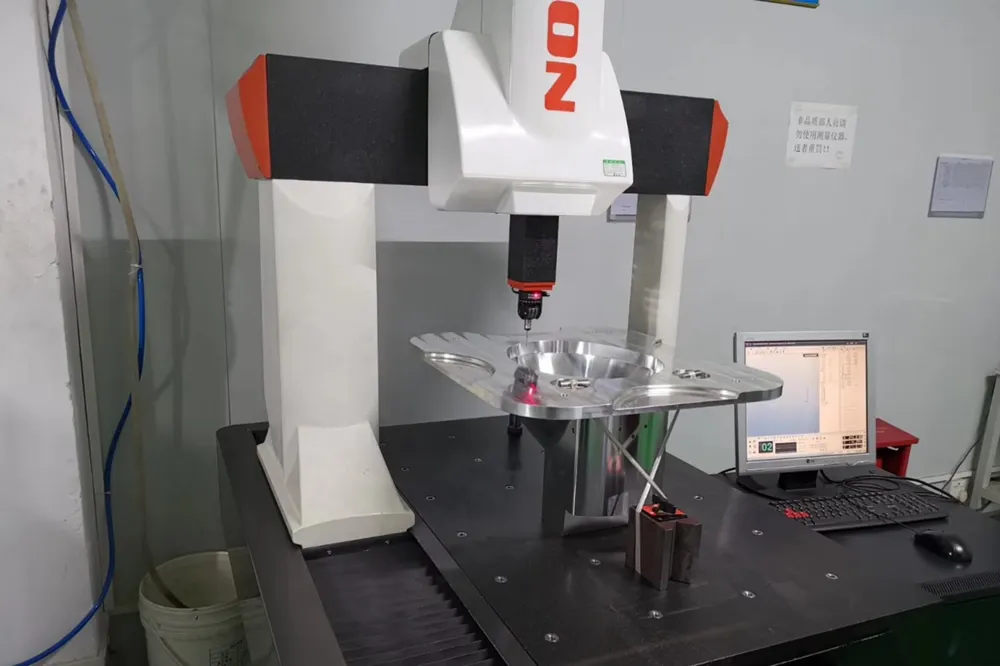
In precision manufacturing, “trust but verify” is the only rule. Rollyu enforces a strict 100% Incoming Materials Inspection protocol. Every batch of raw stock is cross-referenced against mill certificates (MTRs) to ensure no sub-standard material enters the line. Backed by ISO 9001 and ISO 13485 (Medical Devices) certifications, we use advanced CMM (Coordinate Measuring Machines) to guarantee your specs are met. From the first article to the final shipment, we provide the traceability you need to launch with confidence.
FAQ
What is the difference between strength and toughness in metals?
Strength measures how much load a material can hold before it deforms (Yield) or breaks (Tensile). Toughness measures how much energy it can absorb before fracturing. A material can be strong but brittle (like glass), whereas a tough material withstands impact.
Can heat treatment improve strength without changing materials?
Yes. Processes like quenching and tempering (or precipitation hardening in aluminum) can significantly increase the hardness and yield strength of standard alloys. This allows you to achieve high performance using affordable materials.
Does choosing a stronger alloy always increase the final part cost?
Yes, but usually due to machining time rather than material price. Stronger alloys are harder to cut, which increases tool wear and slows down production speed. This extended cycle time is often the biggest driver of the final part cost.