

Choosing the right medical sheet metal fabrication company can feel overwhelming. There are many suppliers promising precision, but only a few truly understand what medical device manufacturers require — strict tolerances, biocompatible materials, traceability, and compliance with ISO 13485 standards.
At Rollyu Precision, every project we take on is handled with care and precision. From cutting and bending to welding, finishing, and inspection, each step follows the strict regulatory standards of the medical sector. Our goal is simple: to deliver metal components that are accurate, clean, and safe to use — every time.
In this guide, we’ll walk through what medical sheet metal fabrication is, how it’s used in the medical industry, and the key factors to consider when choosing a fabrication partner.
What Is Medical Sheet Metal Fabrication
Medical sheet metal fabrication produces metal parts for medical devices, equipment, and surgical tools. Typical parts include trays, housings, brackets, covers, and small structural components. The process combines precision cutting, bending/forming, welding, finishing, and inspection to deliver parts that are cleanable, corrosion-resistant, and durable under repeated sterilization.
Common fabrication processes
- CNC Laser Cutting cuts metal sheets to precise shapes with smooth edges.
- CNC Bending and Forming is used to bend stainless steel or aluminum to make trays, panels, or housings in specific sizes.
- TIG Welding is used to join parts together with a strong and clean weld.
- Deburring flattens the edges and applies finishes such as brushed or electropolished finishes to facilitate easy cleaning of parts.
- Inspection and quality control identify dimensions, flatness, and surface quality to make sure that all is on firm medical standards.
We use medical-grade stainless steel 304 and 316. These materials resist corrosion and are capable of undergoing repeated sterilization. Surgical trays, device housings, dental equipment, and other tools are made in this process.
What Is the Manufacturing Processing for Medical Sheet Metal Fabrication
Producing high-precision medical sheet metal components involves a series of tightly controlled manufacturing steps designed to meet the strict cleanliness, dimensional accuracy, and regulatory standards of the medical industry.
At Rollyu Precision, each stage of our process — from material sourcing to final inspection — follows documented ISO 9001 and ISO 13485 procedures to guarantee safety, reliability, and full traceability.
- Material Selection and Certification
Every project begins with the selection of medical-grade metals, most commonly:
- Stainless Steel 321/304 / 316:Corrosion-resistant, sterilizable, and ideal for surgical and dental applications.
- Aluminum 5052 / 6061/7075:Lightweight, formable, and perfect for diagnostic or electronic housings.
- Titanium Ti-6Al-4V:Biocompatible and used in high-strength medical components.
All raw materials are sourced from certified suppliers with mill test reports (MTRs) and full batch traceability, ensuring compliance with ISO13485 requirements.
- CAD Design and Engineering Review
Once the CAD models are received, our engineering team performs a Design for Manufacturability (DFM) analysis to:
- Validate tolerances and bending allowances
- Identify risk areas (sharp corners, hole alignment, weld joints)
- Suggest cost-saving geometry adjustments
Using SolidWorks & AutoCAD, we create flat patterns and digital simulations before releasing data to production — reducing rework and ensuring first-pass yield success.
- CNC Laser Cutting
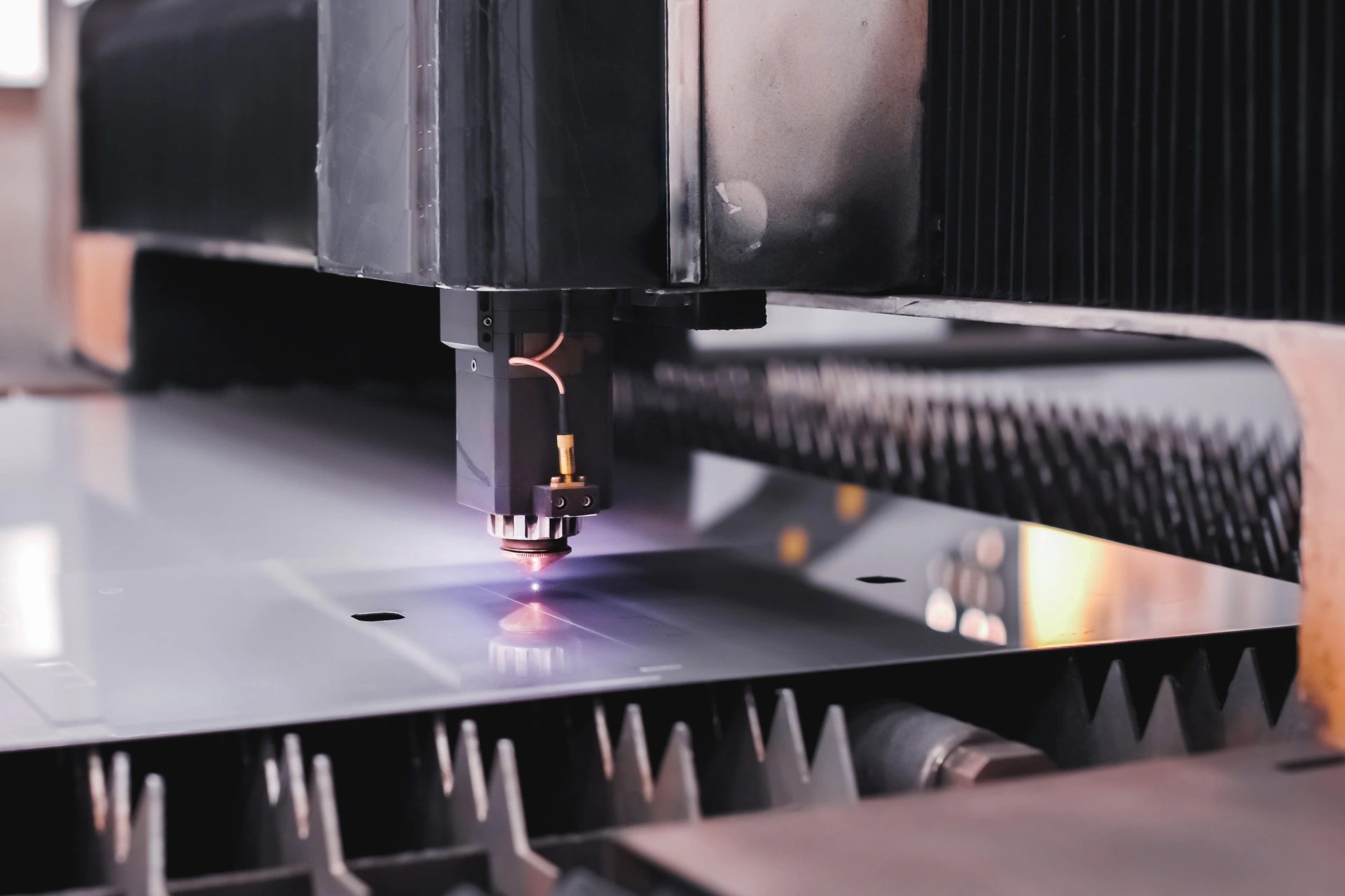
Flat sheets are precisely cut using fiber-optic CNC laser cutters that deliver edge accuracy within ±0.05 mm.
This process minimizes heat distortion and ensures clean, burr-free edges suitable for subsequent forming and finishing.
For thicker or reflective materials such as stainless 316 or titanium, cutting parameters are optimized to prevent micro-cracks or oxidation.
- CNC Bending and Forming
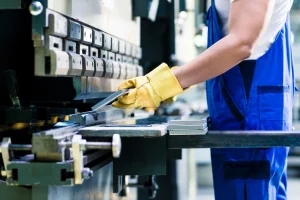
After cutting, parts are transferred to CNC press brakes for forming.
Computer-controlled bending ensures consistent angles and repeatable radii, while real-time angle correction sensors maintain tight tolerances — essential for assemblies like housings, panels, and surgical trays.
Tooling is selected to minimize surface marks and maintain the required Ra ≤ 0.8 µm finish for medical components.
- Welding and Joining
For assembly, TIG (Tungsten Inert Gas) welding is the preferred technique in medical fabrication due to its precision and cleanliness.
It produces strong, contamination-free joints with minimal spatter.
Other joining methods include:
- Laser Welding:For miniature or thin-wall stainless components.
- Spot Welding:For lightweight housings or brackets.
- Riveting and Fastener Installation:Using PEM or clinch nuts for removable assemblies.
All welded areas are polished and inspected to eliminate porosity and discoloration.
- Deburring and Surface Finishing
Smooth surfaces are critical for sanitation and biocompatibility.
After forming, every part undergoes:
- Mechanical Deburring:To remove sharp edges.
- Bead Blasting or Brushing:For uniform surface texture.
- Electropolishing or Passivation:To enhance corrosion resistance and sterility.
- Anodizing or Powder Coating (for Aluminum):Adds durability and aesthetic appeal.
Rollyu’s finishing department ensures that no microscopic residue or contaminants remain — a requirement for components used in sterile environments.
- Dimensional Inspection and Quality Control
Each batch is verified using CMM (Coordinate Measuring Machine) systems, height gauges, and optical comparators.
Measurements such as flatness, hole alignment, and bend angle are checked against 2D drawings.
We also provide:
First Article Inspection (FAI) reports
Material and surface finish certificates
Full traceability documentation
This stage ensures complete conformity before any part moves to packaging or delivery.
- Assembly and Integration
Complex housings or panels are assembled with fasteners, gaskets, and electrical mounts as per customer drawings.
For medical devices, components may also undergo fit and functional testing to confirm alignment and enclosure integrity before shipping.
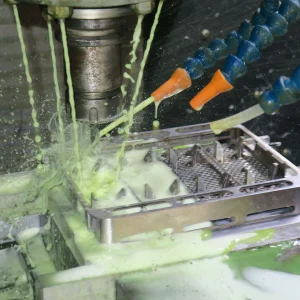
- Cleaning, Packaging, and Delivery
Final cleaning removes fingerprints, oils, and dust using ultrasonic or alcohol-based cleaning methods.
Parts are then individually sealed in protective anti-static or PE bags, wrapped with foam layers, and packed in custom export-grade cartons or wooden crates.
Each package includes the inspection checklist and traceability tag for easy verification at the customer site.
The manufacturing process for medical sheet metal fabrication requires precision at every step — from selecting biocompatible materials to verifying every dimension before shipment.
By combining advanced machinery, rigorous inspection, and ISO 13485-certified quality systems, Rollyu Precision ensures that each fabricated part is accurate, clean, traceable, and ready for medical use.
Applications in the Medical Field
Medical sheet metal fabrication plays a crucial role in creating durable, precise, and sterilizable components that form the backbone of today’s healthcare technology.
From surgical rooms to diagnostic labs, sheet metal fabrication provides the strength, cleanliness, and precision needed to meet the industry’s strict regulatory demands.
Below are the most common medical applications — each benefiting from Rollyu Precision’s engineering expertise and ISO 13485-certified manufacturing process.
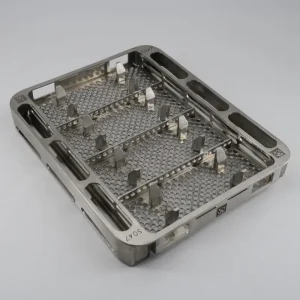
Surgical Trays and Sterilization Racks
Surgical trays are among the most widely fabricated metal products in the healthcare industry.
They hold, organize, and sterilize surgical instruments during procedures. These trays must be made of high-grade stainless steel 304 or 316, or AISI 321 Annealed Stainless Steel (SS) as these alloys resist corrosion and can endure repeated autoclave sterilizations without degradation.
At Rollyu Precision, we laser-cut and form surgical trays with smooth, rounded edges and electropolished finishes to eliminate microscopic burrs and contaminants. The result: trays that are durable, hygienic, and easy to clean — ensuring that surgical tools stay safe and sterile.
Typical examples:
- Laparoscopic instrument trays
- Orthopedic screw and implant trays
- Dental surgical racks and holders
Dental Equipment and Housings
Dentistry demands compact, high-strength metal components capable of withstanding constant cleaning and chemical exposure.
Fabricated sheet metal is used to build brackets, frames, and enclosures for dental chairs, autoclaves, lighting systems, and sterilization units.
We manufacture these assemblies using stainless steel, titanium, or aluminum, each chosen for corrosion resistance and biocompatibility.
Precision TIG-welded joints, brushed finishes, and clean geometry ensure every housing is safe for clinical use and aligns with the aesthetic quality expected in modern dental offices.
Applications include:
- Dental chair frames and support brackets
- Ultrasonic cleaning device housings
- Instrument storage cabinets and sterilization modules
Medical Device Enclosures and Frames
Most electronic medical equipment — such as patient monitors, diagnostic analyzers, and surgical robots — relies on sheet-metal enclosures to protect internal circuitry.
These housings prevent dust, fluid, and electromagnetic interference, providing both functional and regulatory protection.
Our CNC-bent aluminum and stainless steel housings are built with tight tolerances and finished with anodizing or powder coating for durability. Each enclosure undergoes CMM inspection to ensure alignment and repeatability.
Common examples:
- MRI and X-ray machine covers
- Diagnostic analyzer casings
- Control panels and power-supply housings
Laboratory and Diagnostic Equipment
In clinical laboratories, metal fabrication supports the creation of precise structures like analyzer frames, reagent compartments, and automation tracks.
These assemblies must stay stable under vibration and temperature fluctuations while remaining easy to clean.
Rollyu Precision employs stainless steel 316 and anodized aluminum to achieve chemical resistance and surface smoothness. Each component is polished to eliminate crevices where contamination could occur, ensuring compliance with ISO 13485 standards.
Robotic and Automated Medical Systems
As surgical and diagnostic automation grows, precision sheet metal becomes integral to robotic arms, positioning brackets, and support panels.
Each part requires tight dimensional accuracy, consistent surface finishes, and a lightweight yet rigid structure.
Our 5-axis CNC and laser-cutting systems deliver parts with ±0.1 mm sheet-metal tolerance — ensuring robotic assemblies move with perfect repeatability and safety in clinical environments
Small Components, Brackets, and Covers
Even small fabricated parts play a major role in the reliability of medical equipment.
Brackets, clamps, shields, and covers must align perfectly with mechanical assemblies to ensure electrical insulation, component stability, and safety.
Rollyu fabricates these small components with precision bending and laser cutting, followed by brushing, bead blasting, or electropolishing for surface quality. We maintain full traceability to material batches, making these components compliant with ISO 13485 documentation standards.
Hospital Furniture and Support Frames
Beyond devices, sheet metal is used in hospital infrastructure such as instrument trolleys, adjustable tables, and support stands.
These structures need to be robust, smooth, and resistant to disinfectants.
Our fabrication process combines tube welding, sheet bending, and powder coating, ensuring every frame is stable, clean, and built for years of continuous use in medical facilities.
Key Factors When Choosing a Medical Sheet Metal Fabrication Company
Choosing the right fabrication company ensures quality and reliability in medical products.
Regulatory Compliance
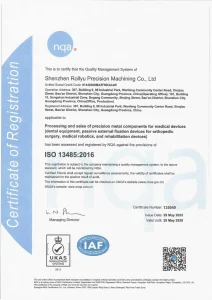
Medical components demand strict quality standards. Reliable firms adhere to ISO 9001 and ISO 13485. These standards guarantee that all parts are safe, traceable, and can be sterilized. Working with a compliant manufacturer also minimizes risks and saves time when approving the product.
Material Selection
Choosing the right material has an impact on durability and safety. Stainless steel 304 and 316 are popular due to their resistance to corrosion as well as their ability to be sterilised many times. When selecting a company that can be able to know the material that will be best suited for your application, then it is certain that your parts will last longer and will be reliable.
Design and Engineering
Good fabrication always starts with a smart and thoughtful design. This way, errors during production can be avoided by specifying what you should change in your designs. This assists parts to fit in place, waste minimization, and easy assembly.
Surface Finish for Medical Sheet Metal Fabrication
In the medical industry, surface finish is not just about appearance — it’s a critical performance factor.
A properly finished surface improves cleanability, corrosion resistance, and biocompatibility, ensuring that components remain sterile and safe throughout their service life.
At Rollyu Precision, every medical sheet metal part is finished according to its intended clinical environment and sterilization requirements. Our finishing process adheres to ISO 13485 and ASTM A967 standards to guarantee compliance and traceability.
Electropolish (electrochemical polishing):
Electropolishing (electrochemical polishing, EP) is an electrochemical process that smooths, brightens, and deburrs metal surfaces by selectively removing microscopic peaks of material. It is widely used on stainless steel, nickel alloys, and some other corrosion-resistant metals to improve surface finish, corrosion resistance, and cleanability.
Mechanical finishing (brushed, satin, or directional finishes)
Mechanical finishing refers to the controlled abrasion of a metal surface to create a uniform grain pattern or texture.
Rather than chemically altering the material, this process uses fine abrasive belts, wheels, or pads to achieve a consistent directional appearance.
In the medical device industry, mechanical finishing is widely used for stainless steel and aluminum housings, trays, and panels, providing a clean, professional aesthetic while maintaining surface smoothness for easy cleaning and sterilization.
Chemical passivation:
Chemical passivation is a controlled surface-treatment process that enhances the corrosion resistance and cleanliness of stainless-steel medical components.
Rather than adding a coating, passivation works at the molecular level — it removes free iron and surface contaminants, allowing a stable chromium-oxide layer to form naturally on the metal surface.
For medical sheet-metal fabrication, this invisible film is essential: it protects parts from rust, contamination, and chemical attack during sterilization and long-term use.
Anodizing:
Anodizing is an electrochemical surface-conversion process that transforms the outer layer of aluminum into a durable aluminum-oxide (Al₂O₃) coating.
Unlike paint or plating, this layer is integral to the metal itself — it cannot peel or flake.
In medical sheet metal fabrication, anodizing is valued for its corrosion resistance, wear protection, cleanability, and professional appearance. The process also allows color coding for device identification while maintaining biocompatibility.
Coatings (powder coat, PVD, antimicrobial)
Coatings add more than color or visual appeal — in medical manufacturing, they provide functional protection, sterilization safety, and material longevity.
A well-engineered coating improves corrosion resistance, biocompatibility, and cleanability, while helping devices comply with strict ISO 13485 and FDA performance standards.
At Rollyu Precision, coatings are applied in-house under controlled conditions, ensuring full traceability, uniform thickness, and adhesion verification for every part.
Powder coating is a dry finishing process that applies a thermoset or thermoplastic polymer powder electrostatically and cures it under heat to form a continuous protective layer. It’s an ideal choice for non-sterile medical housings, carts, cabinets, and support frames that demand durability, chemical resistance, and aesthetics.
PVD coating is a vacuum-based thin-film deposition process where metal atoms are vaporized and condensed onto the substrate surface to create an extremely hard, dense, and wear-resistant coating. It is often applied on stainless steel and titanium components requiring both durability and aesthetic refinement.
Quality Assurance
Quality is of the essence in medical applications. Reliable companies often check each part in terms of dimensions, flatness, and surface finish. Therefore, defects are avoided by using proper quality control, reliability is upheld, and patient safety is safeguarded.
On-time Delivery
Medical projects are usually characterized by severe schedules. A producer who delivers punctually will allow you to save time and keep your production on schedule. The quality of the parts is important, as is the timely delivery.
Red Flags to Avoid
If a companies avoid showing certifications, evades inspections, and utilizes substandard materials, it’s a red flag. Moreover, poor communication, inconsistent lead times, and not understanding of the processes also lead to unsatisfactory results. By avoiding these problems, you can pick a partner that you can trust.
Why Choose Rollyu for Medical Sheet Metal Fabrication
Rollyu brings a wealth of experience in making medical-grade metal parts. We see every small detail that matters most for safety and performance. Every part is cut, bent, welded, and finished with extra care.
Our company sources materials from certified suppliers. Usually, we use medical-grade titanium, aluminum, steel, and stainless steel 321,304 and 316. We also follow strict ISO 9001 and ISO 13485 standards. So, we consistently deliver reliable parts.
When you send us your design, our engineers will review your design, suggest improvements, and inspect each part to meet exact specifications. So, you can trust us as a dependable partner for medical device manufacturers and engineers.
Conclusion
This article has provided useful insights into medical sheet metal fabrication. It also highlighted the key factors to consider when choosing a fabrication partner and why Rollyu is a trusted choice.
Medical sheet metal fabrication is essential for creating precise and durable parts. However, it’s important to work with a reliable company that can understand the intricacies of medical parts. At our facility, every project benefits from careful attention to detail. Whether you need a single prototype or full production, we ensure that medical parts are produced well and perform safely and reliably.