
Making the wrong call on materials gets expensive fast. According to Thomasnet, raw material selection drives nearly 50% of total manufacturing costs. For most industrial buyers, the debate lands on two heavyweights: Cast Iron or Steel. While both start as iron ore, they perform completely differently on the shop floor. It isn’t just about chemistry, it’s a choice between the easy casting of iron and the impact toughness of steel.
The decision splits between rigidity and toughness. Cast iron absorbs vibration, making it the standard for heavy, stationary bases. Steel flexes under impact, which is essential for moving parts. This guide compares their costs and properties to help you make the right choice.
What’s Cast Iron?
Cast Iron is a family of alloys engineered specifically to be melted and poured. It acts less like a solid block and more like a liquid molding material. This category includes distinct types like Gray and Ductile iron. The primary advantage here is the process itself. Manufacturers create the final component geometry directly from liquid metal instead of cutting it out of a solid piece.
What’s Steel?
Steel is a refined iron alloy designed for fabrication and mechanical working. Unlike cast iron, it is processed to remove impurities for better workability. It is typically rolled, forged, or stamped into shape. Think of it as the “blank canvas” of the metal industry. You can modify it easily through heat treatment or heavy machining to fit almost any industrial application.
What is the Difference Between Cast Iron and Steel?
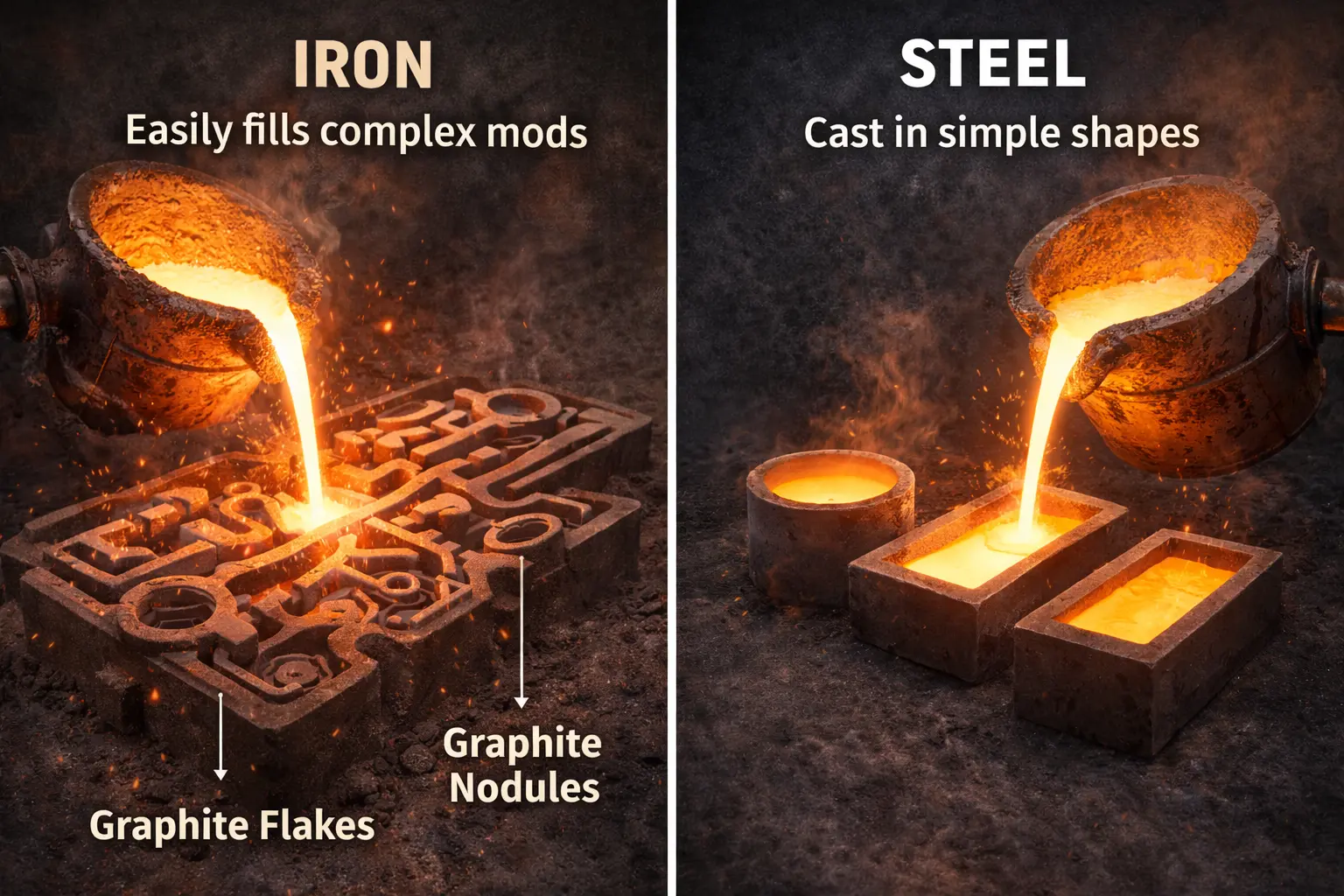
Carbon content drives the difference. It dictates whether your part casts easily or resists impact. Iron excels at filling complex molds. Steel dominates on tensile toughness. Compare the specific trade-offs below to select the right alloy.
Composition and Microstructure
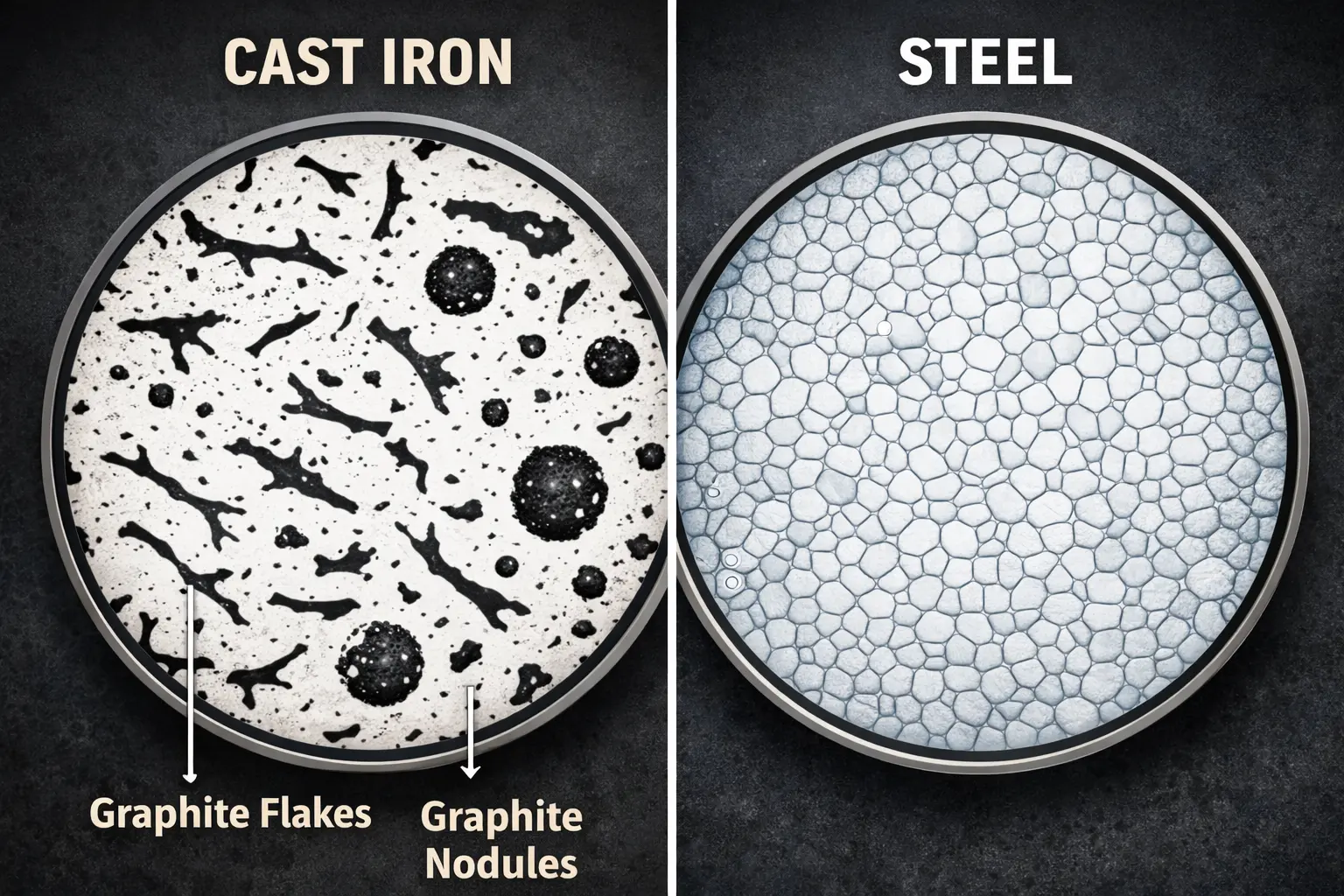
Cast iron holds a surplus of carbon, typically 2% to 4%. During cooling, this excess carbon precipitates out as graphite particles which interrupt the metal matrix. In Gray Iron, the graphite forms flakes that make the material brittle but excellent at damping vibration. In Ductile Iron, the graphite forms spherical nodules, providing significantly better toughness and impact resistance.
Steel maintains a much lower carbon count, usually under 2%. Manufacturers refine it heavily to remove impurities. This results in a tighter and more uniform microstructure that is chemically cleaner than iron.
Manufacturing and Castability
Cast iron melts easily and flows like water. It is built for the mold. Foundries can pour it into intricate shapes with minimal shrinkage. This efficiency saves massive energy costs during production.
Steel is more stubborn to cast due to its high melting point. It flows like syrup rather than liquid. Pouring steel typically requires carefully engineered mold designs and skilled labor to manage shrinkage and reduce the risk of internal voids.
Mechanical Performance
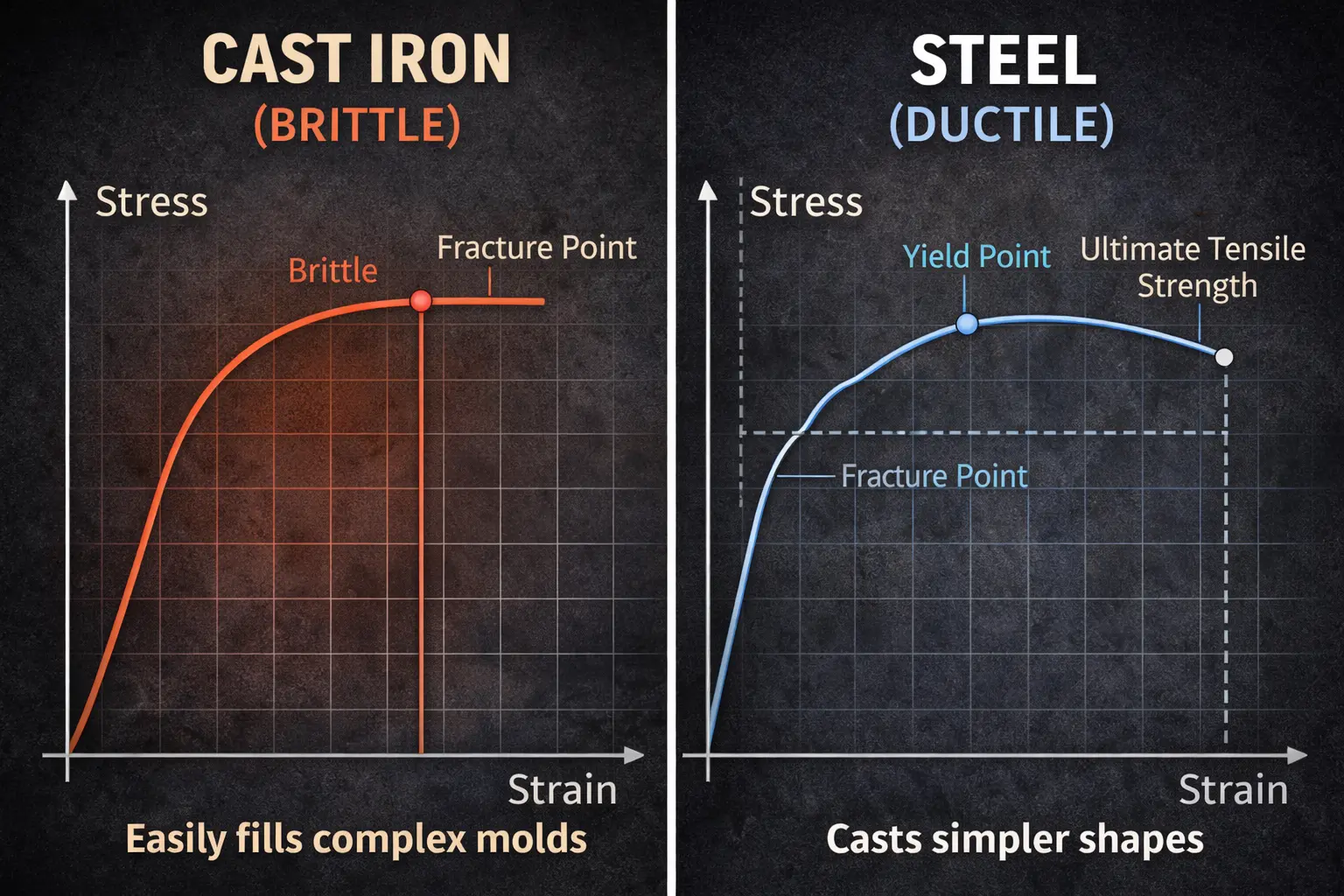
Cast iron offers incredible rigidity and vibration damping. The internal graphite absorbs shock and stops ringing. It is the industry standard for heavy machine beds. However, many cast irons, especially gray iron, are relatively brittle in tension and can crack under high tensile stress. Ductile iron typically provides higher ductility and impact resistance.
Steel is the choice for high-impact toughness and tensile strength. It is ductile. It bends under stress instead of snapping. This flexibility is vital for parts that face sudden shock loads or twisting forces.
Durability in Service
Cast iron naturally resists surface wear. The graphite acts as a built-in dry lubricant. This stops parts from grinding or seizing during friction. It also resists deformation well under high heat.
Carbon steel requires protection against rust. It is stronger structurally but vulnerable to the elements. Without galvanizing or painting, moisture will corrode the surface and compromise the part over time.
Cost and Typical Applications
Cast iron saves money on high-volume production. The lower melting point reduces energy consumption significantly. It is the default material for engine blocks, cookware, and manhole covers.
Steel costs more due to energy-intensive refining. You pay that premium for structural safety. Steel is widely specified for I-beams, fasteners, and automotive frames because it offers predictable strength and ductility for safety-critical designs.
Cast Iron vs Steel Comparison Table
See the main differences in the table below.
| Feature | Cast Iron | Steel |
| Carbon Content | High (2% – 4%) | Low (< 2%) |
| Castability | Excellent (Fluid) | Poor (Viscous) |
| Tensile Strength | Low (Brittle) | High (Tough) |
| Vibration Damping | High | Low |
| Wear Resistance | Excellent | Good |
| Cost | Lower | Higher |
| Best Use | Static machinery, Complex molds | Structural parts, Impact loads |
Cast Iron vs Steel: Which One to Choose?
Material selection depends entirely on the operating environment. Neither alloy is universally superior. The decision typically splits based on mechanical stress. Static, heavy machinery benefits from the rigidity of iron, while dynamic, high-impact structures require the resilience of steel. In automation parts manufacturing, both materials are commonly used for bases, frames, and moving assemblies.
Pros and Cons of Cast Iron
It offers superior manufacturing efficiency at the expense of tensile flexibility.
Pros:
- Excellent Castability: Molten iron flows into intricate molds with minimal shrinkage.
- Vibration Damping: The internal structure absorbs machine noise and shock effectively.
- Cost Efficiency: Lower energy and labor requirements make it ideal for mass production.
Cons:
- Brittleness: The material cracks under high tension or sudden shock loads.
- Poor Weldability: High carbon content makes repairs or modifications difficult.
Select cast iron for stationary equipment where rigidity and cost savings are critical. It performs best in static applications that require superior vibration damping to stabilize heavy loads.
Pros and Cons of Steel
It provides unmatched structural integrity at a higher manufacturing cost.
Pros:
- Unmatched Toughness: Steel resists fracture and handles high stress without failing.
- Design Versatility: The alloy is easy to weld, machine, and modify after casting.
- Impact Resistance: It bends rather than breaks during collisions or heavy loading.
Cons:
- Higher Cost: Energy-intensive refining drives up the price per unit.
- Casting Difficulty: Lower fluidity and higher shrinkage typically require more conservative geometries and tighter process control, and they can increase labor and inspection needs.
Specify steel for dynamic components that demand high impact resistance. Its ability to bend without breaking makes it essential for parts facing high-stress structural environments.
Choose Rollyu for Metal Machining Services
Selecting the right alloy is just the start. Rollyu Precision ensures performance with end-to-end manufacturing support. From prototype to production, we combine precision machining and custom finishing to deliver functional, precision CNC machining parts at scale.
Precision CNC Machining Solutions
Great material selection fails without precise machining. Rollyu Precision operates under ISO 9001 and ISO 13485 standards, offering full traceability and tolerances as tight as ±0.005 mm. We adapt our machining strategies to your specific alloy, ensuring perfectly fitted components with medical-grade quality control.
Engineering and DFM Support
Hidden design errors burn the budget. We secure your project with a thorough DFM review, spotting risks like thin walls before metal is cut. This proactive step prevents scrap and optimizes production. Upload CAD files for feedback and a quote within 48 hours.
FAQ
Does Cast Iron Rust?
Yes, unprotected iron rusts quickly in moisture. However, thick castings often form a surface patina that preserves the core structure for decades, unlike thin steel which can rot through.
Are Iron and Steel the Same?
No, they are distinct metals defined by carbon levels. Cast iron contains high carbon (2-4%) for easy melting, while steel keeps carbon low (<2%) to ensure structural toughness.
Which Is More Durable Steel or Cast Iron?
It depends on the stress type. Steel offers superior durability against sudden impact and shock, while cast iron provides better durability against friction and surface wear.
What Is the Difference Between 4140 and 4130 Steel?
4140 has higher carbon for superior strength in heavy-duty gears. 4130 has lower carbon, making it easier to weld for structural frames. Read our full guide on 4140 vs 4130 Steel.
What Is the Difference Between Wrought Iron Vs Steel?
Wrought iron is an obsolete, soft metal worked by hand. Steel is the modern, high-strength replacement used in virtually all industrial and structural applications today.
Conclusion
Match the material to the movement. Cast iron provides the stability needed for heavy, stationary bases. Steel delivers the toughness required for dynamic, high-stress parts. Regardless of your choice, Rollyu Precision ensures the final component meets rigorous quality standards. We provide end-to-end CNC machining solutions to turn your designs into functional, high-precision reality.