
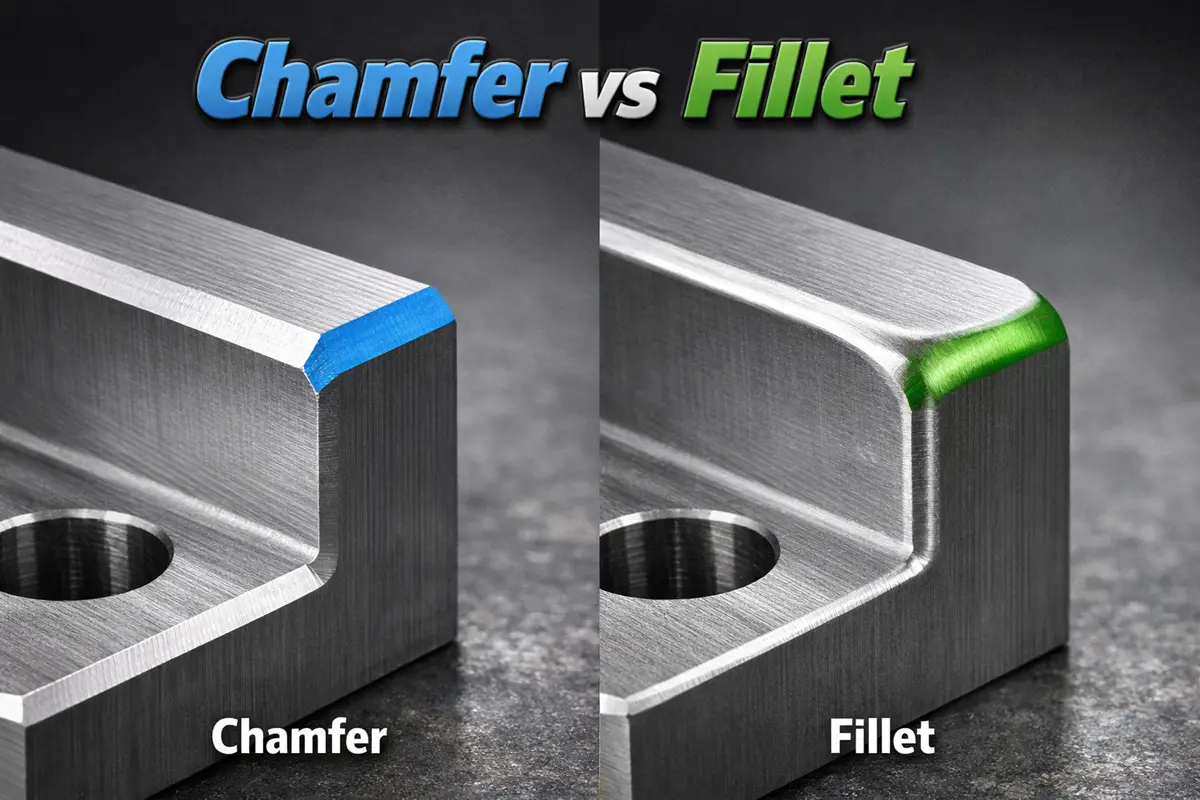

According to Machine Design, 70% of manufacturing costs are committed during the initial design phase. While edge treatments like chamfers and fillets seem minor on a blueprint, they heavily influence production budgets and lead times. A mismatched edge spec creates unnecessary stress concentrations and spikes CNC machining hours, turning a simple part into a production bottleneck.
This article explains the difference between chamfers and fillets. Chamfers are flat cuts that speed up assembly. Fillets are rounded curves needed for strength. It compares their shapes, uses, and costs to help you pick the right edge for your design.
What Is a Chamfer?
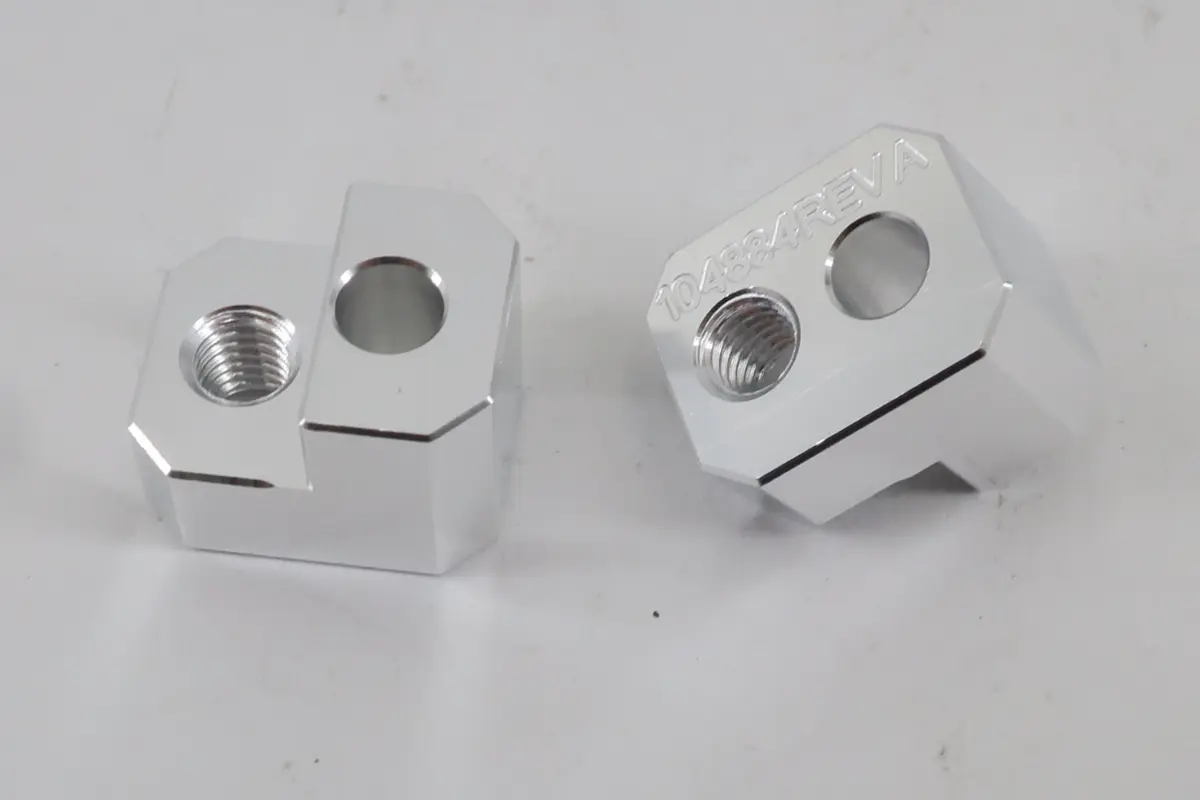
A chamfer is a flat, angled cut across a sharp corner. This linear geometry creates a measurable dimension for inspection. It clearly defines “edge intent,” preventing subjective disputes.
Key Purposes of Chamfering
Chamfers serve functional roles that directly impact assembly speed and part acceptance.
- Simplifying Assembly: Chamfers align mating parts to prevent jams. The sloped surface also absorbs impact damage, protecting the critical fit from deformation during handling.
- Reducing Inspection Disputes: Vague edge-break notes rely on inconsistent hand filing. A specific callout forces a measurable machine cut, replacing subjective opinions with verifiable dimensions.
Common Applications of Chamfer
Chamfers are the standard for edges that need to be safe to handle and ready for assembly.
- Bolt and Screw Ends: Prevents cross-threading when leading threads into nuts.
- Hole Entrances: Guides tapping tools and fasteners into position.
- Mating Surfaces: Ensures flush contact between assembling parts.
Drawing Spec Example
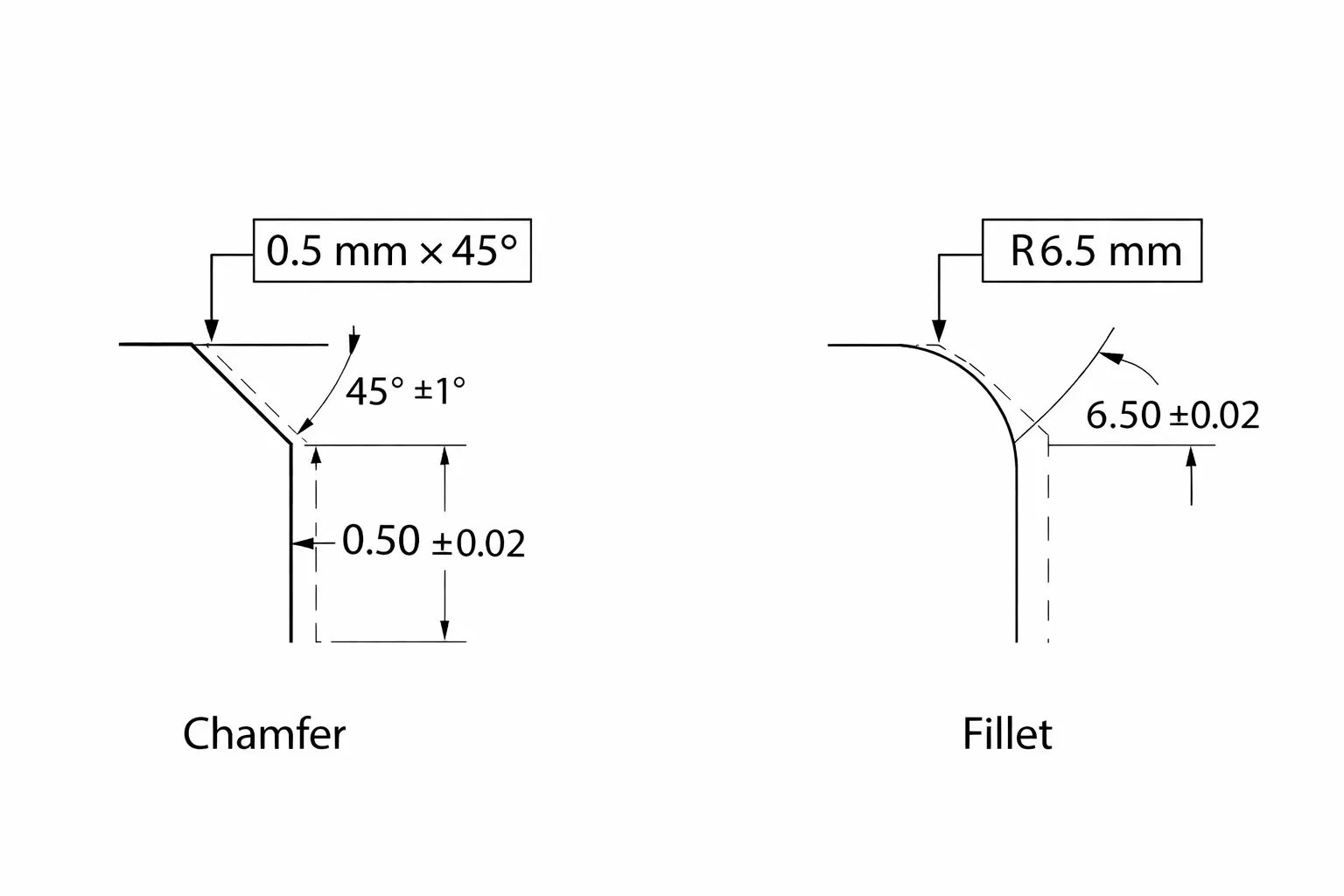
A precise callout like 0.5 mm × 45° is a powerful tool because it defines a measurable edge condition. It tells the shop to machine the edge rather than hand-file it. This creates a consistent, burr-free transition, which simplifies inspection and reduces variability from manual deburring.
What Is a Fillet?
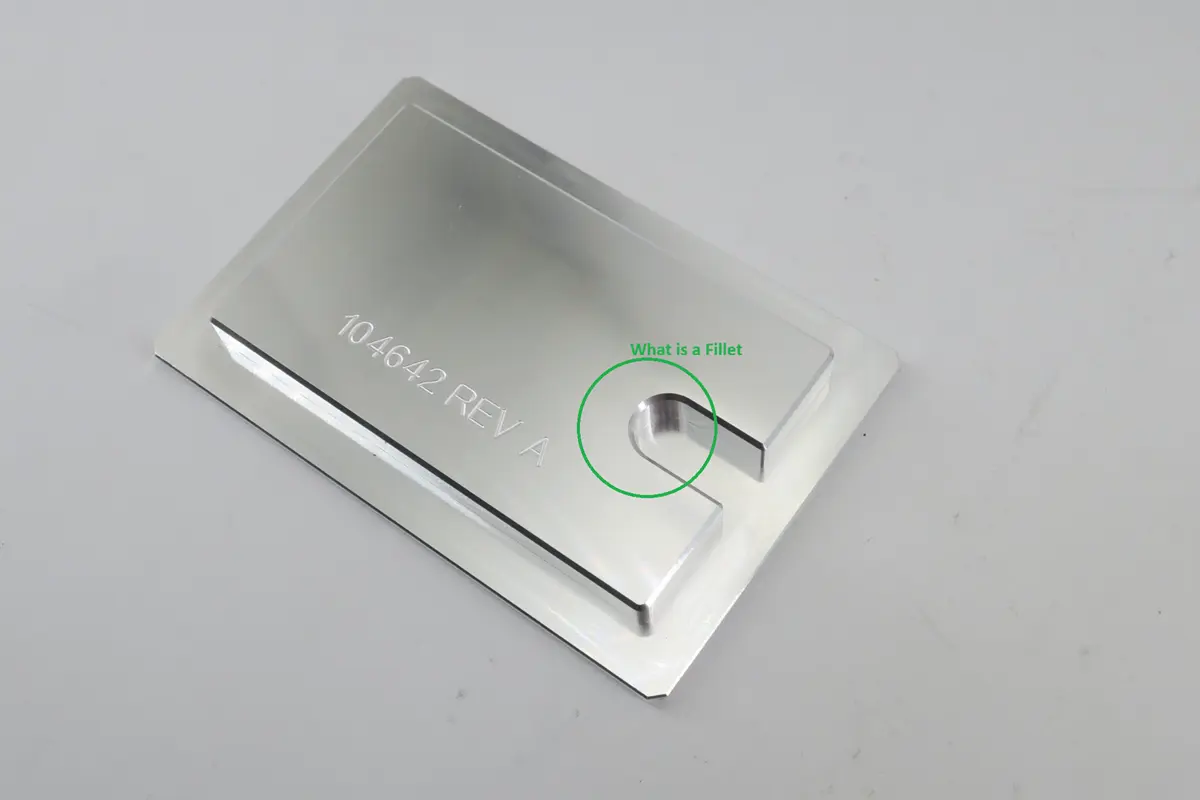
A fillet is a rounded transition connecting two surfaces. Because rotating end mills are round, they cannot cut sharp internal corners, leaving a radius by default. Specifying a fillet matches the design to the tool, ensuring the feature is machinable.
Key Purposes of Fillets
Fillets solve critical issues regarding both manufacturability and structural integrity.
Enabling CNC Machinability:
Rotating tools cannot cut zero-radius corners. A fillet allows the end mill to turn and move continuously. Demanding a sharp internal corner forces the shop to use expensive, slow alternatives like electrical discharge machining (EDM).
Reducing Stress Concentration:
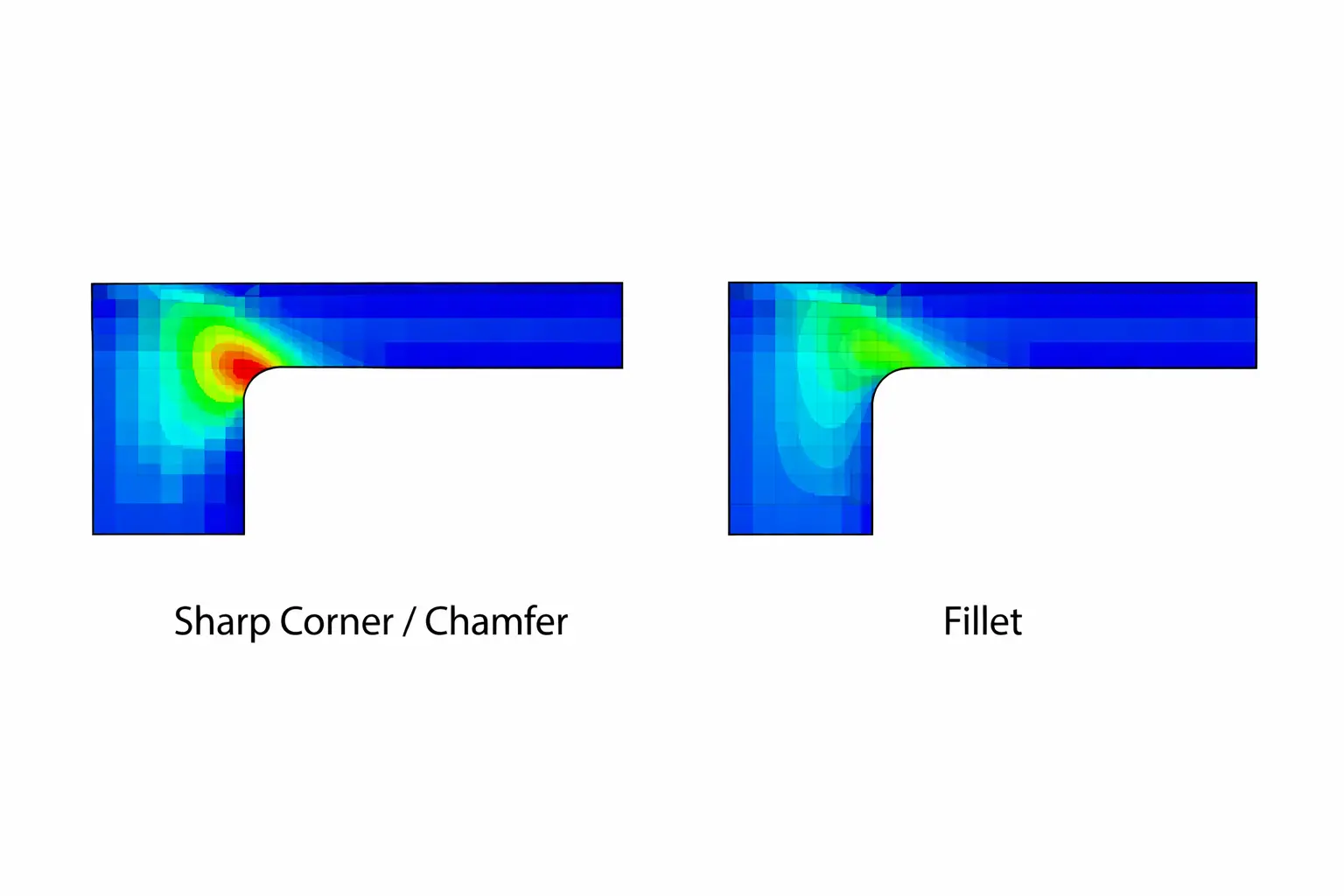
Sharp internal corners act as “stress risers,” focusing load on a single point to invite cracks. A fillet distributes that stress over a broader arc, preventing fatigue failure.
Common Applications of Fillet
Fillets are the default choice for internal geometry and high-stress zones.
- Internal Pockets: Vertical walls inside a part must have fillets to accommodate the end mill’s radius.
- Load-Bearing Walls: Essential for floor-to-wall connections in structural parts to prevent cracking.
- Castings & Moldings: Smooth curves improve material flow and ensure clean mold release.
DFM Spec Example
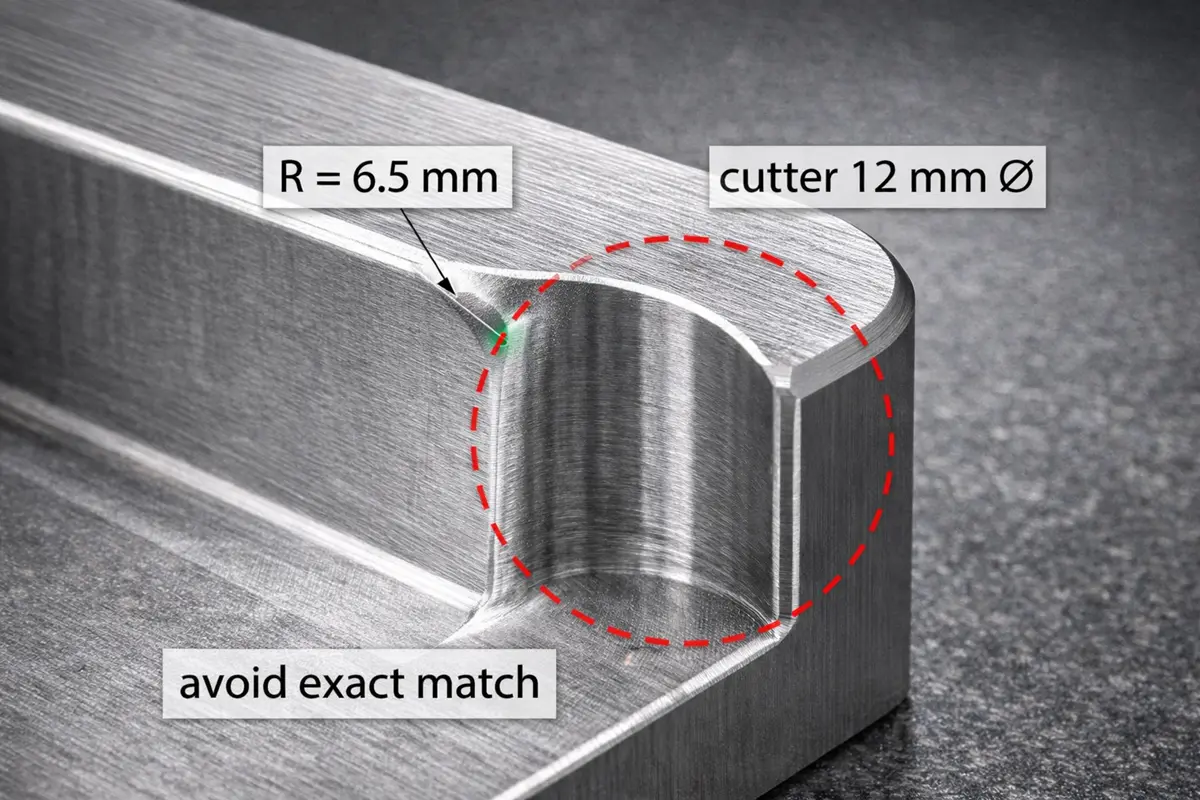
Don’t match the tool radius exactly (e.g., R = 6mm for a 12mm cutter). Instead, specify R = 6.5mm. This clearance lets the tool turn without stopping (dwelling). It minimizes chatter, reduces tool wear, and cuts cycle time
What’s the Difference between Fillet and Chamfer?
While both remove sharp edges, they serve distinct roles. The choice comes down to a trade-off between stress management and machining time.
Geometry and Appearance
Chamfers create a distinct edge, fillets create a flow. A chamfer makes a linear cut with a clear start and stop, ideal for defining mating surfaces. In contrast, a fillet creates a seamless blend, which is aesthetically pleasing and easier to clean but harder to inspect for dimensional accuracy.
Stress Concentration
Chamfers for safety, fillets for strength. Chamfers are sufficient for breaking sharp edges to prevent cuts during handling. However, for load-bearing parts, fillets are mandatory. They distribute stress over a broader area, whereas chamfers still leave stress concentration points at their corners.
Machining Efficiency and Cost
Chamfers are faster, and fillets take longer. A chamfer is often a single-pass feature using a spot drill or chamfer mill. A fillet requires corner interpolation, which adds cycle time. That makes chamfers more cost-effective for non-critical edges. In regulated work like medical device CNC machining, edge consistency and inspection time can matter as much as cutting time.
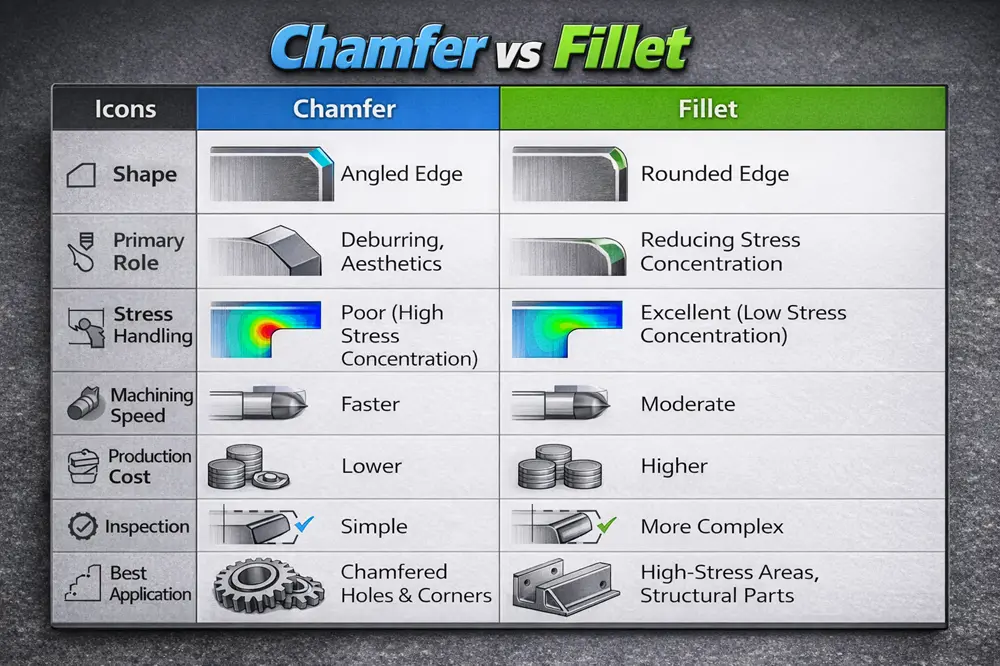
Chamfer vs Fillet: Quick Comparison
Use this chart to balance cost and performance.
|
Feature |
Chamfer | Fillet |
|
Shape |
Flat linear cut |
Smooth curved arc |
|
Primary Role |
Assembly & Safety | Strength & Flow |
| Stress Handling | Concentrates stress |
Distributes stress |
|
Machining Speed |
Fast | Slow |
|
Production Cost |
Low |
High |
| Inspection | Simple |
Complex |
| Best Application | Mating surfaces |
Load-bearing walls |
How to Choose Fillet or Chamfer for Your Project?
Function and budget dictate the right choice. For CNC machining parts, toolpaths, inspection time, and edge consistency directly affect cost and lead time. Use these guidelines to decide between a flat angle and a smooth curve.
Choose Chamfer for Cost Efficiency and Mating Parts
Default to chamfers for external edges. They machine faster, directly lowering cycle times. Use chamfers for bolt holes and mating surfaces to aid assembly. If an edge only needs to be safe to touch, a chamfer is the most cost-effective option.
Choose Fillet for Structural Integrity and Internal Pockets
Select fillets for high-stress areas and internal pockets. They distribute stress to prevent cracks, making them mandatory for load-bearing walls. For inside pockets, design radii larger than the tool and limit depth to 4x diameter to prevent chatter. If a design demands sharp internal corners, expect higher costs for EDM.
Choose Rollyu for Precision Machining
Trust Rollyu for certified precision and free DFM feedback on your edge designs. From simple chamfers to complex fillets, our 5-axis centers machine intricate geometries in a single setup. Backed by ISO 9001 and ISO 13485, our in-house inspection verifies every dimension to ensure strict quality compliance.
FAQ
What’s the Difference between Bevel and Chamfer?
A bevel angles the entire side; a chamfer cuts only the edge. Bevels slope the whole thickness of a material to prepare it for welding. Chamfers simply break the sharp corner at 45° for safety and easy assembly.
Is a Chamfer the Same As a Taper?
No. A chamfer finishes an edge; a taper shapes the part. A chamfer cuts a small angle on the corner. A taper gradually reduces the diameter of a cylinder along its length to fit into a socket or hole.
Is a Fillet the Same As a Bevel?
No. A fillet is round; a bevel is flat. A fillet adds a curved radius to strengthen internal corners against stress. A bevel cuts a flat, angled slope, typically to align mating parts.
Conclusion
Smart design balances cost and performance. Chamfer external edges to save money. Fillet internal pockets to add strength. Rollyu machines every detail to strict medical grade standards making your parts easy to manufacture and tough to break.