
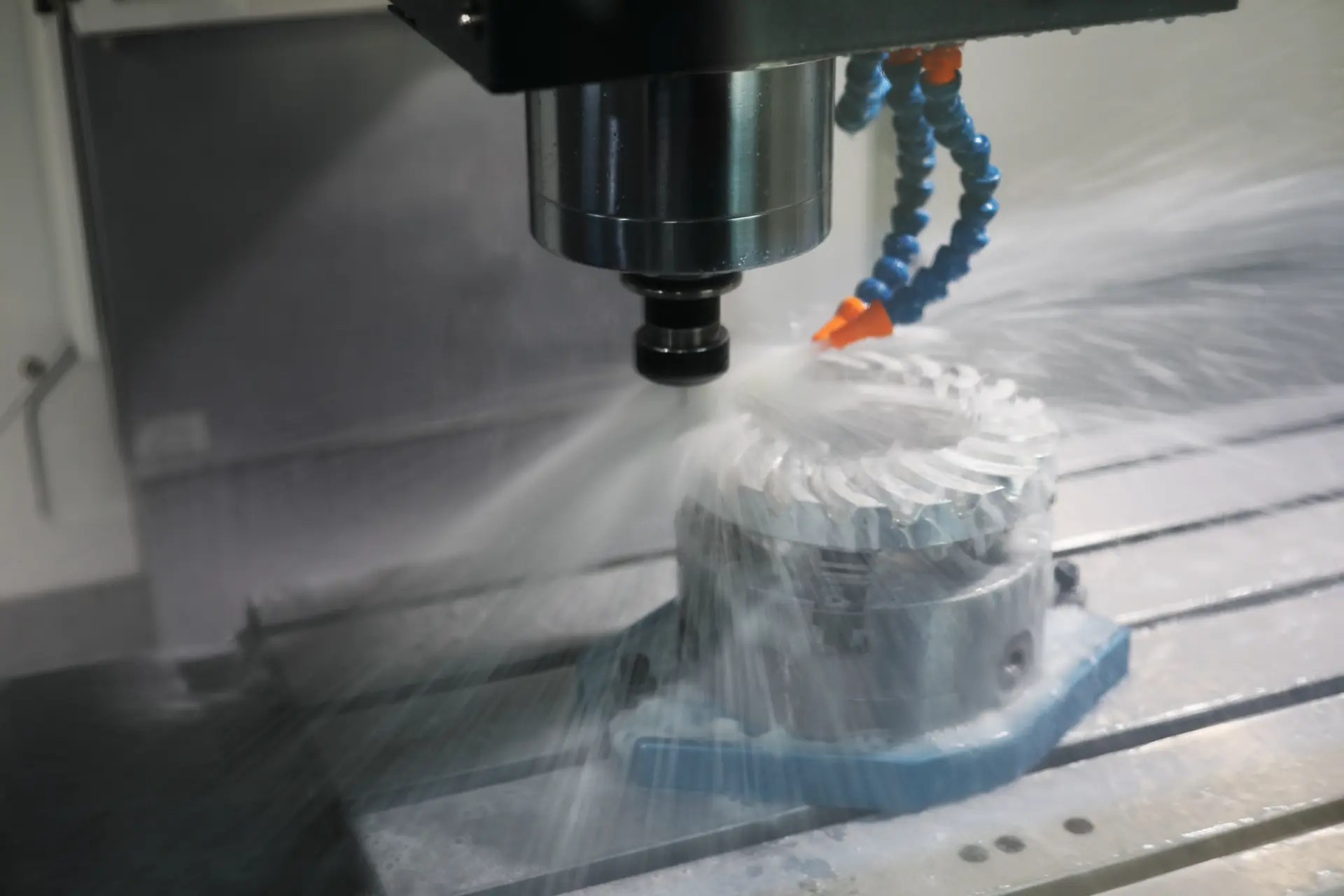

From aerospace impellers to medical implants, milling is the precision engine behind modern manufacturing. According to Fortune Business Insights, the global CNC machine market is projected to reach about $195 billion by 2032, driven by the critical need for automated precision. This process does more than shape metal. It transforms digital blueprints into physical reality. For engineers, it remains the industry standard for achieving tight tolerances and structural durability.
Success depends on selecting the right equipment. This guide analyzes the differences between VMC and 5-axis systems, compares material properties from aluminum to PEEK, and reviews key industrial applications. It provides the technical insight needed to optimize your production strategy.
What Is Milling and How Does It Work?
Milling is a core subtractive manufacturing process that removes material from a solid block instead of adding it like 3D printing. For a deeper comparison, read 3D printing vs CNC machining.
The Mechanics:
In milling, the cutting tool rotates while the machine controls the relative motion between the tool and the workpiece. The process relies on shear force to remove material as chips. Operators secure the workpiece to the machine table, and the spindle runs at high RPM. The machine feeds the cutter into the material to form the required geometry. Heat is generated during cutting, so coolant or other cooling methods are commonly used.
The Benefits of Milling
These fundamentals lead to key advantages:
- Unmatched Precision: Milling achieves tight tolerances that casting or 3D printing often struggle to match. It creates exact dimensions for critical aerospace and medical parts.
- Versatility: A single setup handles drilling, slotting, and chamfering. You do not need multiple machines to finish complex features.
- Surface Quality: High-speed cutters leave a smooth, polished finish. This often eliminates the need for secondary grinding or polishing.
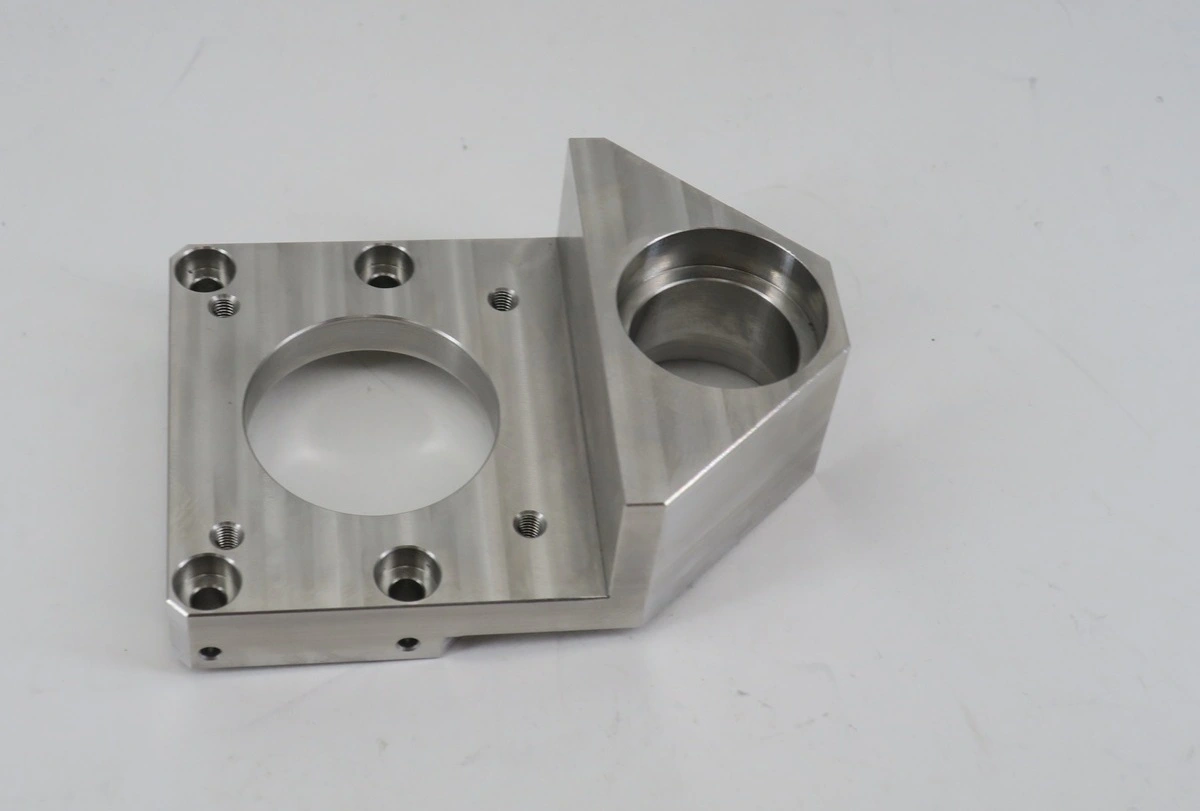
Common Milling Machine Types and Selection Guide
Choosing the right mill depends on part geometry and production volume. Shops classify these machines by spindle orientation and movement capabilities.
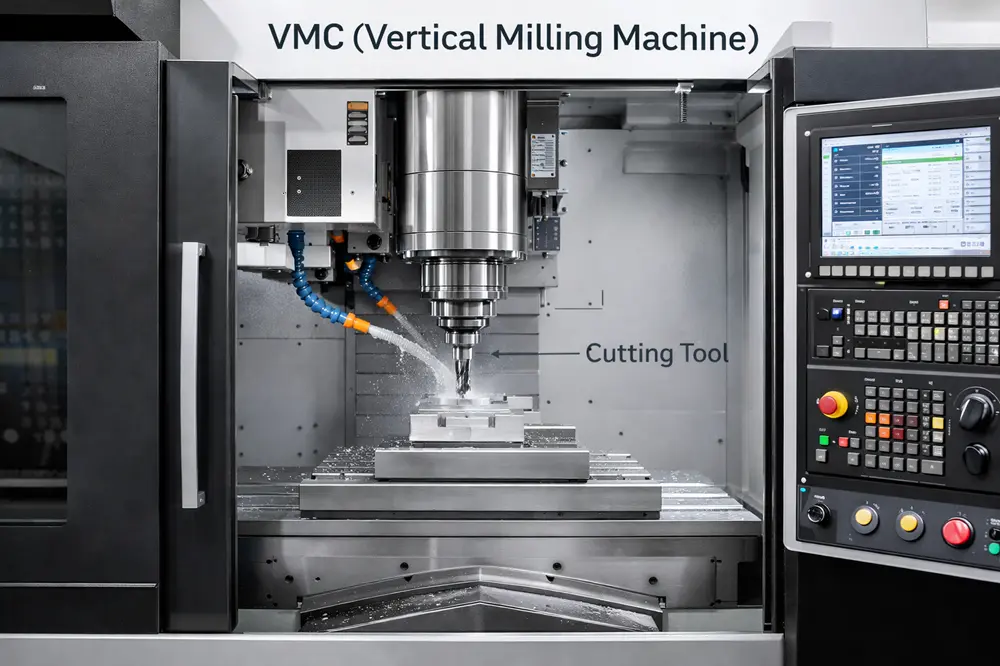
Vertical Milling Machines (VMC)
The Vertical Machining Center (VMC) is the industry standard. Its vertical spindle drives cutters straight down. This gives operators a clear view of the work. It is the most cost-effective choice for machining simple to moderately complex parts like plates, dies, and molds.
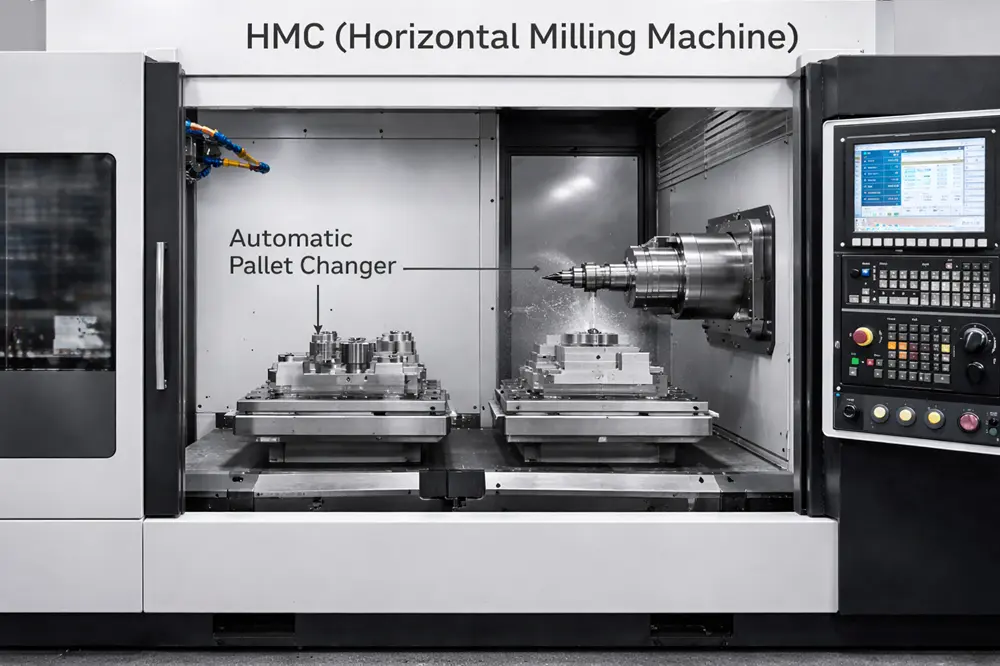
Horizontal Milling Machines (HMC)
Horizontal mills mount the spindle parallel to the floor. Gravity helps chips fall away naturally. This feature extends tool life and prevents surface damage. These machines are common in high-volume production because they can machine multiple sides of a part with fewer refixturing steps.
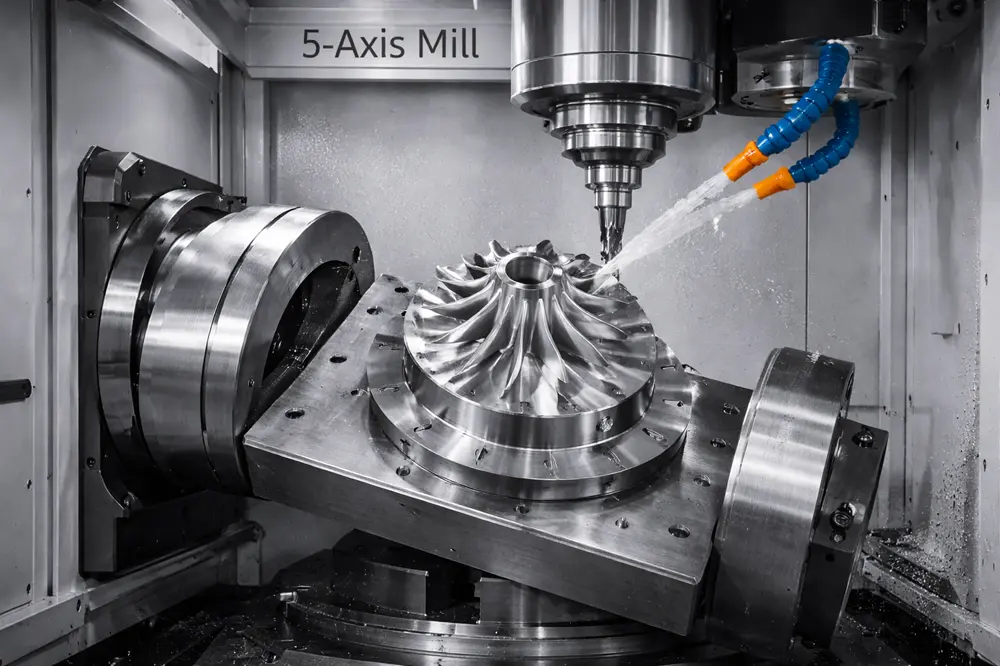
5-Axis Milling Machines
5-axis machines can complete many complex parts in one setup. The tool approaches the workpiece from any angle. This capability allows shops to finish complex shapes like aerospace turbines in a single setup. It can reduce the errors and downtime associated with manually flipping parts.
How to Choose The Right Machine
Use this quick comparison to match your production needs with the right equipment.
| Feature | Vertical (VMC) | Horizontal (HMC) | 5-Axis |
| Ideal Application | Flat parts, Dies, Simple Molds | High Volume, Multi-sided parts | Complex Geometries (Impellers, Medical) |
| Chip Evacuation | Average (Requires Air/Coolant) | Excellent (Gravity Assist) | Good |
| Setup Complexity | Low | Medium | Medium (Single Setup) |
| Investment | Low – Medium | High | Very High |
What Are the Different Types of Milling Operations
Operations determine the final geometry. Machinists employ specific cutting strategies to achieve different shapes and finishes.
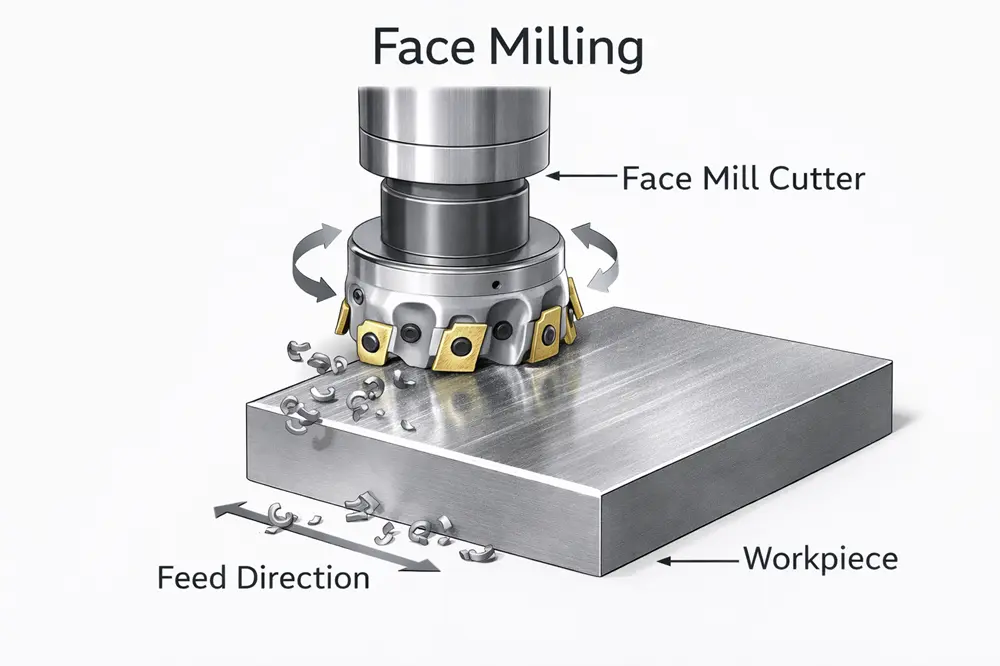
Face Milling
Face milling produces a flat finish on the workpiece surface. The cutter rotates perpendicular to the part, engaging teeth on both the face and edge. This step typically establishes a reference surface for subsequent machining.
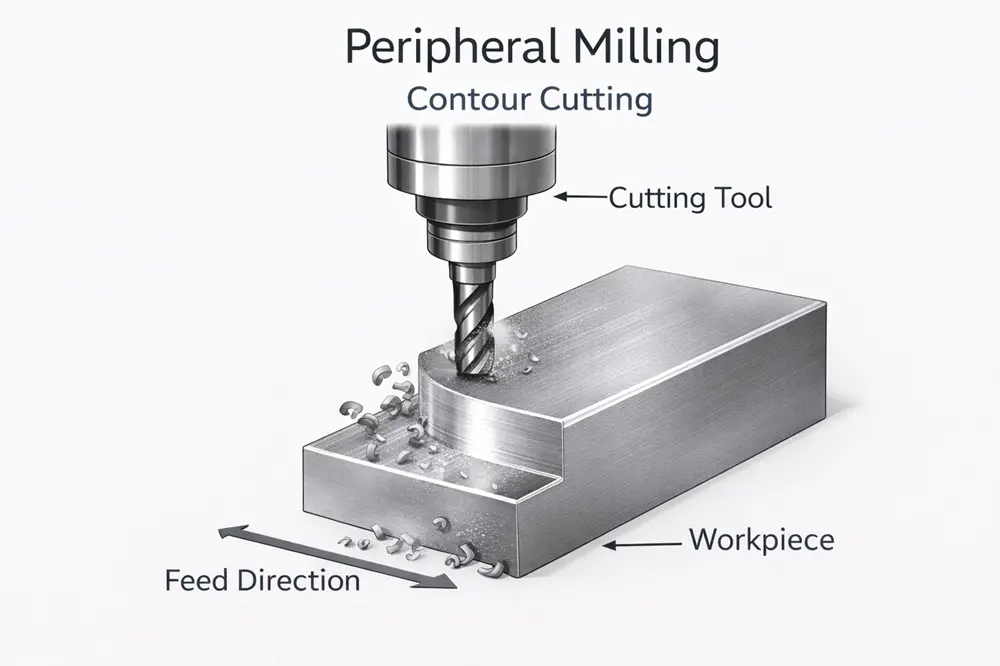
Peripheral Milling
Peripheral milling, often referred to as profile milling, cuts along the outer boundary of a workpiece. It uses the side teeth of an end mill to shape the part’s silhouette or remove large amounts of material quickly.
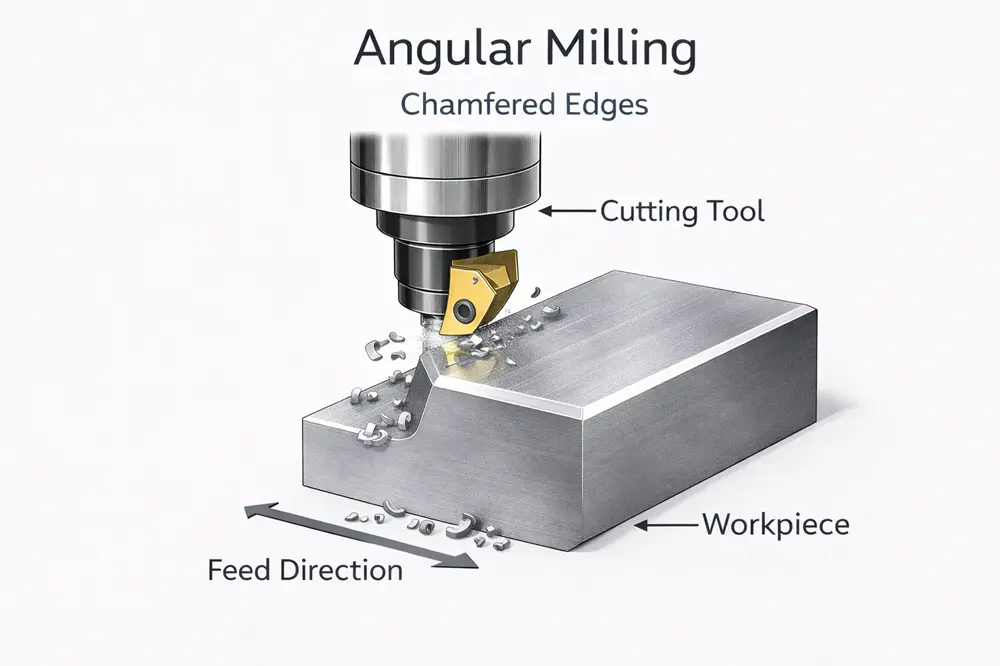
Angular and Side Milling
These techniques shape edges and contours. Side milling cleans up vertical walls to match exact dimensions. Angular milling cuts features like chamfers or dovetails. Both are essential for parts that must mate or slide against others.
Slotting and Pocketing
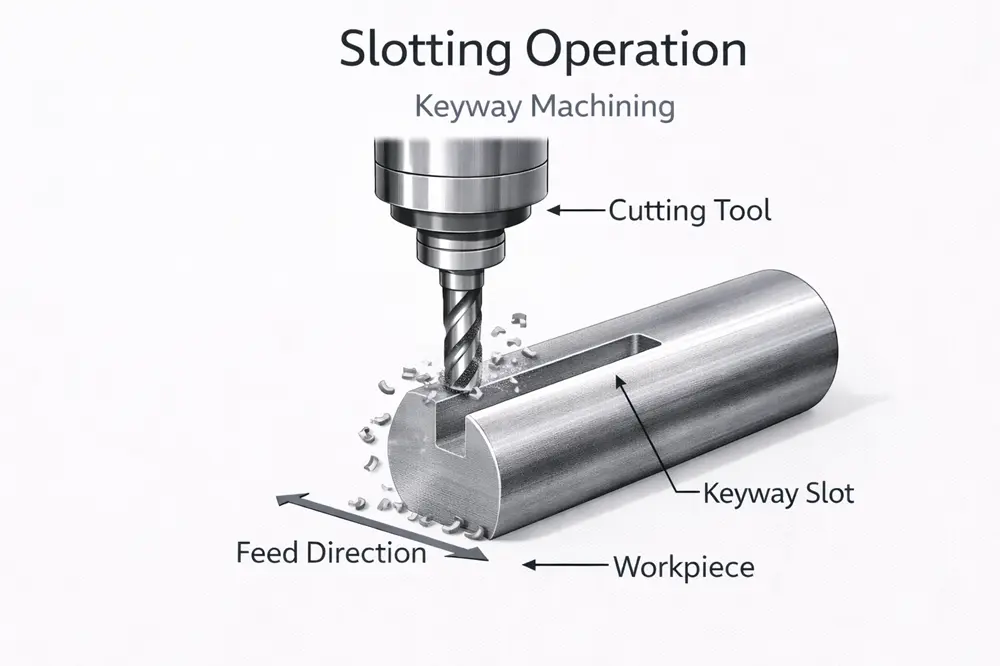
Slotting carves narrow channels or keyways into the metal. Pocketing hollows out enclosed areas to a fixed depth. These methods are standard for creating internal housing space for bearings or electronics.
What Material Can Be Used for CNC Milling?
Material choice dictates the part’s success. While mills handle almost anything harder than foam, engineers must balance mechanical requirements with machining costs.
Metals and Alloys
Metals remain the standard for structural durability.
- Aluminum: The industry go-to for prototyping and aerospace. It machines fast and provides an excellent strength-to-weight ratio.
- Steel: Grades like 304 stainless steel offer strong corrosion resistance. While tougher on tools than aluminum, steel is non-negotiable for high-stress machinery.
- Titanium: Vital for medical and aerospace applications. It delivers immense strength at a low weight but demands slow cutting speeds to manage heat.
Engineering Plastics
Plastics serve critical functional roles beyond simple consumer goods.
- POM (Delrin): A rigid, machinist-friendly plastic. It holds tight tolerances, making it ideal for precision gears and fittings.
- Nylon: Selected for low friction and wear resistance. It works best for sliding components like bearings, though it absorbs moisture over time.
- PEEK: A high-performance option that replaces metal in extreme heat. It withstands aggressive chemicals, justifying its high price point.
Advanced Materials
When standard options fail, specific industries turn to composites and ceramics.
- Composites: Materials like Carbon Fiber (CFRP) offer extreme stiffness. Machining is tricky; incorrect speeds risk delaminating the layers.
- Ceramics: Excellent electrical insulators that withstand intense heat. They are brittle, often requiring diamond-coated tools to cut without fracturing.
What Are the Industries That Use Milling?
Milling drives modern infrastructure. From jet engines to smartphones, it shapes the critical components global supply chains rely on, including a wide range of CNC machining parts.
Aerospace Components
Aerospace applications demand extremely low failure risk and consistent quality. Mills carve airframes and landing gear from solid titanium blocks. This removes weight while retaining the strength needed for high-altitude performance.
Automotive Parts
Automakers use milling for engine blocks and transmission cases. Crucially, the industry also relies on large-scale mills to cut the steel molds that stamp out body panels and bumpers.
Medical Devices
Medical firms rely on CNC machining for medical devices to produce biocompatible titanium hip replacements and bone screws. 5-axis mills create complex organic shapes that match human anatomy, ensuring the flawless, high-precision surfaces needed for successful implants.
Electronics and Tech
Heat sinks are the main driver here. Milling sculpts intricate aluminum fins that cool high-power processors. It also creates rugged enclosures that act as electrical grounds for internal circuits.
Why Choose Rollyu for Your CNC Milling Project?
Finding a machine shop is easy. Finding a partner who scales with you is hard. Rollyu manages the full lifecycle, taking you from prototype to volume production while streamlining the logistics.
One-Stop Prototype to Production
We support projects from prototyping to high volume production. Start with a single prototype for validation, then ramp up smoothly. You don’t need to switch suppliers to handle volume. We manage the assembly and supply chain, protecting your time-to-market.
ISO 13485 and CMM Validation
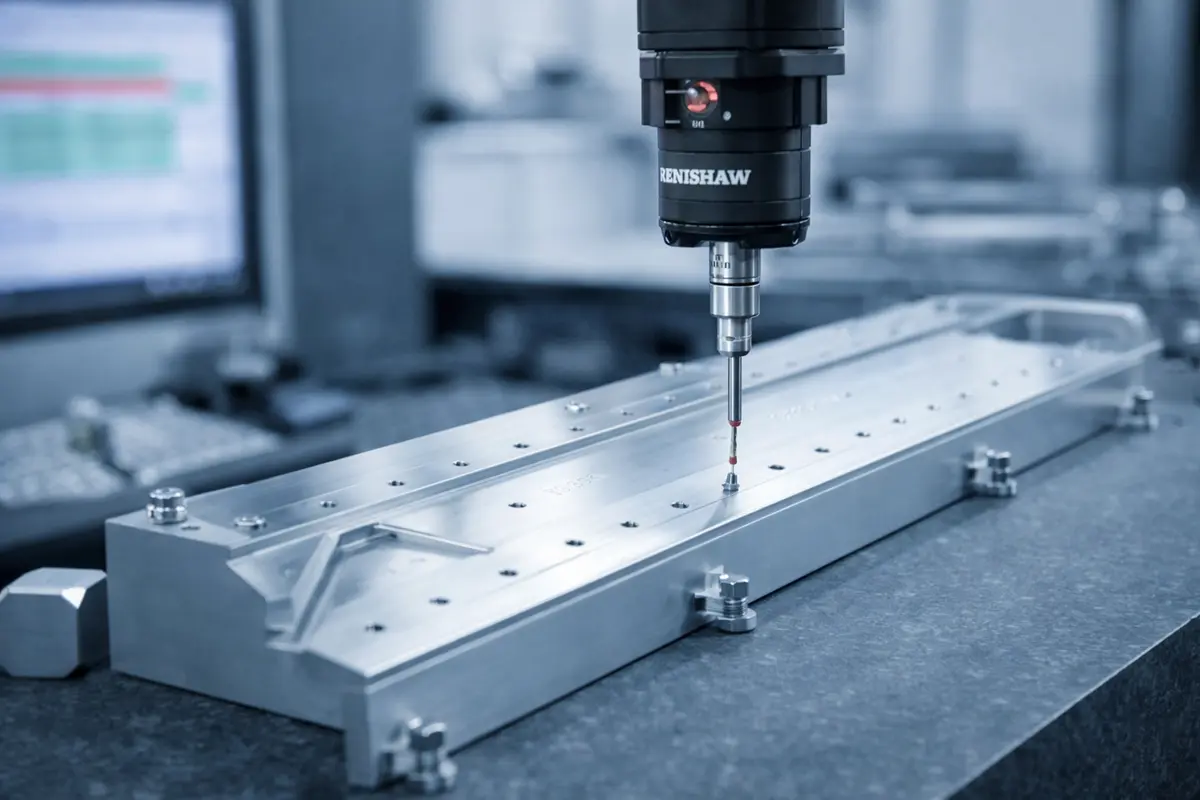
Quality is managed under a certified quality system. We hold ISO 13485 and ISO 9001 certifications, verifying parts down to ±0.005mm. Our CMM lab validates precision, providing full inspection reports and traceability with your shipments. No guessing, just proof.
Expert DFM and Engineering
Our engineering team provides DFM input before machining begins. We identify manufacturability risks early and suggest geometry changes to lower cost. If you lack CAD files, we help convert concepts into manufacturable 3D models.
FAQ
Do I Need 5-Axis Milling for My Parts?
It depends on your geometry. While 5-axis machines excel at complex contours, they are often overkill for simple parts. At Rollyu, we analyze your design to select the most cost-effective path, reserving 5-axis only for parts that truly require it.
What Is the Precision of Milling in Machining?
Standard commercial tolerances typically sit around ±0.1mm. However, high-precision applications demand more. Rollyu achieves tight tolerances down to ±0.005mm, verifying these critical dimensions with CMM inspection to meet strict prints.
What Are the Limitations of CNC Milling?
Milling is subtractive, making scrap waste inevitable. It also faces geometric limits: rotating tools cannot cut square internal corners, requiring a design radius. For parts better suited to casting, see die casting types and applications. For very large runs of 100,000 units or more, stamping often scales better.
What Is the Difference Between CNC Turning and Milling?
Milling spins the cutting tool, while turning spins the workpiece. Mills cut blocky, stationary parts. Lathes spin the material against a fixed cutter, making them ideal for cylindrical items like shafts.
Conclusion
Milling is the standard for making precise parts. But machines don’t run themselves; quality depends on the team behind them. With Rollyu Precision guiding the process, designs turn into finished products, avoiding costly mistakes and wasted material.