

According to Precedence Research, the global titanium market is projected to hit $53 billion by 2034. But for machine shops, the reality is far less glamorous. Prices are climbing, and supply is volatile. In an environment where replacement stock is scarce, you simply cannot afford to scrap parts.
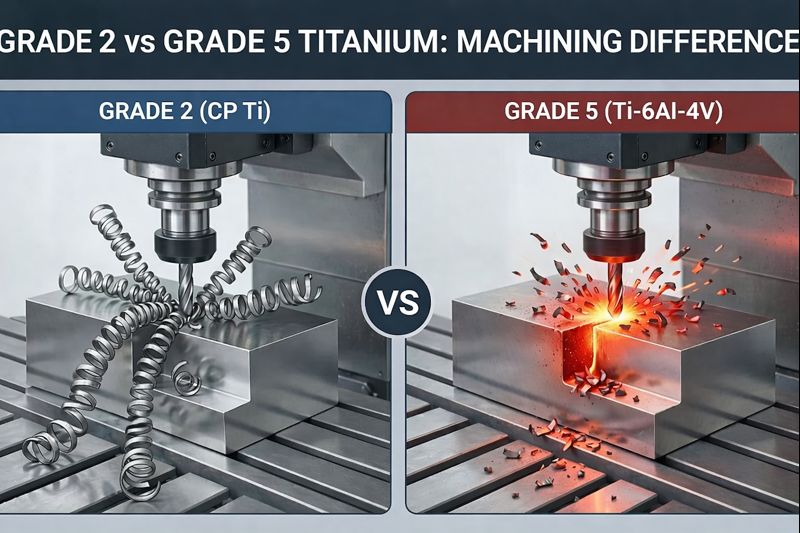
However, a critical mistake persists: treating “titanium” as a generic spec. Grade 2 (Commercially Pure) and Grade 5 (Ti-6Al-4V) may share a name, but they behave like enemies in the machine. One is gummy and clogs your flutes; the other is abrasive and generates enough heat to melt your cutting edge. Knowing the difference isn’t just academic, Executing the Rollyu standard of distinguishing these parameters isn’t just academic; it’s the only way to protect your margins.
What is Grade 2 Titanium
Grade 2 (CP Ti): Commercially Pure (99%) titanium. It is the industry standard for superior corrosion resistance and formability, commonly found in chemical processing equipment and marine hardware.
Grade 2 is defined by ductility. It behaves much like a stubborn 316 stainless steel. Because it is soft, it tends to be “gummy.” Instead of shearing cleanly, the material often welds to the cutting edge (Built-Up Edge), creating long, stringy chips that can clog your flutes.
What is Grade 5 Titanium
Grade 5 (Ti-6Al-4V): The industry workhorse, accounting for ~50% of global usage. Stabilized with Aluminum and Vanadium, this alloy is heat-treatable and significantly stronger—making it the default for aerospace structures and turbine blades.
Grade 5 is defined by heat. While harder than Grade 2, the real enemy is thermal conductivity. The heat doesn’t leave with the chip—it concentrates in the tool. Machining Grade 5 is a constant battle against thermal abrasion and work hardening.
Grade 2 vs Grade 5: Mechanical Properties Comparison
The following table breaks down the mechanical specifications that directly impact your CAM programming and tool selection.
| Feature | Grade 2 (Commercially Pure) | Grade 5 (Ti-6Al-4V) | Machining Implication |
| Tensile Strength | ~345 MPa (50 ksi) | ~950 MPa (138 ksi) | Grade 5 requires significantly higher cutting forces and machine rigidity. |
| Hardness | ~149 HB (Brinell) | ~341 HB (Brinell) | Grade 5 is harder, leading to faster abrasive wear on tool coatings. |
| Density | 4.51 g/cm³ | 4.43 g/cm³ | Negligible difference for machining, though Grade 5 is slightly lighter. |
| Elongation | ~20% | ~14% | Grade 2 is stretchier (ductile), making it prone to long, stringy chips. Grade 5 snaps chips easier. |
| Thermal Conductivity | 16.4 W/m-K | 6.7 W/m-K | Critical: Grade 5 transfers heat poorly. Heat concentrates at the cutting edge, risking thermal failure. |
Data Source: ASTM Standards
Grade 2 vs. Grade 5 Titanium: Machining Process
You’ve looked at the specs; now let’s look at the spindle. The machining strategy for these two grades differs primarily in how you manage chip formation and heat generation.
Machinability of Grade 2: Gummy Chips and Built-Up Edge
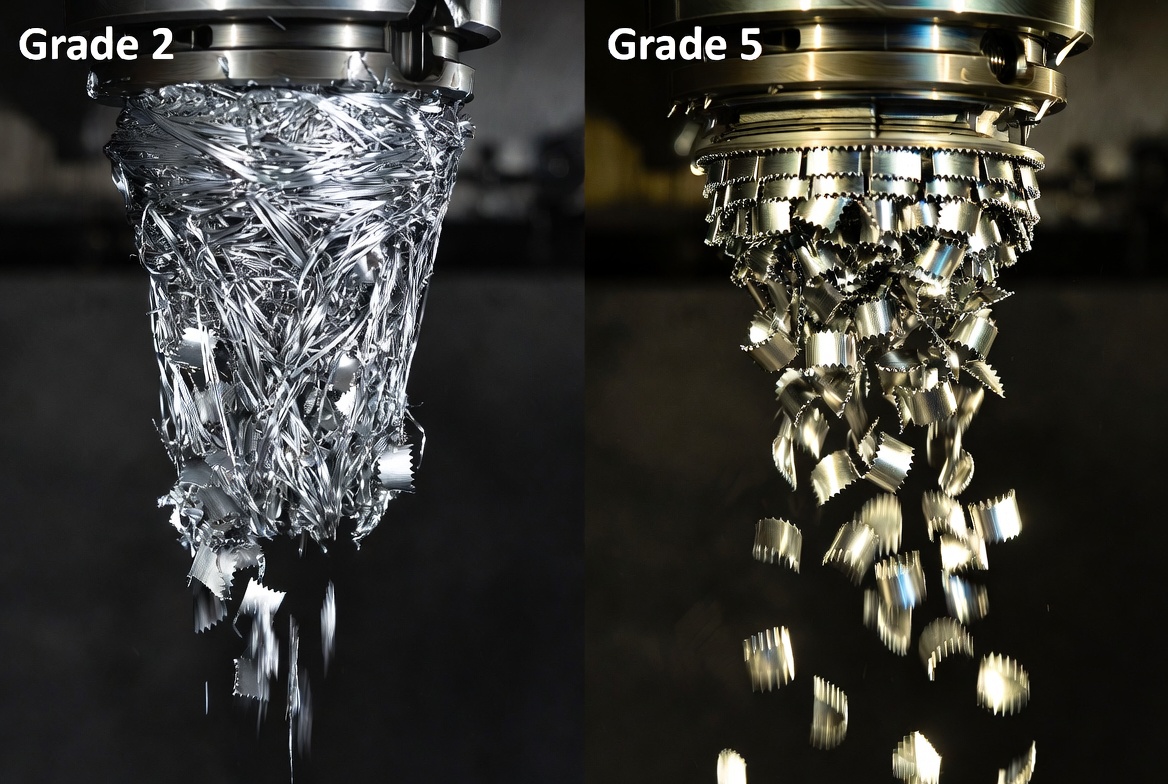
Think of Grade 2 as “sticky chewing gum” made of metal. Because it is soft, it doesn’t just cut; it drags. The material loves to pressure-weld itself to your cutting edge (Built-Up Edge), effectively changing your tool’s geometry mid-cut.
But the real headache is chip control. Unlike harder alloys that snap clean, Grade 2 forms long, stringy “bird’s nests” that wrap around your tool holder. You can’t walk away from the machine. If you ignore it for ten minutes, you risk a clogged flute that snaps the tool and scraps the part. It’s not hard to cut, but it’s high-maintenance.
Machinability of Grade 5: Thermal Conductivity and Tool Wear
With Grade 5, the enemy isn’t the chip—it’s the heat. Titanium is a terrible conductor of heat. When you machine steel, the heat leaves with the flying chips. When you machine Grade 5, the heat has nowhere to go but straight into your insert.
This creates a brutal cycle: the heat causes rapid crater wear, and if your tool “dwells” (pauses) for even a fraction of a second, the material instantly work-hardens. It forms a skin harder than the tool itself. If you rub, you lose. To win, you must be aggressive: keep the tool moving, keep the coolant flooding, or pay the price in burnt inserts.
Which Titanium Grade Fits Your Application?
Choosing the right grade isn’t just about cost; it’s about aligning mechanical limits with the operating environment. Whether you are focused on prototyping verification or moving into full-scale production for aerospace, marine, or medical applications, selecting the correct grade is the first step to avoiding costly failures.
Prototyping vs. Real Production
If you are machining fit-check prototypes, stick with Grade 2 to save costs. However, for functional prototypes intended for stress testing, you must use Grade 5. A Grade 2 part will yield useless data if the final product requires the high tensile strength of the alloy.
Chemical and Marine Equipment
Grade 2 is the industry standard here. Its superior resistance to saltwater and aggressive chemicals makes it the default choice for desalination piping and heat exchangers. Using Grade 5 here is often unnecessary overkill.
Aerospace and Performance Parts
In aerospace, strength-to-weight is everything. Grade 2 cannot compete. Grade 5 (Ti-6Al-4V) is mandatory for structural components like airframe fasteners and landing gear. It handles high stress that would tear Grade 2 apart.
Medical Implants and Instruments
Both grades are critical for medical device manufacturing, but they serve different roles.
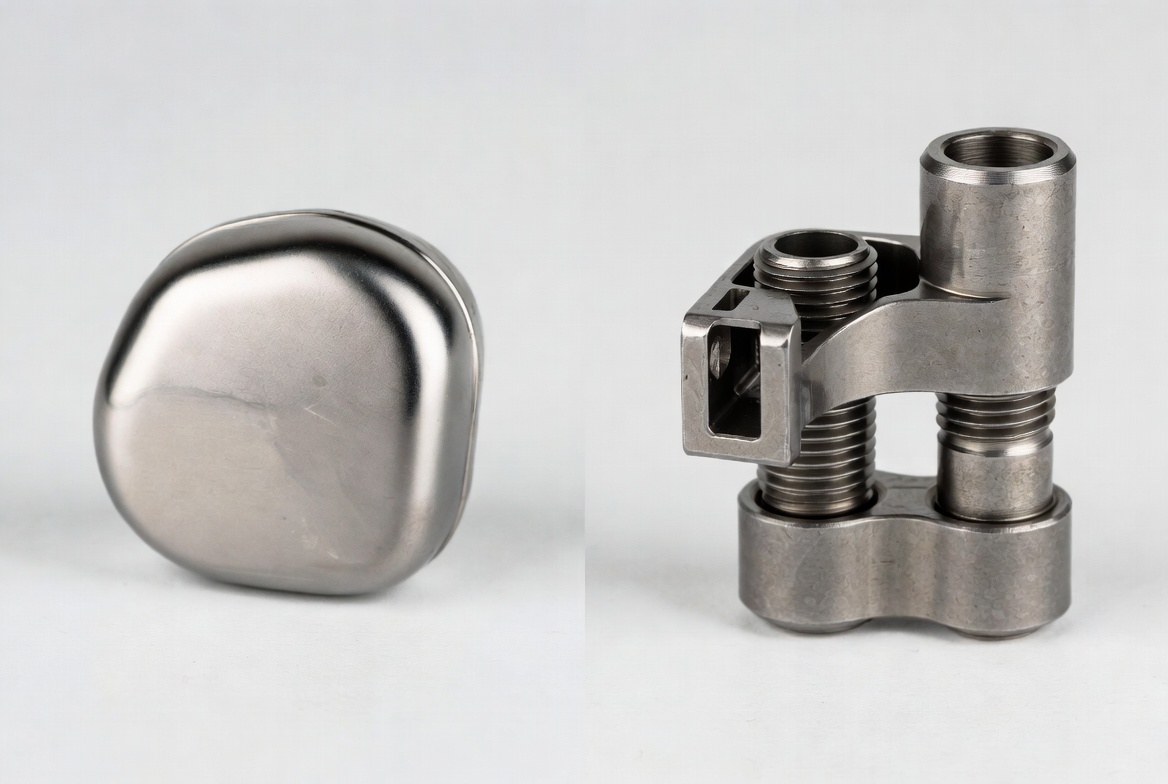
Grade 5 is the choice for load-bearing applications, such as bone screws and joint replacements, where fatigue strength is critical.
Grade 2 is typically used for non-structural devices like pacemaker housings and surgical trays, where formability is required.
Cost Analysis: Raw Material vs. Machining Time
Calculating the final cost requires a holistic view. You need to weigh the raw material savings against the machine time, operator attention, and consumable usage.
Prices of Raw Materials
Grade 2 is the budget winner on paper, generally costing 15-20% less per pound than Grade 5. However, beware of stock availability. Because Grade 5 is the aerospace standard, it is stocked in a massive variety of bar and plate sizes. Grade 2 options are fewer. If you are forced to buy oversized Grade 2 stock and machine it down, the extra cycle time instantly wipes out your material savings.
Machining Efficiency
The trade-off here is simple: Do you want to pay for labor, or do you want to pay for inserts?
Grade 2 incurs an “Operator Tax” The cost is labor. Because Grade 2 creates long, stringy chips, you cannot run it “lights out.” An operator must supervise the machine to clear bird-nests and prevent tool breakage. It is low-wear, but high-maintenance.
Grade 5 incurs a “Tooling Tax” The cost is consumables. Grade 5 chips break cleanly, allowing for high-speed, unmanned automation. However, the intense heat concentrates at the cutting edge, meaning you will burn through carbide inserts significantly faster.
For high-volume production, Grade 5 is often cheaper per part because automation efficiency beats tooling costs. For prototypes or short runs, Grade 2 is cheaper because material cost dominates and labor is fixed.
Rollyu’s Titanium Machining Services
You know the challenges of titanium. Instead of struggling with scrap rates and tool wear in-house, let Rollyu handle the heavy lifting.
Precision CNC Machining for Complex Titanium
We specialize in CNC machining for both Grade 2 and Grade 5 titanium. Using advanced 5-axis centers, we handle complex geometries and hold tolerances down to ±0.01mm. With our “No MOQ” policy, we support your project from the first functional prototype to full production runs.
Certified Medical-Grade Quality
Quality is non-negotiable. Rollyu is ISO 9001:2015 certified. We verify raw material authenticity with XRF analysis and validate final dimensions via CMM inspection. You receive full material certifications and measurement reports with every shipment.
FAQ
Is Titanium Grade 5 Magnetic?
No. Neither Grade 5 nor Grade 2 titanium is magnetic. This makes both grades excellent choices for medical implants (MRI safe) and electronic housings where magnetic interference is a concern.
Can You weld Titanium Grade 5?
Yes, but Grade 2 is far easier. Grade 5 requires strict shielding gas protection to prevent atmospheric contamination and cracking. Grade 2 is more forgiving and better suited for welded assemblies.
Do Titanium Grade 2 and Grade 5 Look Different After Anodizing?
Yes. Titanium Grade 2 produces brighter, more vibrant colors when anodized. Grade 5 has a slightly duller finish due to the aluminum and vanadium alloys. For cosmetic parts, Grade 2 is preferred.