It often comes with challenges when choosing between 3D printing vs CNC machining. These two methods are used to create precise and durable parts. However, principally, they are different.
3D printing builds parts layer by layer. It uses plastic filaments like ABS, PLA, and so on. CNC machining is used to cut, mill, and turn material from a solid block process steel to form the desired part or product. Each process has its benefits and drawbacks. This guide will walk you through the 3D printing vs CNC machining difference and how to choose the best one for your specific project needs.
What Is 3D Printing?
3D printing is an additive manufacturing process. It involves making parts layer by layer using digital models. It is comparatively fast and flexible since it does not require any moulds or other tools or instruments. Generally, it is notably used for making prototypes, custom products, and small production batches.
Principle of 3D Printing
It builds parts by adding layers of plastic one at a time. The process starts by preparing a CAD 3D model. That model is split into thin layers. So, the printer adheres to that pattern to make the actual shape. 3D printing reduces material waste and can easily create intricate prototype designs.
Common 3D Printing Processes
Here are some of the most common 3D printing processes used in manufacturing.
FDM 3D printing
FDM is the most prevalent and affordable 3D printing process among others. It uses a heating plastic filament and deposits it layer on top of another through a nozzle. After cooling, the layers constitute a solid constituent. It can easily 3D print PLA, ABS, and PETG.
SLA 3D Printing
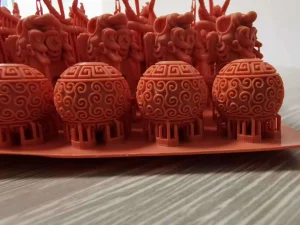
SLA(Stereolithography) employs a laser to cure the liquid resin in layers. The shape is solidified, and a smooth surface is created with each laser pass. The process is highly accurate and detailed, and is therefore the best application for models, medical equipment, and fine design components.
Selective Laser Sintering (SLS)
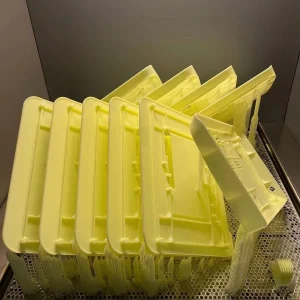
SLS is employed on powdered material to fuse it into solid parts by means of a laser. Each layer is supported by the powder bed; hence, no additional structures are required. It is suitable for hard and highly detailed sections used in the industry, mechanical, and engineering.
Digital Light Processing (DLP)
DLP is comparable to SLA except that it involves the light of a projector rather than a laser. It heals layer by layer and is therefore quicker. Small, tight components requiring high precision and a clean surface finish are excellent for use with DLP.
Materials and Properties
3D printing uses various plastic filaments and metal powders. The right choice depends on your part’s purpose and performance requirements. Here are some of the common examples:
| Material | Type | Key Properties |
| PLA | Plastic | Biodegradable and easy to print, |
| ABS | Plastic | Strong, heat-resistant, durable |
| PETG | Plastic | Impact-resistant, food-safe |
| Nylon (PA12, PA6) | Plastic | Tough, flexible |
| TPU | Flexible | Shock-resistant |
| PC | Plastic | Strong, Transparent |
| Resins | Photopolymer | Precise detail, smooth surface |
| Aluminum | Metal | Lightweight and strong |
| Stainless Steel | Metal | High strength, durable |
| Titanium | Metal | Lightweight, biocompatible |
Typical Use Cases
3D printing applications have become common in most industries since they can enable the realisation of ideas into tangible products in less time and effort. It is more cost-effective, reduces time, and provides a great level of design freedom. Here are the common applications:
Rapid Prototyping
3D printing is ideal for making prototypes. You can test the appearance and functionality of a design before mass production. It assists in early correction and enhances the quality of products.
Aerospace and Automotive
The technology assists in producing light structural components of planes and vehicles. It also enables engineers to create shapes which are of complex shapes that cannot be created by traditional machines.
Consumer Products
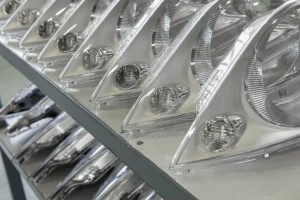
Gadgets, accessories, and household products are being produced through 3D printing by many startups. It is best suited towards small production batches, and it assists in bringing the creative ideas into reality at a fast rate.
Education and Research
3D printing is employed in school labs to learn design and engineering. It allows students and researchers to create and test models on their own.
What Is CNC Machining?
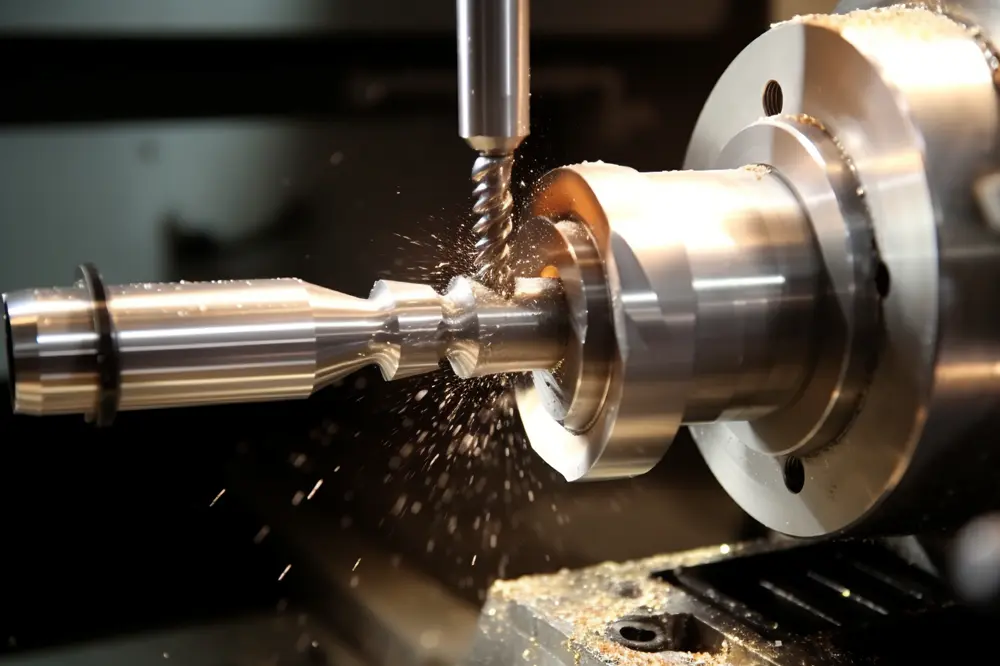
CNC machining is a subtractive manufacturing process. It precisely escalates material from a solid metal block. It uses computer-controlled machines to drill, turn, grind, and mill parts from metals, plastics, and composite materials. It is useful for both prototypes and large-scale production runs.
Principles and Methods
CNC machining uses computerized G-code instructions to rotate cutting tools. Each movement is programmed with high accuracy (i-e, cutting depth, speed, and right angle).
CNC Milling
CNC milling is a subtractive machining process that uses computer-controlled rotating cutting tools to remove material from a workpiece to create shapes, pockets, holes, and precise surfaces. It’s one of the most common methods for producing precision parts from metals, plastics and composites.
CNC Turning
CNC turning is a subtractive machining process that produces rotational (cylindrical) parts by holding a workpiece in a spindle and removing material with stationary or live tools. It’s done on CNC lathes and turning centers and is the go-to method for shafts, bushings, studs, threaded parts and other axisymmetric components.
CNC Swiss Turning
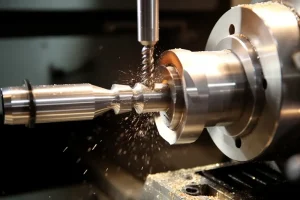
A Swiss-type lathe (sliding headstock lathe) feeds bar stock axially through a guide bushing while the headstock slides forward and back. The guide bushing supports the workpiece very close to the cutting tool, minimizing deflection and enabling tight tolerances on long, slender parts.
CNC Mill-turning
CNC mill-turning (often called mill-turn or turn-mill) is a multi-process CNC machining approach that combines turning and milling capabilities in one machine or cell so you can perform both rotational and multi-axis milling operations in a single setup.
A mill-turn machine is essentially a lathe and a mill combined: it has spindles (main and often sub/spindle), a turret with live tooling, and axes for milling (Y, B/C or full 4/5-axis on some models). Bar feeders, part catchers, and pallet changers are common on production cells.
CNC Drilling
Drilling machines make accurate holes to a given depth and angle. This is done in components that require assembling or fixing.
EDM Machining
EDM (Electrical Discharge Machining) is a non-contact, thermal erosion machining process that removes metal by a series of controlled electrical sparks between an electrode and a conductive workpiece submerged in dielectric fluid. It’s used when conventional cutting can’t reach the geometry, hardness, or small features required.
CNC Grinding
CNC grinding is a precision surface-finishing and dimensional-correction process that uses computer-controlled grinding wheels to remove very small amounts of material and achieve extremely tight tolerances and fine surface finishes.
Unlike milling or turning, grinding excels at achieving micron-level accuracy and mirror-grade surface smoothness, making it indispensable for medical, optical, and high-precision mechanical parts.
Materials and Tolerance
Like 3D printing, CNC machining can also process a wide range of materials. It offers tight tolerances for custom parts production.
| Material Type | Common Examples | Typical Tolerance |
| Metals | Aluminum, Steel, Brass, Titanium | ±0.005 mm |
| Plastics | ABS, Nylon, PEEK, Acrylic | ±0.01 mm |
| Composites | Carbon fiber, fiberglass | ±0.02 mm |
| Others | Copper, Bronze | ±0.005 mm |
Typical Use Cases
CNC machining is used wherever precision and performance matter.
Automotive
CNC machines are used to make engine blocks, transmission housings, and brake components with exact dimensions using CNC machines.
Aerospace and Defense
It produces engine parts, brackets, and turbine components that must meet strict standards.
Medical Devices
In the medical field, CNC machining is used for making implants, surgical tools, and custom medical and dental equipment.
3D Printing vs CNC Machining: Side-by-Side Comparison
Here’s a quick side-by-side look at how 3D printing and CNC machining differ.
Cost Structure
3D printing is an economical option when it comes to small batches and prototypes. It does not require special tools and molds. So, this keeps the costs of setup significantly low.
On the other hand, CNC machining is more preparation-intensive and generates excessive waste. It is also economical; however, when the production volumes are high, the price per component reduces with volume.
Lead Time and Stability
3D printing is relatively fast. It takes only a few hours to move between the design and finished parts. So, it’s useful for quick testing or when you only need to make a single component.
In comparison, CNC machining takes more time for setup. It requires detailed programming, tool setups, and calibration. However, when properly established, CNC machines offer predictable, consistent results during long production processes.
Dimensional Accuracy and Repeatability
CNC machining is more precise than 3D printing in various aspects. It can meet tight tolerances where parts need to fit perfectly and be used mechanically.
3D printing can exhibit some variations with the layer build-up or material shrinkage. Therefore, in the case of critical engineering components, CNC remains superior.
Surface Finish and Post Processing
CNC machined components often require post-processing to meet functional and cosmetic requirements. While they can come off the machine with good dimensional accuracy, they typically need deburring, edge-breaking, and—depending on the application—polishing or finishing (e.g., brushed/satin polish, bead blast, electropolish, anodizing, passivation) to remove tool marks, improve cleanability, and achieve the specified Ra.
By contrast, 3D-printed parts usually show visible layer lines. Plastics (e.g., ABS, PA, TPU) benefit from sanding, media blasting, chemical/vapor smoothing, priming/painting, or clear coats to improve surface quality. Metal AM parts commonly require support removal, stress-relief heat treatment or HIP, machining of critical surfaces, and finishing (e.g., bead blasting, tumbling, electropolishing, or coating) to reach final tolerance, strength, and surface finish.
Geometry Limits and Part Size
3D printing outperforms when it comes to complex and lightweight designs. It can make hollow geometry or internal features that cannot be accessed by CNC machines. Nonetheless, there are build size and strength of material limits to printers.
CNC machining can easily operate larger and denser materials, but is not able to cope with complicated or disguised geometries.
How to Choose for Your Project?
Choosing between 3D printing and CNC machining depends on your priorities: geometry, precision, surface quality, quantity, and material performance.
Use the following checklist to determine which process best fits your design and production needs.
Decision Checklist
| Factor | 3D Printing (Additive Manufacturing) | CNC Machining (Subtractive Manufacturing) |
| Design Complexity | Excellent for highly complex, organic, lattice, or internal geometries impossible to machine. | Ideal for geometrically defined parts with accessible surfaces and clear tool paths. |
| Material Options | Broad selection of plastics (PLA, ABS, PA, PEEK) and limited metal alloys (Ti, Al, SS) depending on technology (SLA, SLS, DMLS). | Extensive range of engineering metals and plastics — aluminum, stainless steel, titanium, brass, PEEK, Delrin, Ultem, etc. |
| Dimensional Accuracy | ±0.1–0.3 mm typical; tightest around ±0.05 mm for high-end metal systems. | Up to ±0.005 mm for precision parts — ideal for assemblies, sealing faces, and critical fits. |
| Surface Finish | Layered texture; often requires sanding, polishing, or coating to reach Ra ≤ 1.6 µm. | Smooth milled or turned surfaces right off the machine (Ra 0.4–1.6 µm); can be polished or coated further. |
| Mechanical Strength | Moderate; strength depends on layer bonding direction. Best for prototypes or low-stress parts. | Excellent; isotropic properties from billet or bar stock ensure high mechanical strength and fatigue resistance. |
| Material Density / Porosity | Porous in some printing methods (SLA/SLS); may require infiltration or sealing. | Fully dense; no porosity, consistent structural integrity. |
| Production Volume | Economical for one-offs, prototypes, and small batches (1–50 pcs). | Scalable for medium-to-high volume runs (10–10,000+ pcs) with consistent repeatability. |
| Lead Time | Extremely fast for initial prototypes — 1–3 days typical. | Slightly longer setup, but faster for repeat or multi-part production — 3–7 days typical for small batches. |
| Tooling & Setup | No tooling required; digital file direct to print. | Requires CAM programming and fixturing, but faster and more stable once set up. |
| Cost Efficiency | Low initial cost for short runs or concept validation; high per-part cost as volume increases. | Higher setup cost, but significantly lower per-part cost at scale. |
| Post-Processing | Often necessary — support removal, sanding, vapor smoothing, or coating. | Optional — deburring, polishing, anodizing, plating, or passivation for cosmetic or functional needs. |
| Best Use Cases | Rapid prototypes, design validation, complex geometries, lightweight structures, and custom fixtures. | End-use components, tight-tolerance assemblies, metal housings, optical mounts, surgical parts, and production tooling. |
Scenario Recommendations
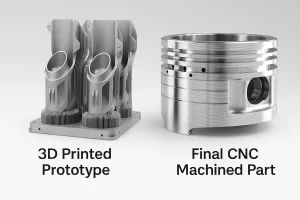
For quick prototypes, use 3D printing. It’s perfect for testing new designs, checking fit, or showing clients a model. You can make changes easily without spending much.
For functional parts, choose CNC machining. It gives accurate, strong, and reliable components. This is ideal for automotive, aerospace, or industrial tools.
For combined projects, you can use both methods. For testing, use 3D printing, and switch to CNC machining when your design is final.
Rollyu Manufacturing Capabilities
Our manufacturing services include full support services, prototyping, and small-scale manufacturing. The core services that we offer are CNC machining, 3D printing, vacuum casting, and sheet metal prototyping. Turning your ideas into ready-to-use parts, our advanced equipment and professional engineers help us make them accurate and ready to use.
3D Printing Service at Rollyu
At Rollyu, we offer a quick and precise 3D printing of plastic parts. It is perfect for hastened prototyping and testing, and iterating on design. Our printers are fine and intricate in nature and can give you quality parts in a few days.
Rollyu CNC Machining Service
We provide comprehensive CNC machining for high precision and quality surface finishes. Aluminum, steel, and plastics are some common materials that we work with in order to create strong components used in medicine, industry, and robotics sectors.
Quality Assurance and Certifications
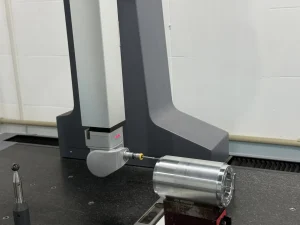
Quality is our top priority at Rollyu. We check the dimensions of each part to ensure it’s exact as per your design using CMM machines and digital calipers. We are ISO 9001 and 13485 certified, so we guarantee a dependable manufacturing standard.
Conclusion
Both 3D printing and CNC machining offer useful ways to create parts. However, the right choice depends on what you’re making. If you need a quick prototype with a complex shape, 3D printing is usually the easier option. For precise and durable components, CNC machining tends to work better. Each method has its own place in modern manufacturing. The best results come from matching the process to your project’s goals.