
According to Assembly Magazine, the global fasteners market reached 97 billion dollars in 2022. Snap fit joints reduce this expense by replacing physical screws and metal hardware. Manufacturers use these molded connectors to shorten assembly time and simplify production lines.
Choosing the right joint prevents loose enclosures, broken parts, and costly tooling changes. This guide breaks down joint types, plastic material selection, and design failures to help you specify the correct connection for your engineering project.
What are Snap Fit Joints?
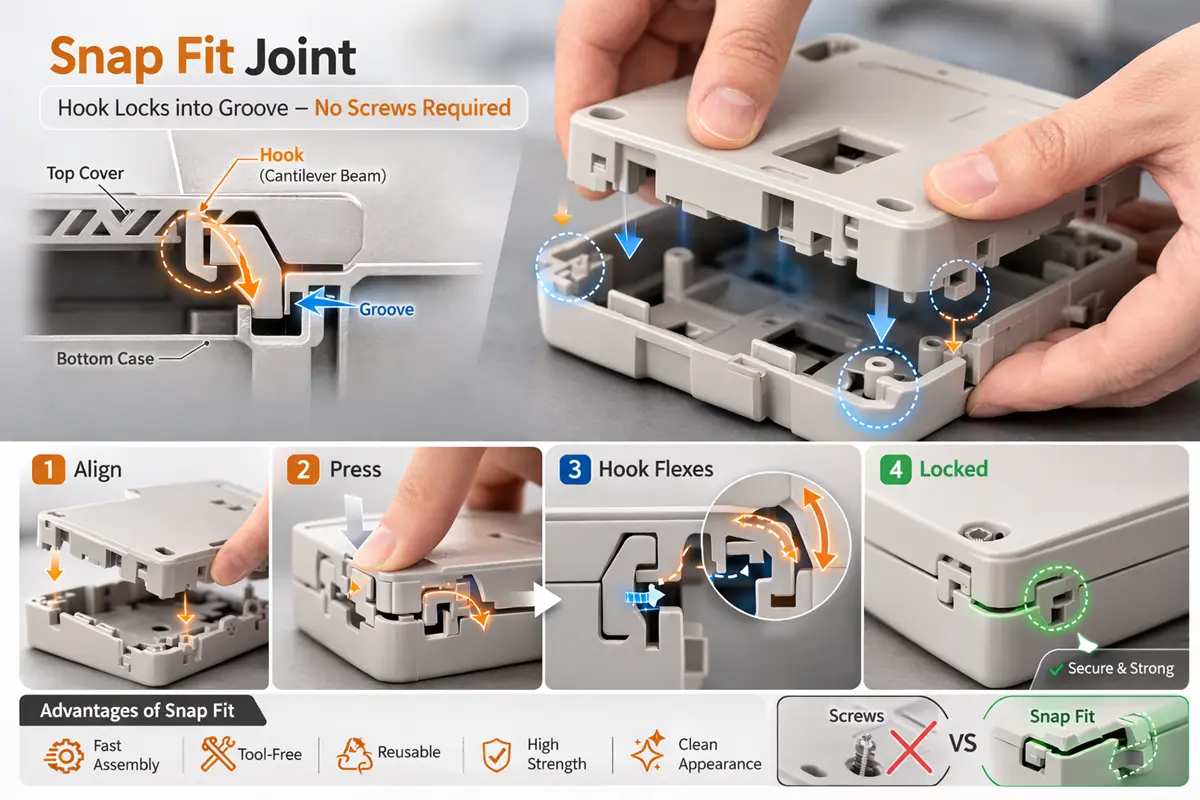
A snap-fit joint is a molded plastic mechanism that locks components together without screws or glue. One part features a flexible hook that bends just enough to slide past a ridge on the mating part. The hook then snaps back into its original shape, trapping the two pieces together.
Common Types of Snap Fit Joints
Available internal space and whether the connection is permanent dictate the specific joint shape.
Cantilever Snap Joints
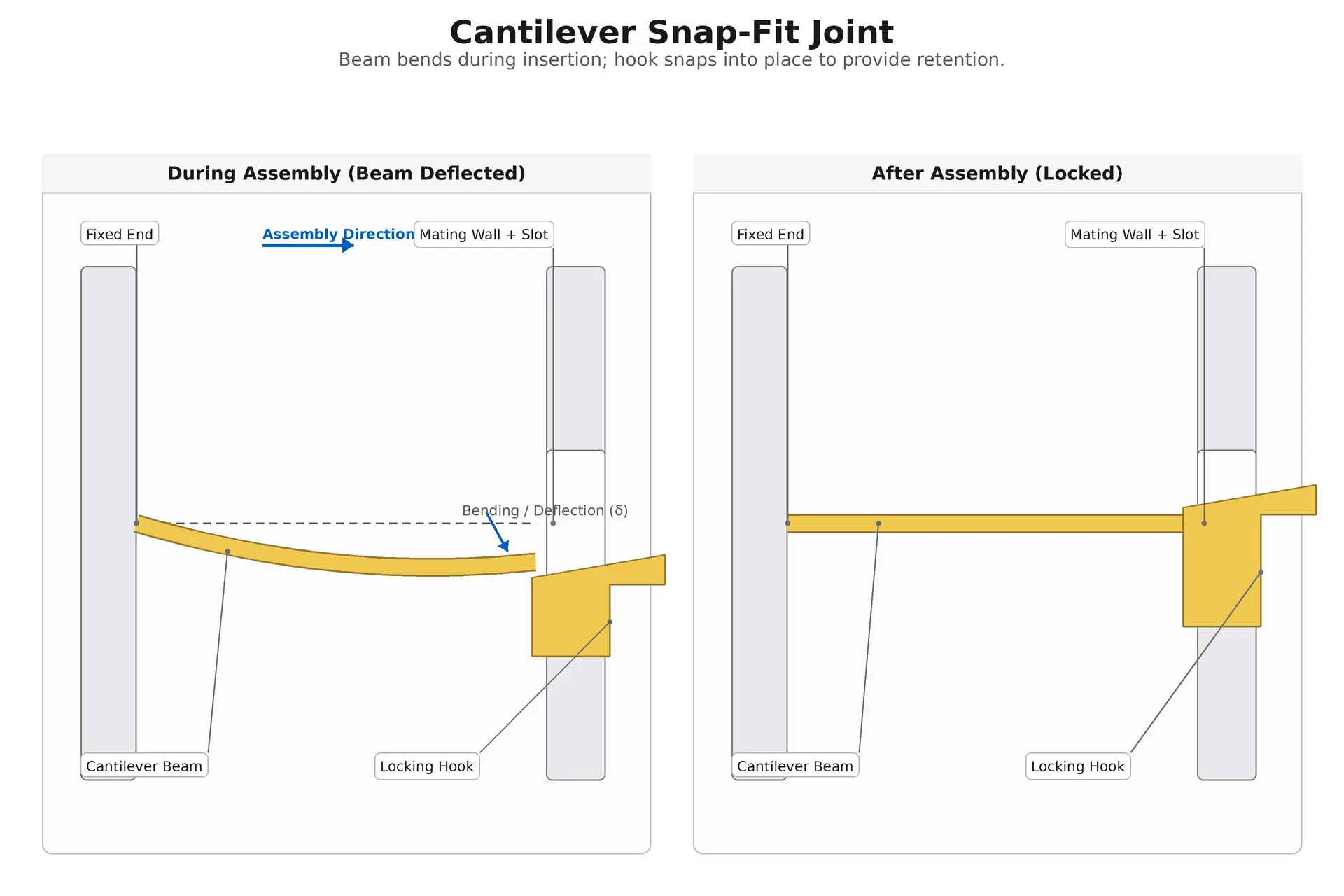
Cantilever joints feature a straight plastic beam with a hooked end. The beam bends during assembly and snaps onto an internal ledge. This shape tolerates repeated opening and closing without losing tension. Engineers specify cantilever clips for battery covers and consumer electronics to prevent fatigue failure over the product’s lifespan.
Annular Snap-fit Joints
Annular joints secure circular parts like bottle caps and round tubing. A continuous plastic bump on one component stretches slightly to push past a groove on the mating cylinder. The resulting 360-degree grip maintains constant pressure to keep cylindrical closures tight.
Torsion Snap Joints
Torsion joints use twisting forces to release a catch. Pushing down on one side of a molded lever lifts the hook on the opposite end. Manufacturers build torsion mechanisms into hinged lids and quick-release panels so users can easily open the housing with one hand.
U-shape Snap Joints
U-shaped joints fold a plastic beam back on itself. This layout increases the flexible length of the hook without demanding extra horizontal room. Designers specify U-shapes inside crowded enclosures where a standard straight beam would be too stiff and break under pressure.
L-shaped Snap-fit
L-shaped joints bend at a 90-degree angle to bypass physical barriers. The right angle lets the hook reach around thick walls or circuit boards. Engineers route L-shaped clips through complex internal assemblies when other components block a straight locking path.
Snap Fit Joint Types Comparison Table
This quick reference table matches specific mechanical actions and space constraints with the correct joint geometry.
|
Joint Type |
Mechanical Action | Common Applications | Key Engineering Advantage |
|
Cantilever |
Straight beam bending | Battery covers, consumer electronics |
Tolerates repeated opening without losing tension |
|
Annular |
360-degree radial stretching | Bottle caps, round tubing |
Maintains constant pressure for tight cylindrical closures |
|
Torsion |
Twisting lever | Hinged lids, quick-release panels | Allows easy one-handed operation for users |
| U-shape | Folded beam bending | Crowded internal enclosures |
Increases flexibility without requiring extra horizontal space |
| L-shape | 90-degree angled bending | Complex internal assemblies | Bypasses thick walls or circuit boards to lock |
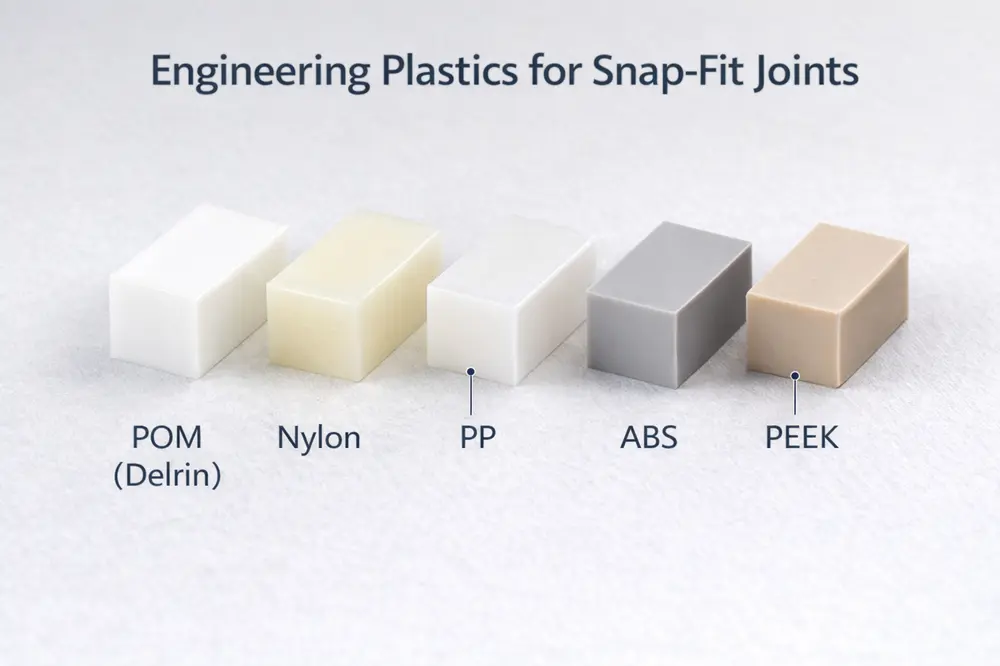
What Are the Best Materials for Snap Fit Joints?
Engineers match plastic elasticity for the initial assembly and fatigue resistance to the product’s required lifespan.
POM and Delrin
POM (Delrin) provides high stiffness and excellent memory. though engineers often must weigh the key differences between Acetal and Delrin to select the exact polymer grade.
A POM hook snaps back to its exact original shape after assembly without permanent deformation. This fatigue resistance makes it the top choice for CNC machined prototype clips.
Nylon (Polyamide)
Nylon survives high friction and thousands of mating cycles. The polymer absorbs physical impact without cracking. Engineers specify Nylon for heavy-duty buckles and reusable industrial fasteners.
Polypropylene (PP)
Polypropylene bends repeatedly without tearing. Manufacturers rely on PP exclusively for living hinges and integrated snap caps on packaging. It yields easily under pressure, making it strictly for low-force connections.
Acrylonitrile Butadiene Styrene (ABS)
ABS forms rigid, low-cost connections for single-use assemblies. Designers put ABS clips inside permanently closed consumer electronics. However, the plastic lacks fatigue resistance; bending an ABS hook repeatedly snaps it outright.
PEEK and Ultem
PEEK and Ultem withstand extreme heat, harsh chemicals, and medical sterilization. Engineers use them for precision clips in aerospace equipment and medical implants.
Because machining tough plastics like PEEK is difficult, Rollyu Precision uses multi-axis CNC to hold ±0.005 mm tolerances, delivering cleanroom-ready joints that will not degrade under extreme conditions.
3D Printing vs Injection Molding Snap Fit Joints
Depending on the manufacturing process, engineers deploy these molded connectors to ensure structural integrity across several major industries.
3D Printing for Rapid Visual Prototyping
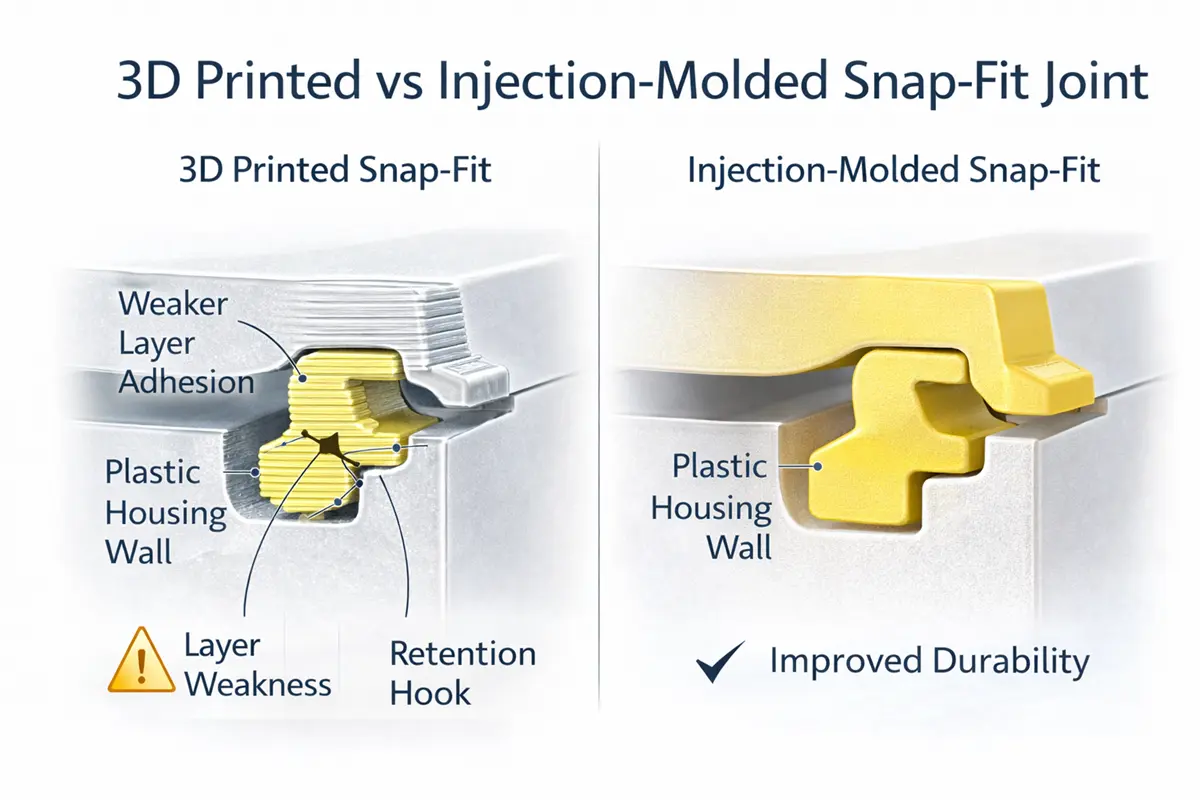
During rapid prototyping, Engineers 3D print prototypes to test hook clearances before buying expensive steel molds. Printing quickly verifies the physical assembly fit. However, the resulting plastic layers lack the shear strength needed for real-world stress.
Injection Molding for High Volume Production
Injection molding creates durable joints for mass production. The process forms the clip as a single continuous solid. This unified structure gives the hook enough flexibility to bend thousands of times without tearing.
Material Strength and Durability Differences
Molded plastics hold uniform strength in all directions (isotropic). 3D printed clips snap easily right along their printed layer lines under bending stress (anisotropic). Designers keep printed parts in the testing phase and rely on molded joints for final structural assemblies.
3D Printing vs. Injection Molding Comparison Table
The following table highlights why 3D printed clips remain limited to testing, while injection molding is required for functional, high-stress applications.
| Manufacturing Method | Engineering Phase | Material Structure | Bending Durability |
| 3D Printing | Rapid prototyping and fit testing | Anisotropic (layered plastic) | Snaps easily along printed layer lines under stress |
| Injection Molding | Final structural assemblies and mass production | Isotropic (single continuous solid) | Bends thousands of times without tearing |
Top Applications of Snap Fit Joints
These molded connections streamline assemblies to lower production costs and reduce total part counts.
Medical Device Housings and Wearable Equipment
Molded clips remove screws that trap bacteria or loosen in vibrating wearables. Handheld monitors and pulse oximeter cases rely on these joints for a smooth, hygienic exterior. This assembly method protects internal sensors while maintaining a seamless surface for easy sterilization.
Automotive Interior Panels and Dashboard Components
Car manufacturers use plastic snaps to secure dashboard trim and door panels without tools. Switching from metal hardware reduces vehicle weight and stops interior rattling noise.
These connectors speed up high-volume assembly lines by allowing interior components to click into place instantly.
Industrial Sensors and Robotics Assembly
Snap joints seal sensitive sensors inside tamper-proof housings without the heat stress of ultrasonic welding.
When designing precision robotics parts, these clips secure modular components and wire harnesses. This layout allows technicians to swap parts quickly in the field without using specialized hand tools.

How to Choose the Right Snap-fit Joint
Engineers narrow down the correct joint geometry and material by evaluating four critical constraints.
Single Use Versus Repeated Assembly Requirements
Permanently sealed devices (IoT sensors, medical casings) require a steep retention angle near 90 degrees. The hook locks permanently; disassembly breaks the plastic outright.
For reusable components like battery covers, specify a cantilever joint with a shallow retention angle. Pair this geometry with high-fatigue plastics like Nylon or POM (Delrin) to let the hook disengage without shearing over time.
Product Geometry and Space Constraints
Cylindrical parts (bottle caps, round connectors) strictly require an annular snap-fit to maintain 360-degree radial pressure.
Inside crowded enclosures packed with PCBs, standard straight cantilever beams are too stiff and snap under bending stress. Fold the beam into a U-shape or L-shape instead. This increases the flexible length without demanding extra horizontal room.
Assembly Force and Retention Strength
High insertion force fatigues assembly workers, while low retention force lets the product fall apart.
Balance these forces through the hook’s lead angle. A 30-degree lead angle allows components to slide together easily. Fine-tune the stiffness and the physical “click” by adjusting the beam’s base thickness and length.
Manufacturing Feasibility and Undercut Considerations
Snap-fit hooks create undercuts, requiring expensive lifters or sliders in injection molds. Test the physical snap before paying for production tooling. 3D-printed plastics lack the isotropic shear strength for bending tests.
Machine functional prototypes from solid Delrin or PEEK instead. Rollyu Precision provides DFM analysis and uses 3-axis, 4-axis, and 5-axis CNC machines to hold ±0.005 mm tolerances. Testing a precise, CNC-machined joint prevents costly mold rework later.
FAQ
What Are the Ideal Tolerances for Snap Fit Joint Designs?
Standard molded snap-fits generally require tolerances around ±0.1 mm. However, critical components demand tighter control. Rollyu Precision machines prototype snap-fits down to ±0.005 mm to ensure the prototype’s insertion force closely mirrors the final injection-molded part.
Can Snap-fit Joints Provide a Waterproof or IP-rated Seal?
No. Rigid plastic-on-plastic contact naturally leaves microscopic gaps. To waterproof an enclosure, you must add a rubber O-ring or silicone gasket. The snap-fit joint simply provides the clamping force to compress that gasket.
How Does Operating Temperature Affect Snap-fit Joints?
High heat softens standard polymers like ABS, causing the hook to lose tension and pop open. Conversely, freezing temperatures turn plastics brittle, making the beam prone to fracturing. For extreme thermal environments or medical sterilization, specify high-performance plastics like PEEK or Ultem.
Can Snap-Fit Joints Replace Screws or Fasteners?
Yes, but with limitations. Plastic snap-fits are unsuitable for structural components that carry constant physical loads.
Can You CNC Machine Functional Snap-Fit Prototypes?
Yes. When comparing 3D printing vs CNC machining, remember that 3D-printed clips often break along layer lines. CNC machining solves this by cutting joints directly from solid plastics like Delrin or PEEK, ensuring accurate testing before investing in molds.
Conclusion
Snap-fit joints often replace metal screws to help cut manufacturing costs and speed up assembly. However, a poorly toleranced hook can break during production or fail to lock, often leading to expensive mold rebuilds.
Physical testing verifies the insertion force before committing to steel tooling. Rollyu machines functional snap-fit prototypes directly from solid engineering plastics like Delrin and PEEK.